# Frequency definition and the frequency formula

<p class="callout success">Source: [https://www.omnicalculator.com/physics/frequency](https://www.omnicalculator.com/physics/frequency)</p>

Have a look at the following model of a wave; it will help you understand the terms used in the frequency definition below it.
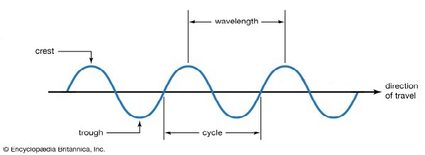
<div class="contentPart css-12zi0x1" id="bkmrk-source%3A%C2%A0encyclopedia"><div class="contentPart css-12zi0x1"><div class="textBlock"><center><picture><source media="only screen and (-webkit-min-device-pixel-ratio: 2) and (max-width: 800px)" srcset="https://uploads-cdn.omnicalculator.com/images/britannica-wave.jpg?width=748&enlarge=0&format=webp" type="image/webp"></source><source media="(max-width: 800px)" srcset="https://uploads-cdn.omnicalculator.com/images/britannica-wave.jpg?width=374&enlarge=0&format=webp" type="image/webp"></source><source media="only screen and (-webkit-min-device-pixel-ratio: 2)" srcset="https://uploads-cdn.omnicalculator.com/images/britannica-wave.jpg?width=850&enlarge=0&format=webp" type="image/webp"></source><source srcset="https://uploads-cdn.omnicalculator.com/images/britannica-wave.jpg?width=425&enlarge=0&format=webp" type="image/webp"></source>![Picture of a wave with terminology](https://uploads-cdn.omnicalculator.com/images/britannica-wave.jpg?width=425&enlarge=0&format=jpeg)</picture><small>Source: [Encyclopedia Britannica](https://kids.britannica.com/students/article/wave/628468)</small></center></div></div></div>**Frequency is the number of completed wave cycles per second**. In other words, frequency tells us how many wave crests pass a given point in a second.

This frequency definition leads us to the simplest **frequency formula**:

`f = 1 / T`.

`f` denotes frequency and `T` stands for the [time](https://www.omnicalculator.com/conversion/time-unit-converter) it takes to complete one wave cycle measured in seconds.

The SI **frequency unit is Hertz (Hz)**, which equals 1/s (one [cycle per second](https://www.omnicalculator.com/conversion/cps-converter)). Other frequency units include millihertz (mHz), kilohertz (kHz), megahertz (MHz), gigahertz (GHz), and terahertz (THz).

## Frequency equation from the wavelength

Have a look at another picture which will allow us to see that frequency is connected to wavelength. Wavelength is the distance between two adjacent crests (or troughs). In other words - it is the [length](https://www.omnicalculator.com/conversion/length-converter) of one wave cycle. **The longer the wavelength, the lower the frequency**:
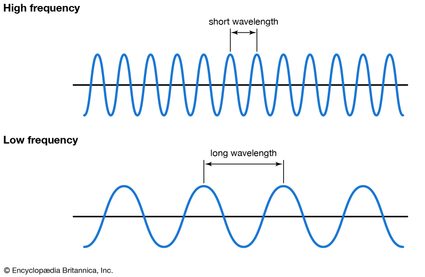
<div class="contentPart css-12zi0x1" id="bkmrk-source%3A%C2%A0encyclopedia-0"><div class="contentPart css-12zi0x1"><div class="textBlock"><center><picture><source media="only screen and (-webkit-min-device-pixel-ratio: 2) and (max-width: 800px)" srcset="https://uploads-cdn.omnicalculator.com/images/britannica-wave-frequency.jpg?width=748&enlarge=0&format=webp" type="image/webp"></source><source media="(max-width: 800px)" srcset="https://uploads-cdn.omnicalculator.com/images/britannica-wave-frequency.jpg?width=374&enlarge=0&format=webp" type="image/webp"></source><source media="only screen and (-webkit-min-device-pixel-ratio: 2)" srcset="https://uploads-cdn.omnicalculator.com/images/britannica-wave-frequency.jpg?width=850&enlarge=0&format=webp" type="image/webp"></source><source srcset="https://uploads-cdn.omnicalculator.com/images/britannica-wave-frequency.jpg?width=425&enlarge=0&format=webp" type="image/webp"></source>![Picture of a low frequency and high frequency waves](https://uploads-cdn.omnicalculator.com/images/britannica-wave-frequency.jpg?width=425&enlarge=0&format=jpeg)</picture><small>Source: [Encyclopedia Britannica](https://kids.britannica.com/students/article/wave/628468))</small></center></div></div></div>Another fact we need - how fast the waves travel at (wave velocity) determines how many of them will pass a given point per second. This means **the higher the wave velocity, the higher the frequency**.

These two relationships between frequency and wavelength (λ), and between frequency and velocity (v), bring us to the following **frequency equation**:

`f = v / λ`.