# Electrical Polarization process

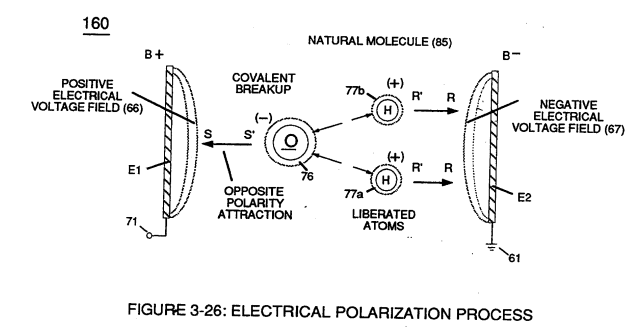
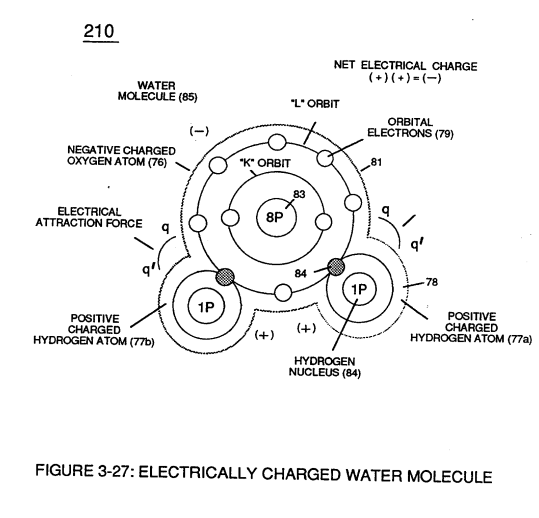
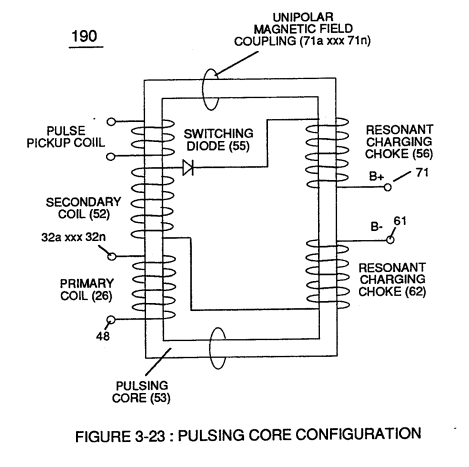
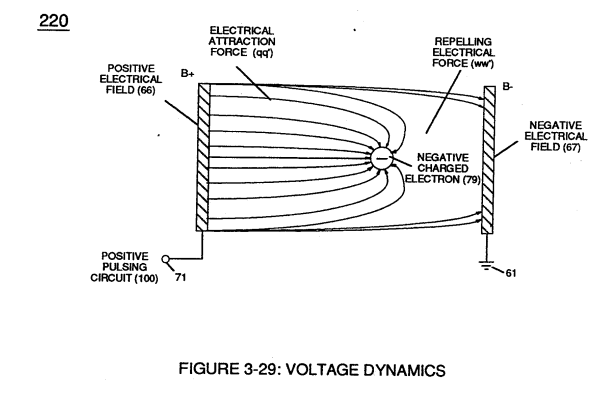
Placement of a **pulse voltage potential** (65) across **Excitor plates** (E1/E2) (*voltage zones 66/67*) of Figure (3-29) as to Figure (3-26) while inhibiting and preventing electron flow within voltage intensifier circuit (190) of Figure (3-23) causes water molecule (210) of Figure (3-27) to separate into its component parts (released hydrogen and oxygen gases) by pulling away (utilizing opposite attraction forces SS' and RR') its charged water molecule atoms (76n7), as illustrated in (160) of Figure (3-26).

<table border="1" id="bkmrk-figure-%283-29%29-figure" style="border-collapse: collapse; width: 100%; height: 59.6px;"><tbody><tr style="height: 29.8px;"><td class="align-center" style="width: 49.9383%; height: 29.8px;">Figure (3-29)

[![image-1703376333059.png](https://stanslegacy.com/uploads/images/gallery/2023-12/scaled-1680-/5AN8vz6fgBPasqR1-image-1703376333059.png)](https://stanslegacy.com/uploads/images/gallery/2023-12/5AN8vz6fgBPasqR1-image-1703376333059.png)

</td><td class="align-center" style="width: 49.9383%; height: 29.8px;">Figure (3-26)

[![image-1703376323691.png](https://stanslegacy.com/uploads/images/gallery/2023-12/scaled-1680-/FI7iyHF5qFsbEw5X-image-1703376323691.png)](https://stanslegacy.com/uploads/images/gallery/2023-12/FI7iyHF5qFsbEw5X-image-1703376323691.png)

</td></tr><tr style="height: 29.8px;"><td class="align-center" style="width: 49.9383%; height: 29.8px;">Figure (3-27)

[![image-1703376101819.png](https://stanslegacy.com/uploads/images/gallery/2023-12/scaled-1680-/tgj1TAs4iQMFjqTd-image-1703376101819.png)](https://stanslegacy.com/uploads/images/gallery/2023-12/tgj1TAs4iQMFjqTd-image-1703376101819.png)

</td><td class="align-center" style="width: 49.9383%; height: 29.8px;">Figure (3-23)

[![image-1703232587555.png](https://stanslegacy.com/uploads/images/gallery/2023-12/scaled-1680-/7ffVlnHJcIOSoYRS-image-1703232587555.png)](https://stanslegacy.com/uploads/images/gallery/2023-12/7ffVlnHJcIOSoYRS-image-1703232587555.png)

</td></tr></tbody></table>

<p class="callout info">Stationary "**positive**" electrical **voltage-field** (66) (*voltage plate E1*) <span style="text-decoration: underline;">not only attracts</span> **negative charged oxygen atom** (76) but also <span style="text-decoration: underline;">pulls away</span> **negative charged covalent electrons** (84) from **water molecule** (210).</p>

[![image-1703376323691.png](https://stanslegacy.com/uploads/images/gallery/2023-12/scaled-1680-/FI7iyHF5qFsbEw5X-image-1703376323691.png)](https://stanslegacy.com/uploads/images/gallery/2023-12/FI7iyHF5qFsbEw5X-image-1703376323691.png)At the same time stationary "**negative**" **electrical voltage field** (67) (*voltage plate E2*) attracts **positive charged hydrogen atoms** (77a/b).

<p class="callout success">Once **negative electrically charged oxygen atom** (76) is dislodged from **water molecule** (85), **covalent bonding** (*sharing electrons between atoms*) ceases to exist, switching-off and disrupting **electrical attraction force** (qq') between unlike atoms (76/77), as further illustrated in (160) of Figure (3-26).</p>

**[![image-1703376101819.png](https://stanslegacy.com/uploads/images/gallery/2023-12/scaled-1680-/tgj1TAs4iQMFjqTd-image-1703376101819.png)](https://stanslegacy.com/uploads/images/gallery/2023-12/tgj1TAs4iQMFjqTd-image-1703376101819.png)Opposite polarity electrical attraction force** (SS') continues to cause **negative charged oxygen atom** (76) to migrate to **positive voltage-plate** (E1) (*positive voltage zone 66*); while, at the same time, **opposite polarity electrical attraction force** (RR') causes **positive charged hydrogen atoms** (77a/b) to migrate in the <span style="text-decoration: underline;">opposite direction</span> to negative **voltage-plate** (E2) (*negative voltage zone 67*) as **step-charging voltage-wave** (65) increases in voltage amplitude from <span style="text-decoration: underline;">several millivolts to several hundred volts</span> **during each pulse train** (65a xxx 65n) which, in application, causes **water molecule** (210) of Figure (3-27) charged atoms (76/77) <span style="text-decoration: underline;">to elongate</span> (<span style="text-decoration: underline;">increasing distance between unlike atoms 76/77</span>) to the point where **covalent hydrogen electrons** (84) of Figure (3-27) breaks away from **electrostatic force** (qq').

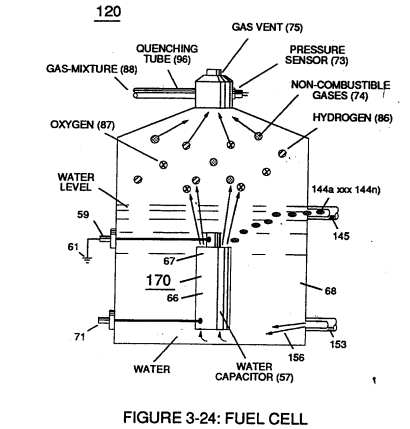
<p class="callout success"><span style="text-decoration: underline;">Repetitive duplication</span> of **voltage pulse** (65a xxx 65n) <span style="text-decoration: underline;">continues to separate</span> or split apart other **water molecules** (85a xxx 85n) which, in turns, forms **hydrogen** (86) and **oxygen** (87) **gas-mixture** (88) of Figure (3-24).</p>

<p class="callout info">Dissociation of **water molecule** (85) by way of **voltage stimulation** (65) is herein called "**The Electrical Polarization Process**", as illustrated in (160) of Figure (3-26).</p>

<table border="1" id="bkmrk-figure-%283-24%29-figure" style="border-collapse: collapse; width: 100%;"><tbody><tr><td class="align-center" style="width: 33.9866%;"><sub>Figure (3-24)</sub>

<sub>[![image-1703377231066.png](https://stanslegacy.com/uploads/images/gallery/2023-12/scaled-1680-/eS2UmsVf6o8YkE39-image-1703377231066.png)](https://stanslegacy.com/uploads/images/gallery/2023-12/eS2UmsVf6o8YkE39-image-1703377231066.png)</sub>

</td><td class="align-center" style="width: 66.0134%;"><sub>Figure (3-26)</sub>

<sub>[![image-1703376323691.png](https://stanslegacy.com/uploads/images/gallery/2023-12/scaled-1680-/FI7iyHF5qFsbEw5X-image-1703376323691.png)](https://stanslegacy.com/uploads/images/gallery/2023-12/FI7iyHF5qFsbEw5X-image-1703376323691.png)</sub>

</td></tr></tbody></table>