# Gas Destabilization Process
[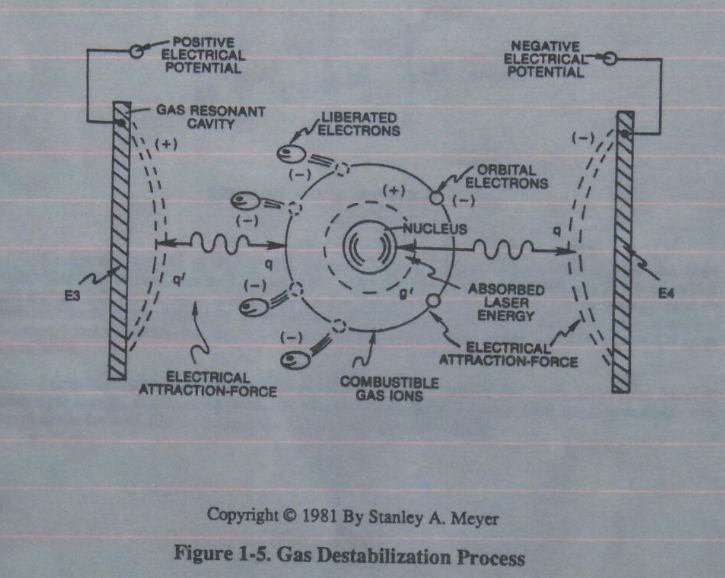](https://stanslegacy.com/uploads/images/gallery/2024-10/dmamtcwtGzMDRJnB-image-1729960689754.png)Placement of a pulse-voltage potential across the **Excitor-Array** (ER) of **Gas Resonant Cavity** (t) while inhibiting or preventing electron flow within the **Voltage Intensifier Circuit** (AA) causes the Gas Atom of **Argon** (Ar) to become an positive charged ion by pulling away orbital electrons from the gas molecule or gas atom, as illustrated in Figure 1-5.
The stationary **"positive"** **electrical** **voltage-field** (E3) attracts the negative charged electrons from the Gas Atom.
At the same time, the stationary **"Negative"** **electrical voltage field** (E4) attracts the positive charged nucleus of the **gas atom** (s).
Once the negative electrically charged electrons are dislodged from the gas atom, the gas atom becomes destabilized…having missing electrons.
Dislodging electrons from the gas atom by way of voltage stimulation is hereinafter called **"The Gas Destabilization Process."**
Attenuating and adjusting the **"pulse-voltage-amplitude"** with respect to the **"pulse voltage frequency,"** now, regulates **"The Electron Extraction Process."**