# Gated Pulse Frequency generator (80)
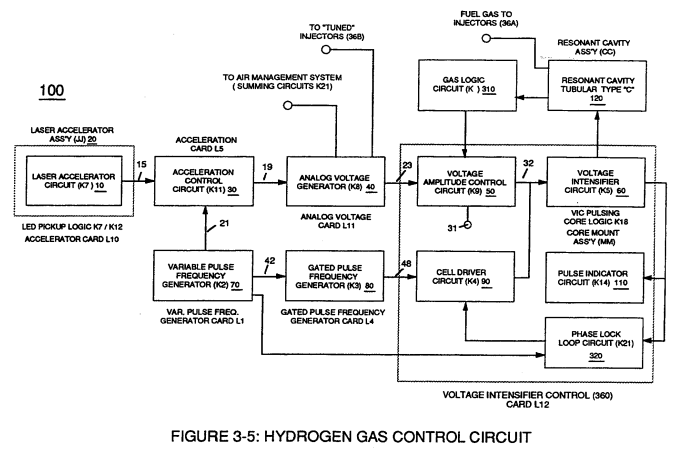
[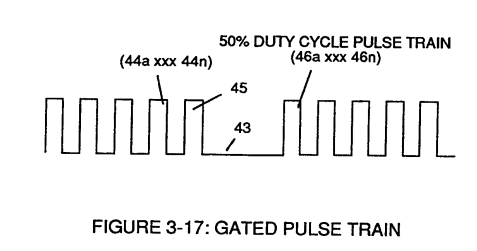](https://stanslegacy.com/uploads/images/gallery/2023-12/h6jn0TLfbRJCaqQW-image-1703199575965.png)**Gated Pulse Circuit** (80) of Figure (3-5) switches "**off**' and "**on**" sections of incoming clock signal (42) to form **gated pulse** (45) which is, in turn, duplicated in succession to produce **gated pulse train** (46a xxx 46n) of Figure (3-17).
Together **pulse train** (44a xxx 44n) and **pulse off-time** (43) forms **gated pulse duty cycle** (45).
**[](https://stanslegacy.com/uploads/images/gallery/2023-12/d5x6lw5jRAJT48i1-image-1703195613050.png)**
**Pulse train** (44a xxx 44n) is exactly the same as **pulse train** (41a xxx 41n) and its established **pulse frequency** (*number of pulse cycles per unit of time*) changes uniformly when **pulse generator** (70) of Figure (3-5) is calibrated and adjusted for system operations.
Newly formed **gated duty pulse** (45) is proportional to the physical change in **pulse train** (44a xxx 44n) when **circuit** (80) is adjusted for calibration purposes.
**Pulse train** (44a xxx 44n) becomes **widened** while **pulse off-time width** (43) becomes **smaller**, simultaneously.
Conversely, opposite **pulse shaping occurs** when **circuit** (80) of Figure (3-5) is **calibrated in reverse** **order**.