**Sub-critical Oxygen atom** (129) having less than the normal amount of **covalent electrons** (orbital electrons) is unable to reach "stable-state" (*six to eight covalent electrons required*) when the two **hydrogen atoms** (128 a/b) seek to form the water molecule during thermal gas ignition.
**Absorbed laser energy** (131) of **hydrogen gas atom nucleus** (133) weakens **"electrical bonding" force** (CC') between **hydrogen atom electron** (132) and **hydrogen atom nucleus** (133);
while, at the same time, **absorbed laser energy** (135) prevents **oxygen atom** (129) from reaching "stable state" when **electrical attraction force** (BB') (opposite electrical attraction force being equivalent to the number of missing electrons) locks onto and pulls away **hydrogen atom electron** (132) while **repelling force** (DD') keeps the two **positive charged nucleus's** (133/136) apart.
[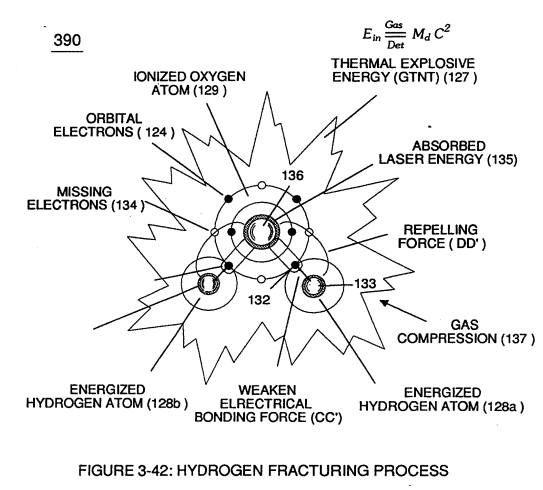](https://stanslegacy.com/uploads/images/gallery/2023-12/kfEIJ9oXKSQGdG0T-image-1703231970050.png)These "'**abnormal**" and "**unstable**" conditions coupled with **thermal interaction** (gas ignition) under **gas compression** (137) of Figure (3-42) as to Figure (3-38) (*fuel-gas 88 being compressed via piston-action 105*) causes **combustible gas atoms** (129 and 128a/b) to decay ... releasing **thermal explosive energy** (gtnt) (127) under control means.This atomic thermal-interaction between sub-critical **combustible gas atoms** (127 and 128a/b) is, now, herein after called "**The Hydrogen fracturing Process**. "