# Inductance (FL)

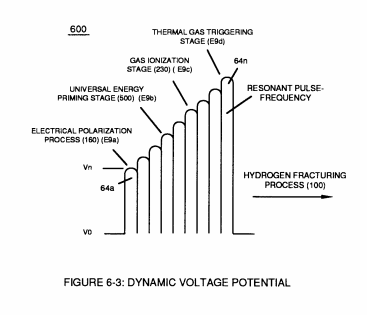
**Component Interaction** promotes **Component Reactance** during D.C. pulsing operations while allowing variable voltage amplitude (Vo - Va -Vb - Vn) of Figure (7-13) to be <span style="text-decoration: underline;">attenuated independently</span> of **Voltage Pulse frequency** (49a xxx 49n), as so illustrated in (600) of Figure (6-3).

<table border="1" id="bkmrk-figure-%287-13%29-%28600%29-" style="border-collapse: collapse; width: 100%; height: 57.8px;"><tbody><tr style="height: 57.8px;"><td class="align-center" style="width: 49.9485%; height: 57.8px;">Figure (7-13)

[![image-1702522907000.png](https://stanslegacy.com/uploads/images/gallery/2023-12/scaled-1680-/twi9EVhUdHC5iU2v-image-1702522907000.png)](https://stanslegacy.com/uploads/images/gallery/2023-12/twi9EVhUdHC5iU2v-image-1702522907000.png)

</td><td class="align-center" style="width: 49.9485%; height: 57.8px;">(600) of Figure (6-3)

[![image-1702522927175.png](https://stanslegacy.com/uploads/images/gallery/2023-12/scaled-1680-/yR2ozomX4d6ZwF4Q-image-1702522927175.png)](https://stanslegacy.com/uploads/images/gallery/2023-12/yR2ozomX4d6ZwF4Q-image-1702522927175.png)

</td></tr></tbody></table>

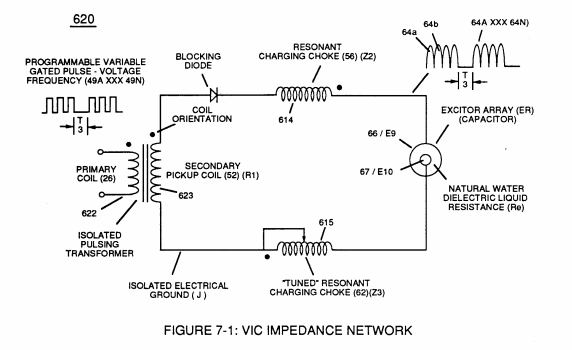
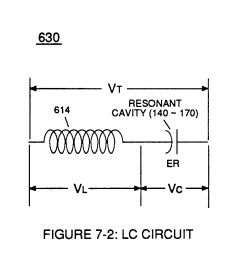
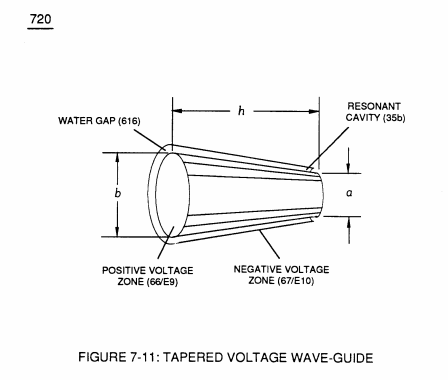
**Resonant Charging Circuit** (630) of Figure (7-2) being an LC Circuit is fanned when **Inductor** (614) of Figure (7-1) is electrically linked to **Taper Capacitor** (720) of Figure (7-11) in series arrangement.

<table border="1" id="bkmrk-%28630%29-of-figure-%287-2" style="border-collapse: collapse; width: 100%;"><tbody><tr><td class="align-center" style="width: 33.2984%;">(630) of Figure (7-2)

[![image-1702522955010.png](https://stanslegacy.com/uploads/images/gallery/2023-12/scaled-1680-/4sdqZG0IaZYnSlgA-image-1702522955010.png)](https://stanslegacy.com/uploads/images/gallery/2023-12/4sdqZG0IaZYnSlgA-image-1702522955010.png)

</td><td class="align-center" style="width: 33.2984%;">(614) of Figure (7-1)

[![image-1702522964899.png](https://stanslegacy.com/uploads/images/gallery/2023-12/scaled-1680-/NBG7afC58ntC82uF-image-1702522964899.png)](https://stanslegacy.com/uploads/images/gallery/2023-12/NBG7afC58ntC82uF-image-1702522964899.png)

</td><td class="align-center" style="width: 33.2984%;">(720) of Figure (7-11)

[![image-1702522979960.png](https://stanslegacy.com/uploads/images/gallery/2023-12/scaled-1680-/yhRkCX4nPiB5Jzre-image-1702522979960.png)](https://stanslegacy.com/uploads/images/gallery/2023-12/yhRkCX4nPiB5Jzre-image-1702522979960.png)

</td></tr></tbody></table>

**Inductor** (614) is an insulated wire wound in a spiral pathway around **Bobbin Cavity** (580) of Figure (6-1) to form **Voltage Stepping Coil** (710) of Figure (7-10) as to (580) of Figure (6-1).

<table border="1" id="bkmrk-%28580%29-of-figure-%286-1" style="border-collapse: collapse; width: 100%;"><tbody><tr><td style="width: 50.0618%;">(580) of Figure (6-1)

[![image-1702523026667.png](https://stanslegacy.com/uploads/images/gallery/2023-12/scaled-1680-/nQymCnRuuu9kwxZK-image-1702523026667.png)](https://stanslegacy.com/uploads/images/gallery/2023-12/nQymCnRuuu9kwxZK-image-1702523026667.png)

</td><td style="width: 50.0618%;">(710) of Figure (7-10)

[![image-1702523048872.png](https://stanslegacy.com/uploads/images/gallery/2023-12/scaled-1680-/nWBMpPPEl3Kp8QLw-image-1702523048872.png)](https://stanslegacy.com/uploads/images/gallery/2023-12/nWBMpPPEl3Kp8QLw-image-1702523048872.png)

</td></tr></tbody></table>

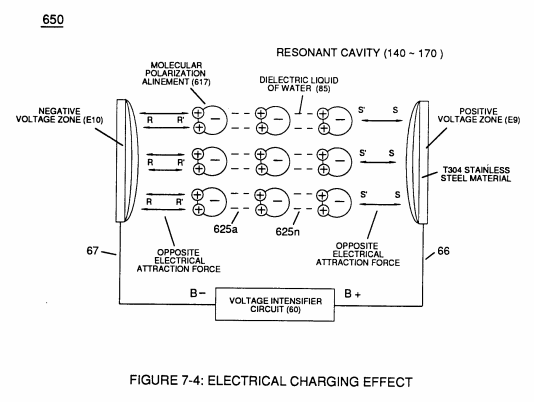
**Capacitor** (E9/E10) of figure (6-2) as to (720) of Figure (7-11) is formed when **outer tapered surface** (66) and **inner tapered surface** (67) forms **Water-Gap** (616) of Figure (7-11) as to Figure (590) of Figure (6-2) having placed there between **Dielectric Water Bath** (85/Re), as schematically illustrated in matrix outline in (670) of Figure (7-6) as to (690) of Figure (7-8) and further detailed in **Electrical Charging Effect** (650) of Figure (7-4).

<table border="1" id="bkmrk-%28e9%2Fe10%29-of-figure-%28" style="border-collapse: collapse; width: 100%;"><tbody><tr><td style="width: 33.2984%;">(E9/E10 &amp; 590) of figure (6-2)

[![image-1702321431762.png](https://stanslegacy.com/uploads/images/gallery/2023-12/scaled-1680-/yfkyykTD8kyZ0ZlP-image-1702321431762.png)](https://stanslegacy.com/uploads/images/gallery/2023-12/yfkyykTD8kyZ0ZlP-image-1702321431762.png)

</td><td style="width: 33.2984%;">(720, 616) of Figure (7-11)

[![image-1702523112314.png](https://stanslegacy.com/uploads/images/gallery/2023-12/scaled-1680-/WDhQyKFykbXZqyE9-image-1702523112314.png)](https://stanslegacy.com/uploads/images/gallery/2023-12/WDhQyKFykbXZqyE9-image-1702523112314.png)

</td><td style="width: 33.2984%;">(650) of Figure (7-4)

[![image-1702523165277.png](https://stanslegacy.com/uploads/images/gallery/2023-12/scaled-1680-/92eJFYnLb8CP2KCf-image-1702523165277.png)](https://stanslegacy.com/uploads/images/gallery/2023-12/92eJFYnLb8CP2KCf-image-1702523165277.png)

</td></tr><tr><td style="width: 33.2984%;">(670) of Figure (7-6)

[![image-1702523182522.png](https://stanslegacy.com/uploads/images/gallery/2023-12/scaled-1680-/v9yvZKzZQoj22ijf-image-1702523182522.png)](https://stanslegacy.com/uploads/images/gallery/2023-12/v9yvZKzZQoj22ijf-image-1702523182522.png)

</td><td style="width: 33.2984%;"></td><td style="width: 33.2984%;">(690) of Figure (7-8)

[![image-1702523192729.png](https://stanslegacy.com/uploads/images/gallery/2023-12/scaled-1680-/mS1TJ8D4WchLcBMl-image-1702523192729.png)](https://stanslegacy.com/uploads/images/gallery/2023-12/mS1TJ8D4WchLcBMl-image-1702523192729.png)

</td></tr></tbody></table>

**Component Reactance** to D.C. pulsing transforms **Inductor** (614) of Figure (7-1) / **Capacitor** (E9/E10) of Figure (7-11) LC circuit of Figure (7-2) into an **Resonant Charging Choke** (614) which steps up an unipolar oscillation of an given charging frequency with the <span style="text-decoration: underline;">effective capacitance</span> of a **pulse-forming network** (64a xxx 64n) of Figure (7-1) as to (600) of Figure (6-3) in order to charge **Voltage Zones** (E9/E10) to a <span style="text-decoration: underline;">higher potential beyond applied voltage input</span>

<table border="1" id="bkmrk-inductor-%28614%29-of-fi" style="border-collapse: collapse; width: 100%;"><tbody><tr><td class="align-center" style="width: 33.2984%;">**Inductor** (614) of Figure (7-1)

[![image-1702523206210.png](https://stanslegacy.com/uploads/images/gallery/2023-12/scaled-1680-/MzvPeyjbCL5eKKdo-image-1702523206210.png)](https://stanslegacy.com/uploads/images/gallery/2023-12/MzvPeyjbCL5eKKdo-image-1702523206210.png)

</td><td class="align-center" style="width: 33.2984%;">**Capacitor** (E9/E10) of Figure (7-11)

[![image-1702523235713.png](https://stanslegacy.com/uploads/images/gallery/2023-12/scaled-1680-/we95r1OtxtgObNm1-image-1702523235713.png)](https://stanslegacy.com/uploads/images/gallery/2023-12/we95r1OtxtgObNm1-image-1702523235713.png)
</td><td class="align-center" style="width: 33.2984%;">LC circuit of Figure (7-2)

[![image-1702523248932.png](https://stanslegacy.com/uploads/images/gallery/2023-12/scaled-1680-/DJ53zhMs2MJCXMU1-image-1702523248932.png)](https://stanslegacy.com/uploads/images/gallery/2023-12/DJ53zhMs2MJCXMU1-image-1702523248932.png)

</td></tr><tr><td class="align-center" style="width: 33.2984%;"></td><td class="align-center" style="width: 33.2984%;">(600) of Figure (6-3)

[![image-1702523261641.png](https://stanslegacy.com/uploads/images/gallery/2023-12/scaled-1680-/LnZPOrM8WkzklnDw-image-1702523261641.png)](https://stanslegacy.com/uploads/images/gallery/2023-12/LnZPOrM8WkzklnDw-image-1702523261641.png)

</td><td class="align-center" style="width: 33.2984%;">  
</td></tr></tbody></table>

... interacting **Distributed Capacitance** (Cda xxx Cdn) and **Distributed Inductance** (D1a xxx D1n) of Figure (7-3) of **Inductor Coil** (614) of (7-1) with "**Electrical Charging Effect**" brought on by the dielectric value of water bath (85/Re), as pictorially illustrated in (650) of Figure (7-4).

(650) of Figure (7-4)

[![image-1702523354217.png](https://stanslegacy.com/uploads/images/gallery/2023-12/scaled-1680-/SzIwo8acjqHB6coL-image-1702523354217.png)](https://stanslegacy.com/uploads/images/gallery/2023-12/SzIwo8acjqHB6coL-image-1702523354217.png)
<table border="1" id="bkmrk-figure-%287-3%29-%28614%29-o" style="border-collapse: collapse; width: 100%; height: 57.8px;"><tbody><tr style="height: 57.8px;"><td style="width: 35.356%; height: 57.8px;">Figure (7-3)

[![image-1702523366857.png](https://stanslegacy.com/uploads/images/gallery/2023-12/scaled-1680-/Vuwjy3nHVnRyKDxQ-image-1702523366857.png)](https://stanslegacy.com/uploads/images/gallery/2023-12/Vuwjy3nHVnRyKDxQ-image-1702523366857.png)

</td><td style="width: 64.6441%; height: 57.8px;">(614) of (7-1)

[![image-1702523375710.png](https://stanslegacy.com/uploads/images/gallery/2023-12/scaled-1680-/uOpq8b10Ve8tCGxN-image-1702523375710.png)](https://stanslegacy.com/uploads/images/gallery/2023-12/uOpq8b10Ve8tCGxN-image-1702523375710.png)

</td></tr></tbody></table>

The established **Dielectric Value of Water** (85) being 78.54 ohms since the electron "L" orbit of the water molecule (210) of Figure (3-27) occupies the maximum allowable number of eight electrons when covalent linkup of 'unlike oxygen atom (76) and hydrogen atoms (77a/b) occurs' stabilizing **Water** molecule (85) into existence ... thereby, maintaining molecular stability of water <span style="text-decoration: underline;">by opposing the exchange of electrons from an external electron source</span> (amp inducing circuit) beyond molecular Structure (85).

<table border="1" id="bkmrk-%28210%29-of-figure-%283-2" style="border-collapse: collapse; width: 100%;"><tbody><tr><td style="width: 99.8972%;">(210) of Figure (3-27)

[![image-1702523405268.png](https://stanslegacy.com/uploads/images/gallery/2023-12/scaled-1680-/EaaeCiLWG4eF5IYO-image-1702523405268.png)](https://stanslegacy.com/uploads/images/gallery/2023-12/EaaeCiLWG4eF5IYO-image-1702523405268.png)

</td></tr></tbody></table>

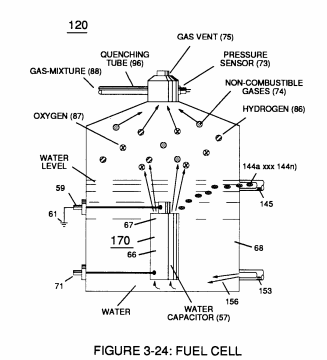
<p class="callout success">Electron interaction (movement of electrons through the liquid medium of water) is <span style="text-decoration: underline;">further inhibited</span> since natural water contaminates (144a xxx 144n) of Figure (3-24) is normally <span style="text-decoration: underline;">less than 20 ppm.</span></p>

Figure (3-24)

[![image-1702523475722.png](https://stanslegacy.com/uploads/images/gallery/2023-12/scaled-1680-/Kfu24EK7tggNsqf0-image-1702523475722.png)](https://stanslegacy.com/uploads/images/gallery/2023-12/Kfu24EK7tggNsqf0-image-1702523475722.png)

<table border="1" id="bkmrk-figure-%283-24%29-%28760%29-" style="border-collapse: collapse; width: 100%;"><tbody><tr><td style="width: 50.0618%;">(760) of Figure (7-15)

[![image-1702523547925.png](https://stanslegacy.com/uploads/images/gallery/2023-12/scaled-1680-/nkqNgBaOQsVb217Y-image-1702523547925.png)](https://stanslegacy.com/uploads/images/gallery/2023-12/nkqNgBaOQsVb217Y-image-1702523547925.png)

</td><td style="width: 50.0618%;">(750) of Figure (7-14)

[![image-1702523537999.png](https://stanslegacy.com/uploads/images/gallery/2023-12/scaled-1680-/xXYPbXntk7oyMnOD-image-1702523537999.png)](https://stanslegacy.com/uploads/images/gallery/2023-12/xXYPbXntk7oyMnOD-image-1702523537999.png)

</td></tr></tbody></table>

<p class="callout info">... distilled water, of course, is generally lab-tested 1ppm or less, as illustrated in (760) of Figure (7-15) as to (750) of Figure (7-14).</p>