# WFC Atomic Degaussing Process
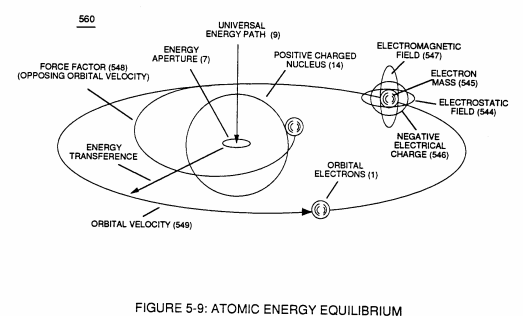
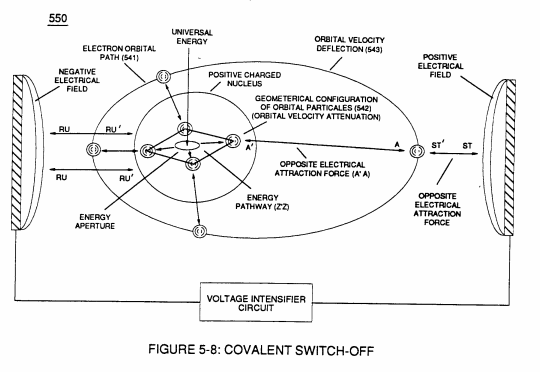
The orbital gyroscopic architecture (6a xxx 6n) of WFC Figure (5-1) / WFC Figure (10-6) as to Figure (5-10) existing within the nucleus of the atom functions as a “**Energy Regulator**” (*orbital velocity attenuator*) since the overall **electrical bonding force** (zz’) of the **orbital sub-****particle**(s) (542) of Figure (5-8) (*geometrically grouped together*) is directly linked to the **Energy Aperture** (7) by way of **electrical intensity** (qq’) (*electrical attraction force that exists between* *Opposite charged mass entities*) which, in turns, is directly controlling a quantum influx of energy into the energy spectrum of the atom in order to maintain the orbital spin velocity of the electron(s) (549) of Figure (5-9) at a given energy level to promote stable state of equilibrium of the atom.
[](https://stanslegacy.com/uploads/images/gallery/2024-03/8XtCcDbcW43uiYuB-image-1709345293818.png)
If the orbital spin-velocity of the orbiting sub-particles decrease in vector-speed due to parasitic electrostatic drag or by other **external force factor** (s) (548) of Figure (5-9) (*opposing the movement of the electrons*), then the **Energy Aperture** (7) automatically enlarges its energy-portal (functioning as an **Energy One-Way Gate Valve**) to allow additional energy to pass into (*via energy pathway zz’ or aa’*) the Energy Spectrum of the Atom until the nucleus orbital **sub-particle** (s) (542) returns to the proper energy level needed to sustain and maintain the atom at a stable state of equilibrium, once again. Conversely, the Energy Aperture **diminishes** the size of its energy-portal (*reducing the flow of inputted energy*) to stabilize the atom at a stable state of equilibrium if the vector-speed of the orbiting sub-particles becomes too great. At stable state of equilibrium, the orbiting sub-particles (542) of the nucleus of the atom are at a “**Balance State of Condition**”
… meaning that the orbital pathway(s) of the orbiting **sub-particle**(s) (542) (*geometrical configuration*) are moving in a circular motion about the axis of the **Energy Aperture** (7) at a constant spin/velocity and that the **sub-particles** (542) are being displaced uniformly ... and that the electrical intensity (qq’) between the orbiting **sub-particle**(s) (542) and the **Energy Aperture** (7) of the nucleus of the atom remains constant ... a condition by which the atom is not radioactive.
[](https://stanslegacy.com/uploads/images/gallery/2024-03/QgHLJEWBdtcSiwIF-image-1709348606364.png)