EP0106917A1 Gas Electrical Hydrogen Generator
Gas electrical hydrogen generator.
A hydrogen gas generator system for converting water into hydrogen and oxygen gasses, in combination with a magnetic particle accelerator for voltage/current amplification. The hydrogen gas generator encompasses an array of plates immersed in water in a pressure-tight enclosure. Direct current voltage applied to the plates causes the hydrogen/oxygen gasses to disassociate from the water molecule. The upper portion of the container is a hydrogen/oxygen collection chamber for maintaining a predetermined gas pressure. A hydrogen/oxygen gas mixture outlet means connected to the collection chamber of the generator includes a magnetic particle accelerator in magnetic relationship with the primary winding for imparting a magnetic potential to the hydrogen gas and the oxygen gas atoms as they are being pressure released from the collection chamber. Attached to the gas outlet means is a non-magnetic conductive loop or tubing. A coil wound around the tubing will have a voltage induced therein as the pressure velocity polarized magnetized gas particles pass therethrough. The induced voltage is used as an electrical power source. The hydrogen and oxygen gas may be utilized such as a burner system or alternatively returned to the gas storage area of the hydrogen generator in a closed-loop arrangement for recycling.
CROSS REFERENCE AND BACKGROUND:
There is disclosed in my co-pending patent application, filed, September 16, 1981, Serial Number, 302,807, for, Hydrogen Generator, a hydrogen gas generating system. The apparatus comprises a pressure-tight enclosure for a water bath having immersed therein an array of plates. The hydrogen and oxygen atoms are disassociated from the water molecule by the application of a non-regulated, non-filtered, low-power, direct current voltage potential to the plates having water passing therebetween. The plates are non-oxidizing and of similar metal to comprise a sub-atomic action non-electrolysis system. The upper portion of the container is a hydrogen/oxygen storage chamber for maintaining a predetermined level.
In my co-pending patent application, Serial Number: 411,977, for, Controlled Hydrogen Gas Flame, filed, August 25, 1982, there is disclosed a hydrogen gas burner. The nozzle in that burner is connected to the storage area or gas collection chamber via an appropriate line. The port in the nozzle has an opening of a controlled size and configuration, related to the size of the flame and the temperature and velocity of the burning gas mixture.
Also, in my co-pending patent application, Serial Number 367,051, for Electrical Particle Generator, filed April 4, 1982, there is disclosed an electrical generating system.
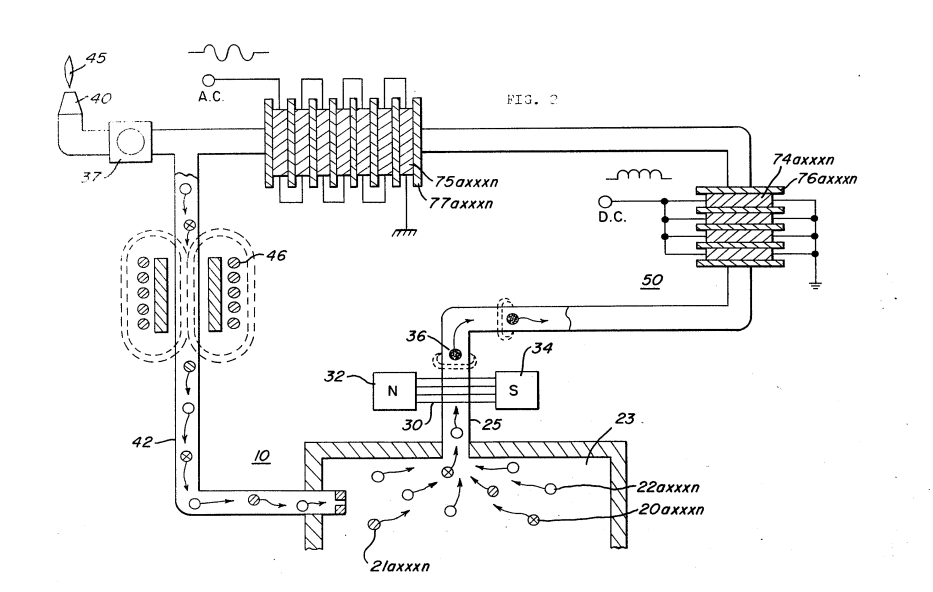
The non-magnetic pipe is filled with the discrete gas particles having a magnetic polarized field placed thereon. The magnetic charged gas particles proceed through the pipe at a high velocity dependent on the pressure in the gas generator storage chamber.
As the magnetic particles pass through the core of the winding there is induced a voltage/current therein, that may be utilized in the same manner as any other electrical source.
The hydrogen/oxygen gas mixture emitted from the opposite end of the pipe is connected to a gas burner where the hydrogen/oxygen gas mixture may be utilized such as for a flame as shown in my co-pending application, Serial number, 411,977. When the flame is not in use the gas is directed back by alternate means to the storage chamber in the hydrogen generator in a closed loop arrangement.
SUMMARY OF INVENTION:
The present invention utilizes the basic principle of a particle accelerator and the principle of inducing a voltage current in a secondary winding by passing a magnetic element therethrough in combination with a hydrogen gas generator. The particle accelerator utilizes the principles of my co-pending application, Serial Number, 367,051, and the hydrogen generator is particularly that of my co-pending patent application, 302,807.
The structure comprises an electrical inductive winding, having a large number of turns and an output for utilizing the voltage current induced therein. The inductive winding is positioned around an endless - closed loop, non-magnetic pipe or tubing.
The hydrogen gas generator encompasses an array of plates immersed in a pressure-tight enclosure. Direct current voltage applied to the plates causes the hydrogen/oxygen gasses to disassociate from the water molecule. The upper portion of the container is a hydrogen/oxygen storage chamber for maintaining a predetermined gas pressure. A hydrogen/oxygen gas mixture outlet means connects the non-magnetic tubing to the storage chamber of the generator. Adjacent the outlet a magnetic polarizer establishes a magnetic field and imparts a magnetic potential to the hydrogen and the oxygen gas being pressure released from the outlet.
The apparatus comprises a non-magnetic pipe in a closed loop having a substantial amount of magnetized particles encapsulated therein. A magnetic accelerator assembly is positioned on the pipe and includes an inductive primary winding with a low voltage input. A secondary winding is positioned on the pipe opposite to the primary winding. Upon voltage being applied to the primary winding, the magnetized particles accelerate through the magnetic accelerator assembly with increased velocity. The velocity-accelerated particles induce an electrical voltage/current potential as they pass through the secondary winding.
In a closed-loop system, the process is continuous. The increased secondary voltage current is utilized in a direct current or alternate current amplifier arrangement.
OBJECTS:
It is a principal object of the present invention to provide a hydrogen gas electrical generator capable of producing a voltage/current much greater in magnitude heretofore possible.
Another object of the present invention is to provide such a hydrogen gas electrical generator utilizing magnetized elements and wherein the magnetized elements are charged gas particles from a hydrogen generator.
Another object of the present invention is to provide such a hydrogen gas electrical generator in combination with a controlled output hydrogen generator.
Another object of the present invention is to provide such an electrical generator that may be utilized with a hydrogen generator having another utility output for alternative generation.
A further object of the present invention is to provide such an electrical generator that utilizes components readily available and adaptable to the simplified embodiment.
Other objects and features of the present invention will become apparent from the following detailed description when taken in conjunction with the drawings in which:
|
|
|