
9XD: The 7805/7812 Voltage Regulator Supply
7805 and 7812 Voltage Regulators: Building 5V and 12V Power Supplies
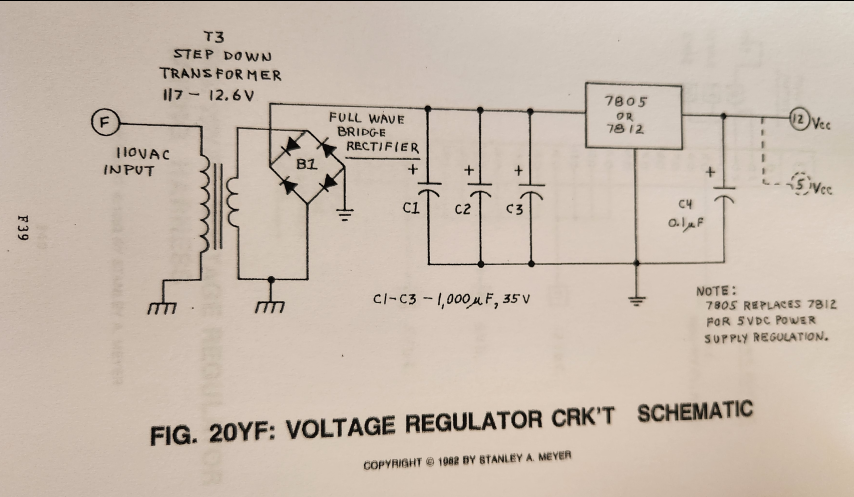
The 7805 isand a7812 are popular and reliable voltage regulatorregulators used to create a stable 5V output,and 12V outputs, making itthem ideal for low-power electronics and microcontroller circuits. ThisThese voltage regulatorregulators isare widely used because of itstheir simplicity, efficiency, and capability to provide a steady output voltagevoltages regardless of input variations. In this article, we will explore how to set up aboth 7805 and 7812 voltage regulator circuit,circuits, as illustrated in Stanley Meyer's schematic, to create a regulated 5V and 12V power supply.
How the 7805 and 7812 Voltage RegulatorRegulators WorksWork
The 7805 isand a7812 are three-terminal voltage regulatorregulators that provides aprovide fixed output voltagevoltages of 5V. Itand is12V respectively. They are capable of handling input voltages between 7V and 35V for the 7805 and 14V and 35V andfor outputsthe a7812. regulatedThese 5Vregulators output stable voltages suitable for powering most small electronic circuits. The three pins on theboth 7805regulators are:
-
Input (Vin): The input voltage, which needs to be greater than the desired output by at least
2V (typically between 7V and 35V).2V. -
Ground (GND): The common ground for both the input and output.
-
Output (Vout): The regulated output voltage, fixed at
5V.5V for the 7805 or 12V for the 7812.
TheBoth 7805regulators hashave internal current limiting and thermal shutdown features, which make it athem reliable optionoptions for most low-power electronics projects.
Setting Up the 7805 and 7812 as a 5V Power SupplySupplies
To create a reliable 5V and 12V power supply,supplies, you'll need a few components in addition to the 7805 or 7812 voltage regulator:regulators:
-
Step-Down Transformer: A transformer to step down the AC voltage from 110V to around 12V AC
.for the 7805 or 15V AC for the 7812. -
Bridge Rectifier (B1): A full-wave bridge rectifier to convert the AC voltage to DC.
-
Filter Capacitors (C1, C2, C3): These capacitors are used to smooth out the DC voltage after rectification, typically 1000μF, 35V capacitors.
-
Input Capacitor (C4, 0.1μF): This capacitor helps stabilize the input voltage to the regulator.
-
Heat Sink (optional): To prevent the
7805regulator from overheating, especially if the current draw is significant.
Here is how to wire the 7805 or 7812 as a regulated 5V power supply:
-
AC to DC Conversion: Start by connecting the step-down transformer (T3) to the 110V AC input to step down the voltage to 12V AC (for 7805) or 15V AC (for 7812). The AC output is then fed to the full-wave bridge rectifier (B1), which converts the AC into DC voltage.
-
Filtering the DC Voltage: Use the filter capacitors (C1, C2, C3), each rated at 1000μF, 35V, to smooth out the DC voltage. These capacitors help reduce the ripple and ensure a steady DC voltage is provided to the voltage regulator.
-
Voltage Regulation: Connect the output from the filter capacitors to the Vin pin of the 7805 or 7812. Add an input capacitor (C4, 0.1μF) between the Vin pin and ground to stabilize the input. The GND pin is connected to the common ground, and the Vout pin provides the regulated 5V (for 7805) or 12V (for 7812) output.
-
Output Filtering: To ensure a stable output, you can add a small capacitor (typically 0.1μF) between the Vout pin and ground. This helps filter out any high-frequency noise.
Practical Considerations
-
Heat Dissipation: When there is a large difference between the input voltage and the regulated output (e.g.,
12V15V input to5V12V output), the7805regulator will dissipate excess energy as heat. To prevent overheating, attach a heat sink to the regulator. -
Current Capability:
TheBoth the 7805 and 7812 can supply up to 1A of current, but this depends on the input voltage and the ability to dissipate heat. If the current requirement is higher, consider using a switching regulator or adding a more efficient cooling solution. -
Input Voltage: Ensure that the input voltage is at least 2V higher than the desired output. For the 5V output, the input should be at least 7V, and for the 12V output, the input should be at least 14V to maintain proper regulation.
Using the 7805 or 7812 in a Project Box
To create a practical 5V or 12V power supply,supplies, you can mount the 7805 or 7812 circuit in a project box. Add an external on/off switch, input and output terminals, and consider adding a fuse on the input for safety. This can provide a versatile power source for your electronics projects.
Conclusion
The 7805 and 7812 voltage regulatorregulators is anare easy and reliable solutionsolutions for creating a fixed 5V and 12V power supply.supplies. By using a step-down transformer, bridge rectifier, filter capacitors, and the 7805 or 7812 itself, you can build a regulated power supplysupplies suitable for a wide range of electronic applications. The addition of heat sinks and careful consideration of the input voltage ensures the regulator operates effectively without overheating. ThisThese simple power supply designdesigns can be used to power anything from microcontrollers to sensors, providing a stable 5V sourceor 12V sources for your DIY electronics projects.