
LM317 as a Variable Power Supply: 0-35V Adjustable Voltage
The LM317 is a versatile and widely used adjustable voltage regulator that can provide output voltages ranging from 1.25V up to 35V, making it ideal for DIY electronics projects. This regulator can deliver up to 1.5A of current with proper heat dissipation, making it a convenient solution for powering various circuits with a customizable voltage range. In this article, we will explore how to set up the LM317 as a variable power supply, using a potentiometer to adjust the output voltage.
How the LM317 Works
The LM317 is a three-terminal adjustable regulator that can output a stable voltage by regulating the difference between its input and output. It has three pins:
-
Input (Vin): The input voltage is supplied here, typically between 3V and 40V.
-
Output (Vout): This pin provides the regulated output voltage, adjustable between 1.25V and the maximum input voltage.
-
Adjust (Adj): This pin is used to set the output voltage through an external resistor network.
The key to adjusting the output voltage lies in the resistor network connected between the Output and Adjust pins. By changing the resistance value, the output voltage can be easily controlled.
Setting Up the LM317 as a Variable Power Supply
To create an adjustable power supply with the LM317, you need a few key components:
-
LM317 Voltage Regulator
-
Potentiometer (typically 5kΩ or 10kΩ)
-
Fixed Resistor (typically 240Ω)
-
Input Capacitor (0.1μF) and Output Capacitor (1μF or larger)
-
Heat Sink (optional, but recommended for higher currents)
Here is how to wire the LM317 as a variable power supply:
-
Input Voltage: Connect the input voltage source (e.g., 12V-40V DC) to the Vin pin of the LM317. A 0.1μF capacitor can be added between the input and ground to stabilize the input voltage.
-
Output Voltage: Connect the Vout pin to the positive terminal of your load. Add a 1μF capacitor between the output and ground to improve stability and reduce ripple.
-
Adjust Pin and Voltage Divider: To control the output voltage, connect a 240Ω resistor between the Vout and Adjust pins. Then, connect a potentiometer (typically 5kΩ or 10kΩ) between the Adjust pin and ground. The potentiometer acts as an adjustable resistor that allows you to vary the voltage.
The output voltage (βVoutβ) is calculated by the following formula:
$$ V_{out} = 1.25V \times \left( 1 + \frac{R_2}{R_1} \right) + I_{adj} \times R_2 $$
Where:
-
R1 is the fixed resistor (typically 240Ω).
-
R2 is the resistance of the potentiometer, which varies as you adjust it.
-
Iadj is a small adjustment current (typically ignored for most practical purposes).
By adjusting the potentiometer, the ratio of R2 to R1 changes, allowing you to vary the output voltage between approximately 1.25V and 35V, depending on the input voltage.
Practical Considerations
-
Heat Dissipation: The LM317 can get quite hot, especially when supplying higher currents or when the input-output voltage differential is high. To prevent overheating, it is recommended to attach a heat sink to the regulator.
-
Capacitor Placement: Placing a capacitor between the input and ground and one between the output and ground helps to filter out noise and reduce voltage ripple, resulting in a more stable output.
-
Input Voltage: To achieve a higher output voltage, make sure that your input voltage is sufficiently higher than the desired output. The LM317 requires at least 3V above the desired output voltage to regulate correctly.
Using the LM317 in a Project Box
To make a practical adjustable power supply, you can mount the LM317 and the associated components inside a project box. You can add an external potentiometer to the box, which allows you to adjust the voltage easily. Include input and output terminals, and an on/off switch for added convenience. A volt meter module can also be added to display the output voltage in real time.
Conclusion
The LM317 is a versatile component for building a variable power supply, allowing you to easily adjust the output voltage from 1.25V to 35V. By using a potentiometer in combination with a fixed resistor, you can fine-tune the output voltage to suit the needs of your project. With proper heat dissipation and careful setup, the LM317 can provide a stable and adjustable power source for a wide range of electronic applications.
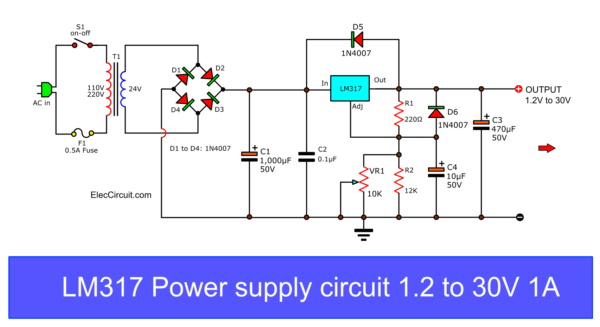
Source: https://www.eleccircuit.com/lm317-power-supply/#Elec_Circuit_vol1