
Local inventor gives car its first road test - October 17th, 1985
By Shannon Hanscom
October 17th, 1985
Source: https://grovecity.advantage-preservation.com/viewer/?k=&t=30203&i=t&d=01011901-12312011&m=between&ord=k1&fn=the_grove_city_record_usa_ohio_grove_city_19851017_english_5&df=21&dt=30
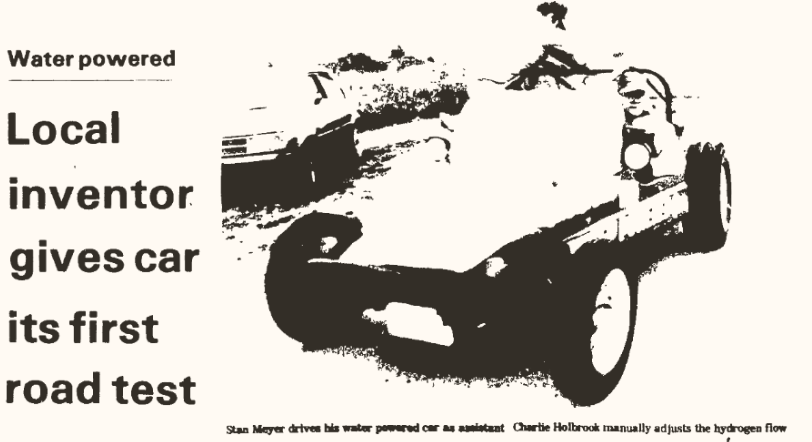 According to local inventor Stan Meyer, he had been waiting 10 years for what happened last Friday. That is when he drove his water-powered car, powered by the Water Fuel Cell, in a road test for the first time.
Among the witnesses were the Grove City Record; several friends and relatives of Meyer; Jack Cook of Jack’s VW Service; and Lt. Col. Stanley Parkinson of the United States Air Force.
To everyone’s astonishment, Meyer drove his Water Fuel Cell-powered dune buggy several times at distances covering nearly one mile, at speeds in excess of 50 MPH. The demonstration came nearly one year after Meyer presented the car in an idling condition for the Record.
Meyer said since those tests a year ago, he has been working on the acceleration controls and the method by which to accurately control the burn rate of the hydrogen gas. Although the system is not perfected, he said he is planning a demonstration for the national press within the next several weeks.
“Up until recently, we had the car idling on the Water Fuel Cell sitting on the ground and ran static testing,” Meyer said. “Then, we began working on the accelerator controls to learn how to mix the hydrogen gas, exhaust gas, and ambient air, for actual road testing under load conditions. That had to be done before the car could be driven. It is one thing to operate the car under lab conditions, and another to drive it on the road under load conditions,” Meyer added.
Air Force to examine
According to Lt. Col. Parkinson, he said there is no doubt that, “the system in the fuel cell is breaking down water in component parts via the Water Fuel Cell and operating the dune buggy.”
Parkinson has degrees in industrial and systems engineering and is a 25-year Air Force veteran. He has spent the last 15 years as an Air Force program manager and systems engineer in research and development of most and application of weapons systems.
“Technically, from my viewpoint, there is no doubt that the system can quickly break down water into hydrogen and oxygen. It is working. But to perfect it to a working system, we need more time and study,” Parkinson said.
“It will still take some time to work out the controls. I can’t tell how long that will be. It may be right around the corner. He may have a few more hills to climb, but it appears they may be climbed. Now he has to work out further control of the burn mixture of the gases, and he will have a real system.”
After a break, the gas tank was removed from the car, the hydrogen gas valve was opened, and the Water Fuel Cell was started and gas production began again. Meyer then drove the car, with assistant Charlie Holbrook manually adjusting the hydrogen flow.
Lt. Col. Parkinson was then given a ride of more than a half-mile at 21 MPH. Cook was given a ride of about 7 miles at speeds in excess of 50 MPH. The Record reporter then rode almost twice at about 7 miles between 45-55 MPH. Finally, Meyer drove the car almost at full mile at 50 MPH with Holbrook and another friend.
Although Meyer was excited by the performance of the car, the demonstration highlighted some areas that need improvement. He operated the car up grades with more than 940 pounds of passengers and equipment payload. The car accelerated well, but each time the dune buggy maneuvered around several small curves, Holbrook had difficulty maintaining constant hydrogen flow. When Meyer had to slow down, the hydrogen flow remained the same, thus flooding out the engine.
Also, before each test run, the car had to be started with gasoline, then switched to the hydrogen gas.