
Laser Interaction
 Light-emitting diodes arranged in a Cluster-Array (see Figure 1-11) provides and emits a narrow band
of visible light energy into the voltage stimulated water bath, as illustrated in Figure (1-13) as to Figure (1-
12).
|
Figure (1-13)
|
Figure (1-12) |
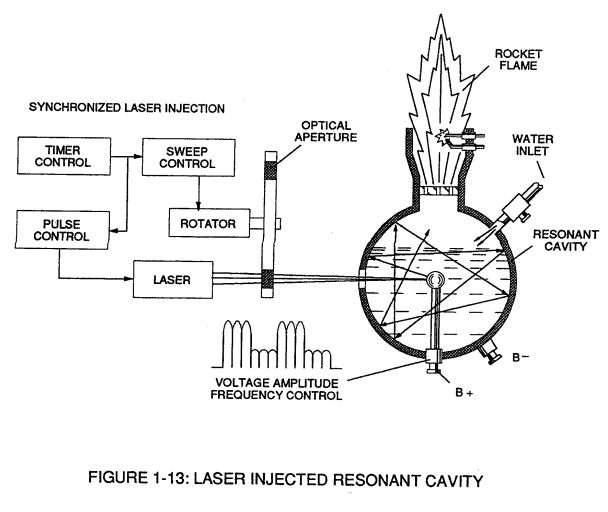
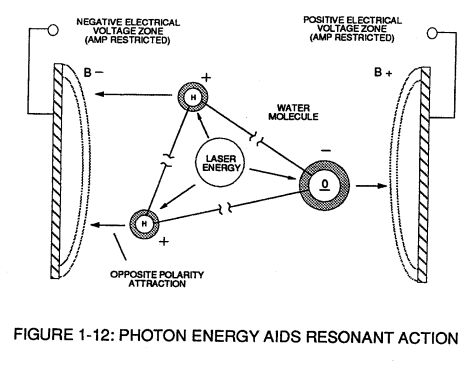
The absorbed Laser Energy (Electromagnetic Energy) causes many atoms to lose electrons while
highly energizing the liberated combustible gas ions prior to and during thermal gas-ignition.
Laser or
light intensity is linear with respect to the forward current through the LEDS,LEDs, and, is determined by
by:

Where
I led is the specified forward current (typically 2Oma.20ma. per diode); V led is the LED voltage drop
(typically 1.7 volts for red emitters).
Ohm's Law for LED circuit in parallel array, and is given by
(Eq 16)

Where
(It) is the forward current through LED cluster-Array: Vcc is volts applied (typically 5 volts)._____________________________________________________________________________Stanley
Whereby
Laser or light intensity is variable as to duty cycle on/off pulse-frequency from 1Hz to 65 Hz and
above is given by
(Eq 17)
 Le is light intensity in watt;
 Tl
T1 is current on-time;
T2 is current off-time;
and (ION)=RMS value of
load current during on-period.
Injecting Laser Energy into the Electrical Polarization Process and controlling the intensity of the
light-energy causes the Combustible Gases to reach a higher energy-state (electromagnetically priming
the combustible gas ions)ions) which, in turn, accelerates gas production while raising gas-flame
temperatures beyond "normal" gas-burning levels.
Injecting "Electromagnetically Primed"Primed" and "Electrically Charged"Charged" combustible gas ions (from
water) into other light-activated Resonant Cavities further promotes gas-yield beyond voltage/laser
stimulation, as illustrated in Figure (1-16) as to Figure (1-18).
