
LC Voltage
The voltage across the inductor (C) or capacitor (ER) is greater than the applied voltage (H).
At
frequency close to resonance,resonance, the voltage across the individual components is higher than the applied
voltage (H),
and, at resonant frequency,frequency, the voltage VT across both the inductor and the c:apacitorcapacitor are
theoretically infinite.infinite.
However, physical constraints of components and circuit interaction prevents the
voltage from reaching infinity.
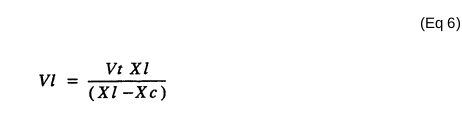
The voltage (VL) across the inductor (C) is given by the equation
(Eq 6)
The voltage (VC) across the capacitor is given by
(Eq 7)

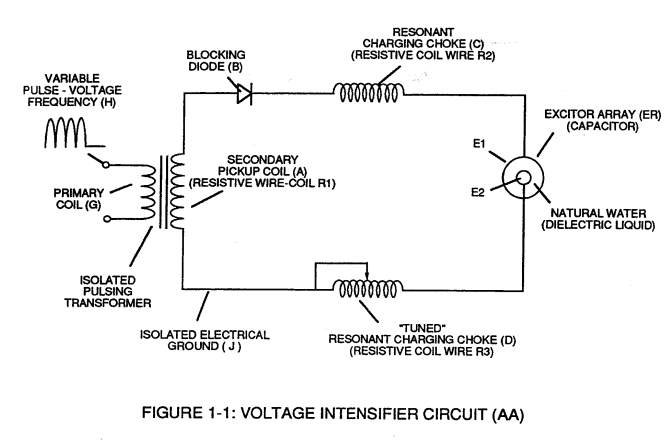
During resonant interaction,interaction, the incoming unipolar pulse-train (H) of Figure (1-1) as to Figure
(1-5) produces ana step-charging voltage-effect across Excitor-Array (ER), as illustrated in Figure i1-(1-3)
and Figure (1-4).
|
Figure (1-1)
|
Figure (1-5)
|
|
Figure (1-3)
|
Figure (1-4)
|
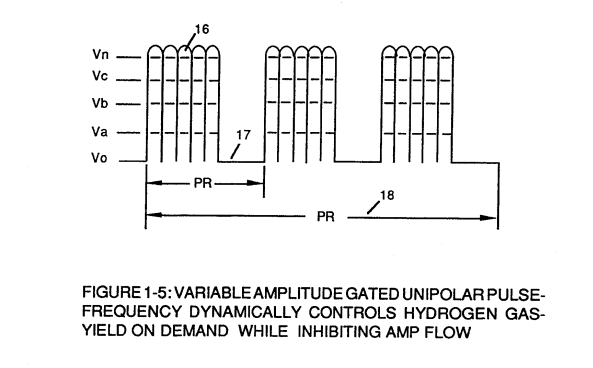
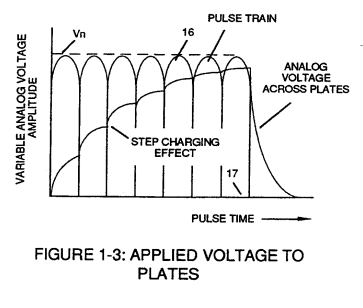

Voltage intensity increases from zero 'ground-state'state' to ana high positive voltage
potential in an progressive function.function.
Once the voltage-pulse is terminated or switched-off,off, voltage
potential returns to "ground-state"state" or near ground-state, to start the voltage deflection process over
again.
Voltage intensity or level across Excitor-Array (ER) can exceed 20,000 volts due to circuit (AA)
interaction and is directly related to pulse-train (H) variable amplitude input.