
Thermal Explosive Energy
Exposing the expelling "laser-primed"primed" and "electrically charged"charged" combustible gas ions (exiting from
Gas Resonant Cavity)Cavity) to a thermal-spark or heat-zone causes thermal gas-ignition, releasing thermal
explosive energy (gmt) beyond the Gas-Flame Stage,Stage, as illustrated in Figure (1-19) as to (1-18).
|
Figure (1-19)
|
Figure (1-18)
|
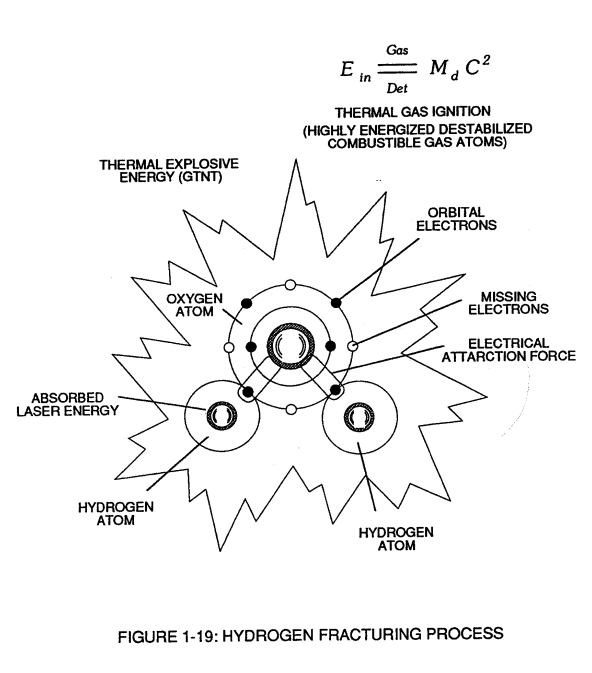

Thermal Atomic interaction (gmt) is caused when the combustible gas ions (from water) fail to
unite or form a Covalent Link-up or Covalent Bond between the water molecule atoms.atoms as
illustrated in Figure (1-19).
The oxygen atom having less than four covalent electrons (Electron
Extraction Process)Process) is unable to reach "Stable-State"State" (six to eight covalent electrons required)required) when
the two hydrogen atoms seeksseek to form the water molecule during thermal gas ignition.
The absorbed Laser energy (Va.Va, Vb and V c)Vc) weakens the "Electrical Bond"Bond" between the orbital
electrons and the nucleus of the atoms; while, at the same time, electrical attraction-force (qq'),
being stronger than "Normal" due to the lack of covalent electrons.electrons, "Locks Onto"Onto" and "Keeps"Keeps" the
hydrogen electrons.
These “abnormal”abnormal” or “unstable”unstable” conditions cause the combustible gas ions to
over compensate and breakdown into thermal explosive energy (gmt).
This Atomic Thermal-_____________________________________________________________________________Stanley A. Meyer1 - 10RE: Hydrogen Fracturing ProcessMemo WFC420
Interaction between highly energized combustible gas ions is hereinafter called "The Hydrogen
Fracturing Process.Process."
By simply attenuating or varying voltage amplitude in direct relationship to voltage pulse-rate
determines Atomic Power-Yield under controlled state.