
Voltage Dissociation of The Water Molecule
Placement of a pulse-voltage potential across the Excitor-Array (ER) while inhibiting or
preventing electron flow from within the Voltage Intensifier Circuit (AA) causes the water molecule to
separate into its component parts by, momentarily, pulling away orbital electrons from the water
molecule, as illustrated in Figure (1-9).
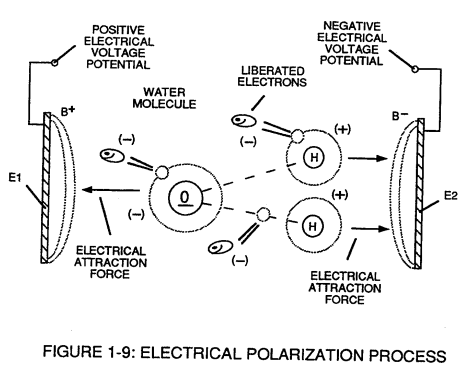 The stationary "positive" electrical voltage-field (
EI)E1) not only attracts the negative charged oxygen
atom but also pulls away negative charged electrons from the water molecule.
At the same time, the
stationary "negative" electrical voltage field (E2) attracts the positive charged hydrogen atoms.atoms.
Once
the negative electrically charged electrons are dislodged from the water molecule, covalent bonding
(sharing electrons) ceases to exist, switching-off or disrupting the electrical attraction force (qq')
between the water molecule atoms.
The liberated and moving atoms (having missing electrons)electrons) regain or capture the free floating
electrons once applied voltage is switched-off during pulsing operations.
The liberated and electrically
stabilized atomatoms having a net electrical charge of "zero" exit the water bath for hydrogen gas utilization.
Dissociation of the water molecule by way of voltage stimulation is herein called 'The Electrical
Polarization Process"Process"._____________________________________________________________________________Stanley
Subjecting or exposing the water molecule to even higher voltage levels causes the liberated atoms to
go into a "state" of gas ionization.
Each liberated atom taking-on its own "net" electrical charge.charge.
The
ionized atoms along with free floating negative charged electrons are, now, deflected (pulsing electrical
voltage fields of opposite polarity) through the Electrical Polarization Process
… imparting or
superimposing a second physical-force (particle-impact)impact) unto the electrically charged water bath.
Oscillation (back and forth movement) of electrically charged particles by way of voltage deflection is
hereinafter called "Resonant Action"Action", as illustrated in Figure (1-10).
Attenuating and adjusting the "pulse-voltage-amplitude"amplitude" with respect to the "pulse voltagefrequency" frequency", now, produces hydrogen gas on demand while restricting amp flow.