
Voltage Dynamics
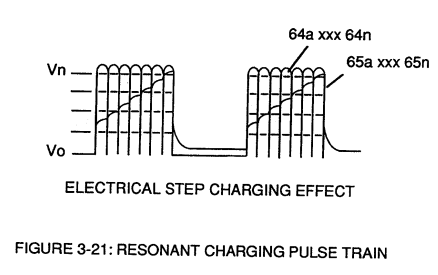
Voltage is "electrical pressure" or "electrical force" within electrical circuit (60) and is known
as voltage potential (65a xxx 65n) of Figure (3-21).
The higher the voltage potential (VOVo xxx Vn), the
greater "electrical attraction force"force" (qq') or"or "electrical repelling force"force" (ww') ofStanley A Meyer3-11RE: WFC Hydrogen Gas Management SystemMemo WFC 422 DA
Figure (3-29) is applied to electrical circuit (60) of Figure (3-22).
Voltage potential (65) is an "unaltered"
or "unchanged" energy-state when "electron movement" or "electron deflection" is prevented or
restricted within electrical circuit (190) of Figure (3-23).
|
Figure (3-22) |
Figure (3-23) |
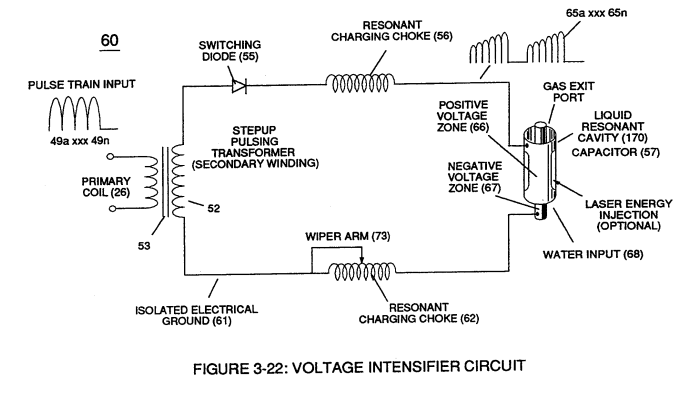
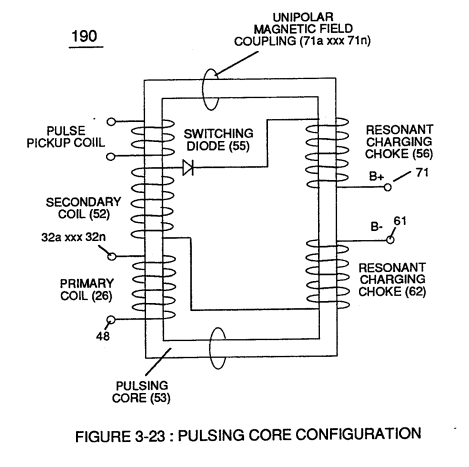
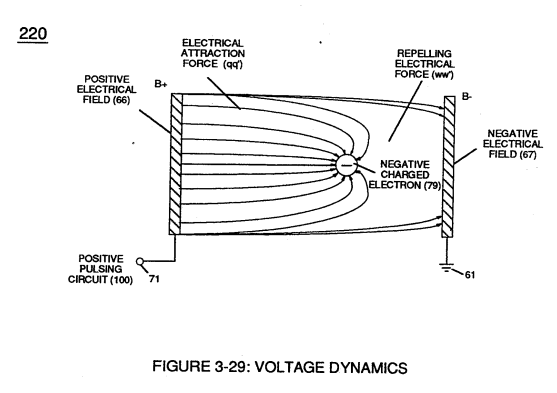 Unlike voltage charges within electrical circuit (60) steps up "electrical attraction
 force"force" (qq');
whereas, like electrical charges within the same electrical circuit (60) encourages an "repelling action"
action" (ww'), as illustrated in Figure (3-29).
In both cases, electrical charge deflection or movement is directly
related to applied voltage (65).
These electrical "forces"forces" are known as ''voltage fields"fields" and can exhibit
either a positive (66) or negative (67) electrical charge.
Likewise, Ions or charged particles (atoms having missing or sharing electrons between
unlike atoms)atoms) within electrical circuit (60) having unlike electrical charges are attracted to each other.
Ions or particlesparticle mass having the same or like electrical charges will move away from one another, as
illustrated in (220) of Figure (3-29).
Furthermore, electrical charged ions or particles can move toward stationary voltage fields or
voltage zones (66/67) of opposite polarity, and, is given by Newton's second law
(Eq 12)
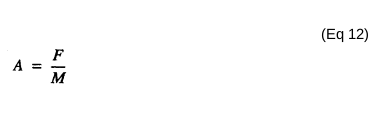
Where, the acceleration (A) of a particle mass (M) acted on by a net force (F).
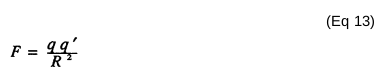
Whereby, net force (F) is the "electrical attraction force" (qq') between opposite electrically charged
entities (210) of Figure (3-27), and, is given by Coulomb's law
(Eq 13)
Whereas, difference of potential between two charges is measured by the work necessary to bringStanley A Meyer3-12RE: WFC Hydrogen Gas Management SystemMemo WFC 422 DA
the charges together,together, an~and is given by
(Eq 14)
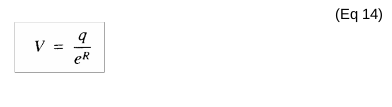
The potential at a point to a charge (q) at a distance (R) in a medium whose dielectric constant is (e).