
Energy One-Way Gate Valve
The orbital gyroscopic architecture (6a xxx 6n) of WFC Figure (5-1) / WFC Figure (10-6) as to Figure (5-10) existing within the nucleus of the atom functions as a “Energy Regulator” (orbital velocity attenuator) since the overall electrical bonding force (zz’) of the orbital sub-particle(s) (542) of Figure (5-8) (geometrically grouped together) is directly linked to the Energy Aperture (7) by way of electrical intensity (qq’) (electrical attraction force that exists between Opposite charged mass entities) which, in turns, is directly controlling a quantum influx of energy into the energy spectrum of the atom in order to maintain the orbital spin velocity of the electron(s) (549) of Figure (5-9) at a given energy level to promote stable state of equilibrium of the atom.
|
WFC Figure (5-1) |
WFC Figure (5-10)
|
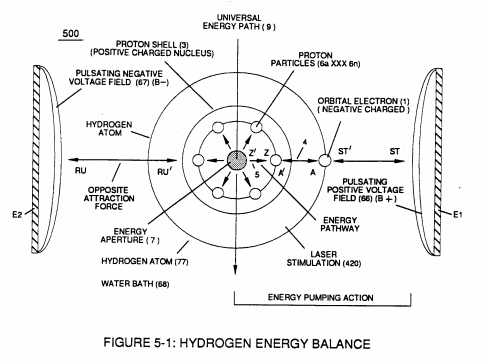
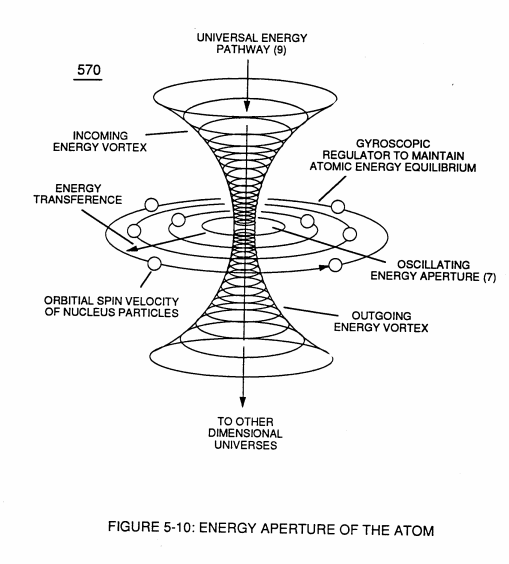
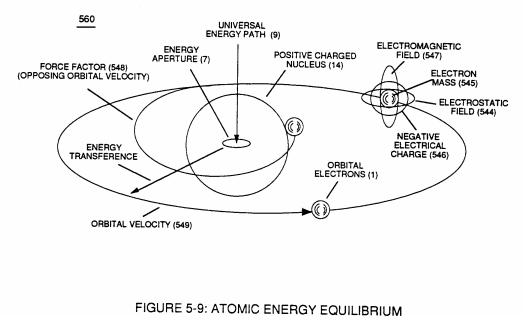
If the orbital spin-velocity of the orbiting sub-particles decrease in vector-speed due to parasitic electrostatic drag or by other external force factor (s) (548) of Figure (5-9) (opposing the movement of the electrons), then the Energy Aperture (7) automatically enlarges its energy-portal (functioning as an Energy One-Way Gate Valve) to allow additional energy to pass into (via energy pathway zz’ or aa’) the Energy Spectrum of the Atom until the nucleus orbital sub-particle (s) (542) returns to the proper energy level needed to sustain and maintain the atom at a stable state of equilibrium, once again. Conversely, the Energy Aperture diminishes the size of its energy-portal (reducing the flow of inputted energy) to stabilize the atom at a stable state of equilibrium if the vector-speed of the orbiting sub-particles becomes too great. At stable state of equilibrium, the orbiting sub-particles (542) of the nucleus of the atom are at a “Balance State of Condition”
… meaning that the orbital pathway(s) of the orbiting sub-particle(s) (542) (geometrical configuration) are moving in a circular motion about the axis of the Energy Aperture (7) at a constant spin/velocity and that the sub-particles (542) are being displaced uniformly ... and that the electrical intensity (qq’) between the orbiting sub-particle(s) (542) and the Energy Aperture (7) of the nucleus of the atom remains constant ... a condition by which the atom is not radioactive.
The quiescent atom remains at stable state of equilibrium and does not become radioactive until the atom absorbs a given quantum-amount (high-energy end of the electromagnetic energy spectrum) of electromagnetic energy (gamma radiation) into the energy spectrum of the atom.
Once absorbed, the atom reaches a “State of Unbalance” when the orbital sub-particles pathway (s) (542) of Figure (5-8) are deflected (moved) to a higher energy state which, in turns, induces a change in the orbital pathway (s) from an circular to an elliptical configuration since the orbiting sub-particles (542) are regrouped to from a different and distorted arrangement... being displaced unevenly ... thereby, setting up a condition by which the atom, now, becomes radioactive ... an emitter of electromagnetic energy.
The degree by which the atom becomes more radioactive is simply determined by either the atom absorbing additional incoming gamma radiation (very energetic X-rays) and/or excepting alpha (consist of two protons and two neutrons bound together), beta particle (nothing more than an electron (s), and/or neutron particles from another radioactive substance (s). In each and all unstable condition (s), the elliptical pathway of the orbiting sub-particles becomes even more exaggerated (increasing the wobbling effect) .. and, proportionally causing the atom to become even more unbalanced (becoming more radioactive).
This unbalance state of condition(s), now, causes the Energy Aperture (7) to start to oscillate (be elongated repeatedly) in direct relationship to the elliptical pathway of the sub-particles (542). As the orbiting sub-particle (542) approaches the apogee node of the elliptical movement, the Energy Aperture (7) is elongate to a larger opening ... thereby, allowing more energy to go into and to be absorbed and pass through the energy spectrum of the atom. When the perigee node of the elliptical movement is alternately reached, the Energy Aperture (7) opening is reduced in size and thereby shuts-off the flow of inputted energy going into the energy spectrum of the atom. This “Oscillatory Action” of switching on and off the energy flow going into the atom, now, causes the unstable atom to become radioactive (emitting radiation) since the Oscillatory Action energy-primes the atom beyond normal energy-levels. The unstable (unbalanced) atom continues to be an emitter of electromagnetic energy (radiation) until the atom is returned to a stable state of equilibrium by way of atomic decay.
To achieve and bring about atomic decay in an instant of time, one needs only to expose the unstable atom to a high pulsating “Electrical stress” across the individual radioactive atom by way of opposite voltage potential, as so illustrated in (550) of Figure (5-8) by the use of WFC Voltage Intensifier Circuit as so defined in WFC memo 426 titled “VIC Matrix Circuit.”
This applied pulsating electrical stress actually physically “Rings” the unstable atom to perform the Atomic Degaussing Process instantly rather than relying on normal half-life cycling (typically, thousands of years) since the applied “Electrical Stress” effects (attenuates) the electric field strength (qq’) (electrical attenuation Aqq’) of the atom... being that, the atom is composed of electrical charged particles of different electrical intensities, as so illustrated in WFC Memo 424 titled “Atomic Energy Balance of Watér.”
Within the Atomic structure, the Proton exhibits a Positive electrical charge (B+), electrons emanates an negative electrical charge (B-), and neutrons which is/are made up of a positive charged Proton (B+) electrically bonded together (opposite electrical attraction force qq’) with an negative charge electron (B-). These electrical charged particles that make up the atom structure are interrelated and held together by an Electrical Bonding Force (electrical attraction force (qq’) that exists between each opposite electrical charged mass entities) since each individual and separate sub-atomic particle mass entity exhibits one of the two opposite electrical charged fields (B+) or (B-).
Electrical attenuation of the unstable (radioactive) atom Electrical Bonding Force(s) (Electrovalent Bonding Force) (qqa’ xxx qqb’) by subjecting and exposing the unstable atom to “Electrical Stress” of opposite voltage polarity simply causes the atom to return to stable state of equilibrium (no longer radioactive) by causing the unstable atom to give up any unwanted mass entity (s) such as an extra neutron(s), proton(s), and/or electron(s) which is directly contributing to the Wobbling Effect (unbalance condition of the atom).
Electrical attenuation (Aqq) of the Electrical Bonding Force (qq’) of the unstable atom occurs when opposite electrical attraction forces (RU-RU’ / ST’-ST) are set up between the electrical charged sub-particles of the atom and the recurring pulsating electrical voltage fields (E15/E16) of opposite electrical polarity of potential (B+/B-), as so illustrated in (1020) of Figure (11-1) titled “Neutron Electrical Polarization Process” as to Figure (10-1) titled “Voltage Intensifier Circuit”.
When applied, the opposite voltage fields (E15/E16) overcomes the electrovalent bonding force (qq’) that exists between the two unlike electrical charged subatomic particles forming the neutron
... whereby, the positive charged proton (B+) is deflected toward stationary negative voltage field (B-) (B15) and, simultaneously, the negative charged electron (B-) is deflected in opposite direction toward the stationary positive voltage field (E16) since unlike charges attract (RU-RU’ / ST’-ST) under the law of physics
… thereby, overcoming electrovalent bonding force (qq’).
Once separated, the newly liberated proton and electron (neutron no longer exists) can be immediately captured by the unstable atom to cause the atom to transmute (transform) into another element having a different mass number.
This “Transformation of the Elements” by way of electrical stress (hereinafter called The Atomic Degaussing Process) continues until the atom reaches a state whereby the newly formed stable atom has the same number of protons as to electrons and the number of neutrons remaining are such as to eliminate the “isotopes” condition of the the once unstable atom... eliminating the Wobbling Effect ... thereby, causing the atom to become non-radioactive.
The surplus electromagnetic energy (gamma ray absorption), if any, is simply absorbed into the energy spectrum of the atom when the atom transmutes into another element (s) during the Neutron Electrical Polarization Process, as so illustrated in (1020) of Figure (11-1).
Wherein, the newly liberated protons and neutrons from the de-materializing alpha Particles, further, contributes to the Atomic Degaussing Process, when exposed to the same pulsating “Electrical Stress,” as so illustrated in (1030) of Figure (11-2) titled “Alpha Electrical Polarization Process.” The WFC Atomic Degaussing Process can be used to alter the state of any unstable atom (s) that has become radioactive since each atom has the same electrical charged particle mass entities, just different in atomic numbers. Remember, all substances are composed of atom structures grouped in different molecular forms.
To ionize (vaporize) the nuclear spent fuel rods to allow the Atomic Degaussing Process to take place, simply expose the material of the nuclear spent fuel rods to a hydrogen/oxygen flame by the use of WFC Technology of Inventions that economically uses Water as Fuel ®.