Controlled Process For The Production Of Thermal Energy From Gases And Apparatus Useful Therefore #4,826,581
United States Patent Patent Number: 4,826,581
Date of Patent: May 2, 1989(54) CONTROLLED PROCESS FOR THE PRODUCTION OF THERMAL ENERGY FROM GASES AND APPARATUS USEFUL THEREFORE
(76) Inventor: Stanley A. Meyer, 3792 Broadway, Grove City, Ohio 43123
(21) Appl. No.: 81,859
(22) Filed: Aug. 5, 1987Related U.S. Application Data
(63) Continuation-in-part of Ser. No. 835,564, Mar. 3, 1986, abandoned.
(51) Int. Cl.*: C07G 13/00
(52) U.S. Cl.: 204/157.41; 204/164
(58) Field of Search: 204/164, 157.41, 157.44References Cited
U.S. PATENT DOCUMENTS:
4,233,109 11/1980 Nishizawa ...................... 204/164 X
4,406,765 9/1983 Higashi et al ................ 204/164
4,687,753 8/1987 Fiato et al ...................... 204/157.41 X
4,695,357 9/1987 Boussert ....................... 204/157.41Primary Examiner—Stephen J. Kalafut
Attorney, Agent, or Firm—Porter, Wright, Morris & Arthur
(57) ABSTRACT
A method and apparatus for obtaining the release of energy from a gas mixture including hydrogen and oxygen in which charged ions are stimulated to an activated state, and then passed through a resonant cavity, where successively increasing energy levels are achieved, and finally passed to an outlet orifice to produce thermal explosive energy.
CONTROLLED PROCESS FOR THE PRODUCTION OF THERMAL ENERGY FROM GASES AND APPARATUS USEFUL THEREFORE
FIELD OF THE INVENTION
This invention relates to a method of and apparatus for obtaining the release of energy from a gas mixture including hydrogen and oxygen, in which charged ions are stimulated to an activated state, and then passed through a resonant cavity, where successively increasing energy levels are achieved, and finally passed to an outlet orifice to produce thermal explosive energy.
BACKGROUND OF THE PRIOR ART
Processes have been proposed for many years in which controlled energy-producing reactions of ions or molecules are achieved by electrical stimulation of gases. (See, e.g., Raphael J. Incerpi, "SCF-Nobel Laureate," found in Scientific American, July 1977, page 58). The various ions and molecules described in such processes are ignited by tremendous levels of force and energy is derived from precise atomic components in controllable amounts.
OBJECTS OF THE INVENTION
It is an object of this invention to release sufficient energy from atoms by splitting ions into their constituent components, which allows energy to be obtained from the gas in controlled steps.
It is another object of the invention to release atomic energy by resonance frequencies within the gas mixture, where the resulting resonance increases atomic energy to an extremely high level.
It is a further object of the invention to ignite and control the release of atomic energy in a controlled state by progressively increasing the energy released from ionized atoms until thermal explosive energy is achieved.
BRIEF DESCRIPTION OF THE DRAWINGS
FIG. 1 is a diagrammatic view of a resonant cavity for collecting gas atoms and directing them to a focusing electrode, illustrating the process of energy generation.
FIG. 2A is an exploded view of the electrode and gas intake used in FIG. 1.
FIG. 3A, 3B, 3C illustrate step-by-step processes in which resonance frequencies are progressively increased until thermal explosive energy is achieved.
DESCRIPTION OF THE PREFERRED EMBODIMENT
The hydrogen fracturing process follows the sequence of steps shown in the following Table I, in which hydrogen is first introduced into the ionization chamber, where the gas is subjected to resonantly increasing electrical, wave frequencies that progressively stimulate the atoms until forced to release stored forces. Ion clusters are aligned with an electrode that eliminates the atomic nucleus, allowing the waste molecule to be combusted with oxygen in an electrical potential. The gas mixture is then channeled to a second treatment area where it is forced into a further chamber with a valve designed to cause additional resonance frequencies to drive the ionized molecules into high energy levels. Resonance increases, with energy being successively transferred to higher energy levels until a threshold is reached. The gas is directed into an expansion area where energy is released and thermal explosive energy is achieved.
TABLE 1 PROCESS STEPS LEADING TO IGNITION
- STIMULATE OXYGEN ATOMS AND/OR HYDROGEN
- ALIGNMENT OF MOLECULAR ATOMS
- ELECTRODE IGNITION
- HEAT BUILD-UP
- ATOMIC COLLAPSE
- FULL LOAD IGNITION
- HIGH-TEMPERATURE FUSION OR LASER IGNITION
- COMPLETE ELECTRONIC EXPLOSION
- TOTAL ENERGY ABSORPTION
The process continues after full load ignition, where further resonance causes complete electron disintegration.
Page 3
unbalanced, destabilized atomic components thermally ignite; the energized and unstable hydrogen gas molecules, with highly energized and unstable oxygen gas molecules, are injected into the resonant cavity where, by resonant timing, the unstable gas reaches an explosive process in the ultimate stage. Thus, the thermal explosive process under a controlled state.
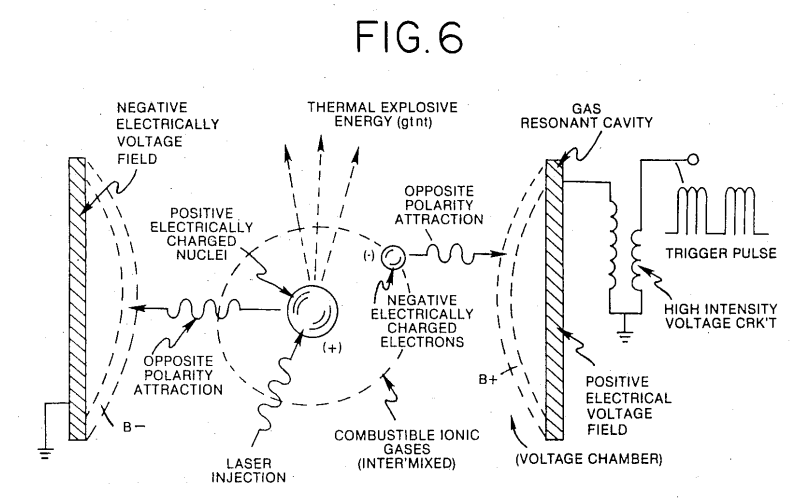
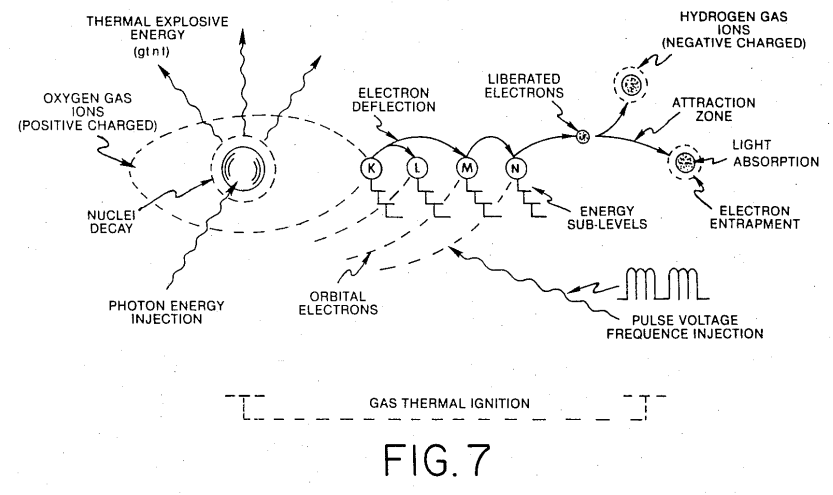
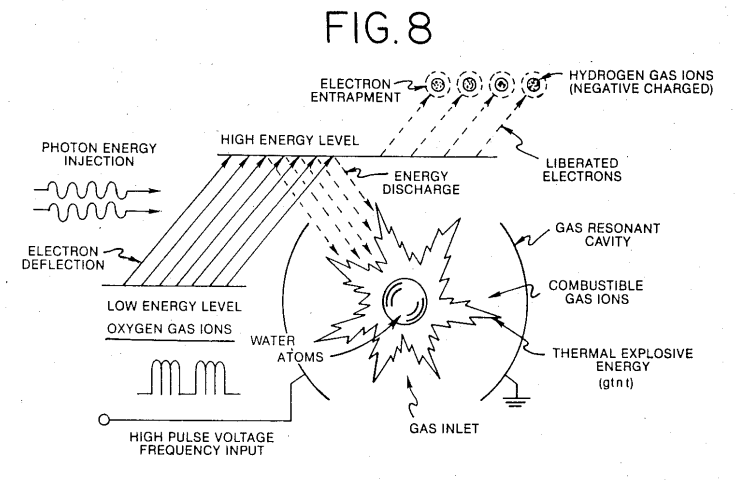
When the electron of the gas atom’s system yields its basic bond, the molecule collapses or destabilizes into its atomic state, and highly energized, ionized particles result. The thermal disintegration of the hydrogen/oxygen gas atoms occurs in a number of electron jumps to disintegrate a hydrogen atom efficiently prior to obtaining thermal explosive energy in the combustion process. This is facilitated by a concentration of electrons that destabilizes the electron bonds of atoms. As a result, at least a portion of the hydrogen/oxygen gas is ionized. Once the electron bonds are destroyed, atomic energy is released.
Step Process
An electrode is used in this process to introduce sufficient energy to the ionized gas, causing the gas to destabilize. In this case, a set frequency of electrical pulses or waves is used to further the process by which resonance energy in excess of atomic thresholds is built up.
The charged particle’s electrons are aligned such that the destabilized atom can be easily shifted. This results in further disintegration of the hydrogen/oxygen atom, disintegrating the proton-electron linkage of the hydrogen/oxygen gas atom. After this, resonance continues in the resonant cavity where resonance increases as the temperature increases, until thermal energy is released.
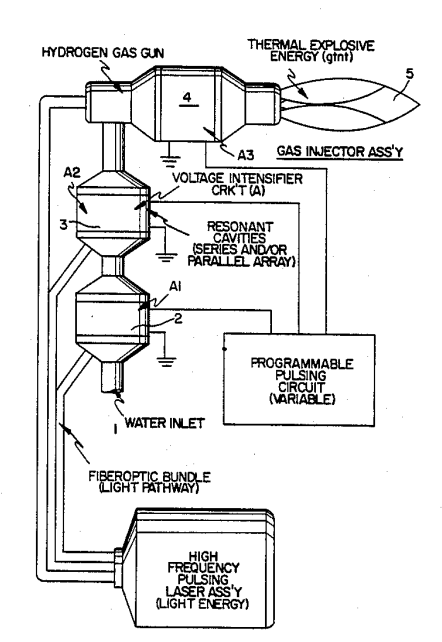
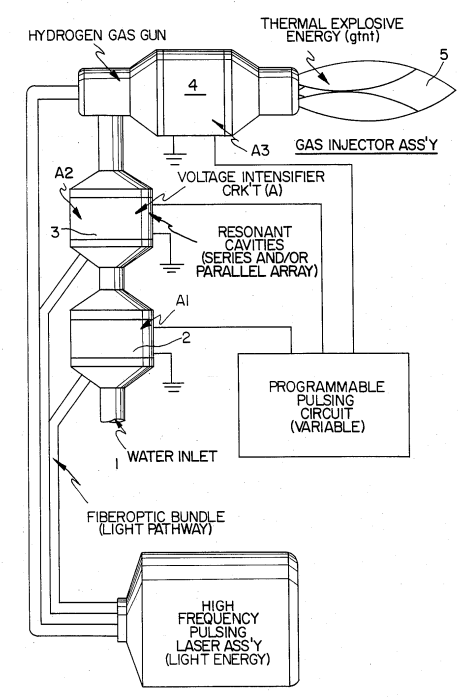
It has been shown in FIG. 1 that when introduced at inlet 1 into a resonant cavity, water fracturing mode is 3 steps, wherein the molecular atom breaks down into hydrogen/oxygen atoms and releases energy. On completion, an electrical and associated process is prepared to achieve resonance. In my co-pending application Ser. No. 835,564, filed March 3, 1986, which incorporates this description, energy release is intensified and energy gas output reaches explosive proportions.
A gas generator is introduced to a successive stage where energy is enhanced and output. The gases are further energized, subjected to additional and successive resonance frequencies, achieving combustion in a secondary process, expelling gas that passes through an outlet, creating a strong electrical spark that ignites the energized gases.
Electrodes
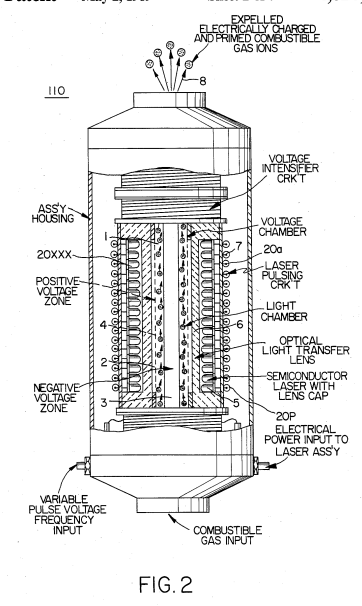
In FIG. 2C, gas electrodes provide continual electrical and energy buildup, whereby thermal explosive energy is achieved.
Page 4
conductive plates of opposite electrical polarity. A preferred construction material for the plates is stainless steel T-304, which is noncorrosive, reactive with water, hydrogen, or oxygen. In an electrical wave function, the gas mixture receives the electrical charge field.
The resonant cavity or resonant accelerator is the processing area, through which fed the gas stream of charged particles and emits an electrical output at the spark terminals. This process is operated with each stroke or combustion and thermal explosive gases ignite beyond the critical load level. The gas is exploded and additional waves are added in succeeding stages.
The gas output continually discharges via this reaction field. Any further resonance cavity will trigger spark ignition. The ignition process is continuously repeated at high energy levels, releasing increased explosive energy with subsequent gas streams being energized through increased resonance.
Once triggered, the thermal explosive energy output from this resonant cavity will result in an explosion of hydrogen/oxygen gas, forcing the voltage to rise at extremely high frequency. The electrodes accelerate the gas mixture until voltages are maximized.
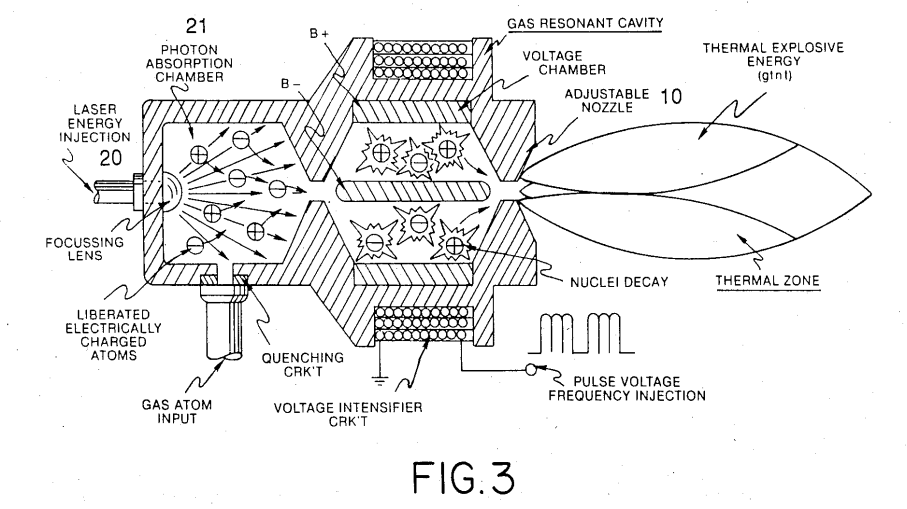
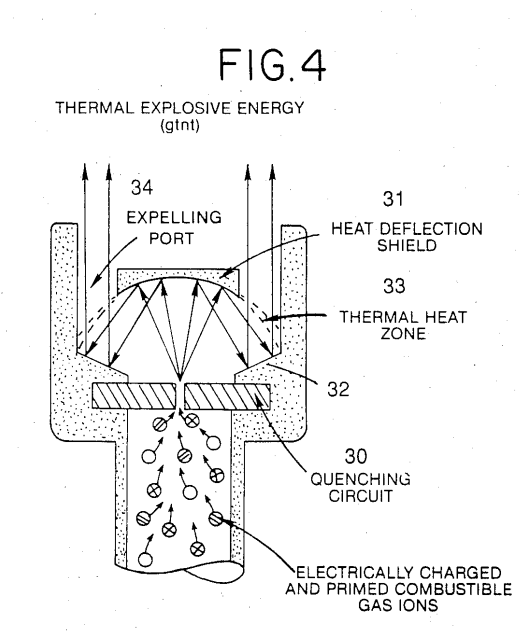
As shown in FIG. 4, gas waves are repeatedly subjected to the resonant cavity (shown as a coil) while providing thermal explosive energy, where one pulse ignites the gases and changes the gas to successively higher energy levels. Once a thermal explosion occurs, subsequent gas molecules repeat the cycle, outputting hydrogen/oxygen gas at a tremendously high frequency until the system reaches maximum energy.
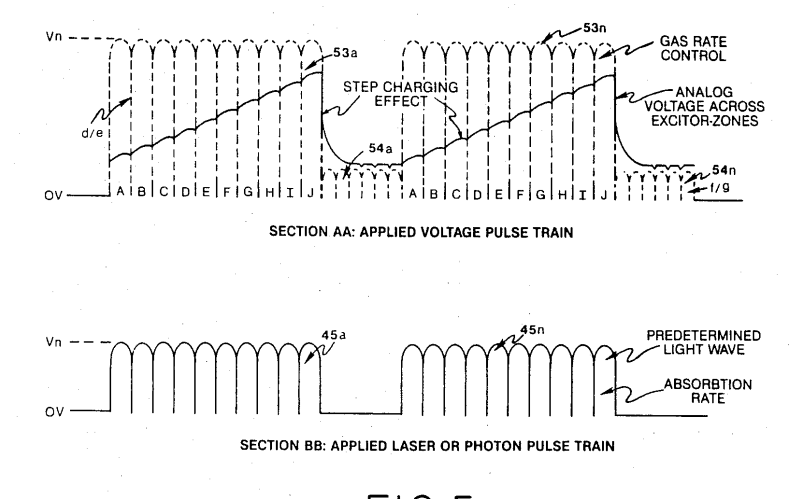
By triggering the input/output pulses, further resonance is built up. Resonant cavity/energy level is increased at each stage. This results in the gases being subjected to output/input spark electrodes until the next pulse is triggered, causing subsequent higher energy states.
|
|
|
|
|
|
|
|
|
|
|
|
|
|
|
|
|
|
|
|