
Electrical Pulse Generator #4,613,779
PDF Download: Meyer #4,613,779 Electrical Pulse Generator.pdf
ABSTRACT:
An electrical pulse generator comprising a series of electromagnets spatially positioned about the outer circumference of a disc-like base and a second series of complimentary electromagnets positioned about an inner position on said disc. One of each of said first and second series electromagnets positioned relative to each other creating a magnetic field therebetween. A second disc-like base rotatable above and parallel with said first disc. A continuous coil winding ring mounted on the underside of said second disc and positioned relative to said first and second series of electromagnets to traverse said magnetic field upon rotation of said second disc and thereby inducing a voltage/current potential in said coil winding.
BACKGROUND:
Power supplies for electrical systems have been utilized for a century or so. As time progressed new uses of electrical systems placed a need for more sophisticated systems. One particular utilization is the need for power transfer to the utilization device but yet with the requirement that there be power isolation. The advancement of electronics and power devices such as SCRs, Triacs and the such, appeared to be an obvious solution to such a power transfer. Current limiting circuits also were developed. Unfortunately, the solution was not met. The electronic devices in most instances could not limit or tolerate high power. Finally, it became apparent that the electrical systems, with this type of current limiting requirement necessitated electrical power supplies—not electronic. A very ineffective device is the auto alternator that will provide an increased power output with limited current. However this device, too, with it's sufferings, such as opposing magnetic fields, rubbing contacts and the such, made this device very inefficient.
SUMMARY OF INVENTION:
The electrical generator of the present invention is a substantial improvement of the state of the art in power isolation and power transfer and particularly the conventional alternator. A practical working embodiment has no contacts and no opposing magnetic fields. Also of equal significance is that the voltage output is variably dependent on several controllable features. The structure comprises a series of electromagnets positioned on the outer periphery of a stationary disc. A second series of electromagnets are positioned about the inner circumference of the stationary disc. One of each of said first and second series of electromagnets are positioned relative to one another to create a magnetic field therebetween when energized. A second disc has positioned on its underside a winding coil having a non-magnetic ring with a continuous winding thereon, extending downwardly between said first and second series of electromagnets.
The winding is positioned between the first and second series of electromagnets in the magnetic field created thereby. Upon rotation of the second disc the continuous winding on the ring traverses the magnetic fields and in turn the magnetic fields induce a voltage in the windings on the ring. In a preferred embodiment, a third and fourth series of electromagnets are positioned on the upper side of the rotatable disc much in the same manner as the first and second series of electromagnets positioned on said first stationary disc. The voltage/current induced in said first ring winding is utilized to energize said third and fourth electromagnets to create a second magnetic field therebetween. The second non-magnetic ring traverses the second magnetic field, causing an electrical potential for utilization. The apparatus does not have contact rings or brushes, nor are there opposing magnetic forces. Simi- lar arrangements are cascaded for voltage multiplication. Multiple windings on each ring provide independent outputs for multiple utilization devices.
OBJECTS:
It is a principal object of the present invention to provide an electrical arrangement that is power isolated but yet, permits increased power transfer to a utilization device. Another object of the present invention is to provide such an electrical system that is free of opposing magnetic fields, contacts, slip rings, moving wires, and the like. Another object of the present invention is to provide such an electrical system that has an output potential that may be varied in magnitude. Another object of the present invention is to provide a structure that is not affected in size and that may be duplicated in cascade for high power outputs. Still another object of the present invention is to provide a winding ring having induced therein multiple discrete voltages. Other objects and features will become apparent from a detailed description of the invention when taken in conjunction with the drawings in which:
BRIEF DESCRIPTION OF DRAWINGS:
FIG. 1 is a top view illustrating a first and second series of electromagnets positioned on a first and second metallic base plate in a physical relationship to create a magnetic field therebetween.
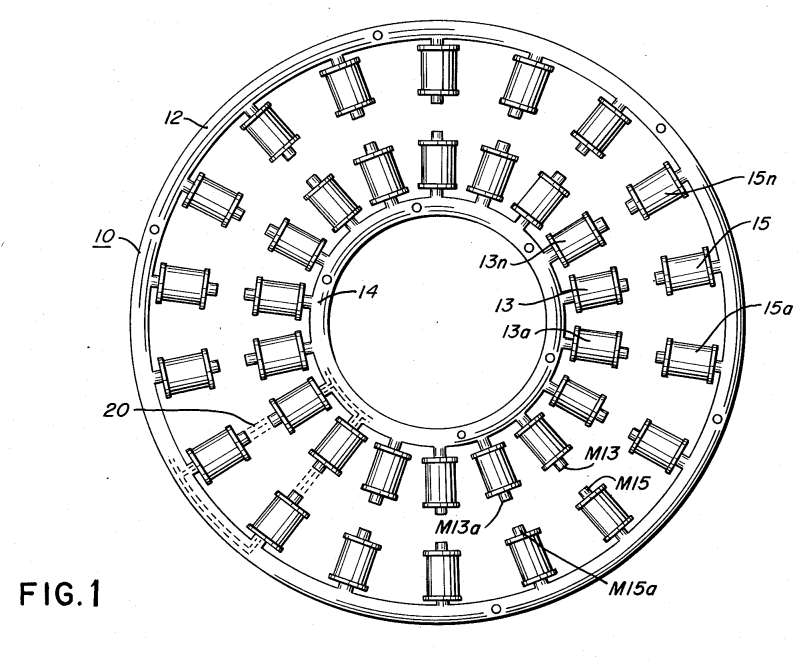
FIG. 2 is a schematic illustration of a non-magnetic 30 ring having a secondary winding wound thereon and FIG. 2A illustrates multiple windings with discrete voltage terminals wound on the ring.
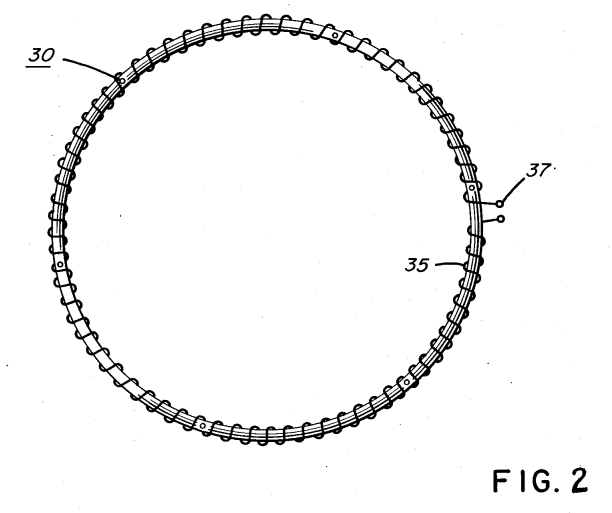
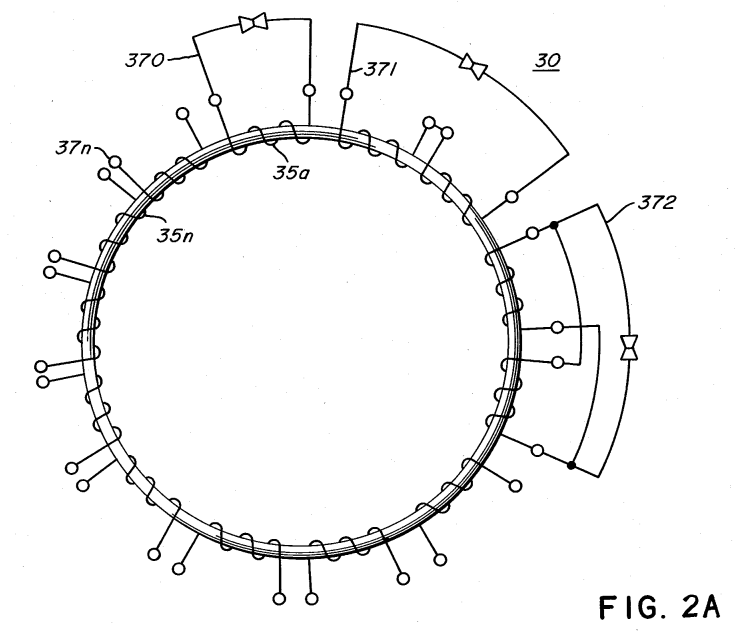
FIG. 3 is a cross-sectional view of a complete preferred embodiment.
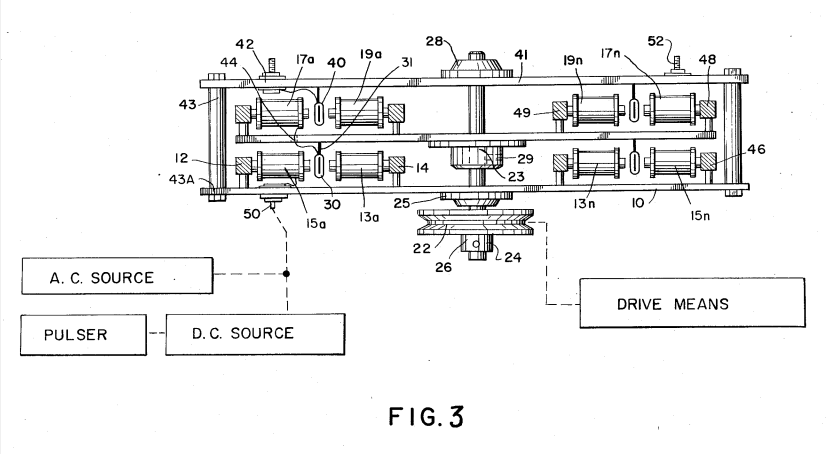
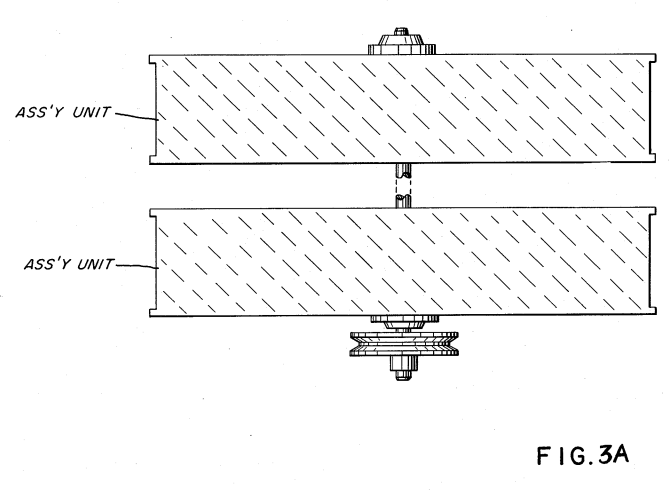
FIG. 3A is a partial illustration of the systems of claim 3 that have been cascaded.
DETAILED DESCRIPTION OF DRAWINGS:
With particular reference now to the drawings and the figures therein, the basic assembly comprising the electrical generator of the present invention includes a stationary disc 10, a first series of electromagnets 15 positioned about the outer periphery 12 of the disc 10, and a second series of electromagnets 13 positioned about the inner periphery 14 of the disc 10. The electromagnets 13a xxx 13n and 15a xxx 15n are positioned end-wise in a face-to-face relationship. The magnetic fields of the electromagnets of the complimentary pairs of electromagnets is created in that each successive magnet 13a xxx 13n in the first series are of opposite polarity, and similarly each magnet 15a xxx 15n in the second series is also of opposite polarity. Again, each of the electromagnets of the first series 13a xxx 13n in the complimentary pairs of electromagnets and of the second series of electromagnets 15a xxx 15n, are of opposite polarity. Upon energization of the first and second series of electromagnets, as set forth below, there is created a magnetic field between each complimentary pair of electromagnets in the first series 13a xxx 13n and 15a xxx 15n, as depicted by field 20. The outer ring 12 coupling the series of electromagnets 15a xxx 15n and the inner ring 14 coupling the series of electromagnets 13a xxx 13n are each of magnetic material. The magnetic field 20 extends through each magnetic; that is, the magnetic rings 12 and 14 magnetically couple the magnetic fields thereby enhancing the magnetic field between each pair of complimentary magnets.
In this way if there are discrepancies in the structures, orientation etc., the inductive coupling rings 12 and 14 of the electromagnets 13 and 15 will integrate and average the magnetic fields. Each magnetic field between the first and second series of electro- magnets are now exactly identical. The significance of having identical fields resides in the induced output voltage, a pulse of identical magnitude. With particular reference to FIG. 2 there is illustrated the winding ring 30 comprising a non-magnetic loop 32 having a conductive wire 35 wound thereon. The number of windings 35 on ring 30 is determined by the desired output at the ring-winding output—within practical limitations. It can be appreciated, the greater the number of turns the greater the induced output voltage at terminals 37. With reference to FIG. 2A there is illustrated the winding ring 30 with more than one winding 35a xxx n thereon. The purpose of windings 35a xxx n as set forth below, is to provide isolated voltage sources for a like number of utilization devices. The loop may be brass for rigidity and reliability. The windings 35 may be copper or other highly conductive metallic wire. In FIG. 3 there is illustrated in a cross-sectional side view, a complete operable preferred embodiment of the present invention. The electromagnets 13a xxx 13n and 15a xxx 15n comprise the outer periphery series of electromagnets and inner circle of electromagnets of FIG. 1.
The electromagnets 15a xxx 15n (only two electromagnets visible), are supported by angle brackets 46a xxx 46n. One end of the bracket 46 supports the electromagnet and the other end is secured to the stationary disc 10. Also secured to disc 10 is a voltage terminal 50 for applying an electrical voltage current potential to each of the electromagnets 13a xxx 13n and 15a xxx 15n. Shown in cross-section in FIG. 3 is the winding ring 30 positioned in the gap between electromagnets 13a xxx n and 15a xxx n. The winding ring 30 is supported by support 31 to the underside of rotating disc 44. Disregarding only for the moment the upper portion of FIG. 3, the fundamental operation of the invention may be described. The electromagnets are positioned end-wise with the inner ring of electromagnets 13a xxx 13n facing the outer ring of electromagnets 15a xxx n. The one magnet will have an end north pole whereas the opposite magnet will be an end south pole. Also, the adjacent magnets will be of opposite polarity.
Upon energizing the electromagnets, via terminal 50, in the gap between electromagnets 13a xxx n and 15a xxx n there will be a magnetic field 20. Considering now that disc 44 is rotating there will be a relative motion between the first and second series of magnets with the winding ring 30 and in consequence the winding ring 30 is traversing the series of magnetic fields 20a xxx n. As the winding ring 30 passes through each of the magnetic fields there will be induced a voltage/current in each of the windings 35a xxx n thereon. The voltage/current potential induced in the windings 35a xxx n will have a magnitude depending on certain parameters and configurations. As aforesaid the greater the number of turns of the winding ring 35, the greater the magnitude of the induced voltage therein. The strength of the magnetic fields 20a xxx 20n will also be proportionably reflected in the output voltage at terminals 37a xxx n. One factor of that the strength of the magnetic field is directly dependent on is the magni