
Pre-History To Development
During the middle to late 1970's, the industrialized nations of the world came to the bleak realization they no longer controlled their own capacity to produce goods and services. This alarming condition developed because the majority of the world's remaining energy reserves were no longer in their control.
IN SEARCH OF OIL:
The Western World had enjoyed several centuries of unchecked industrialization, and showed no signs of slowing in the early 1970's. At the beginning of this industrialization period, wood was the primary source of energy. When wood became scarce and inefficient, coal became an abundant source of energy to further spur economic expansion. Coal, however, gave way to an even more efficient, cleaner, and seemingly more abundant fuel source -- oil.
Countries such as the United States were still expanding their industrial bases at such a rate that energy reserves equivalent to an Alaskan oil field needed to be discovered every 90 days so the existing fossil fuel demand could be met. However, during the middle to late 1960's, the United States also discovered that the oil pressure in its productive fields began falling dramatically. Oil fields that once supplied vast amounts of energy to the greatest industrialized countries of the world were simply beginning to produce less and less, at a time when energy needs were growing daily.
In 1965, the United States imported about five percent of its oil. By 1975, the U.S. was importing more than 40 percent of the oil it needed to maintain its industrial base. This was necessary because oil pressure in productive fields was dwindling, and it was not economically feasible to attempt secondary recovery processes to revitalize these fields.
The U.S. and other industrialized countries, such as japan, Great Britain and West Germany, could no longer count on their own energy production to keep their economies healthy, but without energy, their economies would fail—continued industrial growth would be simply impossible. Although the industrialized Western countries imported oil from Middle East nations to keep their economies afloat, they were looking forward to the day they could become energy independent through the use of the next energy source--nuclear fission.
THE FALSE HOPE OF NUCLEAR ENERGY:
Just as coal replaced wood and oil replaced coal as the primary fossil fuel, the industrialized countries were looking for the replacement of oil by nuclear energy. Although there were technical problems with the use of nuclear power plants, their use became popular. There was hope that the problems with nuclear plants would be solved as they were used. For a time, the future of nuclear power plants looked promising, but then it became clear that nuclear engineers could not solve the major problem of "the hourglass effect." Basically, the nuclear energy production process inherently caused the power plants themselves to deteriorate. The constant handling of uranium, contaminated water, steam and air quickly alters the physical properties of welds in pipes, valves and other structures within the nuclear power plants. Power plants that cost billions of dollars to build had working lives of a little more than two decades. Many of the first nuclear plants built are now being taken off line because they have absorbed as much contamination as possible without suddenly falling apart during use--causing a disastrous accident.
CHINA DESIRES:
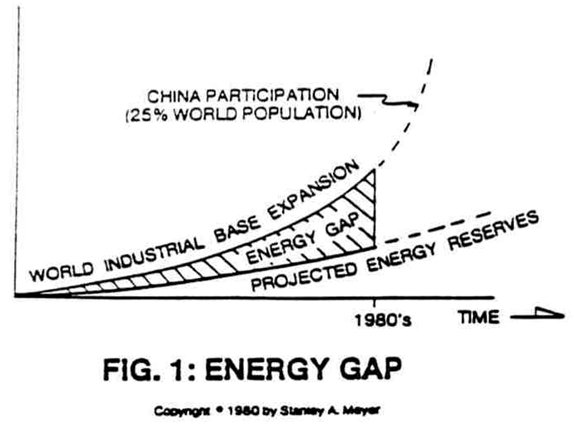
Interestingly, at the time the West began importing oil and discovering nuclear plants were not the savior they had anticipated, China began opening its doors to Western technology. What the West had accomplished in several hundred years would take China only a matter of decades to duplicate. China, with a-quarter of the world's population, was eager to obtain the same goods and services available to the rest of the industrialized nations. To do this, it was obvious they had to compete for the same oil that was already in great demand by the West; thereby perpetuating the world-wide energy gap, as shown in Figure 1.
FIGURE 1:
OPEC CONSPIRACY:
Obviously, countries such as the United States did not enjoy relying upon the Organization of Petroleum Exporting Countries (OPEC) for energy. Figuratively and realistically, the Middle East oil-producing countries had the Western economies over a barrel. A sudden reduction of oil flow from OPEC to the West would create havoc with the world's industrial base. What industrial leaders feared most became a reality in the oil crisis of 1975.
The nations of OPEC realized their desert oil fields were crucial to the industrial well-being of the rest of the world. Knowing they controlled a popular commodity, and adhering to economic laws of supply and demand, the OPEC -nations reduced the amount of oil they were exporting and increased its price. Because the supply of oil was reduced, competition increased for the oil available on the market. This further caused the cost of OPEC oil to spiral upward.
The industrialized countries were paying inflated prices for oil to keep their economies stable, if not in expansion. But the OPEC oil became so costly, the goods and services produced through use of the oil also became costly—to the point that product consumption decreased, industry production decreased, people became unemployed, and economies began to falter.
THE SCRAMBLE TO DEVELOP ALTERNATIVE FUEL SOURCES:
When economic hardship became a reality due to the oil crisis, Western government began to scramble to develop alternate fuel sources to supplement dwindling oil reserves and an unrealistic nuclear energy promise. The administrations of Presidents Gerald Ford and Jimmy Carter declared energy independence as one of their paramount goals. Work was intensified to find a viable energy source through exotic solar, wind and chemical devices.