

article
Water-power car is a new attraction
14 August 1985
Water-power car is a new attraction
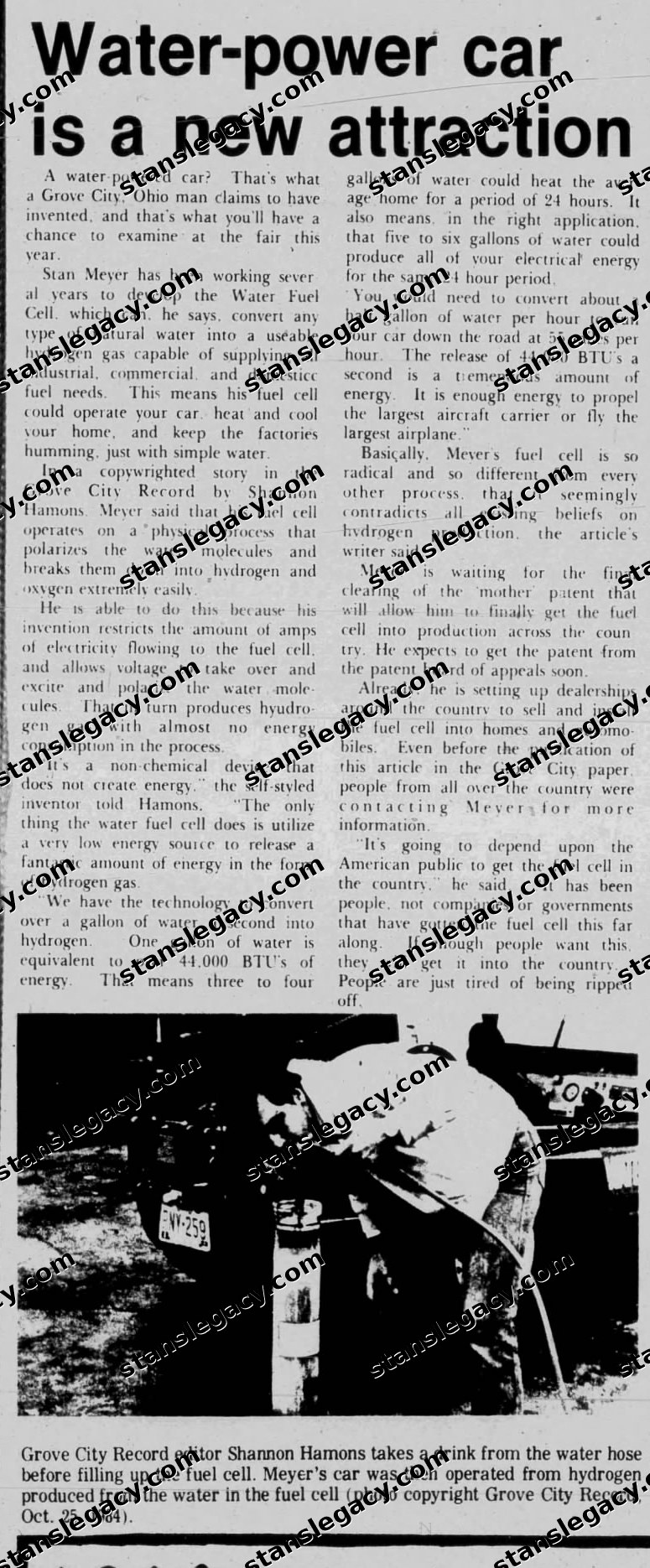
A water-powered car? That’s what a Grove City, Ohio man claims to have invented, and that’s what you’ll have a chance to examine at the fair this year.
Stan Meyer has been working several years to develop the Water Fuel Cell, which can, he says, convert any type of natural water into a useable hydrogen gas capable of supplying all industrial, commercial, and domesticc fuel needs. This means his fuel cell could operate your car, heat and cool your home, and keep the factories humming, just with simple water.
In a copywrighted story in the Grove City Record by Shannon Hamons, Meyer said that his fuel cell operates on a “physical process that polarizes the water molecules and breaks them down into hydrogen and oxygen extremely easily.”
He is able to do this because his invention restricts the amount of amps of electricity flowing to the fuel cell, and allows voltage to take over and excite and polarize the water molecules. That in turn produces hyudrogen gas with almost no energy consumption in the process.
“It’s a non-chemical device that does not create energy,” the self-styled inventor told Hamons. “The only thing the water fuel cell does is utilize a very low energy source to release a fantastic amount of energy in the form of hydrogen gas.
“We have the technology to convert over a gallon of water a second into hydrogen. One gallon of water is equivalent to over 44,000 BTU’s of energy. That means three to four gallons of water could heat the average home for a period of 24 hours. It also means, in the right application, that five to six gallons of water could produce all of your electrical energy for the same 24 hour period.
“You would need to convert about a half gallon of water per hour to run your car down the road at 55 miles per hour. The release of 44,000 BTU’s a second is a tremendous amount of energy. It is enough energy to propel the largest aircraft carrier or fly the largest airplane.”
Basically, Meyer’s fuel cell is so radical and so different from every other process, that it seemingly contradicts all existing beliefs on hydrogen production, the article’s writer said.
Meyer is waiting for the final clearing of the “mother” patent that will allow him to finally get the fuel cell into production across the country. He expects to get the patent from the patent board of appeals soon.
Already, he is setting up dealerships around the country to sell and install the fuel cell into homes and automobiles. Even before the publication of this article in the Grove City paper, people from all over the country were contacting Meyer for more information.
“It’s going to depend upon the American public to get the fuel cell in the country,” he said. “It has been people, not companies or governments that have gotten the fuel cell this far along. If enough people want this, they will get it into the country. People are just tired of being ripped off.”
Grove City Record editor Shannon Hamons takes a drink from the water hose before filling up the fuel cell. Meyer’s car was then operated from hydrogen produced from the water in the fuel cell (photo copyright Grove City Record, Oct. 25, 1984).
Where it comes from
Almost all of this is the Grove City Record’s copyrighted story of 25 October 1984, “Local man solves energy problem!”, retold for a Darke County audience ten months later, with the Record’s photographs and its credit. The new things are the first sentence, that the car is something “you’ll have a chance to examine at the fair this year”, and the paragraphs on the “mother” patent and the dealerships.
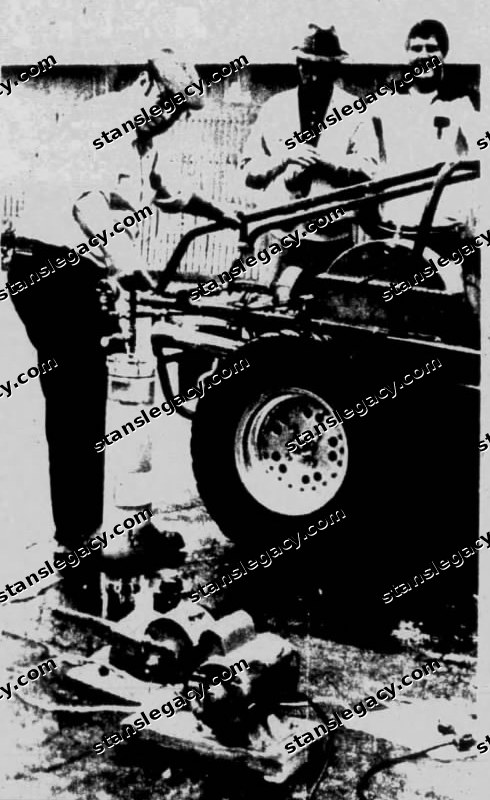
The photograph beside the article, printed without a caption, shows the dune buggy with the fuel cell standing beside its rear wheel and three men behind it. The Record’s story of October 1984 has a photograph of Charlie Holbrook, Stan Graumlich and Stan Meyer operating the car on hydrogen; the archive has not matched the two.
What happened at the fair
The car did not appear. Three days later, on the fair’s second day, the Advocate reported that it had been taken out of the junior fair parade because it would not “clear the U.S. patent board in time”, and that a display would show the theory “as in years past”: Water-power car silenced. The first road test came on 11 October 1985, in Grove City: the Grove City Record.
As printed
The printer’s slips are kept above: “domesticc”, “hyudrogen”, and “copywrighted”. Where the Record had a gallon of water equal to 44,000 BTUs, the Advocate prints “the release of 44,000 BTU’s a second”, which is the Advocate’s wording, not the Record’s. The patent the article calls the “mother” patent, then before the board of appeals, is not named; the archive has not yet identified it.
The original
Provenance
- Shelf
- Press coverage
- Rights
- The newspaper page is copyright its publisher and is reproduced here as a record of what was printed at the time; the archive claims nothing in it. The citation is what a reader needs to find the original.
- Caption
- The Daily Advocate, Greenville, Ohio, Wednesday 14 August 1985, and its Midweek Extra of the same day, page 9A. The second image is the photograph printed beside the article, without a caption of its own.
- Citation
- The Daily Advocate, Greenville, Ohio, August 1985
- Publication
- The Daily Advocate, Greenville, Ohio
- Transcription
- A page image from the newspapers.com archive of The Daily Advocate, supplied by the archive’s editor.