

article
Healthy fuel for people and cars
John Wynhausen · 31 August 1991
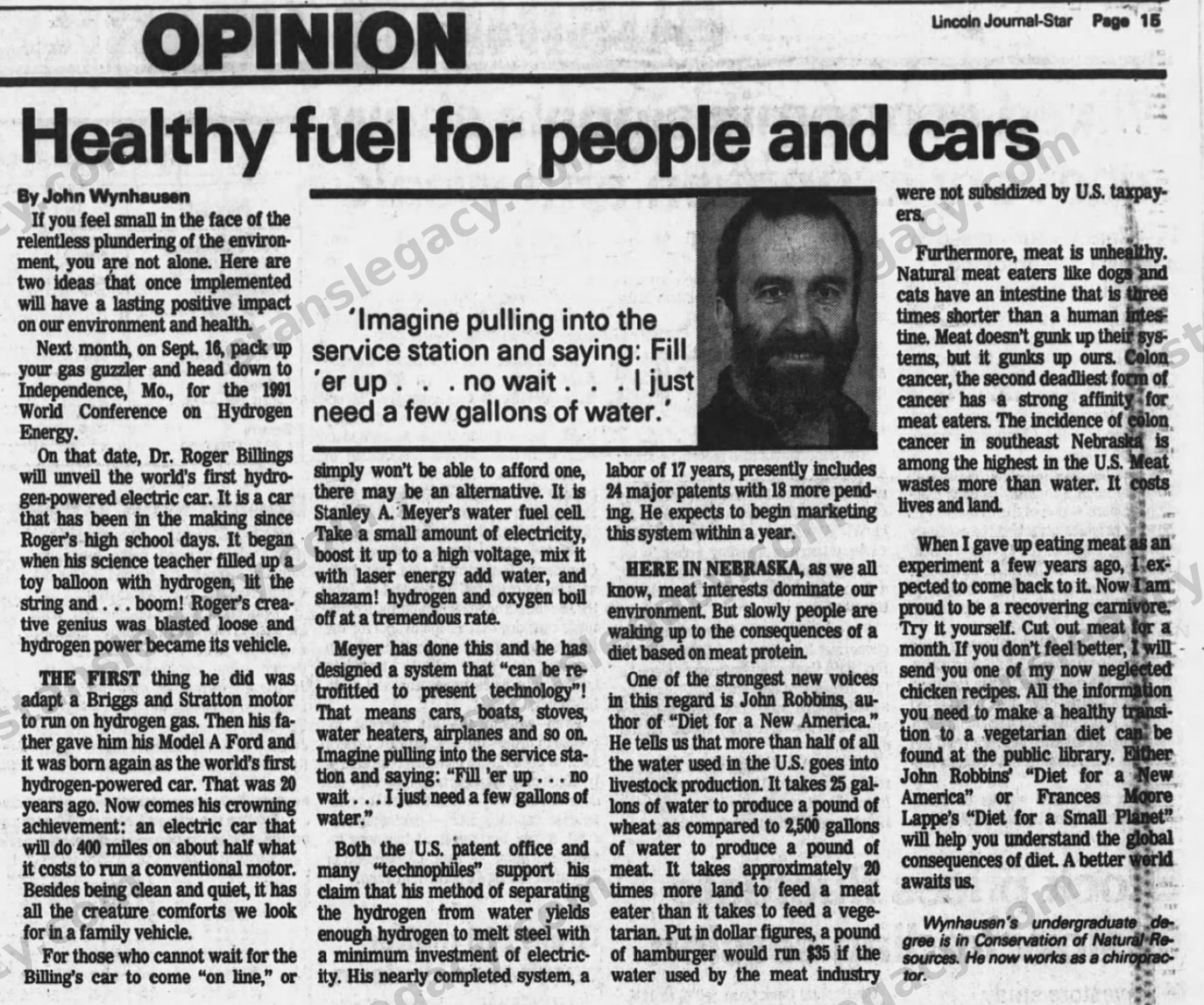
Healthy fuel for people and cars
If you feel small in the face of the relentless plundering of the environment, you are not alone. Here are two ideas that once implemented will have a lasting positive impact on our environment and health.
Next month, on Sept. 16, pack up your gas guzzler and head down to Independence, Mo., for the 1991 World Conference on Hydrogen Energy.
On that date, Dr. Roger Billings will unveil the world’s first hydrogen-powered electric car. It is a car that has been in the making since Roger’s high school days. It began when his science teacher filled up a toy balloon with hydrogen, lit the string and…boom! Roger’s creative genius was blasted loose and hydrogen power became its vehicle.
THE FIRST thing he did was adapt a Briggs and Stratton motor to run on hydrogen gas. Then his father gave him his Model A Ford and it was born again as the world’s first hydrogen-powered car. That was 20 years ago. Now comes his crowning achievement: an electric car that will do 400 miles on about half what it costs to run a conventional motor. Besides being clean and quiet, it has all the creature comforts we look for in a family vehicle.
For those who cannot wait for the Billing’s car to come “on line,” or simply won’t be able to afford one, there may be an alternative. It is Stanley A. Meyer’s water fuel cell. Take a small amount of electricity, boost it up to a high voltage, mix it with laser energy add water, and shazam! hydrogen and oxygen boil off at a tremendous rate.
Meyer has done this and he has designed a system that “can be retrofitted to present technology”! That means cars, boats, stoves, water heaters, airplanes and so on. Imagine pulling into the service station and saying: “Fill ’er up…no wait…I just need a few gallons of water.”
Both the U.S. patent office and many “technophiles” support his claim that his method of separating the hydrogen from water yields enough hydrogen to melt steel with a minimum investment of electricity. His nearly completed system, a labor of 17 years, presently includes 24 major patents with 18 more pending. He expects to begin marketing this system within a year.
…
The rest of the column turns to diet: John Robbins’s Diet for a New America, the water and land cost of beef against wheat, the incidence of colon cancer in south-east Nebraska, and the writer’s own year without meat. It does not return to Meyer. The column’s footer says: “Wynhausen’s undergraduate degree is in Conservation of Natural Resources. He now works as a chiropractor.”
The patent count, in August 1991
“Twenty-four major patents with 18 more pending”, and “a labor of 17 years”. Seventeen years back from 1991 is 1974 — which is the solar silo, not the water fuel cell, and is a different starting point from the twenty years he gave the Bradford church in 1982. Both are his own round numbers, given to writers who were not going to check them, and the archive prints them side by side rather than choosing.
What is checkable is the patent count, against the registrations the archive holds, and against the “30 patents applied for” the Associated Press reported in 1984 and the “26 U.S. and international patents” he claimed in his last paper in 1997.
The conference at Independence, Missouri, on 16 September 1991 is Billings’s, not Meyer’s. Nothing here says Meyer went.
The original
Provenance
- Shelf
- Press coverage
- Page
- 15
- Byline
- John Wynhausen
- Rights
- The newspaper page is copyright its publisher and is reproduced here as a record of what was printed at the time; the archive claims nothing in it. The watermark marks the archive’s copy, not its ownership. The citation is what a reader needs to find the original.
- Caption
- Lincoln Journal-Star, Lincoln, Nebraska, Saturday 31 August 1991, page 15, on the Opinion page.
- Citation
- Lincoln Journal-Star, Lincoln, Nebraska, August 1991, pp. 15, by John Wynhausen
- Publication
- Lincoln Journal-Star, Lincoln, Nebraska
- Transcription
- A clipping from the printed page, photographed and supplied by the archive’s editor. Only the part of the column that concerns Meyer and hydrogen is transcribed; the second half, on vegetarian diet, is summarised.