

article
The strange case of the early electric cars
The Ardross-Man column · 15 May 2024
The strange case of the early electric cars
The Ardross-Man
ELECTRIC cars seem to be growing in popularity these days, but did you know that they were around even before petrol and diesel driven cars?
The first step towards this new fuel source were made by Robert Davidson of Aberdeen in 1839 when he invented the Davidson electric carriage.
It was basically an electric train which was powered by a motor of Davidson’s own design and had non-rechargeable batteries. This paved the way for inventors to think smaller.
By 1884, Thomas Parker, an English inventor in Wolverhampton who went on to electrify the London Underground, built a smaller version of Davidson’s electric train. His was a modified horse-drawn carriage, an electric MPV as it were, but it never really gained popularity.
At around the same time, Scottish firm Maldevic made five-wheeled horseless carriages run by electricity but still not the size of a modern car.
Things moved on as, in 1888, German engineer Andreas Flocken constructed ‘The Flocken Elektrowagen’, a buggy-like design with a 0.7 kW motor which was quickly followed by ‘The Electrobat’, a vehicle patented in the USA in 1894 by Pedro Salom and Henry G. Morris that could travel 25 miles at 20 mph.
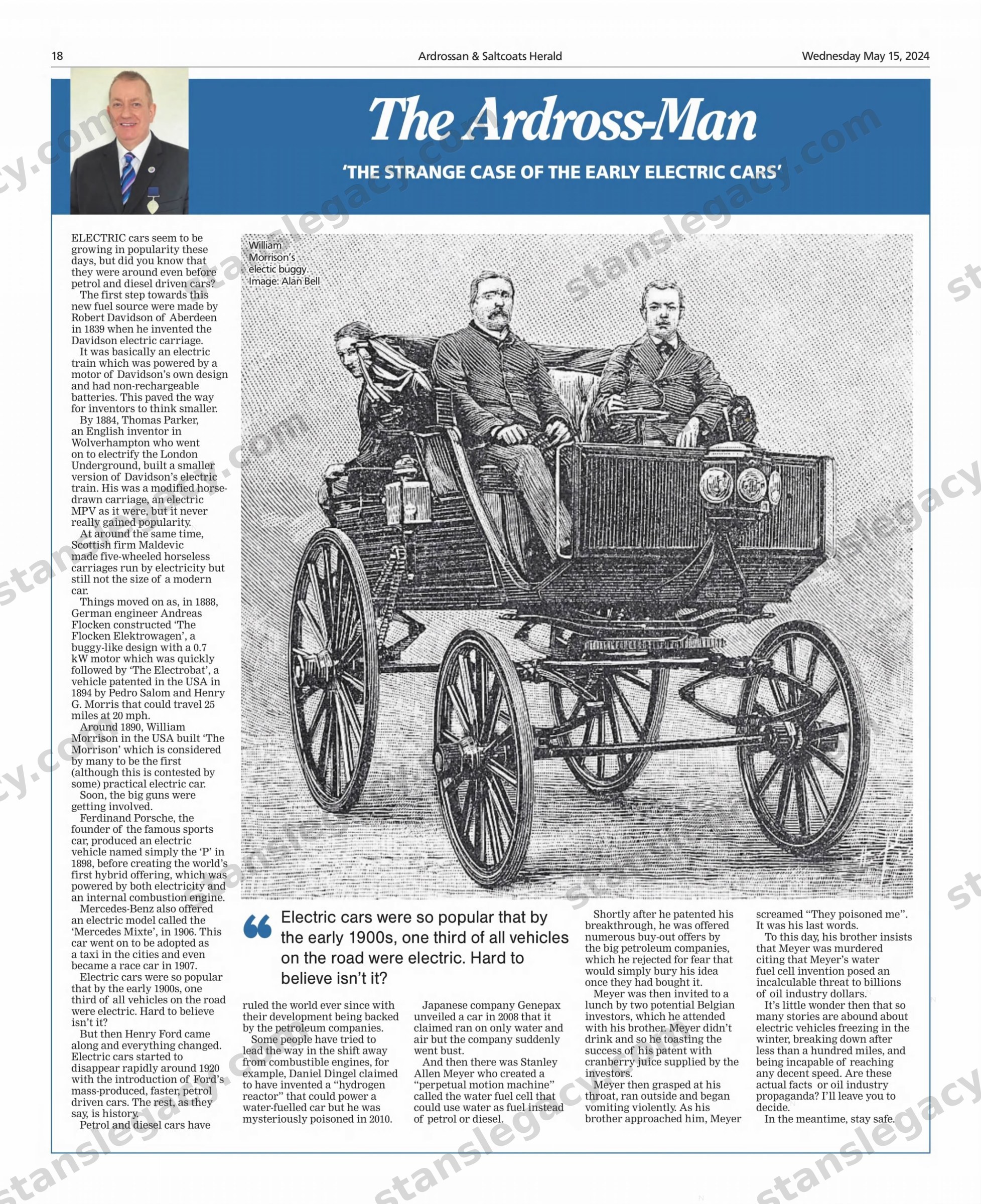
Around 1890, William Morrison in the USA built ‘The Morrison’ which is considered by many to be the first (although this is contested by some) practical electric car.
Soon, the big guns were getting involved.
Ferdinand Porsche, the founder of the famous sports car, produced an electric vehicle named simply the ‘P’ in 1898, before creating the world’s first hybrid offering, which was powered by both electricity and an internal combustion engine.
Mercedes-Benz also offered an electric model called the ‘Mercedes Mixte’, in 1906. This car went on to be adopted as a taxi in the cities and even became a race car in 1907.
Electric cars were so popular that by the early 1900s, one third of all vehicles on the road were electric. Hard to believe isn’t it?
But then Henry Ford came along and everything changed. Electric cars started to disappear rapidly around 1920 with the introduction of Ford’s mass-produced, faster, petrol driven cars. The rest, as they say, is history.
Petrol and diesel cars have ruled the world ever since with their development being backed by the petroleum companies.
Some people have tried to lead the way in the shift away from combustible engines, for example, Daniel Dingel claimed to have invented a “hydrogen reactor” that could power a water-fuelled car but he was mysteriously poisoned in 2010.
Japanese company Genepax unveiled a car in 2008 that it claimed ran on only water and air but the company suddenly went bust.
And then there was Stanley Allen Meyer who created a “perpetual motion machine” called the water fuel cell that could use water as fuel instead of petrol or diesel.
Shortly after he patented his breakthrough, he was offered numerous buy-out offers by the big petroleum companies, which he rejected for fear that would simply bury his idea once they had bought it.
Meyer was then invited to a lunch by two potential Belgian investors, which he attended with his brother. Meyer didn’t drink and so he toasting the success of his patent with cranberry juice supplied by the investors.
Meyer then grasped at his throat, ran outside and began vomiting violently. As his brother approached him, Meyer screamed “They poisoned me”. It was his last words.
To this day, his brother insists that Meyer was murdered citing that Meyer’s water fuel cell invention posed an incalculable threat to billions of oil industry dollars.
It’s little wonder then that so many stories are abound about electric vehicles freezing in the winter, breaking down after less than a hundred miles, and being incapable of reaching any decent speed. Are these actual facts or oil industry propaganda? I’ll leave you to decide.
In the meantime, stay safe.
About this column
Meyer is the last of three examples in a history of the electric car, and the account of his death follows the version that has circulated since the Express in 1998. Set against the record:
- "Perpetual motion machine" is the column's phrase, not Meyer's. He never described the cell that way; his claim, in his patents and memos, was that voltage rather than current splits the molecule.
- The evening was a dinner, not a lunch, at the Cracker Barrel on Stringtown Road, Grove City, on Friday 20 March 1998; he died the next day. "They poisoned me" comes from his brother Stephen's telling. The Franklin County coroner found a ruptured cerebral aneurysm. The archive's account of the evening, and of who said what, is at The day Stan died.
- "Shortly after he patented his breakthrough" compresses eight years: the water fuel cell patents were granted from 1989 to 1992.
The original
Provenance
- Shelf
- Press coverage
- Page
- 18
- Byline
- The Ardross-Man column
- Rights
- The newspaper page is copyright its publisher and is reproduced here as a record of what was printed at the time; the archive claims nothing in it. The watermark marks the archive’s copy, not its ownership. The citation is what a reader needs to find the original.
- Caption
- Ardrossan & Saltcoats Herald, Wednesday 15 May 2024, page 18. The illustration is William Morrison's electric buggy; image credited on the page to Alan Bell.
- Citation
- Ardrossan & Saltcoats Herald, Ardrossan, Scotland, May 2024, pp. 18, by The Ardross-Man column
- Publication
- Ardrossan & Saltcoats Herald, Ardrossan, Scotland
- Transcription
- A clipping from the printed page, supplied by the archive’s editor.