

patent · US3620206A
Fluid heating by radiation
16 November 1971
Text
Page 1bibliographic recordscan →
United States Patent inventors William B. Harris, Jr.
Huntsville;
William B. Harris, Bryan; Richard R.
Davison, Bryan, all of Tex.
Assignee The United States of America as represented by the Secretary of the interior
FLUID HEATENG BY RADATION
11 Claims, 3 Drawing Figs.
U.S.C........................................................ 126/271 int. Cl................. F24j.3/02
UNITED STATES PATENTS
3,146,774 9/1964 Yellott ....... ............. 26/271
3,215. 34 l l 1965 Thomason. 26/271
FOREIGN PATENTS
Primary Examiner-Charles J. Myhre
Attorneys-Ernest S. Cohen and Roland H. Shubert
ABSTRACT: Radiant energy is used to heat a liquid by passing the liquid between two level, flat, heat exchange sur faces, the top surface resting freely on the lower surface and being exposed to the radiant energy. Liquid flows between the surfaces and is maintained in a thin, continuous and substan tially uniform film by operation of Bernoulli's Theorem. In a preferred embodiment, water is heated by solar radiation and the heat exchange surfaces float on a reservoir of the water being heated.
Drawings
Page 2drawing sheetscan →
Page 3drawing sheetscan →
Page 4scan →
FLUID HEATING BY RADIATION tightly on the basal member in that area thus diverting excess BACKGROUND OF THE INVENTION flow to areas of lower flow rate. While FIG. 1 shows liquid being introduced through a central portion of the basal
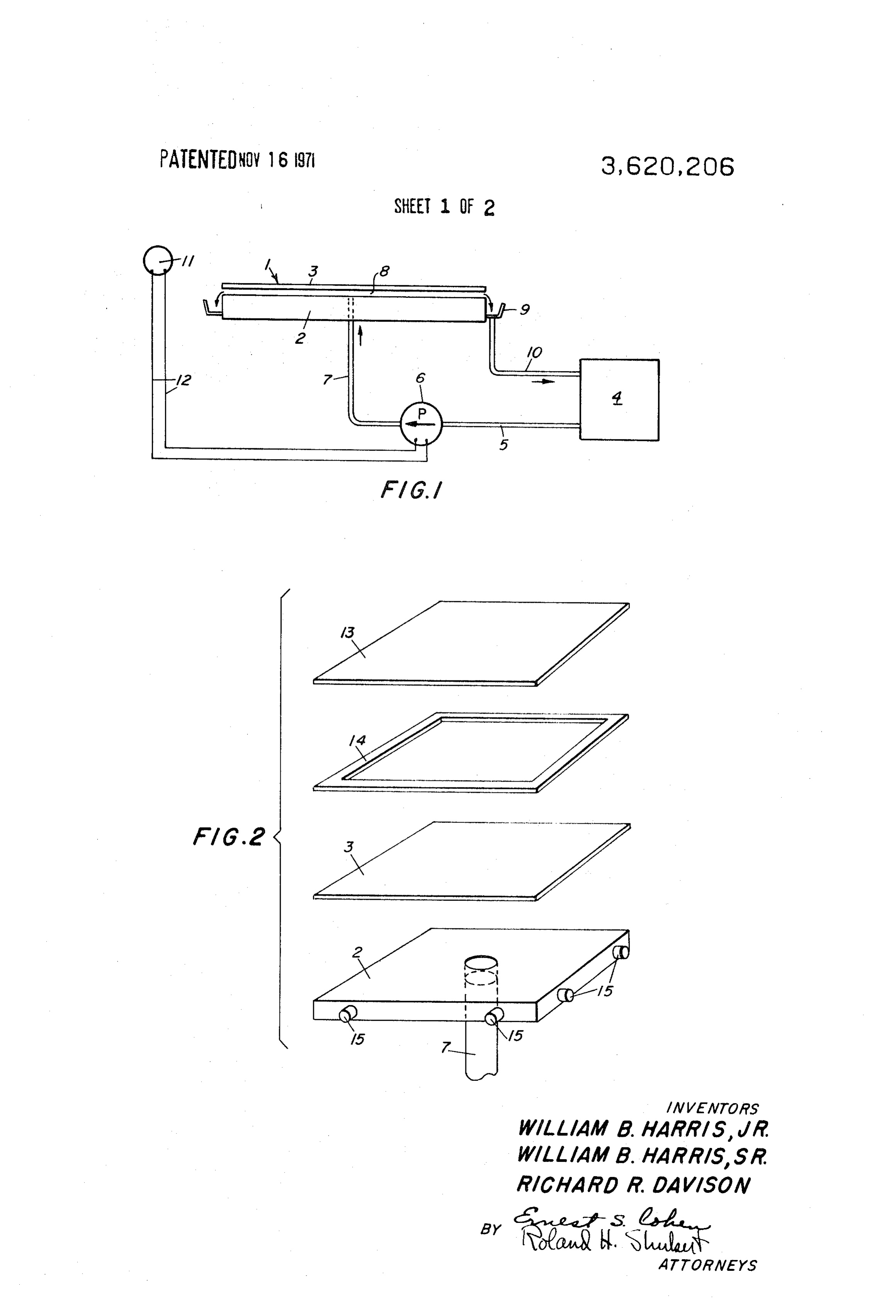
Solar energy has long been used as a source of heat for a member, this is not necessary to proper functioning of the variety of purposes. A number of different types of solar water device. It is also possible to introduce liquid at an edge, but heaters have been developed for domestic heating, heating this is a less effective and less preferred arrangement. swimming pools, for desalination processes and other In operation, cover plate 3 is exposed to an external heat processes which can utilize low-grade heatenergy. flux such as solar radiation. Liquid, such as water, is passed Previous designs of solar water heaters have suffered from a through the heat exchange device as previously described. number of defects. Many designs, such as those incorporating O The heated liquid may be used for any conventional and ap plastic film construction, lack durability. Many durable heater propriate purpose; may be in turn heat-exchanged with designs, such as some proposed and utilized for building heat another liquid orgas, or may be used as storage means for heat ing, have been too expensive for extensive use. Many of the energy.
previous heaters suffered from low efficiency, lacked When the source of external heat flux is variable, such as is quickness of response to changing solar conditions and dis 15 solar radiation, radiation-sensitive control device 11 may be played excessive nightheat loss. connected by means of control wires 12 to control the opera SUMMARY OF THE INVENTION tion of pump 6. Controlling liquid flow through the heat exchange device responsive to external heat flux changes per
It has now been found that a device for the extraction of mits almost instantaneous response to nonheat gain condi heat from radiant energy which utilizes the effect of Bernoul tions. This rapid response time coupled with the very small li's Theorem increases efficiency of the device and allows quantity of liquid exposed to heat exchange conditions results more sensitive and faster response to changing levels of in in large efficiency gains.
cident radiation. In its simplest form, a heat exchange liquid is Turning now to FIG. 2, there is shown an oblique, exploded passed between two relatively rigid, flat surfaces; the top sur 25 view of one preferred embodiment of this invention. In this face being exposed to incident radiation and resting freely on embodiment, basal member 2 is constructed of a material, the lower surface. The upper surface is substantially trans such as foam glass, having insulating properties and having a parent to radiation while the lower surface absorbs radiation. specific gravity less than that of the liquid being circulated. As required by Bernoulli's Theorem, liquid passing between Cover plate 3 comprises a relatively flat and transparent the two surfaces is in the form of a compressed, continuous 30 material resting directly on the basal member and conforming and relatively uniform film, in size and shape to that member. Plate 3 may be constructed In a preferred embodiment of the invention, water is heated of glass, plastic sheet or plastic film. Generally, a rigid material by solar radiation. The two surfaces making up the heat ex such as glass is preferred. A second transparent member 13 tracting portion of the device float on the surface of water forms in cooperation with spacer 14 an insulating, dead air storage or reservoir means while the flow of water between the 35 space. Member 13 may comprise a glass plate or may com surfaces tion.
is controlled responsive to the incident solar radia prise plastic film or similar materials. Liquid is delivered to a central point on the upper surface of basal member 2. Moving
Hence it is an object of this invention to provide a method liquid forms a thin, relatively uniform film between member 2 and means for extraction of heat from radiant energy. and plate 3 and overflows at the edge portions of these two it is a specific object of this invention to provide a solar 40 members. The upper surface of member 2 preferably is water heater having characteristics of high efficiency, low treated with a dark, heat absorbing coating as is well known in heat loss and sensitive response to incident radiation intensity. the art.
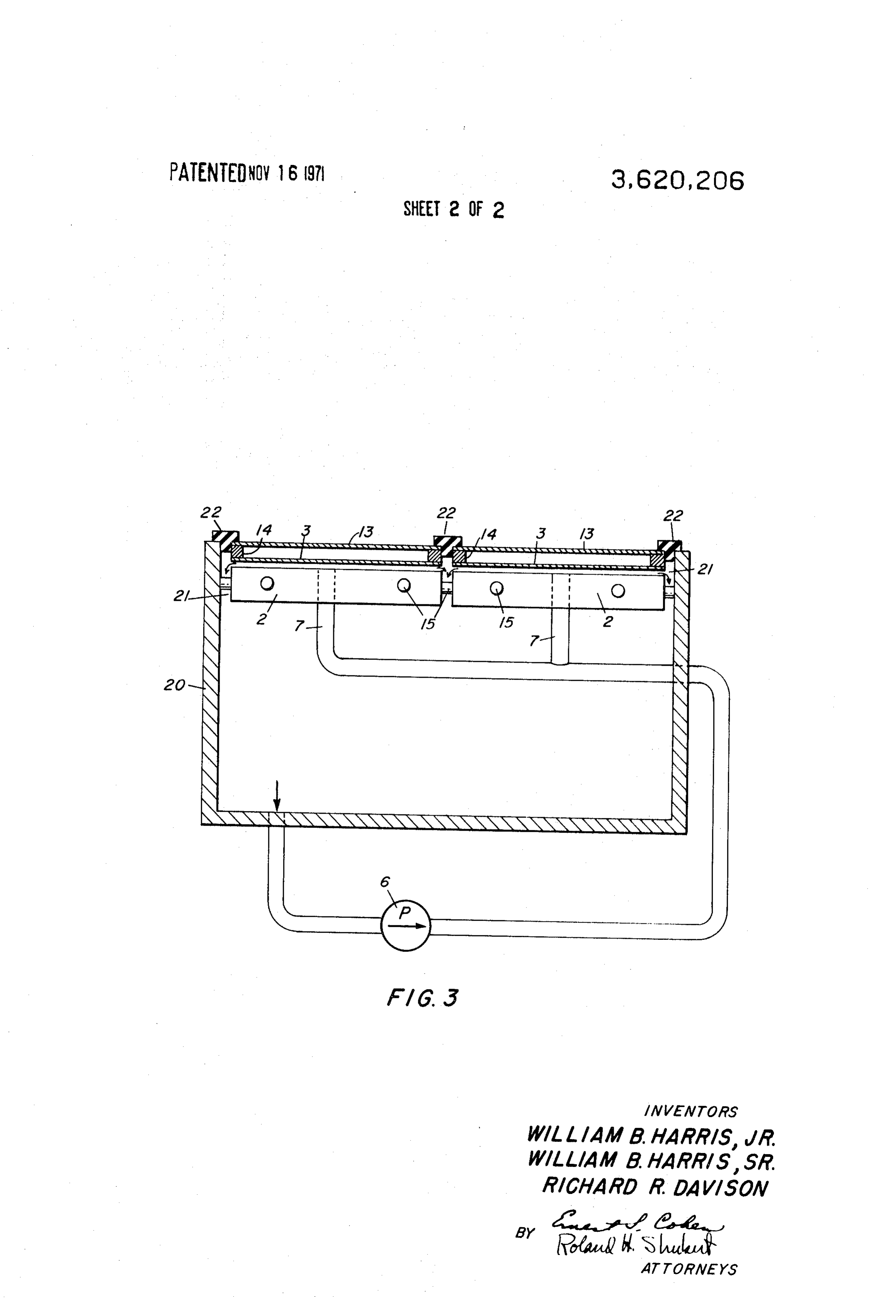
It is a further object of this invention to provide a process FIG. 2 represents a single module or unit. When assembled for the recovery of heat from incident solar radiation. 45 in a multimodule configuration, spacer pegs 15 are provided DETALED DESCRIPTION OF THE INVENTION on the edges of basal member 2. These spacer pegs provide a return channel for the liquid after it is passed through the heat
The invention will be more clearly understood by reference exchange portion of the device. A liquid collection tray may to the accompanying drawings in which: be provided at a level beneath basal member 3 or, in a prefera FIG. 1 represents a diagrammatic view of the heat extract 50 ble embodiment, the return channels communicate directly ing system of this invention. with a liquid storage area. This last embodiment is illustrated FIG. 2 is an oblique, exploded view of a preferred embodi in FIG. 3, ment of a single heat exchange module. FIG.3 represents a partial sectional view of a multimodule FIG. 3 is a partial sectional view of a multimodule heat heat exchange device in accordance with the invention. exchange device constructed in accordance with the inven 55 Liquid storage means 20, preferably constructed of a material tion. having heat-insulating properties, is substantially completely Referring now to FIG. 1, the heat exchange device, filled with the liquid to be heat exchanged. Floating on and generally designated by the numeral 1, comprises a relatively supported by the liquid are a plurality of heat exchange rigid and flat basal member 2 disposed in a substantially modules such as are represented in FIG.2.
horizontal attitude. Resting on the basal member and con 60 Each module comprises a buoyant, basal member 2, a cover forming generally to the size and shape of that member is plate 3, spacer means 14 and a second transparent member cover plate 3. Liquid from supply or storage means 4 passes 13. Buoyant basal member 2 is preferably constructed of a through conduit 5 to pump 6. From pump 6, the liquid is material such as foam glass. However, other materials and passed, via conduit 7, to a central area between basal member methods of construction may also be used. For example, 2 and cover plate 3. Liquid then flows outwardly toward the 65 member 2 may be constructed of metal or other suitable periphery of the basal member and cover plate in a thin chan materials in the form of a flat, hollow, or buoyant-plastic nel 8 formed between the two, Liquid is recovered in collect foam-filled float. Spacer pegs 15 maintain the modules in a ing means 9 and is returned to storage means 4 by means of somewhat separated position thus providing return channels conduit 10. 21 to allow liquid to return to the storage area. Sealing means By operation of Bernoulli's Theorem, liquid flowing through 70 22, which may conveniently comprise flexible strips of the channel 8 is maintained as a compressed, thin and evenly dis configuration, isolate the system from the external environ tributed film. As required by that Theorem, if liquid flow ment. Liquid is circulated from a lower region of storage tended to channel in one direction, the increased rate of flow means 20 through conduit 5 to pump 6. Pump 6 then dis would reduce the pressure in the channelling area. Reduction tributes liquid via conduits 7 to the central portions of in in pressure would in turn cause the cover plate to press more 75 dividual heat exchange modules where the liquid is heated by 5 incident radiation striking basal member 2. As illustrated in plate; and
FIG. 1, the operation of pump 6 is preferably controlled by a d. means at the periphery of the plate and basal member to radiation-sensitive control device so that the pump operates recover the liquid.
only during periods in which incident radiation is of sufficient intensity to cause heating of the circulating liquid. A number 5 member isdevice 2. The of claim 1 wherein the top surface of the basal adapted to absorb radiant energy.
of conventional sensors, including thermistors and photosensi 3. The device of claim 2 wherein the basal member is con tive devices of many kinds, may readily be adapted for this structed of a material having thermal insulation properties and purpose. having buoyancy relative to said liquid. Heat developed and stored by this system may be used to 4. The device of claim 3 wherein the plate is substantially furnish energy for heating, drying, solvent extraction, O transparent to the incident radiant energy. desalination or any other process which can utilize heat at 5. The device of claim 4 wherein liquid storage means are temperatures below the boiling point of water. Utilization of disposed below said basal member.
the heat energy can be accomplished in any conventional 6. The device of claim 5 wherein the basal member is fashion. For example, a secondary heat exchanger may be buoyantly supported on the surface of the liquid in said placed within the liquid stored in means 20. A stream of 15 storage means.
heated liquid may also be transported from means 20 to a 7. The device of claim 6 including sensing means adapted to point of utilization. Other means and methods for utilizing the control the passage of liquid between the basal member and heat energy will be readily apparent to those skilled in the art. the plate responsive to the intensity of incident radiation. Tests of single and multimodule units, constructed in 8. The device of claim 7 including a second transparent general accordance with FIG. 3, were performed using solar 20 member spaced above the plate and forming in cooperation energy as the source of incident heat flux and water as the with that plate an insulating dead airspace. liquid medium. Efficiencies as high as about 65 percent of 9. The device of claim 8 including spacer means on the theoretical were attained by these units. Efficiency in this case periphery of said basal member to provide a channel for liquid is defined as gain divided by input multiplied by 100. Input is a to return to said storage means.
measure of local radiant energy available as measured by a 25 10. A process for heating water by means of solar radiation device such as the Eppley pyrheliometer while gain is mea which comprises passing a flow of water between two relative sured by the increased heat content of the circulating water. ly rigid, flat surfaces, said surfaces being disposed in a substan What is claimed is: tially level attitude, the bottom surface comprising a radiation 1. A device for extracting heat from incident radiant energy absorbing member and the upper surface comprising a radia comprising: 30 tion transmitting member, the upper surface being freely sup a, a basal, relatively rigid, flat member normally disposed in ported by the bottom surface, thereby maintaining a com a substantially horizontal attitude; pressed, continuous and substantially uniform flowing film of b. a flat, relatively rigid plate conforming generally to the water between the two surfaces.
size and shape of the basal member and resting on that member, said plate being adapted for exposure to in 35 betweenThetheprocess two of claim 10 wherein the flow of water surfaces is controlled responsive to the inten cident radiant energy; sity of incident solar radiatign strikingthe upper surface. c. means to pass a liquid between the basal member and the sk k
Provenance
- Collection
- Patents citing this work
- Pages
- 5
- Method
- pdftotext (the PDF's own text layer) + pdftoppm 300dpi page scans
- Patent office record
- patents.google.com →
- Source
- Google Patents citing-documents table
- Assignee
- Us Interior
- Published
- 1971-11-16
- Transcribed from
- patentimages.storage.googleapis.com →