

patent · US4026270A
Combination heat absorber and heat storage system
31 May 1977
Text
Page 1bibliographic recordscan →
United States Patent (19)
Ramey
54 COMBINATION HEAT ABSORBER AND
HEAT STORAGE SYSTEM
Inventor: Harry B. Ramey, Box 272, Rte. 5,
U.S. Cl. ............................................... 126/271 Int. Cl'............................................ F24, 3/02
UNITED STATES PATENTS
1,034,465 8/1912 Kennedy et al. ... ... 126/271 2,213,894 9/1940 Barry ................... ... 126/271 2,342,21 1 2/1944 Newton .... ... 126/271
SS i (erprete. SS
west was as a Yaar Ada Aways
SSS. LSE.
MXYY a 4
SNSSFSR
2,575,478 11/1951 Wilson ............................... 237/1 A
3,250,269 5/1966 Sherock ............................. 126/271 3,894,528 7/1975 Stubblefield ....................... 126/271 Primary Examiner-Lloyd L. King
A brine tank similar to that used in an ice plant is used to store heat added to a thin sheet of water by the Sun and/or ambient air. The stored heat is removed from the water by a heat pump for space heating. Water in containers in the brine may, on occasion, furnish its heat of fusion to the evaporator of the heat pump. In hot weather a reversing valve causes the erstwhile evaporator to become the condenser and to transfer heat to the brine. This heat is then dissipated by the water when it is sprayed onto the roof.
2 Claims, 3 Drawing Figures
Drawings
Page 2drawing sheetscan →
Page 3scan →
ture and causes line 36 to absorb heat from the water in
COMBINATION HEAT ABSORBER AND HEAT tank 10. This heat is transferred to the interior 40 by STORAGESYSTEM the fluid flowing through compressor 30. to line 34 where condensation causes it to give up its heat.
BRIEF SUMMARY OF THE INVENTION 5 The water from spray pipe 20 flows over the roof or The present invention relates to the combination of a over protective cover 21, such as asphalt. The sprayed heat absorber and a heat storage system. Solar heat and water serves as a heat absorbing material both by virtue the ambient air, heat cold water to the ambient temper of its exposure to the atmosphere and its exposure to ature or, on sunny days, above the temperature of the the black surface heated by the sun. Thus, the heat ambient air. Such heating may occur on the roof of a 10 depletion by lines 34 and 36 is compensated for by heat dwelling unit. The water is caused to flow to another restored to the roof top water. The water and its new location where its heat is removed by a heat pump ad energy flows through gutters 50 and downspout 51 used for space heating. The roof may be covered by a back to tank 10.
transparent sheet of material to prevent loss of heat on The operation described above will continue in most clear, cold days, and a fan may be used to blow air over 15 temperate climates during average winter tempera the roof on cloudy days to add atmospheric heat to the tures. Even if the sun is not shining, the heat content of water which is relatively cold because its heat has been the air restores the heat removed by the evaporator 36. removed by the heat pump. On extremely cold by sunny days the water returned Many dwelling units of the trailer type are perma to the roof is near the outside temperature and will not, nently located, and the present invention is readily 20 like the water in other types of solar heaters, lose its adaptable to such units. When so adapted, aesthetics heat rapidly, but is rather warmed by the sun at least to and space usage require that the absorber be on the the level of the outside temperatures. Of course, this roof and that the heat storage tank be hidden beneath advantage will be more pronounced if transparent the trailer.
The heat storage tank is comparable in size to the 25 cover 22 is used, but cover 22 would not be nessary in mild climates.
well known children's wading pool. In its use it resem bles the brine tank used in an ice plant. Fresh water toThe use of cover 22 requires that a fan 23 be installed containers may be placed in the brine tank and cooled roof water.outside air and its heat content to the sprayed supply below the freezing temperature of water. Thus, the heat Winter weather is usually cold and clear or cloudy pump not only removes the energy indicated by the 30 with specific heat of water but also the heat of fusion. As the can benearly normal temperatures. The present system temperature of the water is being lowered to the freez ever, a few daystomay designed function well in such weather. How be both cloudy and extremely ing point, the temperature difference between the cold. During such weather evaporator coil and the water becomes smaller and use of the internal energy ofthe present system makes smaller and thus more unfavorable, but while the water 35 amount of heat depending on the sizetoofsupply is being frozen, this temperature difference remains The heat pump, comprising compressor 30, linestank. the brine
Constant.
During periods when the sun is not shining and the and 36, and valve 35, first remove the heat of the water temperature is extremely low, the brine may also be by lowering its temperature. Water has an unusally high amount of internal energy, as indicated by its specific heat. Next, the heat pump removes the latent heat of
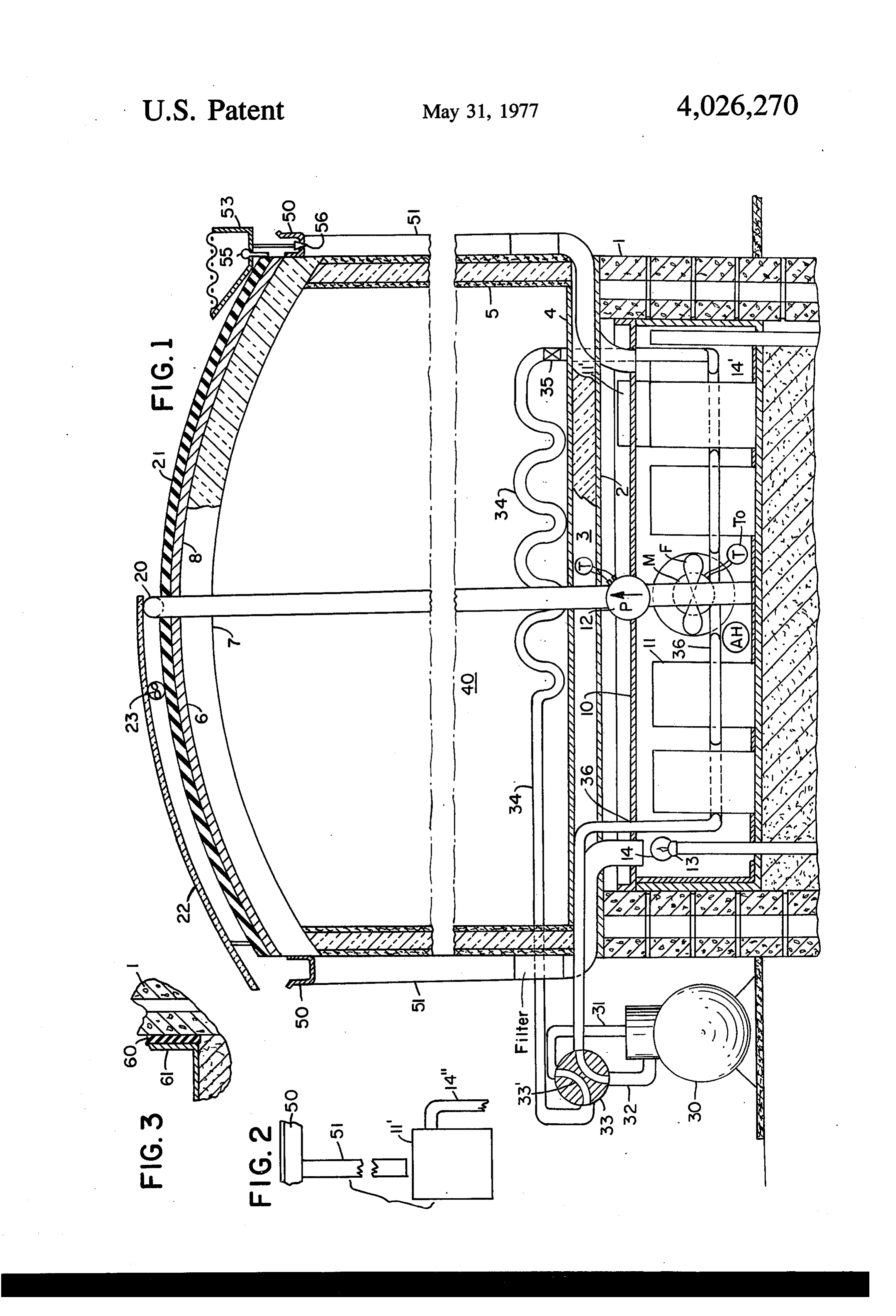
In the drawing:
FIG. 1 is a schematic showing of the invention as it fusion of water in containers 11. Then, the heat of fusion can be removed from the brine. All this heat can would be installed in a trailer type dwelling unit. be restored during the next mild or sunny weather. In FIG. 2 shows a container used to receive rain water from a downspout. 45 other words, the system can go into debt in extremely FIG. 3 shows a flexible liner for the foundation and cold weather.
which forms an impervious container for receiving a The present invention will be most useful in mild brine solution. climates. In more northerly regions the brine will freeze, and a device like thermostat T will be required
DETALED DESCRIPTION SO to stop the pump shown at 12, and some form of auxil As shown in FIG. 1, a trailer type dwelling unit com iary heat will be necessary.
Outside thermostat To starts fan F whenever the prises a foundation 1, vapor barrier 2, floor support 3, floor 4, walls 5, ceiling 6, ceiling support 7, and roof 8. temperature is above the melting point of the brine ice. A tank 10 rests, preferable, on the ground beneath The brine ice then melts, and thermostat T starts pump the trailer. Inside the tank 10 several containers 11 rest 55 12. The brine forced to the roof receives more heat and on the tank bottom. A pump 12 receives cold water or quickly melts all the briny ice and, if mild weather brine and lifts it to the spray pipe 20 above roof 8. A persists, also melts the ice in containers 11. level control valve 13 includes a float 14. The water in containers 11 may also be furnished A compressor 30 may be located near the foundation with antifreeze.
1. High pressure line 31 and low pressure line 32 are 60 If transparent cover 22 is not used, some means to connected to compressor 30. Valve 33, in the position prevent rain water from washing away the brine is nes shown, allows high pressure refrigerant fluid to flow sary. The box 53, secured by hinge 55, is ordinarily through valve passage 33' into condenser 34. Conven overbalanced to lie on the roof. However, when enough tional devices such as air fans and water circulators, rain falls, it fills and tips over and closes valve 56. The omitted for clarity, may be used to aid in the condensa 65 rain water flowing from the roof then backs up to the tion. A valve 35 restricts the flow from the condenser more highly elevated outlet to downspout 51, shown in and enables compressor 30 to lower the pressure in line FIG. 2, and empties into container 11'. The container 36 whereby the evaporation inside lowers the tempera 11"is sized to overflow, ordinarily.
Page 4scan →
Wherever an auxiliary heater is acceptable, it may be the storage means, said container being at least par located inside the dwelling unit. An alternative location tially filled with a liquid, a heat pump including a means is shown at AH in the brine tank of FIG. 1. A thermo to transfer heat from the water at relatively low temper stat can start the heater whenever insufficient energy is atures to the air, at higher temperatures, in the dwelling present in the water to supply heat throughout any unit, means to convey the water to the roof level and to expected or probable period of bitter weather, thus expose said water to the sun and the environment building up a reserve. whereby heat is restored to the water, means to return - An impervious, flexible liner 61 can be fitted to the the water and its newly acquired heat energy to said ground and the foundation to form a relatively inexpen storage means whereby the heat energy in the water is sive brine tank. A compressable sheet 60 allows for 10 retainable by the water and the ground under the im expansion. However, a briny ice is usually mushy and pervious layer, the said means to convey the water to would very likely not be a problem. the roof level including a means to spread the water on A dark substance mixed with the brine enhances the absorption of solar heat. the roof of the dwelling unit, the said roof acting to What is claimed is: 15 gether with the water thereon as a solar heat collector, 1. A dwelling unit having a roof, outer walls, and a the liquid in said container being freezeable to release foundation supporting the outer walls, astorage means its heat of fusion and at least one of said containers comprising an impervious layer of material on the in containing a liquid which freezes at or below 32 F. 2. The combination of claim 1 wherein a coloring side surface of the foundation and on the ground inside matter the foundation,said storage means containing water 20 is added to the water to absorb radiant heat. mixed with an antifreeze, at least one container inside it is at . . .
Provenance
- Collection
- Patents citing this work
- Pages
- 4
- Method
- pdftotext (the PDF's own text layer) + pdftoppm 300dpi page scans
- Patent office record
- patents.google.com →
- Source
- Google Patents citing-documents table
- Assignee
- Ramey Harry B
- Published
- 1977-05-31
- Transcribed from
- patentimages.storage.googleapis.com →