

patent · US4030455A
Antipollution carburetor device for internal combustion engines
21 June 1977
Text
Page 1bibliographic recordscan →
United States Patent (19)
Van Eeck
54). ANTIPOLLUTION CARBURETOR DEVICE .
FOR INTERNAL COMBUSTON ENGINES
Inventor: Philippe F. Van Eeck, 11827
Kearsarge St., Los Angeles, Calif.
Related U.S. Application Data 63 Continuation-in-part of Ser. No. 366,270, June 4, 1973, abandoned.
(52) U.S. C. ............................. 123/25 E; 123/1 A;
(51 int. Cl”......................................... F02D 19/12
UNITED STATES PATENTS
1,488,054 3/1924 Muzzy .............................. 123125 B . 1876,879 9/1932 Drabold ......................... 123/119 E
3,537,434 1 1/1970 Herpin ............. . . . . . . . . . . . . 123/198 3,648,668 3/1972 Pacheeo ............................ 123/1 A 3,818,875 6/1974 Phillips et al.................... 123,125 E Primary Examiner-Carroll B. Dority, Jr.
Assistant Examiner-Ira S. Lazarus
Attorney, Agent, or Firm-Lewis B. Sternfels
Water, with chemical additives and metallic salts therein, is injected into an internal combustion engine, such as for automobiles, to reduce production of car bon monoxide and by reducing the amounts of oxides of nitrogen. Metallic salts may be added to tap water by use of an electrolysis cell connected to the engine's battery or alternator.
23 Claims, 2 Drawing Figures
Drawings
Page 2drawing sheetscan →
Page 3scan →
Another object is the provision of means and method
ANTIPOLLUTION CARBURETOR DEVICE FOR for avoiding the need for leaded fuels. INTERNAL COMBUSTON ENGINES Another object is to provide means and method for CROSS-REFERENCE TO RELATED INVENTIONS 5 anti-detonants enlarging the number of anti-detonants, because more are soluble in water than in gasoline.
This is a continuation-in-part of copending applica Another object is the provision of means and method tion Ser. No. 366,270, filed June 4, 1973 and now for enabling lower engine temperatures. abandoned. Other characteristics and advantages, as well as a .
Background of the invention
more complete understanding of the present invention 10 may be obtained from the following description and 1. Field of the Invention accompanying drawings and are related to different The present invention relates to a device and process methods of accomplishment of the invention, given as by which water, with chemical additives, is combined examples without limitations.
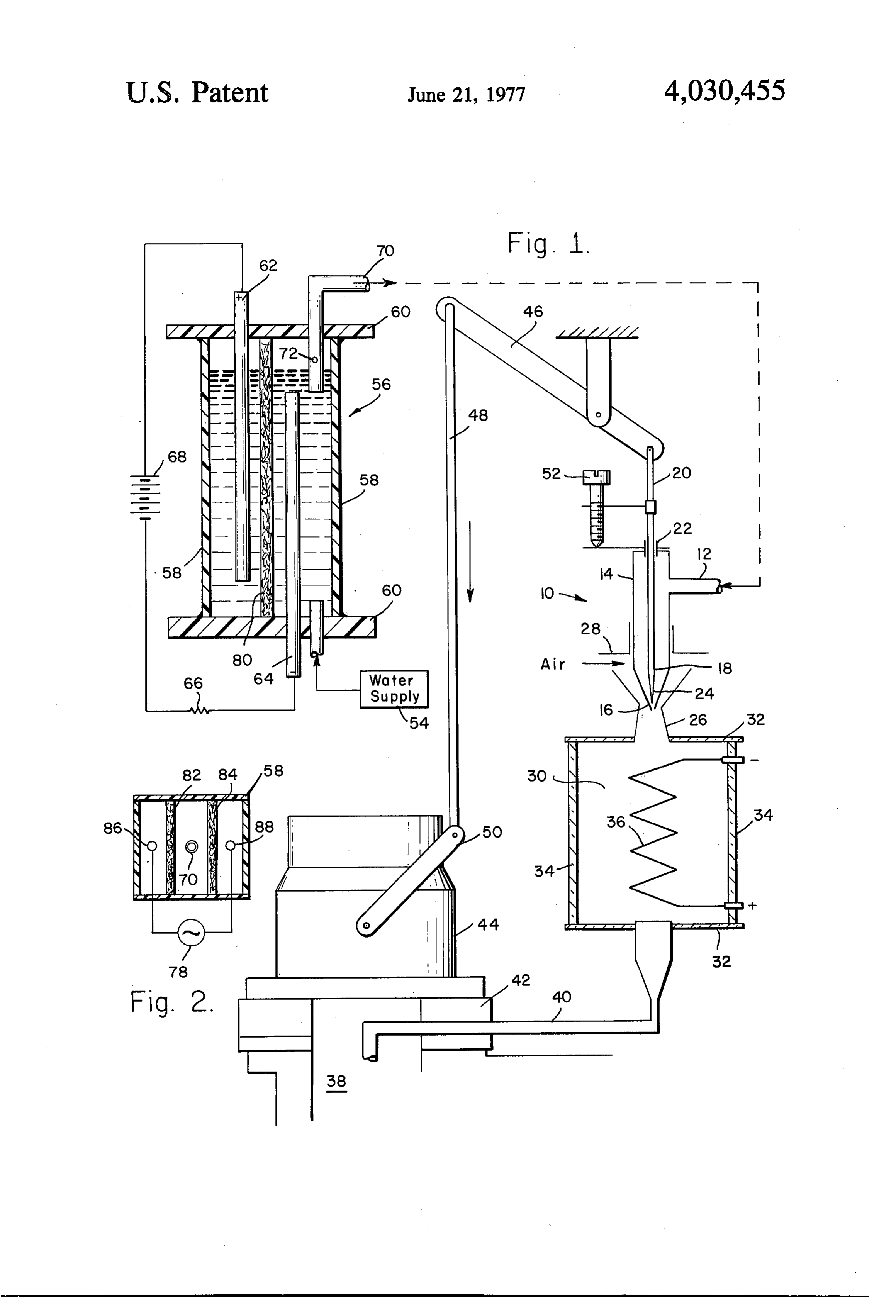
with fuel in an internal combustion engine to maximize DESCRIPTION OF THE DRAWINGS complete combustion. The combination is preferably 15 obtained by means of a water injector working in a FIG. 1 is a schematic diagram showing an injection vacuum atomizer. process for mixing water with additives therein with 2. Description of the Prior Art fuel and with an electrolysis apparatus for adding me Devices for controlling atmospheric pollutants from tallic salts to the water; and internal combustion engines are well-known and have 20 FIG. 2 depicts another embodiment of that shown in taken a multitude of configurations. One especially FIG. 1, utilizing alternating current. popular form is the addition of water to fuel in order to DESCRIPTION OF THE PREFERRED increase the efficiency of combustion, so that the by EMBODIMENT products thereof contain greater quantities of, for ex ample, carbon dioxide than carbon monoxide. How 25 As shown in FIG. 1, an injection system 10 includes ever, a simple addition of water has not solved all prob a conduit 12 connected to a cylindrical tube 14 termi lems. For example, although the combustion products nating in a conical aperture 16. Centrally positioned have shown a decrease in pollutants, the efficiency of within tube 14 is a needle 18 having one end 20 extend converting fuel to the distance driven (e.g., in terms of ing out of the tube at support 22 and a conical tip 24 miles per gallon) has decreased, or at least, has not 30 slidable into conical aperture 16. Water, such as tap exhibited an appreciable increase. water, with dissolved additives therein enters tube 14 Furthermore, mixing of the water with the fuel must through conduit 12 and is metered through aperture 16 be such as to obtain the maximum results, as well as past needle tip 24. Aperture 16 occupies the center of obtaining the most advantageous point of mixing. It is a venturi 26 into which air is fed through an entry 28 desired that the water be broken into its smallest com 35 for atomizing the water as it passes through aperture ponent, such as by atomizing or spraying, and generally 16. Venturi 26 opens into a chamber 30 for receipt of this is accomplished shortly after carburetion, just prior the atomized water. Chamber 30 may be advanta to supplying the mixture to the cylinders for ignition. geously constructed by a pair of end plates 32 closing However, it is evident that the most efficient method off a tube 34. Tube 34 may be made of material such as has not yet been devised, because of the large number 40 pyrex to permit the visual evaluation of the atomized of propositions recently submitted in the literature. water therein. The transparent chamber may contain a SUMMARY OF THE INVENTION filament 36, such as of platinum, which is heated by the current of the automobile battery. The filament, when
Accordingly, the many problems and/or disadvan heated to approximately 800 C, insures the pre-heat tages of prior art devices are avoided and/or improved 45 ing and homogenization of the atomized water before it upon by proportionally combining an air-fuel mixture enters a motor 38. Although use of the filament is not from the carburetor with vaporized water and chemical essential for operation of the present invention because additives. As a result of fuel ignition within the cylin it does not cause any change in the composition of the ders of the engine, the water is converted into steam to exhaust, its use is preferred so that precise setting of the encourage the production of carbon dioxide, simulta 50 atomizer is not required.
neously reducing the amount of carbon monoxide. The atomized water entering the venturi passes Some hydrogen is produced in the process, which fur through a conduit 40 supported by a plate 42 into the ther aids in combustion. The chemical additives in motor, which is placed beneath a carburetor 44. Plate clude both hydrogen- and oxygen-producing com 42 may be constructed of aluminum and have one or pounds, as well as catalyzers to aid the reactions in 55 more openings for the purpose of accommodating the volved in combustion. use of many other accessories, such as windshield It is, therefore, an object of the present invention to washers, wipers, depression-contact switches, ect. It is provide means and method for reducing atmospheric advantageous to place injector 10 as close as possible pollutants from internal combustion engines. to plate 42.
Another object is the provision of means and method 60 Conical tip 24 of needle 18 is coupled to and under for enhancing fuel combustion in such engines, thereby the control of the accelerator by a linkage comprising reducing or substantially eliminating byproducts, in lever 46 connected to needle end 20, rod 48, and a link cluding carbon monoxide and oxides of nitrogen and 50 secured to the butterfly valve of carburetor 44. The sulfur. length of the conical needle tip must be equal to the Another object is to provide means and method for 65 total course of depression of the accelerator. The ratio retarding combustion of lubrication oil which cannot between the course of the accelerator and tip 24 of the burn in the presence of steam, thereby effectively elim needle can be set by adjusting the connection of lever inating free carbon and smoke from exhaust emissions. 46 between rod 48 and needle end 20. At idling of the 4 motor, the needle is designed to substantially close water is for the purpose of providing a free amount of conical aperture 16 to prevent the admission of water hydrogen and oxygen to work under the control of the to the engine except for a small amount of leakage catalyzer for the purpose of achieving maximum com equivalent to about 1% of the weight of the gasoline. bustion. These chemicals are selected on the basis of The samll amount of water may be leaked into chamber their containing elements which decompose easily 30 along a small channel along the surface of the coni under the temperature of the explosion and which are cal point. Instead of this small channel, this amount of soluble in water. By way of example and not by way of water can be obtained by adjustment of micrometric limitation, such chemicals include hydrogen peroxide, screw 52, to avoid complete closing of the orifice of the ammonia, ethylene oxide, ethylene glycol, several conical point. O members of the family of methyl and ethylamine, or a Thus, the quantity of water emitted from the injector combination of those chemicals.
controlled by a cone-shaped presettable needle is The analysis of the exhaust that results from the in thereafter governed and regulated by the accelerator. jection into the cylinder of water already combined The cone-shaped needle controls the amount of water, with its chemical additives shows a mixture of carbon varying between 1% and 10% of the volume of the 15 dioxide and steam, a small percentage of carbon mon gasoline that is furnished by the carburetor. oxide, and no appreciable quantity of nitrate product. The water for injection may be obtained from a tank The catalyzation of the residual carbon monoxide 54 which preferably has a minimum capacity of 10% to and sulfur is made easier to obtain in steam atmo 15% of the capacity of the gas tank. The water tank sphere, may be made of plastic or other resilient material with 20 presenceatofametallic temperature of over 200 C, and in the catalyzers.
enough flexibility to accommodate expansion of water in case of freezing. A filter with a screen of metal, for the presence of steam, lubricating In addition, because oil does not burn in example, is placed in the tank to strain any foreign trace of free carbon or the exhaust emissions have no smoke.
particles from the water. This water may have additives already mixed therein for direct supply to injection 25 anti-explosion power, permitsofthe Furthermore, the presence water, by reason of its use of non-leaded system 10, or may be without additives and furnished to air electrolysis cell 56 which, in turn, is coupled to gasoline.
Very few anti-detonants can be added to gasoline system 10. The operation of cell 56 will be explained in greater detail shortly. because of the incompatability of most anti-detonants. When the motor is stopped, the water returns to the 30 be But by contrast, a great number of anti-detonants can tank, which may be placed four inches below the injec mixed with the injected water. For example but not tor, and close to and on the exhaust side of the motor by way of limitation, 0.5% of ethylene glycol mixed in so that in case of freezing, the vapor tension of the ice with the injected water allows the use of non-leaded is enough to provide sufficient moisture for the idling of gasoline in a racing motor having a compression ratio the motor, and the proximity of the exhaust provides 35 of 9.5 and more.
heat to melt the ice. The motors using injection of water show a lower Instead of preheating of the water by the use of the than normal operating temperature because of the filament, the water can be passed through a few turns evacuation of calories being facilitated by the high of copper tubing which is around the exhaust pipe and thermal conductivity of water.
which leads from the plastic water tank to the atomizer. 40 Although the various additives may be included in The number of turns of copper tube should be suffi the tap water as salts, it is possible to avoid the need for cient to heat the water to about 80° C. However, any salts for solvency purposes by placing such additives production of vapor which would interrupt the delivery directly into the water, such as by use of electrolysis of water by producing a vapor lock in the copper tube cell 56 connected between tank 54 and injector 10. must be avoided. The electrolysis cell comprises a tube 58, such as of The injection of water permits the subtraction at the 45 pyrex, and two lids 60 of plastic having a high melting temperature of explosion, of a sufficient amount of point, such as of nylon. The cell includes two elec calories for transforming the water into steam, and thus trodes 62 and 64 configured as two metal plates or rods encourages the production of carbon dioxide while, at having a preferred minimum surface area of 3 square the same time as a corollary, reduces the production of inches. The electrodes are selected from the family of carbon monoxide. In addition, a portion of the steam is metals capable of acting as catalyzers, such as plati decomposed by the action of the pressure and tempera num, paladium, nickel, cobalt, cadmium, and chro ture of the explosion in the cylinder in accordance with mium. Examples of such electrode combinations in the formula clude electrodes of nickel and platinum, electrodes of ... CO - HO = CO, + 2H. 55 nickel and cobalt, and several alloys which include nickel and chromium within their composition, such as
To provide additional oxygen and hydrogen for the nickel-chromium, monel metal, invar, and constantan. combustion, chemicals are added to the water, with The cell is connected by a current limiter 66 with a further inclusion of a small percentage (0.01 per thou maximum of 0.5 amperes to the battery 68 of the auto sand to 1.0 per thousand) of metallic salts to maximize 60 mobile, or if the automobile has an alternator, prefer performance. Such metallic salts include for example, ably thereto, because with alternating current the elec but not by way of limitation, nickel carbonyl (Ni(Co) trodes are used with more uniformity. or nickel protoxide NiOs in ammonium solution, Cell 56 is filled with water from tank 54. Ordinary tap cobalt carbonyl (CO(CO)), cobalt amine (the salts of water is sufficiently conductive to start the electrolysis cobalt which combine with ammonia to give numerous 65 of metals, because of the presence in the water of chlo complex compositions) or a combination thereof. rine or other conductive matter. If the water is too These salts aid in catalyzing the reaction during the pure, such as distilled water, the electrolysis can be combustion. The addition of other chemicals in the started with a pinch of washing powder or soap. The 5 electrolytic action causes metal from the electrodes to prior to supply thereof to the engine for enhancing react with the minerals already in solution. The water combustion of said hydrocarbon fuel and for control from the cell passes therefrom through a tube 70 to ling the products of combustion thereof. conduit 12. Tube 70 therein a small hole 72 near the 2. The improvement as in claim 1 wherein said water water level (% inch above the level) to permit escape of 5 supplying means includes a vacuum-atomizer for pre electrolysis gas and the formation of water and gas mixing said water with air as a water-air vapor prior to 'bubbles. . . .. . supplying said water-air vapor to said fuel-air mixture. A porous diaphragm 80 may be placed about anode 3. The improvement as in claim 2 further including electrode 62 to avoid possibilities of clogging, espe means for mixing additives in addition to said catalytic 'cially after a period of time when the engine and the 10 agent means with said water.
liquid of cell 56 have had a chance to cool. It has been 4. The improvement as in claim 3 wherein said addi found that the liquid contents tend to flocculate; that is, tives include oxygen and hydrogen supplying chemicals to gel or make a flux-like material when it cools, which to increase combustion.
tends to plug up the injector. This gel tends to concen 5. The improvement as in claim 4 wherein said addi trate about anode 62; therefore it is preferred to isolate 15 tives are selected from the group consisting of hydro the anode from the opening 72 to tube 70, thereby gen peroxide, ammonia, ethylene oxide, ethylene gly maximizing flow of water and decreasing any impedi col, members of the methyl and ethylamine com ments to its flow through cell 56. Diaphragm 80 is pounds, and combinations thereof.
made porous by constructing it of cotton, felt, or pref 6. The improvement as in claim 1 wherein said cata erably fiberglass held between two sheets of perforated 20 lytic agent means are selected from the metallic salts plastic. consisting of nickel carbonyl or nickel protoxide in When the current is not direct current, as shown in ammonia solution, cobalt carbonyl, cobalt amine, and FIG. 1, but alternating, energized by a source 78, the combinations thereof.
construction of FIG. 2 is used. In this case, two dia 7. The improvement as in claim 6 further including phragms 82 and 84 are employed to retain any floccu 25 means for defining oxygen and hydrogen supplying lants at both anodes 86. and 88. additives selected from the group consisting of hydro Water coming out of the cell has a very high-catalyz gen peroxide, ammonia, ethylene oxide, ethylene gly ing property and, when injected into the motor, may be col, members of the methyl and ethylamine com disassociated into hydrogen and oxygen at the tempera pounds, and combinations thereof. m ture and pressure of the explosion. The small amount of 30 8. The improvement as in claim 2 wherein said water catalyzing metal that is liberated during this disassocia supplying means further includes accelerator means tion also catalyzes the combustion of the gasoline by coupled to said carburetion means for adjusting said changing carbon monoxide to carbon dioxide, or into water to air mixture.
methane (CH), depending upon the temperature and 9. The improvement as in claim 8 further including the choice of metal electrode. For example, electrodes 35 means for presetting the amount, of said water mixed of nickel provide methane below 400 C and cobalt with said air during idling of said engine. cadmium provides carbon dioxide below 300 C. The 10. The improvement as in claim 2 further including hydrogen and oxygen that is liberated by the electroly means for heating said water-air vapor prior to supply sis provides additional capability of achieving maxi ing said water-air vapor to the fuel. mum combustion. 40 11. The improvement as in claim 10 wherein said It is advantageous to increase the production of hy heating means is selected from means consisting of an drogen in electrolysis cell 56 for the purpose of increas electrically heated filament and a tubular heat ex ing the catalyzing action of the catalyst and, conse change coil.
quently, to encourage greater conversion of carbon 12. The improvement as in claim 1 further including monoxide into methane. Such increased hydrogen pro 45 means for coupling said fuel supplying means and said duction is enabled by increasing the potential applied water supplying means for providing a proportionate to electrodes 62 and 64. A potential sufficient for this water-to-fuel mixture.
purpose is from 12 volts to 80 volts AC which may be 13. The improvement as in claim 1 wherein said obtained, for example, by use of a solid state AC con dissolved catalytic agent means includes non-toxic, verter having a capacity of 40 watts or by use of a 50 anti-knock, and exhaust-cleaning means. step-up transformer coupled to the automobile alterna 14. In an internal combustion engine, the improve tor. In a similar manner, if the power applied is direct ment in improving the combustion of a fuel-air mixture current, the increase in potential is achievable by a DC in the engine comprising:
to DC or DC to AC converter, depending upon means for defining a water-soluble catalytic agent; whether the desired output is direct or alternating cur 55 means for supplying water with said catalytic agent rent. means dissolved therein from a source to the fuel Although the invention has been described with ref air mixture prior to supply thereof to the engine for erence to particular embodiments thereof, it should be enhancing combustion of said fuel and for control realized that various changes and modifications may be ling the products of combustion thereof, and made therein without departing from the spirit and 60 a cell coupled to said water source and to said water scope of the invention. supplying means, said cell comprising What is claimed is: an enclosure coupled to said water source at an 1. In an internal combustion engine, the improve inlet and to said water supplying means at an ment in improving the combustion of a hydrocarbon outlet and filled with water, fuel-air mixture in the engine comprising means for 65 electrodes in said enclosure and in said water, and defining a water-soluble catalytic agent and means for a source of power coupled to said electrodes for supplying water with said catalytic agent means dis placing said catalytic agent means into said wa solved therein from a source to the fuel-air mixture ter.
Page 6scan →
15. The improvement as in claim 14 wherein said 22. In an internal combustion engine, the improve electrodes comprise platinum, paladium, nickel, co ment in improving the combustion of a fuel-air mixture balt, cadmium, and chromium. in the engine comprising: - 16. The improvement as in claim 14 wherein said means for defining a water-soluble catalytic agent; electrodes are selected from the pairs of electrodes 5 means for supplying water with said catalytic agent consisting of nickel and platinum, nickel and cobalt, means dissolved therein from a source to the fuel and alloys of nickel and chromium. air mixture prior to supply thereof to the engine for 17. The improvement as in claim 14 further including enhancing combustion of said fuel and for control ling the products of combustion thereof;
a porous diaphragm separating at least one of said 10 said water-supplying means comprising an injector electrodes from said inlet and said outlet for decreasing device having a tube having a conical mouth, and a any impediment from the flow of water between said needle moveable therein to form therewith a nee inlet and said outlet. dle valve, a venturi having said conical mouth posi 18. The improvement as in claim 17 wherein said tioned therein, and an air inlet positioned adjacent source of power is direct current and wherein said one 5 said venturi and said conical mouth to permit air to electrode comprises an anode. be drawn into said venturi; 19. The improvement as in claim 17 wherein said means for supplying said fuel-air mixture and com source of power is alternating current and wherein said prising a vacuum chamber and carburetion means porous diaphragm separates both said electrodes from including carburetion controlling means, said vac said inlet and said outlet. uum chamber having a coupling to said venturi; and 20. The improvement as in claim 14 further including means coupling said carburetion controlling means means for increasing the potential applied to said elec and said needle for simultaneously controlling said trodes for increasing the production of hydrogen, carburetion means and the position of said needle thereby for augmenting catalization of carbon monox within said conical mouth. ide to methane. 23. The improvement as in claim 22 further including 21. The improvement as in claim 20 wherein said a heater in said water-supplying means connected to a increasing means comprises a converter coupled to said source of electrical power.
source of power. : . . .. . .. .
Provenance
- Collection
- Patents citing this work
- Pages
- 6
- Method
- pdftotext (the PDF's own text layer) + pdftoppm 300dpi page scans
- Patent office record
- patents.google.com →
- Source
- Google Patents citing-documents table
- Assignee
- Eeck Philippe F Van
- Published
- 1977-06-21
- Transcribed from
- patentimages.storage.googleapis.com →