

patent · US4341649A
Energy storage medium and method
27 July 1982
Text
Page 1bibliographic recordscan →
United States Patent (19)
Burns et al.
(54) ENERGY STORAGE MEDUMAND
METHOD
75 Inventors: Edward J. Burns; Geoffrey T. White, both of Omaha, Nebr.
Assignee: InterNorth, Inc., Omaha, Nebr.
Int. Cl................................................. C09K 5/06 (52) U.S. C. .......................................... 252/70; 165/2;
(58) Field of Search .................. 252/70; 126/400, 900;
4,111,189 9/1978 Dizon .................................. 126/400 4,213,873 7/1980 Church ........................... 252/174.21
4,259,198 3/1981 Kreibich ............................... 252/70 4,276,205 6/1981 Ferry ................................... 252/528
OTHER PUBLICATIONS
Union Carbide, "Polyox Water-Soluble Resins", 21
Page Technical Bulletin, #F-40246-C, Jan. 1964.
European Pat. Appln. 0000099, Published 12-20-78,
Inventors Rurik et al., 11 pp.
Primary Examiner-Dennis L. Albrecht
Attorney, Agent, or Firm-Donald F. Haas
An energy storage medium that can be raised to a high energy state which is comprised of a gel of polyethylene oxide, water, and a salt which causes gelation of poly ethylene oxide and water at or below about 90C., and a method for storing energy with the medium.
4. Claims, 2 Drawing Figures
Drawings
Page 2drawing sheetscan →
Page 3scan →
comprised of a solution of polyethylene oxide and a salt
ENERGY STORAGE MEDUMAND METHOD in water which forms a gel upon heating. Typical salts which may be useful in this invention are sodium chlo
BACKGROUND OF THE INVENTION ride, potassium chloride, sodium acetate, potassium The present invention relates to energy or heat stor fluoride, potassium hydroxide, lithium sulphate, zinc age media having high heat capacity which render them sulphate, magnesium sulphate, potassium sulphate, so potentially useful to systems with facilities for the stor dium silicate, potassium carbonate, sodium carbonate, age of energy or heat along with requisite heat transfer and trisodium phosphate, among others. Any salt which equipment. will cause gelling of polyethylene oxide in water at or Heat storage reservoirs are provided in cases where 10 below about 90° C. can be used in this invention. the amount of heat supply and heat demand differ from Another aspect of this invention is a method for using each other within given time periods. In many in the above energy storage medium. This method com stances, the heat energy is available for a short period of prises heating a solution of polyethylene oxide, water, time, while the heat consumption is more or less contin and one of the salts described above to a temperature at uous. The use of solar energy for heating and for indus 15 or below about 90° C., thereby forming a gel at a high trial processes is an example of this situation. Time energy state. The energy (heat) stored by gelation can unsteady industrial processes would be another. be released by cooling the mixture. This energy can be Many different energy storage media have been used used in any number of applications. A major advantage in the past. Stones, rocks, concrete blocks, bricks, 20 of the medium of this invention is that it can be used gravel, and the like are relatively inexpensive but have repeatedly without suffering degradation whereas salt the disadvantage of a very low heat capacity. Water is . hydrates suffer greatly from cyclical losses due to strati one of the most commonly used media. It has a reason fication.
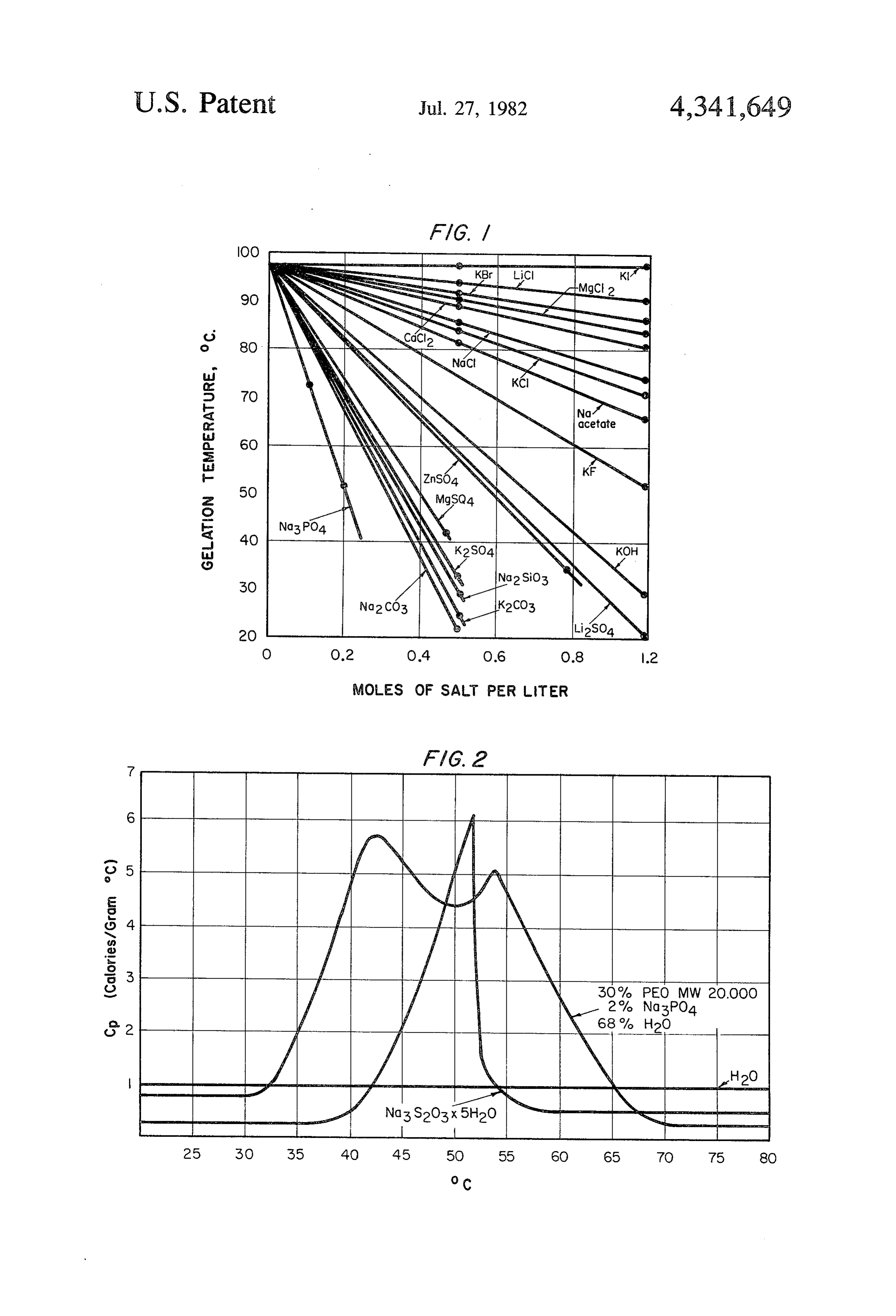
ably high heat capacity and good heat transfer proper ties. The difficulty with water is that an enormous vol BRIEF DESCRIPTION OF THE DRAWINGS ume of it is needed to store a reasonable amount of heat. 25 FIG. 2 is a plot of the specific heat versus tempera Metal salt hydrates or the eutectic mixture of such ture. It compares the overall heat capacity of the energy hydrates with other hydrates or with ion-generating storage compounds are also suitable as energy storage media. two priormedium art of the present invention versus that of energy storage media.
Examples of such energy storage substances are sodium FIG. 1 is a plot of the gelation temperature versus the thiosulfate or sodium phosphate when the storage 30 media are to be used for heating purposes. Examples of concentration of the salt in a solution of polyethylene storage media used for cooling purposes are sodium oxide and water for various salts. sulphate mixed with sodium chloride or calcium chlo DETAILED DESCRIPTION OF THE ride and water. Crystallizing solutions have discontinu INVENTION ities in their cooling curves as a consequence of the 35 An acceptable and functional energy storage medium change in phase from liquid to solid. Usually, during the change in phase large amounts of energy are absorbed must have the characteristics listed below. The energy or released and usually this phase transition occurs over storage medium of the present invention possesses these a relatively narrow temperature range. Thus, the stor characteristics:
age of energy must also take place in a narrow tempera (a) A high energy storage capacity as evidenced by a ture range, usually from 25 to 50" C. In addition, salts high specific heat.
present severe heat transfer problems with resultant low (b) A high specific heat over a broad temperature thermodynamic efficiency in the overall storage sys range.
tems in which they are used. Finally, these salts suffer (c) High thermal conductivity so that it can absorb greatly from cyclical losses due to stratification. 45 heat rapidly.
U.S. Pat. No. 4,153,105, Reversible Latent Heat Stor (d) Low viscosity.
age Method and Reversible Latent Heat Accumulator (e) Low corrosivity.
by Johann Schroder, issued May 8, 1979, discloses the (f) Low vapor pressure.
use of aqueous solutions of potassium fluoride and so (g) Moderate to high density. dium sulphate hydrate as heat storage media. In the 50 (h) Low freezing point and high boiling point. description of prior art in column 1 of the patent, salt (i) Lack of degradation at the operating conditions hydrates are disclosed which include nucleating materi under which it is utilized.
als added which do not dissolve in the medium but I have found that an organic or inorganic salt can be which substantially increase the number of nuclei added to an aqueous solution of polyethylene oxide to formed and also include the addition of an organic (for 55 form a superior energy storage medium that can be example, gelatine) or inorganic (for example, water raised to a high energy state. When a salt such as triso glass) colloidal carrier material which assists in finally dium phosphate is added to an aqueous solution of poly dispersing the nucleating agents throughout the heat ethylene oxide and the solution is heated to a tempera storage medium by solidifying the heat storage medium ture at or below 90' C., the solution forms a gel. The in the form of a gel. The patent goes on to say that gels energy which was necessary to create the gel can be of this kind age comparatively quickly and their thermal released by cooling the medium. The temperature range conductivity is very low. The gels which are utilized in over which gelling occurs is much broader than the the present invention have a long life and their thermal usable range for any other phase change energy storage conductivity is relatively high. media. Because of this and the fact that the specific heat 65 of the medium remains high over the range, the overall
SUMMARY OF THE INVENTION energy state of the energy storage medium of the pres This invention relates to an energy storage medium ent invention, as evidenced by its heat capacity, is very which can be raised to a high energy stage which is high. Referring to FIG. 2, the heat capacity is the area 4 under the curve of the plot of specific heat versus tem salt for use in the present invention since it promotes perature. It can be seen that the area under the polyeth gelation at lower temperatures and lower salt concen ylene oxide-trisodium phosphate curve is much greater trations. Other salts which are effective in the present than the areas under the water and sodium sulphate invention include sodium chloride, potassium chloride, hydrate curves. Obviously then, the polyethylene ox sodium acetate, potassium fluoride, potassium hydrox ide-trisodium phosphate gel is a much better heat stor ide, lithium sulphate, zinc sulphate, magnesium sul age medium than the other two known heat storage phate, potassium sulphate, sodium silicate, potassium media.
As stated above, thermal conductivity is an important carbonate, and sodium carbonate. Polyethylene oxide is a crystalline, thermoplastic, characteristic of a good energy storage medium. The 10 water-soluble polymer with the general formula thermal conductivity of the medium of the present in vention is relatively high as indicated by a measurement The end groups are said to be hydroxyl of the thermal conductivity of one of the possible for groups only in mulations. In this case, the thermal conductivity of a the case of the lower molecular weight species. Unlike solution of 10 percent polyethylene oxide with a molec 5 most polymer systems, polyethylene oxide is commer ular weight of 20,000, one percent of trisodium phos cially available in an extraordinarily wide range of mo phate, and 89 percent of water was determined to lie lecular weights from ethylene glycol, diethylene glycol, between 0.0005 calories per centimeter-seconds-degrees and so on, up to polymers that have molecular weights centigrade, the thermal conductivity of methanol, and many times greater than a million. The lower molecular 0.0015 calories per centimeter-seconds-degrees centi 20 weight members of the series with n up to about 130 grade, the thermal conductivity of water. (molecular weight from about 200 to about 6000) are The energy stored in the gel of the present invention generally known as polyethylene glycols while the can be removed from the gel by exposing it to a suitable higher members (molecular weight greater than 6500 up temperature gradient. As the gel cools because of the to 100,000 to several million) are known as polyethylene transfer of heat energy via the temperature gradient, 25 oxide, polyoxyethylene, or polyoxirane. The preferred there is a phase transition in the gel from solid to liquid polyethylene oxide polymers for use in the present in which releases the stored energy which is then trans vention have a molecular weight of at least about 6500 ferred to whatever medium is causing the temperature gradient. The means for establishing temperature gradi and, The theoretically, there is no maximum.
higher (polyethylene oxide) and lower (polyeth ents are well-known. This cycle can be repeated many 30 ylene glycol) molecular weight members of this series times without the medium of the present invention suf differ sufficiently in properties as to form two classes. fering from degradation or stratification. Several exam The lower members range from relatively viscous fluids pies are provided here. First, the gel of this invention could be contained in a large storage tank of conven to wax-like solids while the higher members are true tional design and in which is placed a heat exchanger. 35 thermoplastics capable of being formed into tough, Preferably, this exchanger would have a high surface molded shapes. The property differences of these two area (high effectiveness) on the gel side with conven classes are due principally to large differences in molec tional channels for the heat exchange fluid (such as ular weight and the relatively greater importance, water or water/glycol mixture) on the other. The so therefore, of the end groups in the low molecular called 'extended surface' heat exchanger is an example weight class. The viscous fluids are generally unsuitable of such a configuration. Another method would be to for use in this invention because they do not form gels. encapsulate the gel in numerous relatively small con The composition of the present invention is prepared tainers which are suitably sealed from the environment. by dissolving the proper amount of polyethylene oxide The heat transfer medium such as water or air would in a measured amount of water. This may be accom then be circulated past the exterior surfaces of these 45 plished by any conventional method, but I have found containers in a suitable fluid-tight chamber. that simply mixing the polyethylene oxide in warm There are many examples of how such a storage water (30 C. to 70° C.) is sufficient to provide the de facility could be used and two examples are provided sired composition. The addition of the salt may be ac here. First, the gel media of this invention could obvi complished by simply mixing the salt with the polyeth ously be used in a solar-thermal facility. In the winter 50 ylene oxide solution.
months, the excess solar heat collected during the day could be stored in the gel and released in the evening theThe following examples are meant only to illustrate invention and not to limit in any way.
hours after facility heating. Another example would be the use of this gel to store low grade process waste heat EXAMPLE 1 during daytime operation to be released at night for 55 A solution of 120 grams of water, 1.5 grams of poly facility heating.
Any salt which will cause polyethylene oxide to gel ethylene oxide with a molecular weight 900,000, and 0.5 in water at or below 90° C. can be used in the energy grams of trisodium phosphate was made by adding the storage medium of the present invention. If a salt will polyethylene oxide and salt to water and stirring until only cause a gelling above 90' C., it generally is not they were dissolved. Gelation occurred below 90' C. acceptable because the temperature will be too close to The heat storage capacity of this solution was deter the boiling point of the solution resulting in a change in mined using a Differential Scanning Calorimeter. Over chemical composition and/or overpressuring of the the temperature range of 27 C. to 92 C., the solution system. had a heat storage capacity of about 110 calories per FIG. 1 shows the gelation temperature for various 65 gram, substantially greater than that of water. Because concentrations of various salts in a 0.5 percent by of its initial liquid state, this material is a good heat weight aqueous solution of polyethylene oxide. This transfer material and requires substantial less volume or graph shows that trisodium phosphate is the preferred weight for the same storage capacity as water.
Page 5scan →
EXAMPLE.2 -continued
Three solutions were made according to the proce Rocks Water Sodiurn
Sulphate
Soln dure of Example 1. The solutions each contained 100 grams of water and 30 grams of polyethylene oxide with Transition Btu?Lb.
Heat Capacity - Btu/Lb.
a molecular weight range of 7000 to 9000. Three solu (11 C. Range) 4. 20 101 85 tions had 0.5 grams, 1.0 gram, and 1.5 grams of triso Heat Capacity - Btu/Lb. dium phosphate, respectively. Gelation occurred below (22°C. Range) 8 40 112 122 90° C. All of the solutions had a heat capacity of about Weight Need to 65 calories per gram over a temperature range of 32' C. 10 Store 108 Btu, Lb. 25 x to 90° C., just slightly greater than that of water. Volume Needed to
Store 106 Btu, Ft. 2,150 1,000 25 150
Example 3
A solution of 100 grams of water, 30 grams of poly The polyethylene oxide and trisodium phosphate ethylene oxide with a molecular weight range of 7000 to 15 solution has the highest specific heat and it has a higher 9000, and 3.5 grams of trisodium phosphate was made heat capacity in both temperature ranges than rocks or according to the method of Example 1. The heat capac water. It also has a higher heat capacity than sodium ity was determined to be approximately 300 calories per sulphate over the broad temperature range. Further gram over a temperature range of 32° C. to 92 C. The more, it requires the least amount of weight to store solution was cooled and showed a strong exothermic 20 1,000,000 Btu's per pound of energy. peak. The solution was then cycled through four addi tional heating and cooling cycles. In each heating, the EXAMPLE 5 solution went through a transition at about 55 C. Upon The specific heats of water, a solution of polyethyl cooling, the transition occurred at 35° C. The heat ca ene oxide with a molecular weight of 100,000 in water, pacity of this mixture between 32 C. and 60° C. is 62 25 a solution of the same polyethylene oxide and trisodium calories per gram. The mixture was then cycled repeat edly for about 40 cycles over a four-day period. There phosphate in water with and without gelation, and so dium sulphate were determined over a temperature was no deterioration or degradation of the solution. range of 35° C. to 81' C. by using a Differential Scan EXAMPLE 4 ning Calorimeter. The following table shows the results 30 of this experiment:
Temp(°C.) H2O PEO Soln PEO & Na3PO4 PEO & Na3PO4 Na3S2O3 x 5H2O 35 1.0 .93 - 0.58 - 37 1.0 77 1.02 0.57 -- 39 1.0 .9 -- 0.71 --
43 1.0 .76 --- 4.07 1.06 45 1.0 .73 - 4.20 2.06
49 .0 59 - 5.00 4.5 51 .0 57 - 4.65 5.6
55 1.0 51 -- 3.30 7
59 O 35 - 4.51 55 61 1.0 .32 - 5.46 5
65 1.0 .30 -- 5.71 5
69 1.0 .32 - 5.44 5 71 1.0 .28 - 4.79 .4 73 1.0 34 50 4.37 - 75 O 20 -- 400 -- 77 1.0 30 68 2.90 -- 79 1.0 .38 --- 1.09 - 81 1.0 33 - 0.45 -
In the following example, the properties of the solu It can be seen that the solution and gel in accordance tion of Example 3 were compared with the properties of with three known energy storage media whose thermody over the present invention has the highest heat capacity the broadest temperature range of any of the five namic properties were determined by conventional thermodynamic techniques. A Differential Scanning 60 energy storage media compared in the table. Further more, it has a much higher specific heat than polyethyl
Calorimeter was used. The following table shows the ene oxide and water alone. The specific heats for triso results of this experiment: dium phosphate were unavailable, but the International Critical Tables of Numerical Data, Physics, Chemistry
Sodium PEO and Technology, Volume V, published by the McGraw
Rocks Water Sulphate Soln 65 Hill Book Company of New York in 1929 gives the
Usable Temp. Range ("C.) Varies 0-100 25-50 25-55 specific heats over a temperature range of 24' C. to 55° Specific Heat Btu/Lb. 0.2 1.0 55 1.9 C. for sodium phosphite, sodium dihydrogen phos Heat of Phase phate, sodium monohydrogen phosphate, and sodium 6 pyrophosphate on page 124. The specific heats were (a) contacting a solution of polyethylene oxide, wa given for various concentrations of these materials in ter, and a salt which causes gelation of polyethyl water and they ranged from 0.85 to 0.98. Thus, it can be ene oxide in water with a warm medium such that seen that there is a synergistic effect by the use of triso the temperature of the solution is raised to at or dium phosphate and polyethylene oxide to form a gel. 5 below about 90° C., thereby forming a gel with a We claim: high energy state, 1. A method of storing energy which comprises heat (b) storing the energy transferred from the warm ing a solution of polyethylene oxide, water, and a salt medium in the gel for a period of time, and which causes gelation of polyethylene oxide and water (c) contacting the gel with a cool medium whereby to a temperature at or below about 90° C., thereby O the gel goes through a phase change to liquid form forming a gel with a high energy state. and the energy stored therein is transferred to the 2. The method of claim 1 wherein the salt is selected cool medium.
from the group consisting of sodium chloride, potas 4. The method of claim 3 wherein the salt is selected sium chloride, sodium acetate, potassium fluoride, po from the group consisting of sodium chloride, potas tassium hydroxide, lithium sulphate, zinc sulphate, mag- 15 sium chloride, sodium acetate, potassium fluoride, po nesium sulphate, potassium sulphate, sodium silicate, tassium hydroxide, lithium sulphate, zinc sulphate, mag potassium carbonate, sodium carbonate, and trisodium nesium sulphate, potassium sulphate, sodium silicate, carbonate. potassium carbonate, sodium carbonate, and trisodium 3. A method of energy storage and transfer which phosphate.
comprises the steps of: sk he k is IX
Provenance
- Collection
- Patents citing this work
- Pages
- 6
- Method
- pdftotext (the PDF's own text layer) + pdftoppm 300dpi page scans
- Patent office record
- patents.google.com →
- Source
- Google Patents citing-documents table
- Assignee
- Internorth, Inc.
- Published
- 1982-07-27
- Transcribed from
- patentimages.storage.googleapis.com →