

patent · US4364814A
Apparatus for the production of aqueous alkali metal hypochlorite
21 December 1982
Text
Page 1bibliographic recordscan →
United States Patent (19)
Langley
54 APPARATUS FOR THE PRODUCTION OF
AQUEOUS ALKALI METAL
HYPOCHELORTE
(76) Inventor: Robert C. Langley, 214 Old Forge Rd., Millington, N.J. 07946
(51) Int. Cl. ........................ C25B 9/00; C25B 11/03;
(52) U.S. C. .................................... 204/278; 204/284;
3,546,089 12/1970 Schneider ........................... 204/278 4,316,787 2/1982. Themy ............................ 204/271 X Primary Examiner-Donald R. Valentine
Attorney, Agent, or Firm-Karl F. Ross
An apparatus is disclosed for the electrolytic produc tion of a solution of an aqueous alkali metal hypochlo rite solution. The apparatus is especially useful for chlo rinating swimming pools. The single vessel is parti tioned horizontally into an upper compartment for the brine and a lower compartment serving as the electro lytic cell and provided with a removable electrode assembly with an electrode spacing of at least 0.5 inch. Brine feeds through and evolved gas emerges through the partition.
9 Claims, 6 Drawing Figures
Drawings
Page 2drawing sheetscan →
Page 3drawing sheetscan →
Page 4scan →
out the world. Industrial chlorine plants operate contin
APPARATUS FOR THE PRODUCTION OF uously to produce a pure product at high current effi AQUEOUS ALKALI METAL HYPOCHLORITE ciency.
A domestic swimming pool requires a maximum of
FIELD OF THE INVENTION one pound of chlorine per day. Several cell designs of This invention relates to an apparatus for the electro this capacity are on the market but their output of chlo lytic production of an aqueous alkali metal hypochlorite rine declines sharply after a short period of use. This solution from brine. The apparatus is particularly useful unsatisfactory performance is due to faulty design, as for chlorinating swimming pool water, especially water 10 can be seen from the following discussion. in domestic swimming pools. It appears attractive to produce chlorine as gas in a small cell because the gas can be readily removed from
BACKGROUND OF THE INVENTION the cell by aspiration through plastic tubing connected Domestic swimming pools have been increasing in to the suction side of the swimming pool pump. With popularity for years. This is particularly the case in the 15 suitable wiring (timer, switch etc.) this allows chlorine to be produced and gradually fed into flowing water states of the Sun Belt where mild weather permits pools whenever to be used as much as ten months of the year. All pools the pump is operating. The problem is that require chemical treatment to destroy potentially harm when chlorine is produced at the anode, an equivalent ful bacterial and unsightly algae growths. In the past, amount of caustic is produced at the cathode. The two treatment has most commonly been done by daily addi products must be physically separated to prevent the hypochlorite reaction, (Equation 2) from taking place.
tions of calcium hypochlorite powder to maintain a 20 This separation is accomplished in swimming pool cells residual chlorine level of about 1 ppm, determined by a by placing an ion selective membrane between anolyte colormetric test kit.
In recent years, sharp increases in the cost of energy and catholyte compartments. In operation, salt and have caused major increases in the cost to the consumer water are supplied to the anolyte. Under a potential of calcium hypochlorite because this chemical is pro 25 sodium ions pass through the membrane to form caustic duced by electrical energy and because it is shipped as at the cathode. The membrane prevents caustic from 65% calcium hypochlorite stabilized by 35% inert in entering the anolyte compartment, so chlorine pro gredient. By contrast, ordinary salt has not escalated in duced at the anode soon exceeds its low solubility in price and can be used in an electrochemical cell to pro 30 brine and goes out of the electrolyte as a gas. However, all ion selective membranes suitable for use duce chlorine at the point of use. Several manufacturers market small cells for domestic swimming pools and in chlorine cells, are very sensitive to clogging by cati these have been accepted by consumers on the basis of ons such as calcium and magnesium. In industrial chlo major savings in cost of chlorinating their pools. The rine plants which use membrane cells, calcium and mag cells are incorporated in systems which allow chlorina 35 nesium are common impurities in the raw brine. They tion to proceed automatically whenever the pump of are removed by caustic and soda ash precipitations, the pool filter is operating. followed by treatment of the brine with ion exchange In addition to cost savings compared to purchased resins and a polishing filtration step. The treated brine is calcium hypochlorite convenience in chlorinating their continuously monitored for hardness by sensitive detec pools is a more important point with most consumers. A 40 the tors to prevent calcium and magnesium from entering cell which operated with little or no maintenance, in swimming membrane cells. Small chlorine cells for use with corporated in a system which automatically chlorinates pools are charged with salt of varying purity the pool and which requires the user's attention infre dissolved in water from the household supply or from quently, for example once a week, will have strong the pool. Calcium and magnesium are almost always chemical appeal in this market. present. As these ions clog an ion selective membrane, 45 transport of sodium ions is reduced and chlorine output
A further advantage of automatic chlorinator sys drops proportionately.
tems, is that residual chlorine levels can be maintained at uniform levels. This contrasts with manual addition When used by the general public, ion selective mem of excess calcium hypochlorite once a day; in this case branes are subject to puncture because they are thin, excess residual chlorine exists at certain times and there typically having thickness of five of six mills. Even 50 small punctures allow caustic to enter the anolyte and may be no residual chlorine at other times.
There are two approaches to chlorinating domestic this reduces evolution of gaseous chlorine. Another swimming pools when using salt as starting material. drawback is that ion selective membranes cost $35 to One approach is to produce chlorine gas in a cell de $40 per square foot at wholesale, so frequency replace signed to allow removal of the gas. This proceeds by 55 ment by the consumer is a substantial operating expense. this electrochemical reaction: Some manufacturers of swimming pool chlorinators have designed systems in which a low level of salt is 2 NaCl--2 H2O-2 NaOH--Cl2 + H2. (1) maintained in the swimming pool. When pool water is circulated through a cell, chlorine is produced electro
The second approach is to produce sodium hypochlo chemically. There is no separator in the cell and chlo rite. This is done by design and operation of a cell in rine is converted to sodium hypochlorite by reaction which chlorine is reacted with caustic as produced. with caustic. These cells can be quite compact and are This chemical mixing reaction proceeds as follows: usually installed in the return line from the filter to the pool. This design approach avoids the problems of
Cl2 +2 NaOH--NaClO+NaCl-i-H2O (2) membrane cells, but new problems are introduced and 65 frequent failures occur. A discussion of these problems
In industry, both processes are carried out on large follows.
scale. Equation 1 describes the process by which mil If the salt supply for a cell comes from the swimming lions of tons of chlorine are produced annually through pool, salt content must be very low to avoid discomfort 5 to swimmers. Chlorinator manufacturers recommend ging of said apparatus by tenacious calcium and/or salt content of 0.3%, about one tenth the content of sea magnesium deposits.
water. An electrolyte of this concentration has high It is a further object of the invention to provide an electrical resistance and cell designers have compen apparatus for continuously electrolytically producing sated for this by spacing electrodes closely, typically an aqueous, alkali metal hypochlorite solution without one sixteenth of an inch. In these designs, anodes are encountering frequent cell failure. made of titanium sheet or mesh coated with an electro It is a further object of the invention to provide a safe, catalyst such as ruthenium oxide or platinum. Cathodes low cost apparatus with little need for maintenance to are titanium or steel and electrode spacing of one six produce an aqueous alkali metal hypochlorite solution teenth is readily achieved. Most swimming pools con 10 for a variety of industrial purposes, but especially for tain calcium in solution, derived from the water supply, the chlorination of domestic swimming pools. prior treatment with calcium hypochlorite or from SUMMARY OF THE INVENTION leaching of concrete structures. In a cell, calcium com pounds are formed as tenacious deposits on the cathode. These objects are attained, in accordance with the In a few weeks of operation, these deposits can clog a 15 present invention, by providing a single vessel. The sixteenth inch space resulting in reduction of electrolyte single vessel is partitioned horizontally into an upper flow through the cell and finally in clogging. When compartment for the brine and a lower compartment electrolyte flow is greatly diminished, the cell can be serving as the electrolytic cell and provided with a destroyed by overheating. This has been a common removable electrode assembly with an electrode spac type of failure of one cell on the market. This cell uses ing of at least 0.5 inch. Brine feeds through and evolved more than 200 Watts, supplied to a volume of about half gas emerges through the partition. The tank is provided a liter. with means for forming a vent at an upper part in said Designers have approached the clogging problem in tank. Preferably the vent consists of at least one hole in hypochlorite cells by interrupting the voltage periodi either the upper part of said wall of said tank or in a tank cally, for example, for 10 minutes in each hour of opera 25 cover movably mounted on said tank. tion, to allow fluid flow to remove cathode deposits. An electrode assembly is inserted into the tank and is This is not a complete solution, as field failures continue removable therefrom. The electrode assembly com to be common. It is very well known in the art that prises an anode, a cathode, and a support. It is very these deposits are not easily removed. One manufac important that the support holds the anode and the turer recommends that the user remove the cell periodi 30 cathode at least one-half inch from one another, but in cally and soak it in hydrochloric acid to dissolve cal juxtaposed relation. Preferably the anode and the cath cium deposits. This raises problems of safety as the ode are spaced one inch apart -0.1 inches. consumer must transport, store and use a strong acid. The reason why it is so important that the anode and In systems which operate on a low salt content main cathode be spaced at least one-half inch apart is that the tained in the pool, there is another cause for premature 35 removable electrode assembly may be easily cleaned failure of the cell. In a situation where flow is signifi between said anode and said cathode. The one-inch cantly reduced, salt content can be completely depleted minimum spacing is required in order to easily remove and oxygen becomes the product at the anode. Anode tenacious calcium and/or magnesium deposits which coatings such as ruthenium oxide or platinum have very build up between said electrodes. It is extremely diffi long lives when evolving chlorine. When evolving 40 cult to clean such a space between said electrodes that oxygen, ruthenium oxide wears rapidly and passivates is less than one-half inch.
quickly. Platinum wears less rapidly than ruthenium Where the tank is to be used for electrolytic produc oxide, but still at a rate many times the rate when evolv tion of alkali metal hypochlorite (e.g. sodium hypochlo ing chlorine. In domestic swimming pools, reductions in rite) from an alkali chloride-containing brine, a D.C. flow commonly occur due, for example, to an article of 45 power source (e.g. rectifier) is attached electrically to clothing drawn into the pump strainer or to a filter each electrode in the electrode assembly thereby form which is greatly overloaded while operating unat ing an electrolytic cell. Preferably the D.C. power tended. source is housed within the movable tank cover. Prefer To summarize the prior art in the field of domestic ably the potential from the D.C. power source amounts swimming pool chlorinators, there have been two de 50 to about 5 volts.
sign approaches to cells and systems. One method is to A partition is included within said tank and divides produce chlorine gas and mix this into recirculating the tank into two compartments, an upper compartment pool water. The other method is to produce sodium and a lower compartment. The upper compartment hypochlorite from a low salt content in the pool water. contains brine. The lower compartment contains the Three or four manufacturers market systems to swim 55 electrode assembly and is where the alkali metal hypo ming pool owners. Despite variations in designs, all chlorite solution is produced. The partition defines at systems are subject to early and frequent cell failure. least one hole to controllably allow brine to pass from There is a need for a cell which will operate reliably the upper compartment to the lower compartment con when used by the general public under typical condi taining the electrode assembly.
tions found in domestic swimming pools. There is a 60 The lower compartment contains means to remove further need that a reliable chlorinator cell be incorpo hydrogen produced at the cathode during the electroly rated in a system which can automatically feed cell sis of the brine to produce the aqueous alkali metal product into a swimming pool. hypochlorite solution. Preferably the means include a OBJECTS OF THE INVENTION tube open at both ends and positioned upwardly 65 through a second hole in said partition. The tube ex
It is the object of the invention to provide an appara tends upwardly through the brine in the upper compart tus for the production of aqueous alkali metal hypochlo ment of the tank and preferably terminates above the rite solution without encountering the problems of clog brine level. The hydrogen upon leaving the tube in the 6 upper compartment exits the tank through the vent in ther provided with at least one vent hole 4 at its upper the upper portion of same. end. A voltmeter may be electrically connected to the Also present is a product line (e.g. tube open at both rectifier to determine potential.
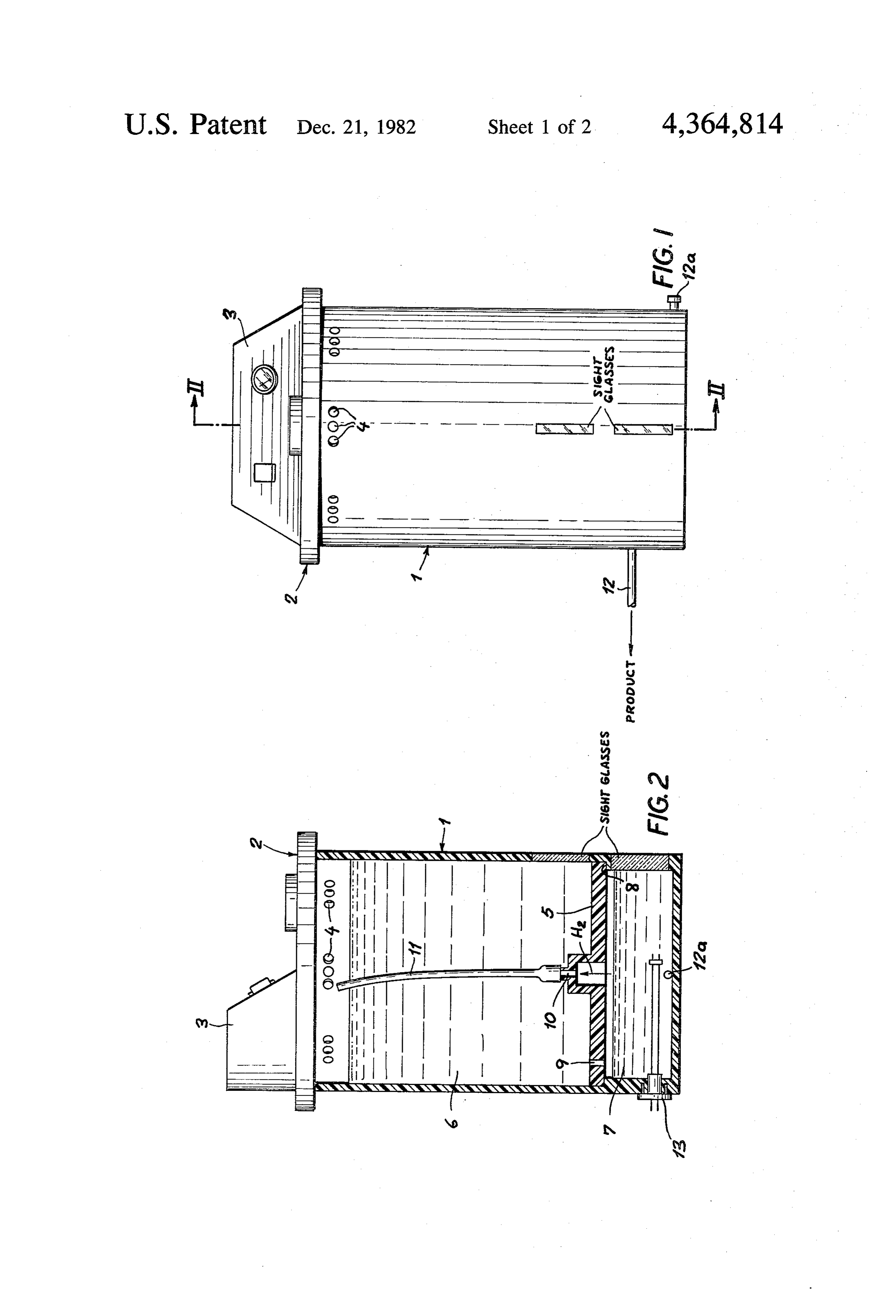
ends) leading from the lower compartment of said tank The interior of the tank is provided with a cell cover through an opening within a wall of said tank to permit 5 5 which forms a partition which divides the inside of the withdrawal of said aqueous alkali metal hypochlorite tank into two compartments; upper compartment 6 and solution. A particularly good use for the aqueous alkali lower compartment 7. Cell cover 5 is supported by metal hypochlorite solution is to chlorinate domestic shoulder 8 attached to the wall of the tank in the lower swimming pools, though there is no reason why the compartment. Cell cover 5 further includes channels 9 aqueous solution cannot be used for any conventional 10 and 10 which communicate between said upper com purposes. partment and said lower compartment. A hose 11 ex The lower compartment may also contain in the tank tends upwardly from channel 10 into the upper com wall a means for draining the contents of the lower partment and terminates in the vicinity of vent holes 4 compartment such as a hole and stopper. The lower near the top of the upper compartment.
compartment tank wall may also contain a sight glass to 15 The lower compartment 7 contains product line 12 permit one to determine the level of the aqueous alkali mounted into the tank wall. At the base of the lower metal hypochlorite solution in the lower compartment. compartment a drain and plug 12a is provided. Elec The anode and the cathode in said electrode assembly trode assembly 13 is removably mounted in the lower can each be made of any material conventionally used in compartment of said tank and may be removed from the electrolytic production of aqueous alkali metal hy- 20 said lower compartment through passage 14. The elec pochlorite solution from the corresponding alkali metal trode assembly is electrically connected to the D.C. brine. Preferably the anode comprises titanium ex power source by two wires (not shown).
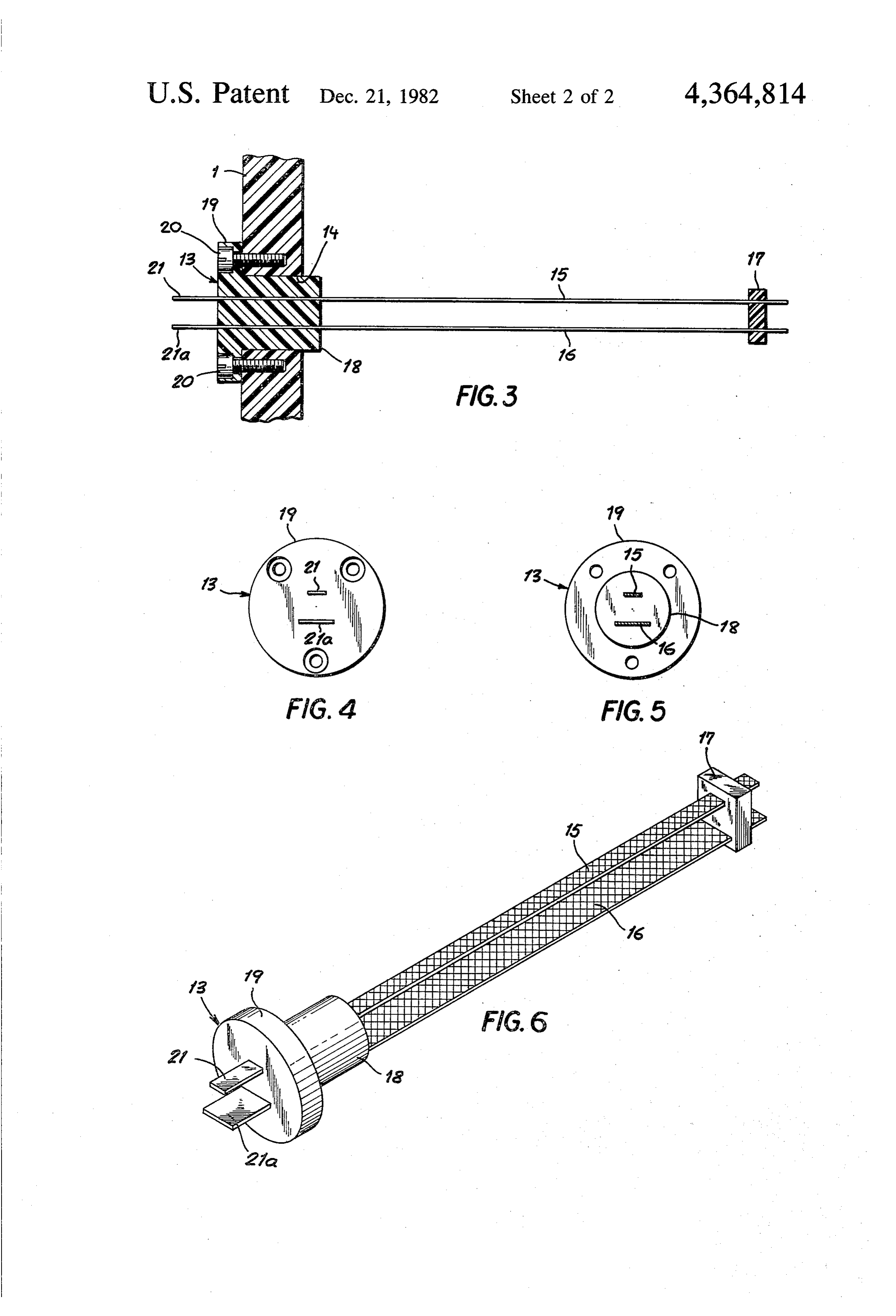
panded mesh coated with platinum-iridium. Preferably As shown in FIGS. 3-6 the electrode assembly 13 is the cathode comprises titanium expanded mesh coated removably inserted into the tank wall in passage 14. The with silver-titanium. These cathodes can be made as 25 electrode assembly comprises an anode 15, a cathode described in U.S. Pat. No. 4, 186,066. 16, an electrode spacer 17 inserted between said anode More specifically the electrode assembly removable and said cathode, a plug 18, and a connector 19. The from said tank preferably comprises as the support a anode 15 and cathode 16 are received in slits in the plug cylindrical insulating body receivable in a hole in the 18 and are electrically connected to tabs 21 and 21a wall of the lower compartment of said tank. The anode 30 embedded in said connector. It is the tabs that are ulti and the cathode project horizontally from said body. mately connected to the wires that run to the D.C. Preferably the support is formed as a plug having con power source.
ductual tabs of different size wherein one of said tabs is The plug and connector are secured to the tank wall connected to the cathode and the other tab is connected of the lower compartment 7 of the tank 1 by fastening to the anode. There is also a connector attached to the 35 the connector to the wall of said tank with screws 20. plug and which has terminals to match the tabs within The screws are inserted through the connector through the plug. The terminals attached to the plug may then corresponding holes in the wall of the tank in such a be connected by wires to the D.C. power source. way that the screws are not equally spaced from one The support is preferably mounted to said tank by another when one faces the front of said connector. The Screws spaced so as to maintain a predetermined posi- 40 plug secured to said connector is received in the lower tion of said anode relative to said cathode. The advan compartment of said tank through passage 14. tage to such spacing is that the electrode assembly, after In the operation of the apparatus brine is poured into cleaning, may be mounted back into the lower compart the upper compartment 6 of the tank 1 when the mov ment of the tank in but one way. As a result there will able tank cover 2 is displaced. When a sufficient supply never be confusion as to which electrode is the anode 45 of brine is added to said upper compartment which will and which electrode is the cathode. produce a predetermined amount of alkali metal hypo BRIEF DESCRIPTION OF THE DRAWING chlorite through electrolysis, the movable tank cover is closed and the D.C. power source is turned on. The
These objects and other objects, features, and advan brine passes controllably from the upper compartment 6 tages will become more readily apparent from the fol- 50 to the lower compartment 7 of the tank through passage lowing, reference being made to the accompanying 9. In the lower compartment the brine is electrolyzed to drawing in which: produce the corresponding alkali metal hypochlorite. FIG. 1 is an elevational view of the apparatus accord The alkali metal hypochlorite product is led from the ing to the invention; tank through product line 12. There the alkali metal FIG. 2 is a sectional view taken along line II-II of 55 hypochlorite can be channeled to whatever site deemed FIG. 1; advantageous. A particularly advantageous use for the FIG. 3 is a detail view of the electrode assembly product is the chlorination of domestic swimming according to the invention; pools.
FIG. 4 is a front view of the electrode assembly; While the aqueous alkali metal hypochlorite is being FIG. 5 is a rear view of FIG. 4; and 60 produced during the electrolytic reaction in the lower FIG. 6 is a detail perspective of the electrode assem compartment of the tank, hydrogen is also produced in bly. said lower compartment at the cathode 16. The hydro SPECIFIC OESCRIPTION gen is removed from the lower compartment by travel ing through channel 10 into hose 11. The hydrogen
As shown in FIGS. 1 and 2 a tank 1 is provided with 65 travels upwardly through hose 11 through the upper a movable tank cover 2 on which rests a D.C. power compartment past the level of the brine where said hose source 3 (e.g. rectifier). The D.C. power source may be 11 terminates. The hydrogen is ultimately passed out of clamped to the movable tank cover 2. The tank is fur the upper compartment through vent holes 4 into the 7 atmosphere. I wish to emphasize that the amount of 6.25% NaCl. The product of electrolysis will contain hydrogen released into the atmosphere is minimal and 4% NaOCl.
so there is no danger of fire when the apparatus is oper EXAMPLE 2 ated.
As mentioned hereinabove, it is very important that By changing the inside diameter of the tank described the space between the anode 15 and the cathode 16 be in Example 1 to 24 inches, the capacity of the tank is maintained at a minimum of one-half inch. Such a space increased 44%. By adding height to the upper compart is necessary in order to remove tenacious calcium and ment of the tank, another 3 or 4 days supply of brine can /or magnesium deposits that build up between the elec be stored if such a tank is made 6 or 7 inches taller. As trodes. Where the space between these electrodes is less 10 a result such a system will be able to supply enough than one-half-inch, removal of these tenacious deposits aqueous sodium hypochlorite solution to chlorinate a becomes very difficult. domestic swimming pool for 14 days. Such a system can After the operation of the apparatus has gone on for operate for 14 days unattended.
a period of time these tenacious deposits build up and it Furthermore, if tests indicate that an 8% sodium is time to remove the electrode assembly from the lower 15 hypochlorite aqueous solution is stable, potentially the compartment of the tank and remove the deposits. The system can operate for 28 days unattended. electrode assembly is unscrewed from the tank and To double the product from an apparatus of the immersed in water. A small brush or the like is used to above dimensions, a bipolar electrode could be placed remove the deposits from the electrodes. The minimum between the anode and cathode. Operation of the elec one-half inch space between the electrodes permits 20 trolytic cell at 15 amps and double voltage (e.g. 10 removal of the deposits in between with the brush. volts) would produce 2 pounds of product per day. This approach has strong appeal from the viewpoint of in
After cleaning the electrode assembly is again screwed ventory of components.
into the lower compartment of the tank and the continu I claim:
ous production of aqueous alkali metal hypochlorite 25 may resume. 1. An apparatus for the controlled production of an There are several features of the electrode assembly aqueous alkali metal hypochlorite solution, which com described herein. For one thing I prefer to employ a prises:
cathode that is larger than the anode. Such a size differ (a) tank and means forming a vent at an upper part of ence in the electrodes prevents mixing up the polarity of 30 (b)said tank;
tank cover movably mounted on the upper end same when electrically connecting the electrodes to the of said tank;
D.C. power source. Also the screws in the connector (c) an electrode assembly inserted into said tank and which serve to attach the entire electrode assembly to removable therefrom, said electrode assembly the lower compartment of the tank are not spaced. comprising an anode, a cathode, and a support equally from one another along the front of said con 35 holding the anode and the cathode at least one-half nector. Such an unequal spacing means that the connec inch from one another, but in juxtaposed relation; tor can be screwed into the corresponding holes drilled (d) a D.C. power source electrically connected to into the tank wall in but one way. Again such spacing of said anode and to said cathode; the screws avoids the possibility of confusing the elec (e) a partition within said tank dividing said tank into trodes and the polarity. 40 an upper compartment for containing brine and a EXAMPLE lower compartment containing the electrode as
The lower compartment of the tank which has over sembly, said partition defining at least one hole to all height of 30 inches, containing the electrode assem controllably allow brine to pass from said upper bly holds 6 gallons of aqueous sodium hypochlorite 45 compartment to said lower compartment and being solution and the product line is placed so that 3 gallons provided with means for allowing hydrogen pro of the hypochlorite solution always remain and the duced in the electrolytic cell in the lower compart electrodes are always covered. If the upper compart ment to pass through the brine in the upper com ment of the tank is depleted of brine, the electrolytic partment to then exit the tank through said vent; and cell can still run continuously without damage and will 50 (f) means communicating with said lower compart raise the temperature of 3 gallons of aqueous hypochlo ment to remove aqueous alkali metal hypochlorite rite solution less than 10 C. solution therefrom.
During construction, the cell cover can fit only in one 2. The apparatus defined in claim 1 wherein said position and it is adhesively bonded to the molded support comprises a cylindrical insulating body receiv shoulder of the brine tank. With an inside diameter of 20 55 able in a hole in a wall of said tank, said anode and said inches, the upper compartment of the tank holds a 7 day cathode projecting horizontally from said body. supply at the dimensions given. The cell cover has a 3. The apparatus defined in claim 1 wherein the sup series of holes on the edge opposite the product line. port holds the anode and the cathode about one inch Fresh brine feeds gradually through these holes to equal from one another.
the volume of fresh hypochlorite product withdrawn 60 4. The apparatus defined in claim 1 wherein said through the product line. anode is composed of titanium mesh coated with plati A raised portion of the cell cover is the hydrogen num-iridium.
collector. The hydrogen rises through a half inch flexi 5. The apparatus defined in claim 1 wherein said ble tube with ends above the brine level and which is cathode is composed of titanium mesh coated with sil fastened near the vent holes at the rear of the upper 65 Ve.
compartment of the tank. 6. The apparatus defined in claim 1 wherein said The salt feed is expressed in multiples of 5 pounds of support is formed as a plug having conductive tabs of salt to 9 gallons of water. Such a solution contains different sizes, one of said tabs being connected to said 8 cathode, another of said tabs being connected to said holding the anode and the cathode at least one-half anode, and a connector to said D.C. power source hav inch from one another, but in juxtaposed relation; ing terminals to match the tabs of said plug. (d) a partition within said tank dividing said tank into 7. The apparatus defined in claim 1 wherein said an upper compartment for containing a solution to support is mounted in said tank with screws spaced so as be electrolyzed and a lower compartment contain to maintain a predetermined position of said anode and ing the electrode assembly, said partition defining said cathode. at least one hole to controllably allow said solution 8. The apparatus defined in claim 1, further compris to pass from said upper compartment to said lower ing means for directing the aqueous alkali metal hypo compartment and being provided with means for chlorite solution to a swimming pool. 10 allowing gas produced in the lower compartment 9. An electrolysis tank which comprises: to pass through the solution in the upper compart (a) a vessel and means forming a vent at an upper part of said vessel; ment to then exit the tank through said vent; and (b) a cover movably mounted on said vessel; (e) means communicating with said lower compart (c) an electrode assembly inserted into said tank and 15 ment to remove electrolysis product solution there removable therefrom, said electrode assembly from.
comprising an anode, a cathode, and a support
Provenance
- Collection
- Patents citing this work
- Pages
- 8
- Method
- pdftotext (the PDF's own text layer) + pdftoppm 300dpi page scans
- Patent office record
- patents.google.com →
- Source
- Google Patents citing-documents table
- Assignee
- Langley Robert C
- Published
- 1982-12-21
- Transcribed from
- patentimages.storage.googleapis.com →