

patent · US4382189A
Hydrogen supplemented diesel electric locomotive
3 May 1983
Text
Page 1bibliographic recordscan →
United States Patent (19) 4,382,189 Wilson May 3, 1983 (54) HYDROGEN SUPPLEMENTED DIESEL References Cited
ELECTRC LOCOMOTIVE
(76) Inventor: John B. Wilson, 1008 Hanover Ct.,
Eldorado Hills, Calif. 95630 2,745,050 5/1956 Johnson et al. ..................... 318/367 3,648,668 3/1972 Pacheco .................................. 123/3 3,792,742 2/1974 Mager ............................... 180/65 F 3,980,053 9/1976 Horvath.................................. 123/3 21 Appl. No.: 262,051 4,111,160 9/1978 Talenti ........................... 123/1 A Filed: May 6, 1981 Primary Examiner-David Smith, Jr. Assistant Examiner-W. E. Duncanson, Jr.
Attorney, Agent, or Firm-Mark C. Jacobs
Related U.S. Application Data 57 ABSTRACT (63) Continuation of Ser. No. 42,340, May 25, 1979. A system is disclosed for using internally generated electricity as the power to OPERATE an electrolysis 51 Int. Cl. .............................................. FO2B 51/04 cell for the production of hydrogen gas. This hydrogen (52) U.S. C. .......................................... 290/3; 290/45; gas would be stored under pressure and used on demand 123/1 A as a fuel supplement as for hill ascension by a diesel (58) Field of Search ...... 123/1 A, 3, 119 E, DIG. 12; locomotive.
DSSPATE
STORAGE
PRESSURE
des
Drawings
Page 2drawing sheetscan →
Page 3scan →
HYDROGEN sUPPLEMENTED DESEL SUMMARY OF THE INVENTION
ELECTRIC LOCOMOTIVE The foregoing objects and other features and advan tages of the invention are attained by generating elec
This is a continuation, of application Ser. No. 42,340, 5 tricity from the excess energy available from dynamic filed May 25, 1979. - brakes employed in diesel locomotives, which electric ity is used in an electrolysis cell to separate water into
FIELD OF THE INVENTION its various gaseous components, namely hydrogen and This invention relates to prime movers of the type 10 oxygen. The hydrogen is stored for use during demand situations, at which time it is injected into the combus utilizing a diesel engine as the motivating energy and to tion chamber of the diesel locomotive, while the oxygen the process of utilizing energy generated by the traction gas is either dissipated or in part stored for use in the motors as the operating force for an electrolysis cell for combustion of the hydrogen and standard diesel fuel. the generation of hydrogen gas for use as a supplemen Air may also be utilized to supplant or totally replace ial fuel for the diesel engine of a locomotive. 15 any oxygen not available from the storage facility on Heretofore numerous attempts have been made to board for the oxidation reaction of combustion.
supplement motive power for both automobiles and While not disclosed in detail, herein, it is recognized iocomotives for use under extreme operating conditions that the diesel electric locomotives upon which the as when ascending steep hills. Thus, Sugiyama in U.S. invention is to be employed operate on the principle of Pat. No. 3,886,810 employs available excess power from 20 the diesel fuel fired engine being operatively connected a prime mover in conjunction with a flywheel to power to a generator which generates power to operate trac the prime mover when additional power is required. He tion motors.
discloses a control system for accomplishing the desired BRIEF DESCRIPTION OF THE DRAWINGS result.
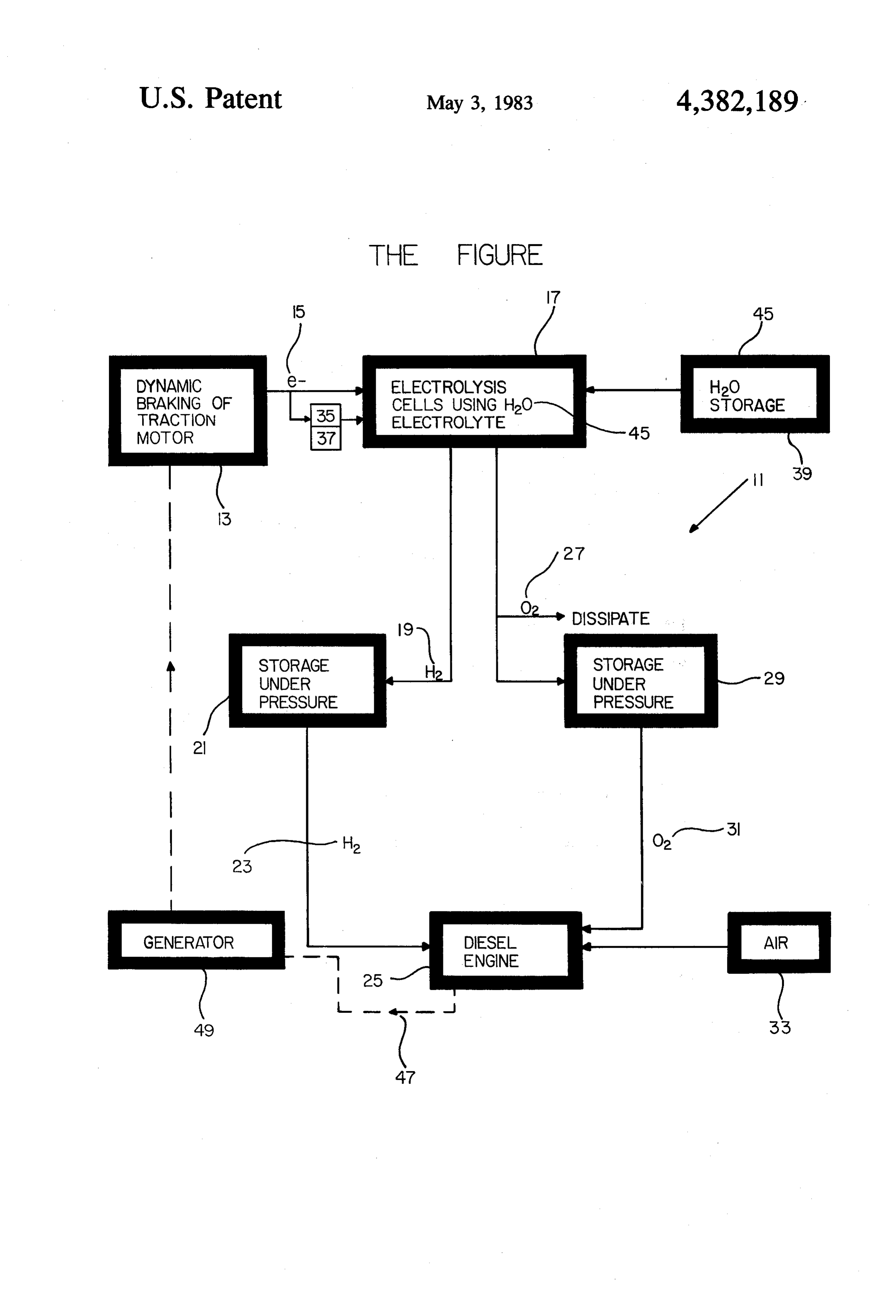
Indeed, Tabor in U.S. Pat. No. 3,858,674 discloses the 25 The FIGURE is a block diagram of the process of use of an electric motor flywheel system. This is but this invention.
representative of what is known today as the state of the DETAILED DESCRIPTION OF THE DRAWING art.
It has long been a problem for the railroad industry to 30 andThis invention is directed to a method of generating supplying hydrogen gas as a fuel supplement to an be able to provide sufficient motive power to ascend internal combustion engine and in particular to a diesel steep hills, such as in the Sierra Nevada mountains. locomotive engine. The invention further relates to the Accordingly, it has been necessary to utilize 2, 3 or even generation of the hydrogen by a fuel cell to serve as a more diesel engines to move long freight trains from the supplemental fuel in the diesel engine. By supplement plateau from the Reno, Nevada area through the moun 35 ing the burning of a conventional fuel with hydrogen, tains to the Great Central Valley of California, which the internal combustion is capable of producing more has an elevation of approximately 140 feet and vice work when operating.
versa. The Sierra Nevada mountains in northern Cali The method of generating the needed hydrogen is by fornia reach a maximum elevation of over 7000 feet. the electrolysis of water. To enhance the electrolysis, a In the journal Rail Classics, Vol. 6, No. 1 of January catalyst such as sodium hydroxide, potassium carbon 1977 Escher Technology Associates proposed the use ate, may be added to the water electrolite. Preferably of hydrogen as the fuel for a diesel locomotive. It was the hydrogen gas should be dried prior to pumping of stated that super-cold liquified hydrogen would be fed same to a storage facility on board the locomotive or in from a large insulated container in a specially designed a separate tender. Oxygen gas that is generated is either tender to the locomotive where the hydrogen would be 45 dissipated or stored for further utilization when needed. injected into the diesel engine conventional fashion. The rate of generation of the hydrogen and oxygen The proposal of Escher presupposes the presence of gases may be controlled by techniques known to the art. hydrogen gas in this specially designed tender car, Diesel locomotives that operate in mountainous re which of course would be required to stand impace as gions generally are equipped with what are known to well as normal operating temperature extremes due to 50 the art as dynamic brakes. Such brakes utilize the trac weather. tion motors mounted on the driving axles of the loco It is an object of this invention therefore to provide a motive weight as power generators. These are powered by the of the descending train. The resistance provided method and apparatus whereby hydrogen can be gener by the generation of electricity is the braking force ated by electrolysis from water stored in a diesel elec 55 keeping the train under control on the descent of down tric locomotive, utilizing electricity generated on board grades. The amount of dynamic braking to be applied the locomotive. can be varied under the control of the engineer. Cur It is another object of the invention to utilize this rently, the electricity from the dynamic brakes as is generated hydrogen as a supplemental fuel for the diesel known to the art is passed through grids similar in con engine when ascending hills and for other difficult time struction, but larger than the grids used as resistance of operation. elements in electric toasters. Heat is dissipated to the Another object is to provide a system for powering a atmosphere by the air circulation passing over the grids. locomotive which employs supplemental power that is It is seen therefore that a change of state from electrical generated during normal operating conditions and energy to heat energy takes, place. Oftimes supplemen which is to be employed during extreme operating con 65 tal fans are used to exhaust the heat.
ditions. In view of the fact that this electricity generated due Further objects will in part be obious and will in part to the weight of the descending train when it operates in appear hereinafter. - .. . .. mountainous terrains is totally wasted, it is indeed re 4 gretful that excess weight and cost are employed for the would be either mixed with conventional diesel fuel or disposal of such electricity when in these troubled times injected directly into the cylinders to reduce the con it would be in the best interest of the railroad to utilize sumption of standard fuel by what is estimated to be suich self-generated electricity for useful work. between 10% and 15% of the fuel requirements of the 'It is seen therefore that the instant invention is di engine. Such gas injection systems are known to the art rected to a "battery” type system which utilizes this today. Oxygen 31 could be pumped from storage ves self-generated electricity as the basis for the electrolysis sels 29 for use in the combustion of both the conven of self-contained water within the locomotive for the tional diesel fuel and the hydrogen. Supplemental air 33, generation of hydrogen. which contains oxygen, can also be pumped into the Turning to the FIGURE. It is seen that the traction 10 combustion chamber, as is conventionally carried out. motors 13, when the train is in downhill travel, give rise It is seen that I have disclosed a total system that to electricity 15 which serves as the power needed for utilizes the electricity generated by the operation of the electrolysis cells 17. Thus, in this first aspect of the dynamic braking of a locomotive as the power source system 11, it is to be seen that the exact amount of elec for the operation of the electrolysis cells whereby hy tricity as measured in direct current voltage would 15 drogen may be generated for use under difficult operat depend upon the incline of the grade being descended, ing conditions of the locomotive.
the type of locomotive, the weight of the train, and of It is to be seen that the invention contemplated herein course, the design of the individual dynamic braking may be employed on many different locomotives. The system. It is safe to say, however, that amperages in the invention is primarily intended for utilization in North neighborhood of 800 amps DC can be generated when America due to the fact that most European countries traveling downgrade through the Sierra Nevada moun have totally electrified their railroad systems. The most tains of northern California. recent country undergoing electrification is the Soviet The electricity 15 so generated may be employed Union.
directly in the electrolysis cells 17, or it may be utilized Typically, the engines capable of utilizing the inven to charge a battery for the subsequent use of electricity 25 tion of this application are the hood-type road switch if not required at the moment of generation. The con ers. An example of same that had the dynamic brake cept of utilizing the momentum of a rail car or other guides, which are dispensed with to carry out this in basis for electricity for the storage of a battery on board vention, is the General Electric V36B. See "Trains', the locomotive or railcar for subsequent use is shown in April 1979, at Page 24 to 29, which is incorporated the U.S. Pat. of Pfeil,723,727. Optionally, the battery 35 30 herein by reference.
may comprise one or more storage batteries and may be It is to be readily understood that for maximum safety used in conjunction with generators to partially re the hydrogen that is transported should be transported charge the bank of batteries when the engine is descend at low pressure from the electrolysis unit to the storage ing. Such a generator system is designated 37. For more vessel, at which place the compression for storage details of such a combined battery generator regenera 35 would transpire. - tive power system for use in a vehicular enviroment, It is also within the scope of this invention to store the reference should be made to U.S. Pat. No. 3,972,380 to electricity 15, generated from the operation of the dy Hudson and Toby. namic brakes, by operating a motor which is connected * The electrolysis cell or cells 17 would include a hous to a flywheel in order to achieve RPM of the flywheel. ing having one or more partitions therein to define a The motor is then operated in reverse to revert the multi-chamber of fuel cells. The cell is charged with an kinetic energy of the flywheel back to electrical energy electrolite comprising water, alone or in combination for use in the electrolysis cells 17.
with a catalyst, such as sodium hydroxide, potassium While specifically disclosed with respect to a loco carbonate or other catalysts known to the art. Extend motive, if a dynamic type braking system can be made ing into the electrolite reservoir are a plurality of posi 45 operative for trucks, or other vehicles, the total system tive and negative electrodes. When the electrodes are of this invention may be employed there as well. energized, hydrogen and oxygen gas are liberated at the While not specifically shown in the drawing, water to respective positive and negative electrodes. Hydrogen be employed as the electrolite would be pumped to the gas 19 generated in cells 17 may be stored under pres electrolysis cells 17 from any suitable location on the sure in storage devices 21 for later use as hydrogen 23 in 50 locomotive 37. Such pump mechanism and storage the combustion chamber of diesel engines 25. Reference tanks are conventional in the art.
is made to U.S. Pat. No. 4,031,865 issued to Patrick OPERATION Dufour, which pertains to a hydrogen oxygen fuel cell for use with internal combustion engines. The fuel cell It is seen that in the normal operation of a diesel disclosed in that patent has direct utility in the invention 55 electric locomotive, that diesel engine 25 operating on of this application, and accordingly the disclosure of diesel fuel, generates power, by driving a generator 49, that patent is incorporated herein by reference. which in turn sends power to the traction motors 13. The separation of the hydrogen gas 19 from oxygen The one or more traction motors mounted in the trucks 27 as generated by the electrolysis cells 17 is within the of the locomotive act as the driving force. The axle of skill of the art. The oxygen gas 27 is allowed to dissipate the wheels that are powered are connected by gearing into the atmosphere through suitable exhausting means, to the motor 13's armature shaft.
not shown, or it may be stored under pressure in storage When the train is descending a hill, a polarity switch tanks 29 for use during an ascending period of travel by is actuated such that the traction motor 13 instead of the locomotive. The compression and storage of both accepting electricity. from the generator. 49, actually hydrogen and oxygen is well known to the prior art. 65 generates electricity itself, which electricity is normally When the locomotive 37, not seen in the drawing, dissipated as heat. Here instead of dissipating the elec requires further power for its diesel engine 25, as for tricity as heat through grids (a principle referred to in pulling a heavy load up a steep incline, hydrogen 23 the art as dynamic braking) the electricity.15, is utilized.
Page 5scan →
The broken line 47 represents the normal flow of (e) means for supplying generated hydrogen to said power from the diesel engine to the generator to the diesel engine as a fuel for said engine. traction motors. There is, as is known, no mechanical 2. The locomotive of claim 1 including: linkage between engine 25 and traction motors 13. (g) means for separately storing oxygen generated in The lag time, if any, between the time of generation said electrolysis cell. of the electricity for the electrolysis of the water 45 and 3. The locomotive of claim 2 further including: the actual ability to split the water molecules, can be (h) means for supplying stored oxygen to said diesel eliminated by having water 45 in the cells 17 awaiting engine.
electrolysis and by having hydrogen prepared, stored in 4. In the locomotive of claim 1 further including tanks 21 as soon as it is made. Thus any hill that arises 10 storage means for storing hydrogen generated in said at will have a supply of hydrogen waiting to be burned least one electrolysis cell.
rather than relying on the timely immediate preparation 5. The method of supplementing the power of a diesel of same for immediate usage. electric locomotive for heavy local conditions, which The actual utilization of the hydrogen in so far as comprises:
dosage per gallon of diesel fuel is at this stage of the 15 (a) dynamically braking the locomotive upon descent advancement of technology either previously known or of hills, to generate D.C. current; within the skill of the art to determine for a particular (b) energizing on electrolysis cell containing water to locomotive. separate the water into H2 and O2, said cell being dis I claim: posed in the locomotive or some other car of said train, 1. A hydrogen supplementally fueled diesel powered (c) feeding the H2 gas into the diesel engine of said locomotive comprising: locomotive.
(a) a conventional diesel electric locomotive having a 6. The method of claim 5, further including storing diesel engine as its prime mover, the H2 gas after the preparation thereof, prior to feeding (b) traction motors mounted in said locomotive the gas to the diesel engine.
adapted for dynamic braking of said locomotive 25 7. The method of claim 5 including feeding at least a and adapted to generate electricity when actuated, portion of the O2 into the diesel engine. (c) at least one electrolysis cell for the electrolytic 8. The method of claim 7 further including the step of decomposition of water, supplementing the O2 with air for use in the diesel en (d) means coupled to said traction motors and to said, gine.
at least one, electrolysis cell to deliver electricity 30 9. The method of claim 5 including the step of storing from said traction motors to said cell upon dynamic the O2 after the preparation thereof. braking to generate hydrogen, . . . .
Provenance
- Collection
- Patents citing this work
- Pages
- 5
- Method
- pdftotext (the PDF's own text layer) + pdftoppm 300dpi page scans
- Patent office record
- patents.google.com →
- Source
- Google Patents citing-documents table
- Assignee
- Wilson John B
- Published
- 1983-05-03
- Transcribed from
- patentimages.storage.googleapis.com →