

patent · US4439299A
Electrolytic metal reclamation device
27 March 1984
Text
Page 1scan →
United States Patent (19)
Houseman
(54) electrolytic metal reclamaton
Device
75 Inventor: Kenneth R. Houseman, Westlake,
Ohio 73) Assignee: General Dental, Inc., St. Louis, Mo.
(52) u.s. c. ................................ 204/271; 204/290 r;
2,349,083 5/1944 Farr, Jr. .......................... 204/242X 2,505,228 4/1950 Chase .................................. 204/271 2,616,845 11/1952 Kreml ................................. 204/242
4,316,787 2/1982. Themy ............................ 204/27 X Primary Examiner-Donald R. Valentine
Attorney, Agent, or Firm-Pearne, Gordon, Sessions, McCoy, Granger & Tilberry
A device for recovering metal from an aqueous bath generating metal ions, by means of an electrolytic pro cess. The device includes a source of direct current and a non-conductive base plate adapted to be immersed in the aqueous bath. One face of the base plate has a con ductive anodic surface layer thereon operatively con nected to the direct current source for charging the anodic surface positively. The other face of the base plate has a conductive cathodic surface layer thereon also operatively connected to the direct current source for charging the cathodic surface negatively so that metal from the metal ion bath is plated onto the ca thodic surface.
5 Claims, 6 Drawing Figures
Drawings
Page 2drawing sheetscan →
Page 3drawing sheetscan →
Page 4scan →
tive anodic surface layer thereon operatively connected
ELECTROLYTIC METAL RECLAMATION to the direct current source for charging the anodic DEVICE surface positively. The other face of the base plate has a conductive cathodic surface layer thereon also opera
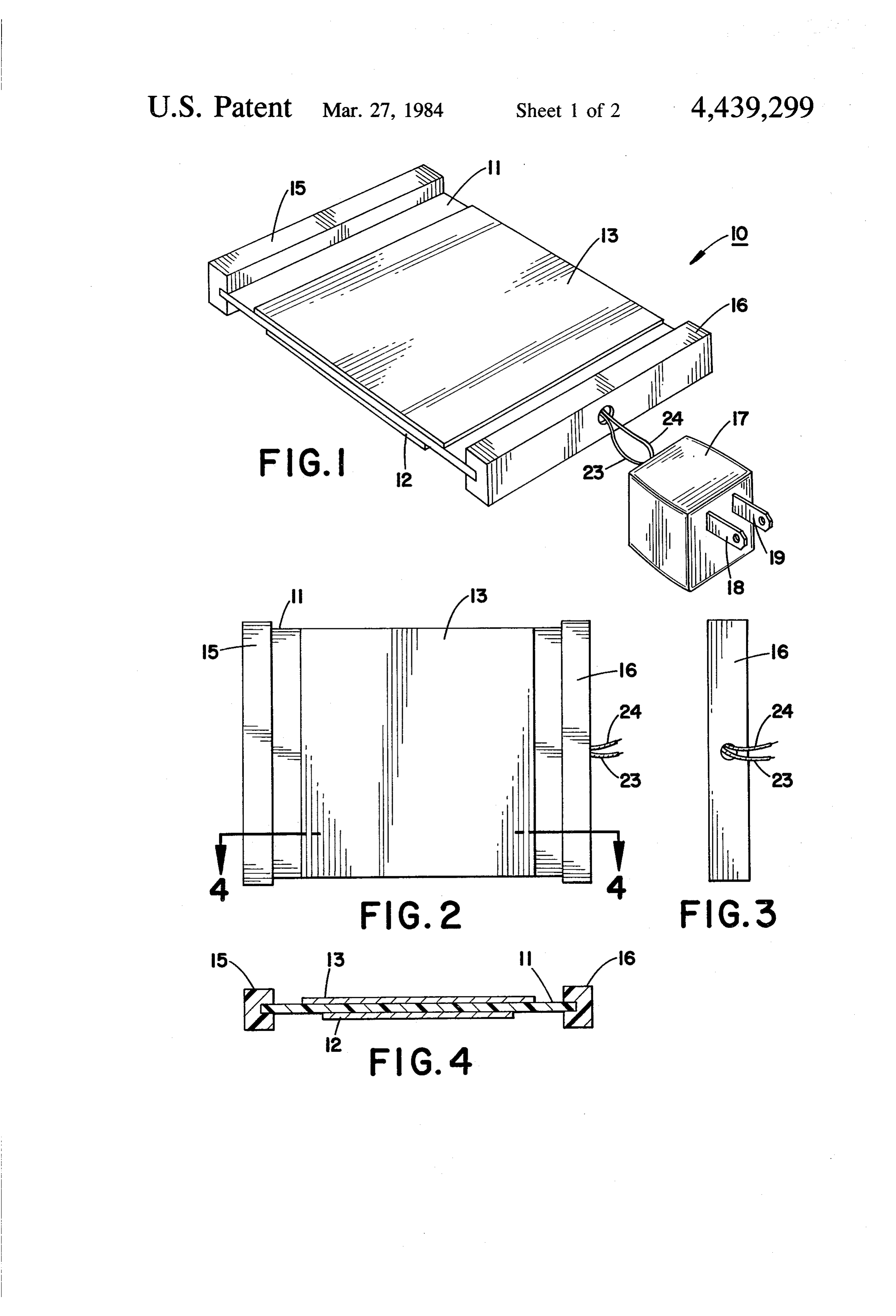
BACKGROUND OF THE INVENTION tively connected to the direct current source for charg This invention relates to the recovery of metal in ing the cathodic surface negatively so that metal from aqueous solutions, and more particularly to an electro the metal ion bath is plated onto the cathodic surface. lytic device for recovering metal in an aqueous bath that is generating metal ions. The metal recovery pro 10 BRIEF DESCRIPTION OF THE DRAWINGS cess proceeds simultaneously with the process that gen FIG. 1 is a perspective view of the metal recovery erates the metal ions. The device of the invention is device of the invention; - particularly useful in connection with the recovery of FIG. 2 is a plan view of the metal recovery device silver from fixing solutions used in photographic or shown in FIG. 1; - X-ray film processing wherein the device is operable to 15 FIG. 3 is a side elevation of the metal recovery de recover silver simultaneously with the fixing process vice of FIGS. 1 and 2;
that produces silver ions. FIG. 4 is a sectional view taken on the line 4-4 of Methods for the electrolytic recovery of metal gener FIG. 2;
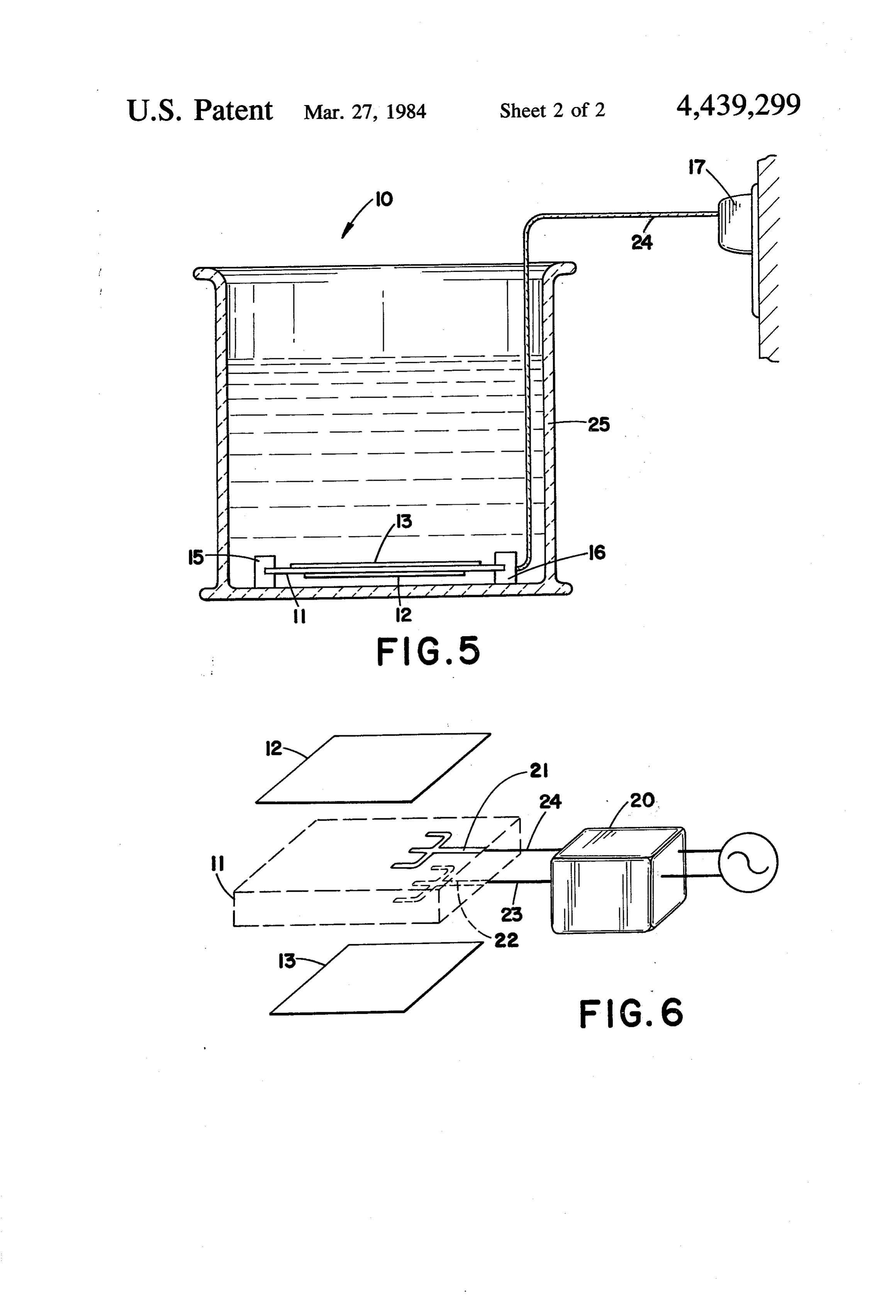
ally involve the immersion of a pair of electrodes within FIG. 5 is a sectional view showing the metal recov the aqueous electrolytic solution containing metal ions. 20 ery device in use in an aqueous electrolytic solution A voltage of sufficient magnitude is impressed across containing metal ions; and the electrodes to effect migration of the metal ions to FIG. 6 is primarily an electrical schematic showing the cathode surface, whereupon the metal ions become the electrical connection of the various circuit elements deionized and deposit a continuous film or coherent of the device.
plate on the cathode surface. Thereafter the metal plate 25 DESCRIPTION OF THE PREFERRED can be removed.
For example U.S. Pat. No. 3,953,313 discloses an EMBODIMENT electrolytic cell containing a plurality of alternate Referring more particularly to the drawings, there is anode and cathode plates spaced laterally and having a shown a metal recovery device 10 adapted to be im sheet of mesh material on each electrode thus providing 30 mersed in an aqueous bath generating metal ions such as a plurality of holes therein. Alternatively, each electro the fixing bath used in a process for developing photo lytic cell has a housing provided with an inlet pipe and graphic or X-ray film. The device includes a base plate an outlet pipe adapted to transfer the electrolytic solu 11 formed of a non-conductive material such as a natu tion from a storage container to the electrolytic cell.
The electrolytic solution is processed in the electrolytic ral or synthetic plastic material such as polyethylene, polyethylene terephthalate, polypropolyene, polysty rene, polyvinylchloride, phenol formaldehyde resin,
Other methods of metal recovery are shown in U.S. polyurethane, polyamide, polyester, epoxy resins as Pat. Nos. 3,663,416 and 4,174,026 wherein a helical or well as natural or synthetic rubbers or elastomers such spiral electrode element is placed in a container wherein as butadiene styrene, vinyl and acrylic copolymers and fluid passageways interconnect the container with a polychloroprene or other rigid or semi-rigid plastic storage or metal ion producing bath. The prior art pro structural material.
cesses, however, require separate self-contained elec trolytic cells to recover the metal in a separate process layer appliedofthereto
One face the base plate 11 has a conductive surface to form an anodic surface 12 and from that which produces the metal ions. the other face of the base plate 11 has another surface The device of the present invention, however, is effective to recover metal from an aqueous bath that 45 layer of conductive material applied thereto to form a generates metalions simultaneously and in the same unit cathodicconductive surface.
in which the metal ion generating process is proceeding. orThe non-oxidizing anodic surface 12 is a non-sacrificing material and advantageously con
As indicated above, the device is particularly useful for prises plastic containing recovering silver from the fixing bath utilized in a pho carbon, platinized titaniumconductive material, such as tographic or X-ray fixing process that results in the cathodic layer 13 can also be a flexible The 50 or tantalum. conductive plastic contain generation of silver ions. ing conductive material such as silver, graphite or car SUMMARY OF THE INVENTION bon as suggested in U.S. Pat. Nos. 3,953,313, and It is among the objects of the present invention to 4,175,026, or carbon black as suggested in U.S. Pat. No. recover metal from an aqueous bath simultaneously 55 4,009,093.
with the process that generates metal ions in the bath. caps Located at opposite ends of the base plate 11 are end Another object is to simplify the recovery of silver and the 15 and 16 which serve to support the base plate 11 ions from a fixing bath for a photographic or X-ray anodic and cathodic surfaces 12 and 13 thereon developing process. in the container for the aqueous bath in such a way that These and other objects and advantages are achieved surfaces 12 and 13 are spaced from any wall, floor or with the novel metal recovery device of the invention any other structure of the container for the bath. which is adapted to be immersed in an aqueous bath The device 10 is adapted to be connected to a wall undergoing simultaneously a process resulting in the receptacle for a standard 110 volt electrical power line generation of metal ions. The device includes a direct 65 by means of a plug 17 with conventional prongs 18 and current source and a non-conductive base plate with 19. The plug also serves as the housing for a rectifier 20 spacers thereon to position the faces of the plate away (FIG. 6).
from the surfaces of the receptacle that contains the byThe positive terminal of the rectifier 20 is connected a lead 23 to a positively charged electrical pole ele aqueous bath. One face of the base plate has a conduc 5 ment 21 formed in the respective face of the base plate recovering metal by electrolytic deposition from said 11 and in contact with the anodic surface 12 and an aqueous bath, said device comprising: other lead 24 serves to connect the negative terminal of a direct current source;
the rectifier to a negatively charged electrical pole a non-conductive flat structural base plate; element 22 formed in the opposite face of the base plate a positively charged electrical polar means formed on 11 and in contact with the cathodic surface 13. one face of said base plate and operatively con FIG. 5 shows the metal recovery device 10 posi nected to said direct current source; tioned in an aqueous bath located in a container 25. It a negatively charged electrical polar means formed will be noted that the end caps 15 and 16 rest against the on the other face of said base plate and operatively bottom of the container so that the anodic and cathodic O connected to said direct current source; surfaces 12 and 13 are well spaced from any wall or a flat planar anodic surface layer comprising a flexible other structural part of the container. plastic material containing conductive particles In operation, such as in recovering silver from a fix formed on said one face of said base plate overlying ing solution for photographic or X-ray film, the device and contacting said positively charged polar means is placed in the aqueous bath in which silver ions are 15 for charging said anodic surface layer positively; being produced and the plug 17 is inserted into a conve a flat planar cathodic surface layer comprising a flexi nient wall outlet. A direct current is impressed upon the ble plastic material containing conductive particles anode surface 12 and the cathodic surface 13 so that metal ions migrate toward the cathodic surface 13 and formed on said other face of said base plate overly are plated thereon. After a buildup of plated silver is ing and contacting said negatively charged polar achieved, the device 10 is removed from the processing means for charging said cathodic surface layer bath and plated silver is removed, such as by scrapping negatively;
or other means. When the plated silver is removed, the means for supporting said base plate in said aqueous device can again be immersed in the fixing bath to con bath lying flat on the bottom of said container with tinue the silver recovery process. The device is opera 25 said anodic and cathodic surface layers exposed in tive to recover silver or other metal without disturbing their entirety to said aqueous bath; the chemicals or the primary process generating the whereby to cause metal from said metal-ion-contain metal ions. ing aqueous bath to be plated onto said cathodic While the invention has been shown and described surface layer.
with respect to a specific embodiment thereof, this is 30 2. A combination as defined in claim 1, wherein said anodic surface layer comprises a plastic material con intended for the purpose of illustration rather than limi taining tation and other modifications and variations of the conductive particles from the group consisting specific device herein shown and described will be of carbon, platinized titanium, and tantalum. apparent to those skilled in the art all within the in 3. A combination as defined in claim 1, wherein said tended spirit and scope of the invention. Accordingly, 35 cathode surface layer comprises a flexible plastic mate the patent is not to be limited in scope and effect to the rial containing conductive particles from the group specific embodiment herein shown and described nor in consisting of silver, graphite, or carbon. any other way that is inconsistent with the extent to 4. A combination as defined in claim 1, wherein said which the progress in the art has been advanced by the metal ions in said aqueous bath comprise silver ions. invention. 5. A combination as defined in claim 1, wherein said What is claimed is: direct current source comprises a rectifier operably 1. In combination, a container for an aqueous bath connectable to a receptacle for a 110-volt electrical generating metal ions and a device immersed in said supply circuit.
container and positioned flat on the bottom thereof for
Provenance
- Collection
- Patents citing this work
- Pages
- 5
- Method
- pdftotext (the PDF's own text layer) + pdftoppm 300dpi page scans
- Patent office record
- patents.google.com →
- Source
- Google Patents citing-documents table
- Assignee
- General Dental, Inc.
- Published
- 1984-03-27
- Transcribed from
- patentimages.storage.googleapis.com →