

patent · US4508774A
Cellular, molded polyurethane parts, process for their preparation by thermoforming of polyester-urethane foam and their use
2 April 1985
Text
Page 1bibliographic recordscan →
United States Patent (19)
Grabhoefer et al.
54). CELLULAR, MOLDED POLYURETHANE
PARTS, PROCESS FOR THEIR
PREPARATION BY THERMOFORMING OF
POLYESTER-URETHANE FOAMAND
THEIR USE
(75) Inventors: Herbert Grabhoefer, Limburgerhof
Otto Volkert, Weisenheim, both of
Fed. Rep. of Germany 73 Assignee: BASF Aktiengesellschaft,
Ludwigshafen, Fed. Rep. of
Germany
Int. Cl. .............................................. C08G 18/14 52 U.S. Cl. .................................... 428/220; 264/321;
Field of Search .................... 521/51, 50; 428/220,
3,400,196 9/1968 Le Roy ............................ 428/311.5
3,740,283 6/1973 Maxey .............................. 428/304.4 4,059,660 1 1/1977 Roth et al. ......................... 264/46.4 4, 19,749 10/1978 Roth et al. ............................ 428/99 4,129,697 12/1978 Schapel et al. ... 521/176 4,241,131 12/1980 Bailey ................................. 264/257
FOREIGN PATENT DOCUMENTS
Primary Examiner-Maurice J. Welsh
Attorney, Agent, or Firm-William G. Conger; Joseph D. Michaels
A cellular polyurethane having a density of from 15 Kg/m3 to 400 Kg/m3 obtained by means of thermo forming, in a forming tool, at a compression factor of from 1 to 10 and temperatures of from 140C. to 200 C., polyester-urethane foams having a density of from 15 Kg/m3 to 40 Kg/m3 which are based on aromatic polyisocyanates and polyester polyols. The resulting polyurethane shaped objects are suitable for use as self supporting trim panels, headliners, engine compartment covers, or instrument panels in the automotive, aircraft or railway industries.
13 Claims, 1 Drawing Figure
Drawings
Page 2drawing sheetscan →
Page 3scan →
complicated shapes with relatively high-viscosity poly
CELLULAR, MOLDED POLYURETHANE PARTS, urethane mixtures. If this were possible at all, very high PROCESS FOR THEIR PREPARATION BY pressure would be required.
THERMOFORMING OF POLYESTER-URETHANE The object of this invention is to prepare cellular, FOAM AND THEIR USE self-supporting, polyurethane shaped objects, having BACKGROUND OF THE INVENTION large surface area and low densities, whereby said ob jects may be produced economically at high volume.
1. Field of the Invention The polyurethane shaped objects should possess a high The present invention relates to thermoformed cellu degree of sound absorption, good thermal insulation lar polyurethane. More particularly, the invention re 10 properties, high flame resistance and the ability to re lates to the formation of shaped polyurethane parts, especially panels, by the thermoforming compression of cover suitable from compression loads. Polyurethane foams for use as the initial components ought not to polyester-urethane foams. The resulting shapes and exhibit core discoloration or scorching. panels are advantageously used in the railway, autono tive, and aircraft industry as headliners, trim panels, 15 SUMMARY OF THE INVENTION engine compartment covers, and the like. The subject invention relates to cellular polyure 2. Description of the Prior Art
Formed sheets such as trim panels, headliners, and thanes having a density of from 15 Kg/m3 to 400 which are produced by thermoforming polyure vehicle trim have exhibited great utility in the automo thane foams having a density of from 15 Kg/m3 to 40 tive, aircraft, and railway industries. As described in 20
German Pat. No. 2,602,839 (U.S. Pat. No. 4,059,660 and Kg/m, and which are based on aromatic polyisocya U.S. Pat. No. 4,119,749), such sheets may be formed by nates and predominately polyester polyols. The thermo laminating smooth sided corrugated paper with a foam forming process takes place in a forming tool at a com layer, for example, a layer of polyurethane foam. An pression factor of from 1 to 10 at temperatures from adhesive is utilized to adhere the various layers follow 25 140 C. to 200 C.
ing which the components are bonded together under The thermoforming of flexible, semi-rigid, and rigid pressure at room temperature and formed to the desired polyurethane foams having densities up to 40 Kg/m3 shape. The preparation of these sheets is highly labor represents a useful addition to in-mold foaming and can intensive and is unsuitable for large-scale production. be used in many cases where conventional methods of Reversibly thermoformable fiber-reinforced rigid 30 producing shaped parts are unavailable. This process polyurethane plastics may be prepared according to can also be used to produce self-supporting shaped parts German Pat. No. 2,164,381 (Great Britain Pat. No. with complicated shapes, large surface area, and low 1,411,958) by incorporating inorganic or organic fibers densities which remain true to contour and which may in a partially reacted polyurethane system which is be produced at high part rates.
liquid up to 50° C., containing primarily bifunctional 35 polyols having hydroxyl numbers from 100 to 600, and DESCRIPTION OF THE PREFERRED modified polyisocyanates or polymeric diphenylme EMBODIMENTS thane-diisocyanates. The disadvantage of this two-step In order to produce the cellular thermoformed poly process is that the fiber reinforcing material, whether urethane shaped objects of the invention, it is necessary woven or non-woven, must first be coated with a flow that the selected starting polyol component comprise able polyurethane reaction mixture followed by curing polyester polyols, possibly mixed with no more than 45 in a closed mold at temperatures over 120° C. The flat weight percent polyether polyols based on the total sheets produced in this manner can then be therno weight of formed at temperatures from 130 C, to 220 C. How componentthe polyol component, and the isocyanate comprise a mixture of diphenylmethane ever, this cost-intensive process also limits the rate at 45 diisocyanates and polyphenyl-polymethylene which molded parts may be produced to a low number cyanates, subsequently referred to as polymericpolyiso MDI. of parts per unit time. This system can be used to continuously produce flexi German Pat. No. 2,607,380 (U.S. Pat. No. 4,129,697) ble, semi-rigid, or rigid polyurethane slab foams on describes the preparation of thermoformable polyisocyanurate foams by reacting polyether polyols, 50 conventional slab foam equipment, or discontinuously glycols, and diphenylmethane diisocyanate, which can in open molds. These slab foams exhibit densities of 15 contain up to 20 weight percent closely related polyiso Kg/m3 to 40 Kg/m3, preferably 20 Kg/m3 to 38 Kg/m3, cyanates of higher molecular weight. Expansion takes are thermoformable, and possess the desired mechanical place in heated molds or on conveyors, whereby the properties, e.g., cushioning, recoverability, hydrolysis foams are post cured or tempered for approximately 15 55 resistance, sound absorption capabilities, etc. minutes at 80° C. One of the disadvantages of this pro Suitably dimensioned foam, corresponding in size to cess is that the polyisocyanurate foams are brittle, do the shaped object which is to be produced, are cut from not exhibit internal cushioning, and are poor sound the resulting polyurethane foam slabs. The initial slabs absorbers. Moreover, polyisocyanurate slab foams can can have dimensions up to 1 mx2 m x 60 m. The cut not generally be produced with slab thicknesses greater 60 slabs must be as free as possible from scrap and dust, than 50 cm since otherwise foam core discoloration can must be able to be split into foam sheets having a thick OCC.T. ness of from 2 mm to 20 cm, preferably from 2 mm to 10 It is difficult or even impossible to use in-mold foam cm, and more preferably from 5 mm to 25 mm. Standard ing to produce flat structures with wall thicknesses industrial splitting equipment is suitable, while oscillat from 1 mm to 6 mm suitable for trim panels, headliners, 65 ing hot-wire slicers are preferred in actual practice. It engine compartment covers, since this would lead to must be cautioned that the larger size foam sheets must very high gross densities. In addition, it is extremely exhibit sufficiently high mechanical stability to be able difficult to completely and uniformly fill molds having to withstand being transported without damage.
Page 4scan →
In order to produce the polyurethane thermoformed copper, brass, gold, or steel up to 0.3 mm thick; poly objects of the invention, the foam sheets which, as al mers such as polyvinyl chloride, acrylo-butadiene-sty ready stated, have densities of from 15 Kg/m to 40 rene polymers, polyamide, polyester, polyethylene, Kg/m3, preferably from 20 Kg/m3 to 38 Kg/m, are polypropylene, sawdust-filled polypropylene, cellulose thermoformed at temperatures from 140 C. to 200 C., 5 esters, and cellulose mixed esters; and cardboard or preferably 150° C. to 180 C., at a compression factor of paper.
from 1 to 10, preferably from 2 to 10, in forming or In a preferred embodiment of the invention the cover stamping tools. Relatively high degrees of compression layers may be partially cured prepregs of unsaturated must be utilized if polyurethane shaped objects which polyester resins, which are then fully cured during ther have a cellular foam core and an outer margin of higher 10 moforming at temperatures from 140” to 200 C. Such density are to be produced. Compression factors of prepregs are preferably 1 to 5 mm thick and in addition greater than 2, preferably from 3 to 8, are suitable. Ac to the unsaturated polyester resin, contain the usual cording to the invention, the compression factor is de monomers, for example, styrene; reinforcing materials, fined as for foam expansion in closed molds, as the e.g., glass fibers; fillers, e.g., chalk; thickeners, e.g., quotient of the density of the produced cellular polyure 15 magnesium oxide; and possibly polymeric additives, thane shaped object divided by the density of the ini e.g., diene rubbers; as well as conventional inhibitors, tially utilized polyurethane foam. A compression factor peroxides, and release agents. The cellular polyurethane of 6, for example, may be illustrated by compressing a shaped objects in accordance with the invention are foam sheet having a density of 20 Kg/m3 to form a prepared exclusively from thermoformable flexible, shaped object having a density of 120 Kg/m3. 20 semi-rigid, or rigid polyurethane foams based on polyes The thermoforming of the polyurethane foam sheets ter polyols or mixtures of polyester and polyether poly at from 140° C. to 200 C. can be accomplished in vari ols, and polymeric MDI, or, in some cases, modified ous ways. In one version, the polyurethane foam sheets polymeric MDI, whereby the semi-rigid blends are are heated to their deformation temperature with the preferred due to their excellent deadening and recovery aid of infrared radiators, hot air ovens, contact hot 25 properties.
plates or other heating means. The heated foam sheets Polyester polyols having a functionality from 2 to 4, are then placed in the forming tool maintained either at preferably from 2.3 to 4.0, and hydroxyl numbers from room temperature or moderately heated, for example to 45 to 380, preferably from 50 to 220, are preferred as 60° C., and are formed therein without the application starting components for the polyurethane foams which of pressure (compression factor 1) or, preferably, with 30 can be used in accordance with the invention. Hydroxyl pressure. The advantage of this method is that the mold numbers of from 50 to 80 are generally used for the ing tools can be made of economical materials such as preparation of flexible foams, hydroxyl numbers of 85 ceramics, gypsum, wood, or plastics, e.g., unsaturated to 150 are used for the preparation of semi-rigid foams, polyester or epoxy resins, and the resulting shaped ob and hydroxyl numbers of from 150 to 380 are preferable jects can be demolded immediately. 35 for the rigid foams.
In the preferred process, polyurethane foam sheets, The polyester polyols can be prepared using known preferably at room temperature, or moderately heated, methods, for example, by condensation polymerization are placed in a temperature controlled molding tool of attemperatures from 100° C. to 250 C., preferably from metal, for example, steel or cast aluminum, heated to 130° C. to 220 C., in some cases in the presence of 140 C. to 200 C., and are formed therein over a period 40 esterification catalysts such as organic compounds of of from 30 seconds to 300 seconds, preferably from 30 titanium, vanadium, or tin. Inert solvents or water en seconds to 120 seconds, without pressure or preferably, trainers such as benzene toluene, xylene, or chloroben under pressure, following which the resulting cellular zene may be utilized for the azeotropic distillation of polyurethane shaped object is demolded. water of condensation, preferably under reduced pres Of course, it is also possible to combine both methods 45 sure. Suitable monomers include dicarboxylic acids, to achieve extremely rapid thermoforming of foam preferably aliphatic dicarboxylic acids having from 4 to sheets which have been preheated to 140° C. to 200 C. 6 carbon atoms in the alkylene residue, and polyfunc and have been placed in 140 C. to 200 C. forming tional alcohols, preferably diols. Some typical aliphatic tools. The polyurethane shaped objects of the inven dicarboxylic acids are glutaric acid, pimelic acid, seba tion, especially those with a cellular core of low density 50 cic acid, and, preferably, adipic acid and mixtures of and a skin of higher density, can be used directly for succinic acid, glutaric acid, and adipic acid, and aro industrial purposes such as sound insulation or as engine matic dicarboxylic acids such as phthalic acid. In addi compartment covers. tion, lesser amounts of high molecular weight monocar If desired, the foam sheets can also be provided on boxylic acids such as fatty acids may be used. Examples one or both sides with reinforcing or decorative cover 55 for di- and polyfunctional alcohols, in particular difunc ings at the same time the thermoforming operation oc tional alcohols, are: ethylene glycol, diethylene glycol, curs in the molding tools. To accomplish this, these 1,3-propylene glycol, dipropylene glycol, 1,4-butylene optional materials are placed in the molding tooland are glycol, 1,5-pentamethylene glycol, 1,6-hexamethylene bonded to the polyurethane foam under pressure with glycol, glycerine, and trimethylolpropane. Diethylene the aid of spray, laminating, or hot-melt adhesives. It is 60 glycol, 1,3-propylene glycol, mixtures of 1,4-butylene especially noteworthy that wood or sawdust-filled glycol, 1,5-pentamethylene glycol, and 1,6-hexamethy polypropylene exhibits a high bonding strength with lene glycol in weight ratios of from 10 to 30:40 to 60:15 the polyester-based polyurethane foam, even without to 35, glycerine, and trimethylolpropane are preferred. the addition of adhesives. Especially preferred are polyester polyols based on Typical reinforcing or decorative coverings, which 65 adipic acid-diethylene glycol-glycerine; adipic acid may be optionally pigmented or printed, comprise propylene glycol; adipic acid-ethylene glycol-diethy woven or nonwoven materials of glass, carbon, plastics, lene glycol; mixtures of succinic, glutaric, and adipic or textile fibers; metal foils, for example, aluminum, acid-diethylene glycol-glycerine or trimethylolpropane;
Page 5scan →
adipic acid mixtures of 1,4-butylene, 1,5-pentamethy utilization of triisopropanolamine with one or more of lene, and 1,6-hexamethylene glycol; and, in particular, the above-mentioned chain extending or cross-linking polyester polyols prepared from adipic acid-diethylene agents glycol-trimethylolpropane, adipic acid-phthalic acid der or iscross-linking preferred. The weight ratio of the chain exten agent to the polyester polyol de 1,3-propylene glycol-trimethylolpropane, adipic acid pends on the mechanical properties desired in the final phthalic acid-oleic acid-trimethylolpropane, and adipic product and can range from acid-glutaric acid-succinic acid-diethylene glycol and preferably from 0 to 5 weight0 topercent 10 weight percent, based on the trimethylolpropane. The polyester polyols can be uti polyester polyol weight.
lized individually or in the form of mixtures. Preferred Water, which reacts with isocyanate groups to form are mixtures comprising 10 (a) 20 parts to 85 parts, preferably 20 parts to 60 parts, carbon dioxide, is among the blowing agents which may by weight, of a polyester polyol of adipic acid-diethy amounts to be used prepare the polyurethane foam. Preferred of water which can be used are from 0.01 to 5 lene glycol-trimethyolpropane, weight percent, preferably from 2 to 4 weight percent (b) 10 parts to 20 parts, preferably 10 parts to 30 parts, based on the polyester polyol weight. by weight, of a polyester polyol comprising adipic acid 15 phthalic acid-1,3-propylene glycol-trimethylolpropane, Other blowing agents which can be used, and which and/or may be used in addition to, or to the exclusion of water, (c) from 5 parts to 80 parts, preferably 5 parts to 30 are liquids with low boiling points which evaporate as a parts, by weight, of a polyester polyol comprising result of the exothermic polyaddition reaction. Suitable adipic acid-phthalic acid-oleic acid-trimethylolpropane, 20 liquids are those which are inert relative to the organic or mixtures comprising polyisocyanates and whose boiling points are not (d) 50 parts to 95 parts, preferably 60 parts to 90 parts, greater than 100° C. at atmospheric pressure, and which by weight, of a polyester polyol comprising adipic acid preferably range from -40 to +50 C. Examples of diethylene glycol-trimethylolpropane, and such preferably used liquids are: halogenated hydrocar (e) 5 parts to 50 parts, preferably 10 parts to 40 parts, 25 bons such as methylene chloride, trichlorofluorometh by weight, of a polyester polyol comprising adipic acid ane, dichlorodifluoromethane, dichloromonofluorome glutaric acid-succinic acid-diethylene glycol-trine thane, dichlorotetrafluoroethane, and 1,1,2-trichloro thylolpropane. 1,2,2-trifluoroethane. Mixtures of these low-boiling The polyester polyols which can be utilized in accor point liquids together and/or with other substituted or dance with the invention exhibit viscosities of approxi 30 unsubstituted hydrocarbons can also be used. mately 6000 mPas to 30,000 mPa.s, preferably 10,000 The most desirable amount of low-boiling-point liq mPas to 25,000 mPa.s, at 25 C. uid to be used to prepare the polyurethane foams de In order to prepare polyurethane foams having spe pends on the desired density as well as on the amount of cial mechanical properties, the polyester polyols can water used. In general, amounts from 0.1 to 20 weight also be mixed with lesser amounts of conventional poly 35 percent, preferably from 5 to 15 weight percent based ether polyols. Suitable polyester-polyether polyol mix on the weight of the polyester polyol offer good results. tures, must be comprised of at least 55 percent by Best results are obtained when mixtures of water and weight of the aforementioned polyester polyols, prefer trichlorofluoromethane are used as the blowing agent. ably from 60 percent to nearly 100 percent by weight In addition, catalysts may be incorporated in the polyester polyol based on the total weight. reaction mixture to accelerate the formation of polyure Mixtures of diphenylmethane diisocyanates and thane, and auxiliaries and additives generally used to polyphenyl-polymethylene polyisocyanates (polymeric produce polyurethane foams can also be incorporated. MDI) having a diphenylmethane diisocyanate isomer Such substances include, for example, surfactants, flame content of from 40 to 85 weight percent, preferably retardants, reinforcing agents, porosity control agents, from 40 to 65 weight percent, and more preferably from 45 antioxidants, agents to protect against hydrolysis, color 40 to 55 weight percent, are used as the aromatic poly ants, pigments, fillers, and other additives. isocyanates. Also suitable is polymeric MDI modified Suitable catalysts for accelerating the reaction be by the presence of carbodiimide groups and/or, prefera tween the polyester polyols and, in some cases, the bly, urethane groups. In addition, for special applica chain extenders, water, and the organic polyisocyanates tions, it may be desirable to incorporate lesser amounts, 50 are, for example: tertiary amines such as dimethylben for example, up to a maximum of 10 weight percent, zylamine, N,N,N',N'-tetramethyldiaminoethylether, based on the polymeric MDI, of carbodiimide- and/or bis(dimethylaminopropyl)urea, N-methyl- or N-ethyl urethane-modified 4,4'- and/or 2,4'-diphenylmethane morpholine, dimethylpiperazine, 1,2-dime diisocyanate. thylimidazole, 1-aza-bicyclo-3.3.0-octane and, prefera Preferably, thermoformable polyurethane slab foams 55 bly triethylenediamine and 2-(dimethylaminoethoxy)eare prepared without the use of chain extenders or thanol, which are used in amounts from 0.1 to 30 cross-linking agents. Depending on the mechanical weight percent, preferably from 0.5 to 25 weight per properties which are desired for the polyurethane cent based on the polyester polyol weight.
foams, however, the addition of chain extenders or Surfactants can also be used, for example, to support cross-linking agents having molecular weights of from 60 the homogenization of the starting materials and, in 60 to 300 can produce desirable results. Aliphatic diols some cases, to regulate the cell structure in the polyure having from 2 to 6 carbon atoms are suitable for this thane foams. Typical examples are siloxane-oxyalkylene purpose, for example, ethylene glycol, 1,4-butylene heteropolymers and other organic polysiloxanes, oxy glycol, and 1,6-hexamethylene glycol. Triols are also ethylated alkylphenols, oxyethylated fatty alcohols, suitable, for example, glycerine and trimethylolpro 65 paraffin oils, castor oil or castor oil acid esters and tur pane, alkanolamines such as ethanolamine, dialkanola key red oil, which are used in amounts from 0.2 to 6 mines such as diethanolamine and trialkanolamines such parts by weight per 100 parts by weight polyester as triethanolamine and triisopropanolamine. The co polyol.
Page 6scan →
In order to improve the flame resistance of the poly ties such as resistance to hydrolysis, formability, cush urethane slab foams, fire retardance can be incorpo ioning ability and recovery, and thermal insulation and rated. Typical examples are phosphorous- and/or halo sound absorption capabilities.
gen-containing compounds such as tricresyl phosphate, The thermoformed cellular polyurethane shaped ob tris(2-chloroethylphosphate, trischloropropylphos 5 jects prepared in accordance with the invention have phate, and tris(2,3-dibromopropylenelphosphate; inor densities from 15 Kg/m3 to 400 Kg/m3, preferably from ganic flame retardants such as antimony trioxide, ar 20 Kg/m3 to 80 Kg/m3. The low-density shaped objects senic oxide, ammonium phosphate, ammonium poly in particular, for example those having densities up to phosphates, ammonium sulfate, etc.; as well as cyanic 40 Kg/m3, have important commercial significance for acid derivatives such as dicyandiamide, guanidine, O increasing the "interior safety' in automotive and air guanidine salts, and melamine. In general, it has been craft design. The polyurethane shaped objects are pref. found to be desirable to use from 5 to 50 parts by weight erably used in the railway, automotive, and aircraft of the cited flame retardants for each 100 parts by industries as headliners, door and wall trim panels, in weight of the polyester polyol. strument panels, dashboards, and engine compartment Typical reinforcing materials are: carbon fibers, glass 15 covers. However, these products are also used in the beads, and, preferably, glass fibers and glass fiber pow furniture industry, audio and television design, and in der. Such reinforcing materials can be incorporated in the construction industry as protective materials to the expandable polyurethane mixture in amounts up to achieve sound absorption or thermal insulation. 25 weight percent based on the polyester polyol weight. The following polyester and polyether polyols are Additional information on the other standard auxilia used to prepare the thermoformable polyurethane ries and additives cited above can be found in the litera foams:
ture, for example, in the monograph by J. H. Saunders Polyester polyol I and K. C. Frisch, “High Polymers,” Vol. XVI, Polyure thanes, pp. 1 and 2, Interscience Publishers, 1962, 1964. A polyester polyol having a functionality of 2.6 and a In order to prepare the polyurethane slab foams, the 25 hydroxyl number of 60, prepared by the condensation organic polyisocyanates and polyester polyols or mix polymerization of adipic acid with diethylene glycol tures of polyester polyols and, in some cases, polyether and trimethylolpropane.
polyols and/or chain extenders are reacted in such Polyester polyol II amounts that the OH-:NCO-group ratio is from 1:(0.7-1.3), preferably from 1:(0.8-1.1). The preferred 30 A polyester polyol having a functionality of 3.0 and a method of preparing flexible polyurethane foams uti hydroxyl number of 215, prepared by the condensation lizes OH-:NCO-group ratios of from 1:(0.8-0.95), while polymerization of adipic acid, phthalic acid anhydride, the preferred method for semi-rigid polyurethane foams 1,3-propylene glycol, and trimethylolpropane. uses OH-:NCO-group ratios of from 1:(0.95-1.05) and Polyester polyol III the method for rigid polyurethane foams uses OH 35 :NCO-group ratios of from 1:(1.05-1.1). A polyester polyol having a functionality of 3.8 and a Preferably, the polyurethane foams are prepared uti hydroxyl number of 350, prepared by the condensation lizing the one-shot process, either continuously on slab polymerization of adipic acid, phthalic acid anhydride, foam equipment forming large foam slabs, or discontin oleic acid, and trimethylolpropane. uously in open molds. When using a mixing chamber Polyester polyol IV with several feed nozzles, the starting components may be fed in separately for vigorous mixing in the mixing A polyester polyol having a functionality of 2.6 and a chamber. It has been found to be particularly advanta hydroxyl number of 63, prepared by the condensation geous to work with a three-component system, polymerization of a dicarboxylic acid mixture compris whereby the polyester polyols or mixtures of polyester 45 ing 50 parts by weight adipic acid, 30 parts by weight polyols, polyether polyols and/or diols are used as the glutaric acid, and 20 parts by weight succinic acid, with A component, the polymeric or modified MDI is used diethylene glycol and trimethylolpropane. as the B component, and a premix comprising blowing Polyether polyol I agents, catalysts, and, possibly, chain extenders or cross-linking agents, auxiliaries, and/or additives is used 50 A trifunctional polyether polyol having a hydroxyl as the C component. Here, depending on the initial number of 35 prepared by oxyalkylating glycerine with components used, it may be desirable to add a low-vis 1,2-propylene oxide and ethylene oxide in an 85:15 cosity polyether polyol having a functionality of from 2 weight ratio.
to 3 and a hydroxyl number of from 30 to 85 as a solubi Polyether polyol II lizing agent in component C. Said solubilizing agent can 55 be added in amounts ranging up to 45 weight percent A tetrafunctional polyether polyol having a hydroxyl based on the total weight of the blowing agent, catalyst number of 480 prepared by oxyalkylating ethylenedi and chain extenders, auxiliaries, and additives. amine with 1,2-propylene oxide. In order to prepare the polyurethane slab foams, the Polymeric MDI described starting substances are vigorously mixed in 60 the aforementioned ratios at temperatures from 15° C. A mixture comprising approximately 50 parts by to 60 C., preferably from 20° C. to 35 C., and then the weight diphenylmethane diisocyanates and 50 parts by reaction mixture is allowed to expand in open, option weight polyphenyl-polymethylene polyisocyanates. ally temperature-controlled, molds.
The resulting thermoformable polyurethane foams 65 EXAMPLE I having densities from 15 to 40 Kg/m3 possess, depend Preparation of a semi-rigid, thermoformable polyure ing on the selection of the polyester polyol and the thane slab foam from the following starting compo OH-:NCO-equivalency ratios, superior physical proper ets:
Page 7scan →
40 parts by weight polyester polyol I, Flexural stress at conventional deflection per DIN 53 20 parts by weight polyester polyol II, 423: 229 kPa 10 parts by weight polyester polyol III, Tensile strength per DIN 53 455: 202 N/mm2 30 parts by weight polyether polyol I, Elongation per DIN 53 455:13 percent 3.2 parts by weight triisopropanolamine, The polyurethane slab foam met the following fire 1.7 parts by weight N,N-dimethylbenzylamine, resistance requirements:
4.0 parts by weight water and per DIN 4201: B 2 97.8 parts by weight polymeric MDI. per FAR 25.853 (a through 1)
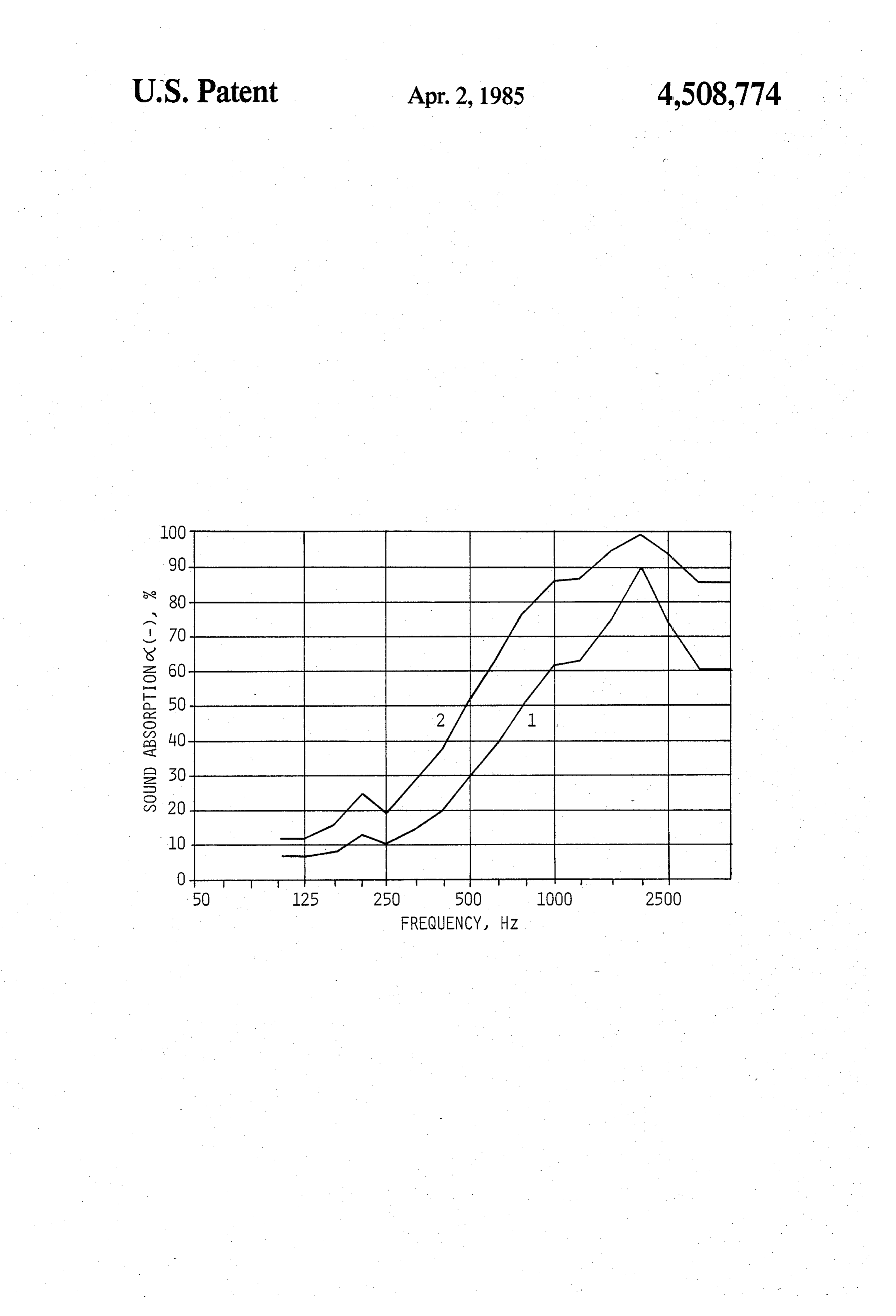
In the one-shot process the starting components are mixed together vigorously in a multiple-component O per UL 94 HF 1 and mixing head at room temperature (23 C.) and are al per U.S.-FMVSS 302 lowed to expand on a continual polyurethane slab line. The sound absorption efficiency a-(-) as a function The following mechanical properties were measured of frequency, f, exhibited the curve shown in the FIG in the resulting polyurethane foam: URE for a foam sheet of density 40 kg/m3 and thickness Density per DIN 53 420:38 kg/m3 15 17 mm in an impedance tube. Curve 1 was measured Heat distortion temperature under flexural load per with the sound directed normal to the sheet while curve DIN 53 424: 134 C. 2 was measured at a statistical angle of incidence. Compression strength per DIN 53 421: 80 KPa EXAMPLE 4 Flexural strength per DIN 53 423: 170 KPa
Tensile strength per DIN 53 455: 161 N/mm2 20 The polyurethane slab foam prepared in accordance Elongation per DIN 53.455; 17 percent with Example 3 was cut into 20 mm-thick foam sheets. EXAMPLE 2 These sheets were heated slightly and compressed to a sheet thickness of 10 mm in a forming tool at 180° C.
Preparation of a flexible, thermoformable polyure and at a pressure of 1.5 bar.
thane slab foam from the following starting compo 25 The following mechanical properties were observed nets: in the resulting shaped objects: 80 parts by weight polyester polyol I, Density per DIN 53 420:80 kg/m3 20 parts by weight polyester polyol IV, Flexural stress at conventional deflection per DIN 53 1.2 parts by weight N,N-dimethylbenzylamine, 423: 376 kPa 1.2 parts by weight foam stabilizer based on polye 30
Heat distortion temperature under flexural load per therpolysiloxane (Niax (R) L 532, Union Carbide DIN 53 424: 138 C.
Corp.), 4.9 parts by weight water, Tensile strength per DIN 53 455: 302 N/mm2 20.0 parts by weight monofluorotrichloromethane Elongation per DIN 53 455: 16 percent and 35 EXAMPLE 5 62.4 parts by weight polymeric MDI.
The starting components were mixed and expanded pared A polyurethane foam sheet of 10 mm thickness pre as described in Example 1 to form a polyurethane slab from the polyurethane slab foam of Example 2 foam in which the following mechanical properties was heated, covered with a 2 mm-thick prepreg of an were observed: unsaturated polyester resin, and molded in a molding Density per DIN 53 420: 20 kg/m3 tool at 150° C.
Tensile strength per DIN 53 571: 114 N/mm2 The resulting cellular shaped sandwich was used as Load at 40 percent compression per DIN 53577: 3.5 cation. an engine compartment cover for an automotive appli
Elongation per DIN 53 571: 68 percent 45 The embodiments of the invention in which an exclu
Example 3
sive privilege or property is claimed are defined as
Preparation of a tough, rigid, flame-resistant, thermo 1. A cellular polyurethane having a density of 15 formable polyurethane slab foam from the following Kg/m3 to 400 Kg/m3 prepared by: thermoforming in a starting components: 50 molding device at a temperature of from about 140° C. 40 parts by weight polyester polyol I, to 200 C. and at a compression factor of from 1 to 10, 20 parts by weight polyester polyol II, a polyurethane foam having a density of from 15 10 parts by weight polyester polyol III, Kg/m3 to 40 Kg/m3, wherein said polyurethane foam is 10 parts by weight polyether polyol II, prepared by reacting an isocyanate component compris 20 parts by weight ammonium polyphosphate, 55 ing a member selected from the group consisting of 10 parts by weight trichloroethyl phosphate, (a) polymeric MDI;
3.2 parts by weight triisopropanolamine, (b) carbodiimide modified MD; 1.2 parts by weight dimethylbenzylamine, (c) urethane modified MDI; and 4.0 parts by weight water, and (d) mixtures thereof, 98.4 parts by weight polymeric MDI. with a polyol component selected from the group con The starting components were mixed and expanded sisting of:
as described in Example 1 to form a polyurethane slab (e) a polyester polyol mixture containing one or more foam in which the following mechanical properties polyester polyols; and were observed:
Density per DIN 53 420; 40 kb/m3 65 (f) a polyester/polyether polyol mixture comprising - Heat distortion temperature under flexural load per one or more polyester polyols and one or more DIN 53 424: 138 C. polyether polyols, provided that the polyester Compression strength per DIN 53 421: 140 kPa polyols comprise at least 55 percent by weight of Flexural strength per DIN 53 423: 231 kPa said polyol component, 8 in the presence of catalysts, blowing agents, and option (b) adipic acid-phthalic acid-propylene glycol-trime ally chain extenders, cross-linking agents, additives, and thylolpropane copolymers; auxiliaries. - (c) adipic acid, phthalic acid-oleic acid-trimetylolpro 2. The cellular polyurethane part as recited in claim 1 5 (d)pane copolymers;
adipic acid-glutaric acid-succinic acid-diethylene wherein said part comprises a cellular foam core and a glycol-trimethylol propane compolymers; and skin of higher density. (e) mixtures of two or more of copolymers (a), (b), (c), 3. The cellular polyurethane part as recited in claim 2, or (d).
wherein a degree of compression of from 2 to 10 is used. 10. The cellular polyurethane part as recited in claim 4. The cellular polyurethane part as recited in claim 1, 10 8 wherein said polyester polyols are selected from the wherein said polyurethane foam has a thickness of 2 mm group consisting of to 20 cm. (a) adipic acid-diethylene glycol-trimethylolpropane 5. The cellular polyurethane part as recited in claim 1, (b)copolymers;
adipic acid-phthalic acid-propylene glycol-trime wherein coverings are applied to one or more sides of 15 thylolpropane copolymers; said polyurethane foam prior to thermoforming. (c) adipic acid, phthalic acid-oleic acid-trimethylolpro 6. The cellular shaped polyurethane part as recited in pane copolymers;
claim 5, wherein said coverings comprise curable, un (d) adipic acid-glutaric acid-succinic acid-diethylene saturated polyester prepregs. glycol-trimethylol propane compolymers; and 7. The cellular polyurethane part as recited in claim 6, 20 (e) mixtures of two or more of copolymers (a), (b), (c), wherein said prepregs contain glass fibers or fillers. or (d).
8. The cellular polyurethane part as recited in claim 1, 11. A cellular polyurethane self-supporting trim wherein said polyester polyol component has a func panel, headliner, engine compartment cover or instru tionality of from 2 to 6 and a hydroxyl number of from 25 ment panel as recited in claim 1. 12. A cellular polyurethane self-supporting trim
9. The cellular polyurethane part as recited in claim 1 panel, ment headliner, engine compartment cover or instru panel as recited in claim 6.
wherein said polyester polyols are selected from the 13. A cellular polyurethane self-supporting trim group consisting of: panel, headliner, engine compartment cover or instru (a) adipic acid-diethylene glycol-trimethylolpropane 30 ment panel as recited in claim 7.
copolymers; xk a ce ck ck
Page 9scan →
United states patent and trademark office
Certificate of correction
NVENTOR (S) : HERBERT GRABHOEFER and OTTO VOLKERT It is certified that error appears in the above-identified patent and that said Letters Patent is hereby corrected as shown below:
First page, Bibliographic Data, add Code 30 - Foreign Application Priority Data - March 15, l983 eigned and escaled this
Twenty-third Day of July 1985
Seal)
Attest:
Donald j. quigg
Attesting Officer Acting Commissioner of Patents and Trademarks
Provenance
- Collection
- Patents citing this work
- Pages
- 9
- Method
- pdftotext (the PDF's own text layer) + pdftoppm 300dpi page scans
- Patent office record
- patents.google.com →
- Source
- Google Patents citing-documents table
- Assignee
- Basf Aktiengesellschaft
- Published
- 1985-04-02
- Transcribed from
- patentimages.storage.googleapis.com →