

patent · US4512388A
High-temperature direct-contact thermal energy storage using phase-change media
23 April 1985
Text
Page 1bibliographic recordscan →
United States Patent (19)
Claar et al.
THERMAL ENERGY STORAGE USING
PHASECHANGEMEDIA
75 Inventors: Terry D. Claar, Lisle; Randy J. Petri, Chicago, both of Ill.
(73) Assignee: Institute of GasTechnology, Chicago,
* Notice: The portion of the term of this patent subsequent to Dec. 20, 2000 has been disclaimed.
Related U.S. Application Data
Int. Cl. .......................... C09K 5/06; F24H 7/04;
U.S. Cl. .......................................... 165/1; 165/10;
3,669,889 6/1972 JuZvuk .................................. 252/71 3,972,821 8/1976 Weidenbenner .. 252/75 4,003,426 1/1977 Best ............... 165/53 4,111, 189 9/1978 Dizon .................................... 165/10 4,115,632 9/1978 Kinoshita. ... 427/215 4,221,259 9/1980 Ronc ..................................... 252/70
4,234,782 li/1980 Barabas et al. ....................... 165/10 4,241,782 12/1980 Schoenfelder ..... ... 65/10 4,259,401 3/1981 Chahroudi et al. ... 165/10 4,268,558 5/1981 Boardman .......... ... 126/400 4,283,925 8/1981 Wildfeuer ............................. 65/10
FOREIGN PATENT DOCUMENTS
Primary Examiner-Albert W. Davis, Jr.
Attorney, Agent, or Firm-Thomas W. Speckman
A high-temperature direct-contact thermal energy stor age element for use in a system for storage and retrieval of thermal energy in the range of about 400 to about 3000 F. The thermal energy is directly stored, without heat exchange tubes in composite latent/sensible heat thermal energy storage media utilizing the heat of fu sion and high-temperature stability of alkaline metal and alkaline earth carbonates, chlorides, nitrates, nitrites, fluorides, hydroxides and sulfates and metal, metallic alloys and mixtures thereof maintained within a porous support-structure material which itself is capable of storage as sensible heat. The thermal energy storage according to the invention may be effectively utilized for storage of thermal energy derived from solar, indus trial waste, process heat, and high-temperature gas reac tor energy sources and retrieved for a wide variety of uses such as combustion air preheating, drying, space heating, heating of process gases, power generating heat engines and the like.
25 Claims, 1 Drawing Figure
Drawings
Page 2drawing sheetscan →
Page 3scan →
fied salts from finned tube heat exchangers during dis
HIGH-TEMPERATURE DIRECT-CONTACT charge cycles to improve thermal efficiencies of such THERMAL ENERGY STORAGE USING systems. However, the mechanical systems have a lim PHASE-CHANGEMEDIA ited lifetime, require frequent maintenance, and may
Cross reference to related
only be used on the discharge cycle due to scraper
APPLICATION freeze-up. Further, tube-intensive latent heat thermal energy systems require high cost super alloy materials
This application is a continuation-in-part application for adequate strength and corrosion resistance above of our earlier filed U.S. patent application Ser. No. 10 about 1300 F.
granted Dec. 20, 1983. SUMMARY OF THE INVENTION BACKGROUND OF THE INVENTION This invention provides a high-temperature direct 1. Field of the Invention contact thermal energy storage element comprising a 15 phase-change salt, metal or alloy retained within a po
This invention relates to high-temperature direct rous, sensible heat storage phase. Thermal energy is contact thermal energy storage. The thermal energy directly stored according to the invention at about 400 stored according to this invention is in the temperature to about 3000 F. without the use of conventional heat range of over about 400" F. up to about 3000' F. and is exchange means. The thermal performance is enhanced directly stored, without necessity of heat exchange by the direct contacting of working fluid and the ther tubes to provide containment and heat transfer surface, 20 mal energy storage element of this invention. Suitable in composite latent/sensible heat thermal energy stor working fluids for direct contact are gases, such as age media utilizing the heat of fusion and high tempera carbon dioxide, ture stability of alkali metal and alkaline earth carbon as argon, helium,oxygen air, hydrogen, inert gases such nitrogen, and combustion gases and ates, chlorides, nitrates, nitrites, fluorides, hydroxides, sulfates and mixtures thereof and metals and alloys 25 liquids, such as oils, molten salts, metals and alloys. maintained within a porous storage-support material The high-temperature direct-contact thermal energy which itself is capable of storage of sensible heat. Vari storage element of this invention is a composite of ous mixtures of alkali metal and alkaline earth salts and phase-change chemical comprising about 10 to about 90 various metals and alloys may be used to obtain desired volume percent and a thermal energy storage-support thermal and physical properties for storage of thermal 30 material which comprises about 10 to 90 volume per energy derived from solar energy sources, industrial cent. This composite latent/sensible heat thermal en waste and process heat, high temperature gas reactors ergy storage element utilizes the heat of fusion and high and the like. temperature stability of alkali metal and alkaline earth 2. Description of the Prior Art carbonates, chlorides, nitrates, nitrites, fluorides, hy There have been many prior attempts to store ther 35 droxides, sulfates, metals, alloys and mixtures thereof mal energy utilizing the heat of fusion in aqueous having a solid-liquid phase-change temperature at about hydrate systems. For example, U.S. Pat. No. 3,986,969 400' to about 3000' F. The phase-change chemical is teaches the use of a heat of fusion material plus attapul retained by capillary action within the pores of a ther gite clay as a homogenizing agent; U.S. Pat. No. mal energy storage-support material which itself is ca 1,894,775 teaches various latent heat of fusion storage 40 pable of sensible heat storage. Suitable thermal energy chemicals; U.S. Pat. No. 4,146,057 teaches thermal stor storage-support materials are metal oxides, aluminates, age as latent heat of fushion by passing a closed potas titanates, zirconates, metal carbides, nitrides, borides sium loop and a closed steam/water loop through alu and silicides having sub-micron particles which do not minum which serves to store the latent heat of fusion substantially coarsen with thermal cycling at tempera and is exemplary of prior practices utilizing tube heat 45 tures exchangers to provide containment and heat transfer havingupa surface to the phase change temperature used and area greater than about 1 square meter surface between storage media and working fluid; U.S. per gram. Exemplary of suitable thermal energy stor Pat. No. 4,223,721 teaches thermal storage by a eutectic salt packed with a thermal insulating material such as age-support materials are materials based on metallic carbides, nitrides, borides, silicides and oxides such as glass fiber insulation; and Japanese Pat. No. 51-96788 50 lithium aluminate, sodium aluminate, magnesium oxide, teaches thermal storage at about room temperature by alumina, lithium ferrite, lithium titanate, barium tita hydrate reaction of Na2SO4 and/or Na2CO3 with a light nate, strontium titanate, and mixtures thereof. The ther aggregate such as gypsum for support and prevention of deliquescence or efflorescence. U.S. Pat. No. 4,237,023 mal and physical properties of the thermal energy stor teaches an aqueous heat storage composition which 55 age element are controlled by varying the phase-change absorbs and stores heat as it is heated above its phase chemical and the relative proportions of phase-change change temperature and releases stored heat as it is chemical and thermal energy storage-support material. cooled below its phase-change temperature, including It is particularly suitable to use alkali metal and alkaline use of fumed silicon dioxide which acts as a stabilizing earth carbonates, chlorides, nitrates, nitrites, fluorides, agent and provides prolonged heat storage efficiency. 60 hydroxides, sulfates and mixtures thereof for phase U.S. Pat. No. 3,720,198 teaches thermal storage by heat change temperatures of about 400' to about 2000 F. of fusion with seed crystals in the thermal storage mate and to use metals and metal alloys for phase-change rial to prevent change of distribution during the melting temperatures of about 400 to about 3000 F., preferable phase. The prior art hydrate systems have experienced temperatures for use of metals and metal alloys being problems with supercooling and phase separation 65 about 1500 to about 3000'. Metal phase-change chemi which the last two patents referred to seek to overcome. cals may also be advantageous at the lower temperature Latent heat based thermal energy storage systems range due to their greatly higher thermal conductivi have employed mechanical scrapers to remove solidi ties.
Page 4scan →
Powders of composite material comprising phase atures of about 1300 to about 3000 F. Suitable metals change chemical and thermal energy storage-support for use in this temperature range include individual particles are prepared by dry blending or spray drying. elements comprising Al, Cu, Si, Mg, Zn, Ti, Ce, La; and Resulting powders are formed into suitable shapes by alloys comprising these elements, such as Mg2Si/Si, cold pressing, extrusion, briquetting or other suitable 5 Cu-Si, Cu-Mg-Si, P-Cu-Zn and Mg-Cu-Zn. Phase methods, and heated above the phase-change chemical change metals and metal alloys are also suitable for use melting point to densify and obtain the desired shape. at lower temperatures, such as, Al-Cu-Si, Al-Cu-Mg It is an object of this invention to provide a high-tem Zn, Al-Mg-Zn. The selection of the phase-change mate perature thermal energy storage element comprising rial is made on the basis of melting point, heat-of-fusion, latent/sensible heat media and process that overcomes O wetting of ceramic support matrix, surface tension, many of the disadvantages of the prior art thermal en viscosity, vapor pressure, volume change on fusion, ergy storage elements and processes. thermal expansion, and chemical compatability with It is another object of this invention to provide a support matrix and working fluid.
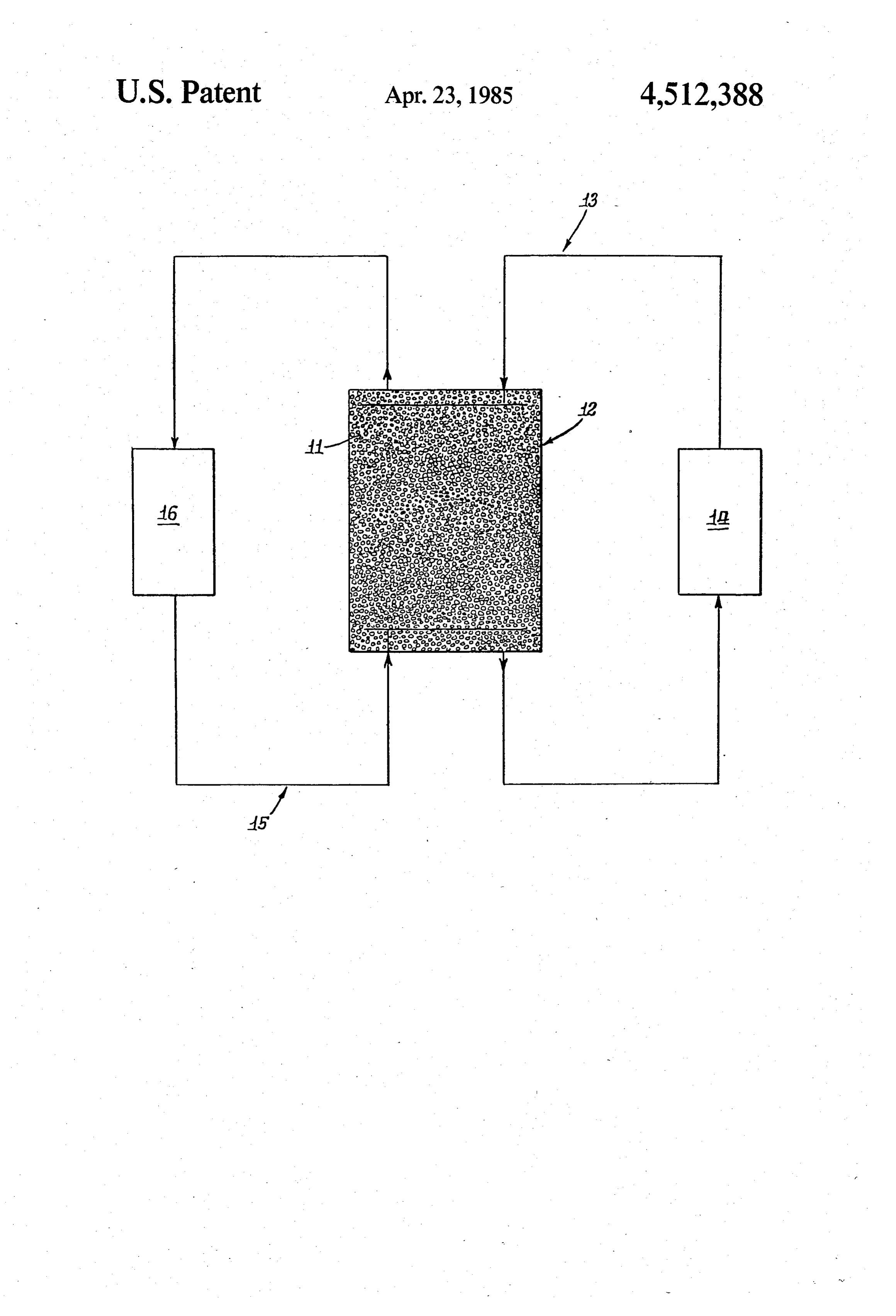
high-temperature thermal energy storage element that The phase-change chemicals utilized in this invention provides direct contact between storage media and 15 are supported within the pores of a material which also working fluid. serves as sensible thermal energy storage. The sensible Accordingly, it is an object of this invention to pro thermal storage-support material needs to be of sub vide a high-temperature direct-contact thermal energy micron particle size and having a surface area greater storage element comprising composite latent/sensible than about 1 and most preferably greater than about 10 heat media and process that eliminates the need for square meters per gram of storage-support material. conventional heat exchange equipment. Preferably, the finished storage-support material has a It is yet another object of this invention to provide a particle size about 0.01 to about 1.0 microns and most heat exchange process utilizing the high-temperature direct-contact thermal energy storage element of this preferably about 0.05 to about 0.5 microns and has a invention. 25 pore surface area about 5 to about 100 and most prefera These and other objects, advantages and features of bly about 10 to about 50 square meters per gram of storage-support material. Furthermore, the sensible this invention will become apparent from the following thermal storage-support material must not substantially description and reference to the drawing. coarsen with thermal cycling at temperatures used for BRIEF DESCRIPTION OF THE DRAWING 30 the particular application. The storage-support material The FIGURE shows a simplified schematic flow should be substantially insoluble in and chemically linert sheet for a thermal energy storage and retrieval process to the phase-change chemical over the high tempera utilizing the high-temperature direct-contact thermal ture range used in the present process. Sensible heat energy storage elements of this invention. storage support materials may be based on carbides, 35 nitrides, borides (oxides or aluminates), silicides and
DESCRIPTION OF THE PREFERRED other refractory metals, such as SiC, Si3N4, TiC, TiN EMBODIMENTS and TiB2. Various metal oxides are suitable, such as The composite latent/sensible heat thermal energy lithium aluminate, sodium aluminate, magnesium oxide, storage media of this invention take advantage of the alumina, lithium ferrite, lithium titanate, barium tuta latent heat of fusion and high temperature stability of 40 nate, strontium titanate, and mixtures thereof. Particu alkali metal and alkaline earth carbonates, chlorides, larly preferred are lithium aluminate, sodium aluminate, nitrates, nitrites, fluorides, hydroxides, sulfates and met magnesium oxide, and mixtures thereof. The choice of als and alloys and mixtures thereof. These phase-change the sensible heat storage-support matrix material de chemicals have a maximum operating range of about pends greatly upon compatibility with the latent heat 400 to about 3000 F. Phase-change chemicals of alkali 45 phase-change chemical and the temperature of opera metal and alkaline earth carbonates, such as sodium, tion of the direct contact thermal energy storage sys potassium, lithium, magnesium, calcium, strontium and ten.
barium carbonates are suitable for phase-change ten The sensible heat storage-support structure may be peratures of about 700 to about 1700 F. while metals reinforced against thermal cycle cracking by the addi and alloys are suitable for temperatures of about 1300 50 tion of ceramic or metallic particulates or fibers or mix to about 3000' F., and may be advantageously used in tures thereof. The effective thermal conductivity can be the temperature range of 400 to 1300 F. due to their regulated by the addition of metallic particulates or higher thermal conductivities. A desired operating fibers or mixtures thereof to the thermal energy storage range between the temperature limits can be produced support material. The additive ceramic or metallic rein by varying the relative amounts of the individual com 55 forcement, such as aluminum, stainless steel, Fe-Ni ponents in a phase-change material/sensible support Cr-Al alloys, copper-aluminum alloys may be present in material mixture. The use of mixtures of phase-change an amount up to about 5 to about 20 volume percent, chemicals is not restricted to eutectic compositions to based upon volume of the sensible heat storage-support obtain desired thermal and physical properties. U.S. material. It is preferred to use fibers of stainiess stee? Pat. No. 3,720,198 teaches the use of metalic salt hy 60 containing approximately 5 to 10 weight percent alumi drates which melt in their own water of crystallization num and of a size 5 to 100 microns making up about 5 to and double salt hydrates as thermal storage substances. about 10 volume percent of the sensible heat storage The use of hydrates restricts the operating range of the support material. The use of ground glass fibers for thermal storage to low temperatures, below about 200 shape retention as taught by U.S. Pat. No. 3,720, 198 is F. compared to the high temperature range of about 65 not suitable in the therinal energy storage element of the 400 to 3000 F. for which the thermal storage of the present invention since it will chemically react with present invention may be utilized. Phase-change chemi many of the phase-change chemicals, such as the car cals of metals and metal alloys are preferred for temper bonates, at the operating temperatures.
Page 5scan →
The high temperature direct-contact thermal energy media comprising a broad range of phase-change mate storage element of this invention comprises the afore rials encompassing the alkali and alkaline earth carbon mentioned solid-liquid phase-change chemical sup ates, chlorides, nitrates, nitrites, fluorides, hydroxides, ported within the pores of the aforementioned sensible sulfates, metals, metal alloys, and mixtures thereof. For thermal storage-support material by capillary action. gases containing oxygen, carbon dioxide or water va The high temperature thermal energy storage element por, the carbonate salts are generally preferred because comprises about 10 to about 90 volume percent solid of their greater high-temperature chemical stability in liquid phase-change chemical and about 10 to about 90 oxidizing environments. Composite thermal energy volume percent storage-support material and preferably storage and retrieval media comprising carbonates are about 50 to about 80 volume percent solid-liquid phase O tolerant to water vapor in the gases, up to certain limits change chemical and about 20 to about 50 volume per depending on temperature, carbonate composition, gas cent storage-support material. By proper selection of composition and gas pressure. The carbonate eutectic the solid-liquid phase-change chemical storage-support 62 mol % Li2CO3 - 38 mol % K2CO3 retained within material ratio, storage-support material composition lithium aluminate support can tolerate at least 5 to 10 and particle size (surface area to weight ratio), and 15 percent H2O in O2-CO2 gas mixtures at 400 to 1600 F. solid-liquid phase-change chemical composition, vari and 1 atmosphere pressure. The working fluid may ous shapes (pellets, briquettes, spheres) of differing heat function as a storage working fluid for thermal energy capacities and phase-change temperatures may be fabri passing from a thermal energy heat source to the ther cated. These thermal energy storage elements retain mal energy storage elements in a storage mode or as a their shape and integrity during repeated melting 20 retrieval working fluid for thermal energy transfer from /solidification thermal cycles at temperatures suitable the thermal energy storage elements in a retrieval mode. for storage of thermal energy from solar sources, indus The storage working fluid and retrieval working fluid trial waste, process heat and high temperature reactor may be the same or may be different as long as there is gas cooling streams. The thermal energy may be recov no undesired chemical reaction between them. ered and used for a wide variety of uses such as driving 25 A high-temperature direct contact thermal energy heat engines, combustion air preheating, drying, space storage and retrieval system according to this invention heating, heating of process gases, and the like. may comprise a plurality of high-temperature direct Powders of composite material containing phase contact thermal storage elements as described above, change chemical and sensible thermal storage-support such as those comprising about 10 to about 90 volume particles may be prepared by dry blending, spray dry 30 percent solid-liquid phase-change chemical having a ing, or by powder metallizing techniques according to phase-change temperature at about 400 to about 3000 methods known to the art. Resulting powders are F. and selected from the group consisting of alkali metal formed by cold pressing, briquetting or extrustion and and alkaline earth carbonates, chlorides, nitrates, ni heated above the phase-change chemical melting point trites, fluorides, hydroxides, sulfates and metals, metal to densify and obtain the desired shape. Alternately, 35 alloys and mixtures thereof supported within the pores sensible storage-support bodies of controlled porosity of sensible thermal energy storage-support material and pore size distribution obtained by sintering may be selected from the group consisting of metal oxides, impregnated with the molten phase change chemical to aluminates, titanates and zirconates, and metallic car produce the composite thermal energy storage element. bides, nitrides, borides and silicides having sub-micron Suitable shape and size for the thermal energy storage 40 particle size which do not substantially coarsen with elements of this invention are discrete shapes such as thermal cycling at temperatures up to about 2000 F. pellets, briquettes, spheres or other shapes of about 0.5 and having a surface area greater than about 1 square to about 12 inches in their maximum overall dimension. meter per gram of storage-support material, said stor The pellets should be so shaped and sized as to allow age-support material comprising about 10 to about 90 packing within a containment vessel while providing 45 volume percent of said thermal storage element; at least low pressure drop working fluid passage. Alternatively, one containment vessel(s) for the thermal storage ele the composite media may be formed into brick-shaped ments; a storage working fluid for thermal energy pass elements (e.g., rectangular shapes approximately ing from a thermal energy heat source to the storage 9'X4;"X3') or into hexagonal shapes with gas flow elements by direct contact with the phase-change chem passages, which can be stacked in an ordered arrange 50 ical at a temperature higher than its phase-change ten ment. The containment vessel may be of any suitable perature and means for passage of the storage working material and thermally insulated either internally or fluid from the heat source to contact with the phase externally. change chemical in a storage mode; and a retrieval An important advantage of the high-temperature working fluid for thermal energy retrieval from the thermal energy storage element according to this inven 55 storage elements by direct contact with said phase tion is that it allows direct contact between storage change chemical at a temperature lower than its phase media and suitable working fluids, for both thermal change temperature and transfer to a desired use; and storage and retrieval, thereby increasing thermal per means for passage of the retrieval working fluid from formance. Suitable working fluids for direct contacting contact with the phase-change chemical to the desired for thermal storage and retrieval are carbon dioxide, air, 60 use in a retrieval mode. It is readily apparent that when oxygen, hydrogen, inert gases such as helium or argon, one containment vessel is used the system must be cy nitrogen and combustion gases, and liquids, such as oils, cled in the storage and retrieval modes. When two and molten salts, metals and alloys, and non-reactive mix more containment vessels are used, the system may be tures thereof. By such direct contacting, the high-tem operated simultaneously in both the storage and re perature thermal energy storage element of this inven 65 trieval modes and on a continuous basis by proper cy tion eliminates the need for conventional heat exchange cling of the storage and retrieval streams to the individ means. Dry inert gases or liquids can be used in contact ual containment vessels. It will be readily apparent to with composite thermal energy storage and retrieval one skilled in the art that a wide range of temperatures 6 and thermal capacities may be accommodated by vary only minor weight loss, some minor crack formation but ing sizes and numbers of containment vessels to obtain no pellet fracturing and good shape retention. desired thermal performance. EXAMPLE II The process of thermal energy storage according to this invention comprises passing a storage working fluid 5 Composite powder comprising 50 weight percent stream in contact with a plurality of thermal energy phase-change chemical sodium carbonate (Na2CO3) storage elements as defined above for thermal storage, having a melting point of 1576 F. and 50 weight per the inlet temperature of the storage working fluid being cent magnesium oxide (MgO) ceramic storage-support above the phase-change temperature of the phase material was prepared by dry blending of the powders. change chemical, and then passing a retrieval working 10 Pellets measuring approximately 0.5 inch high and 0.80 fluid stream in contact with the thermal energy storage inch in diameter and having magnesium oxide surface element for retrieval of thermal energy, the inlet ten areas greater than 16 square meters per gram were again perature of the retrieval working fluid stream being below the phase-change temperature of the phase formed ner as by cold-pressing in a steel die in the same man described in Example I. The pellets were success change chemical, thereby increasing the temperature of 15 fully thermal cycled in an air oven through the sodium the retrieval working fluid stream. carbonate melting point (once from room temperature The figure illustrates in simplified schematic form one to 1652 F. and back) and embodiment of a system for the storage and retrieval of played good shape retentionexamined. The pellets dis and integrity with no S1g thermal energy utilizing the high-temperature direct thermal energy storage elements of this invention. 20 nificant loss of salt.
Thermal energy storage elements 11 are housed in a EXAMPLE III suitable containment vessel 12. Storage working fluid is circulated by conventional means from a high-tempera cycle Brayton engine may power
A solar energy thermal use system with an open heat from a high temper ture thermal energy source 14 through storage working fluid conduit system 13 and brought into direct contact 25 ature thermal energy storage system of this invention to with the thermal energy storage elements at a tempera advantage since the predicted operating efficiency of ture above the melting temperature of the phase-change fully regenerative open-cycle Brayton engines increases chemical. Then a retrieval working fluid is circulated from 27 percent at an inlet temperature of 1850 F. to 48 through retrieval working fluid conduit system 15 and percent at an inlet temperature of 2500 F. with the brought into direct contact with the thermal storage 30 same outlet temperature. A high-temperature direct elements by conventional means at a temperature lower contact thermal energy storage element may be used than the phase-change temperature thereby heating the having 50 weight percent silicon metal solid-liauld retrieval working fluid which delivers heat to a desired phase-change chemical (melting point 2579 F. and use indicated by use means 16. Suitable materials for latent heat of fusion 776 Btu/lb.) supported within the construction, shape, size and number of containment 35 pores of a ceramic support matrix of MgO. Packed bed vessels, piping, fluid transport means and associated configuration having a vold fraction of 0.4 may be used equipment is readily apparent to one skilled in the art with a media temperature swing of 450 F. 2354 upon reading of this disclosure. F.-2804 F.). Studies show such a direct contact ther The following examples are set forth for specific mal energy storage element as compared with Al2O3 exemplification of preferred embodiments of the inven 40 and MgO bricks results in an average 75 percent reduc tion and are not intended to limit the invention in any tion in media mass and an 82 percent decrease in System fashion. volume requirements per million Btu stored at 2354 to EXAMPLE I 2804 F. as well as substantially lowered fabricated media costs.
Composite powder comprising 63 volume percent 45 phase change chemical having a melting point of 910 EXAMPLE IV F. made up of 62 mol percent lithium carbonate (Li2 Powders comprising the indicated weight percentage CO3) and 38 mol percent potassium carbonate (K2CO3) of phase change metal and storage-support materlai and 37 volume percent lithium aluminate (LiAlO2) ce were mixed and blended in a mortar and pestle to form ramic storage-support material was prepared by spray 50 a composite powder. The composite powder was drying an aqueous slurry of y-Al2O3, LiOH H2O and pressed into pellets in a 1.12 inch diameter steel die at KOH. The spray dried powders were reacted with
CO2and heated at 1200' F. to convert the composite the indicated pressure. The pellets were then heat treated at the indicated temperature, time and atmo powder to a mixture of LiAlO2 and Li2CO3-K2CO3 sphere above the melting point of aluminum (1198 F). eutectic. The LiAlO2 particles had surface areas of 55 The conditions of forming the pellets are set forth in greater than about 15 m2/g. The powders were cold Table I:
pressed into pellets measuring approximately 0.60 inch high X 0.81 inch in diameter (mass about 7.30 gram) TABLE I using a steel die, at pressures of 24,490 psi. The pellets Compact- red were than heated in an air furnace for an accumulated 60 !ng Green ensity 232 hours at 1027 F. and subjected to three severe Composition Pressure Density Firing . thermocycles (each one a total of about 20 minutes in wt % psi Theoret. Conditions Theoret. duration) in which its temperature was lowered to 672 60 A/40 Al2O3 10,000 9 hrs, y F. at a rate of about 122 F./min and raised back to 292 F., N. 1022 F. in about 15 minutes. 65 60 A/40 Al2O3 30,000 i6 hrs, Examination of the pellets after these thermocycles 292 F. N.
indicated effective support of the molten carbonate 382 F., N. phase by the sub-micron sized LiAlO2 particles with 46.7 A/3.3. Cu/ 30,000 - 5 hrs,
Page 7scan →
TABLE I-continued storage-support material having particle size about 0.01 Compact- Fired to about 1.0 microns and a pore surface area about 5 to ing Green Density about 100 square meters per gram of ceramic material. Composition Pressure Density Firing % 4. The high-temperature direct-contact thermal en wt % psi % Theoret. Conditions Theoret. 5 ergy storage system of claim 2 wherein said phase 50 SiO2 1292 F., Air change chemical is selected from the group consisting of sodium carbonate, potassium carbonate, lithium car
Examination of the pellets after heat treatment showed bonate, magnesium carbonate, calcium carbonate, negligible changes in size or shape and no visual uneven 10 strontium carbonate, barium carbonate and mixtures distribution of the metal. In each case the pellet surface to thereof and said phase change temperature is about 700 lost its luster and turned dark with the heat treatment. about 1700' F.
While in the foregoing specification this invention has 5. The high-temperature direct-contact thermal en been described in relation to certain preferred embodi ergy storage system of claim 2 wherein said phase ments thereof, and many details have been set forth for change chemical is selected from the group consisting the purpose of illustration, it will be apparent to those 15 of metals and metallic alloys, said phase-change temper skilled in the art that the invention is susceptible to ature is about 1500 to about 3000 F. additional embodiments and that certain of the details 6. The high-temperature direct-contact thermal en described herein can be varied considerably without ergy storage system of claim 2 wherein said storage departing from the basic principles of the invention. 20 support material is selected from the group consisting of We claim: lithium aluminate, sodium aluminate, magnesium oxide, 1. A high-temperature direct-contact thermal energy alumina, lithium ferrite, lithium titanate, barium tita storage and retrieval system for storage of thermal en nate, strontium titanate, and mixtures thereof and said ergy at about 400 to about 3000" F. comprising: phase-change chemical is selected from the group con a plurality of high-temperature direct-contact ther 25 sisting of metals and metallic alloys. mal storage elements comprising about 10 to about 7. The high-temperature direct-contact thermal en 90 volume percent solid-liquid phase-change chem ergy storage system of claim 2 wherein said storage ical having a phase-change temperature at about support material is selected from the group consisting of . 400 to about 3000 F. and selected from the group lithium aluminate, sodium aluminate, magnesium oxide, consisting of alkali metal and alkaline earth carbon alumina, lithium ferrite, lithium titanate, barium tita ates, chlorides, nitrates, nitrites, fluorides, hydrox 30 nate, strontium titanate, and mixtures thereof and said ides and sulfates, metals, metallic alloys and mix phase-change chemical is selected from the group con tures thereof supported within the pores of sensible sisting of sodium carbonate, potassium carbonate, lith thermal energy storage-support materials selected from the group consisting of metallic carbides, 35 ium ate, carbonate, magnesium carbonate, calcium carbon strontium carbonate, and barium carbonate and nitrides, silicides, oxides, aluminates, titanates and mixtures thereof.
zirconates having submicron particle size which do 8. The high-temperature direct-contact thermal en not substantially coarsen with thermal cycling at ergy storage system of claim 1 wherein said sensible temperatures up to said phase change temperature thermal storage-support material additionally comprises and having a surface area greater than about 1 reinforcement selected from the group consisting of square meter per gram of storage-support material, ceramic and metallic particulates and fibers and mix said storage-support material comprising about 10 tures thereof.
to about 90 volume percent of said thermal storage 9. The high-temperature direct-contact thermal en element;
at least one containment vessel(s) for said thermal ment storage ergy system of claim 8 wherein said reinforce comprises about 5 to about 20 volume percent, a storage working fluid for thermal energy transfer based upon the volume of said storage-support material from a thermal energy heat source to said storage of reinforcement selected from the group consisting of elements by direct contact with said storage ele aluminum, stainless steel, Fi-Ni-Cr-Al alloys, and cop ments at a temperature higher than said phase per-aluminum alloys.
change temperature and means for passage of said 50 10. The high-temperature direct-contact thermal en storage working fluid from said heat source to ergy storage system of claim 1 wherein said sensible contact with storage elements in a storage mode; thermal storage-support material additionally comprises and a thermal conductivity enhancing agent selected from a retrieval working fluid for thermal energy transfer metallic particulates and fibers and mixtures thereof. from said storage element by direct contact with 55 11. The high-temperature direct-contact thermal en said storage elements at a temperature lower than ergy storage system of claim 1 of discrete shapes having said phase-change temperature to a desired use and their maximum overall dimension of about 0.5 inch to means for passage of said retrieval working fluid about 12 inches.
from contact with said storage elements to said 12. The high-temperature direct-contact thermal en desired use in a retrieval mode. 60 ergy storage system of claim 1 wherein said working 2. The high-temperature direct-contact thermal en fluids are selected from the group consisting of carbon ergy storage and retrieval system of claim 1 wherein dioxide, oxygen, air, inert gases, hydrogen, combustion said solid-liquid phase-change chemical comprises gases, oils, molten metals, molten alloys and molten about 50 to 80 volume percent and said storage-support alkali metal and alkaline earth salts. material comprises about 20-50 volume percent. 65 13. A process for high-temperature direct-contact 3. The high-temperature direct-contact thermal en thermal energy storage and retrieval comprising: ergy storage and retrieval system of claim 2 wherein passing a storage working fluid stream in contact said storage-support material comprises porous ceramic with a plurality of thermal energy storage elements 8 for storage of thermal energy at about 400 to 16. The high-temperature direct-contact thermal en about 3000 F. comprising about 10 to about 90 ergy storage element of claim 15 wherein said storage volume percent solid-liquid phase-change chemical support material comprises porous ceramic storage-Sup having a phase-change temperature at about 400 port material having particle size about 0.01 to about 1.0 to about 3000 F. and selected from the group microns and a pore surface area about 5 to about i00 consisting of alkali metal and alkaline earth carbon square meters per gram of ceramic material. ates, chlorides, nitrates, nitrites, fluorides, hydrox 17. The high-temperature direct-contact thermal en ides and sulfates, metals, metallic alloys and mix ergy storage element of claim 15 wherein said phase tures thereof supported within the pores of sensible change chemical is selected from the group consisting thermal energy storage-support material selected O of metals and metal alloys.
from the group consisting of refractory metals, 18. The high-temperature direct-contact thermal en carbides, nitrides, silicides, oxides, aluminates, tita ergy storage element of claim 17 wherein said phase nates and zirconates having submicron particle size change temperature is about 1500 to about 3000 F. which do not substantially coarsen with thernal 19. The high-temperature direct-contact thermal en cycling at temperatures up to said phase-change 15 ergy storage element of claim 18 wherein said storage temperature and having a surface area greater than support material is selected from the group consisting of about 1 square meter per gran of storage-support lithium aluminate, sodium aluminate, magnesium oxide, material, said ceramic storage-support material alumina, Iithium ferrite, lithium titanate, barium tuta comprising about 10 to about 90 volume percent of nate, strontium titanate, and mixtures thereof. said thermal storage element, the inlet temperature 20. The high-temperature direct-contact thermal en of said storage working fluid being above the ergy storage element of claim 15 wherein said storage phase-change temperature of said phase-change support material is selected from the group consisting of chemical; and lithium aluminate, sodium aluminate, magnesium oxide, when thermal retrieval is desired, passing a retrieval alumina, lithium ferrite, lithium titanate, barium tita working fluid stream in contact with said plurality 25 nate, strontium titanate, and mixtures thereof and Sald of thermal energy storage elements for retrieval of phase-change chemical is selected from the group con thermal energy, the inlet temperature of said re sisting of elemental Al, Cu, Si, Mg, Zn, Ti, Ce and La, trieval working fluid stream being below the phase and alloys thereof.
change temperature of said phase-change chemical 21. The high-temperature direct-contact thermal en thereby increasing the temperature of said retrieval 30 ergy storage element of claim 15 wherein said phase working fluid stream. change chemical is selected from the group consisting 14. A high-temperature direct-contact thermal en of alkali metal and alkaline earth carbonates, chlorides, ergy storage element for storage of thermal energy at nitrates, nitrites, fluorides, hydroxides, sulfates and mix about 400 to about 3000' F. comprising: tures thereof and said storage-support material is se a containment vessel housing about 10 to about 90 35 lected from the group consisting of metallic carbides, volume percent solid-liquid phase-change chemical nitrides and silicides.
having a phase change temperature at about 400 to 22. The high-temperature direct-contact thermal en about 3000 F. and selected from the group consist ergy storage element of claim 14 wherein said sensibie ing of alkali metal and alkaline earth carbonates, thernal storage-support material additionally comprises chlorides, nitrates, nitrites, fluorides, hydroxides, reinforcement selected from the group consisting of sulfates, metals, metallic alloys and mixtures ceramic and metallic particulates and fibers and mix thereof supported within the pores of sensible ther tures thereof.
mal energy storage-support material selected from 23. The high-temperature direct-contact thermal en the group consisting of metallic carbides, nitrides, ergy storage element of claim 22 wherein said reinforce silicides, oxides, aluminates, titanates and zircon 45 ment comprises about 5 to about 20 volume percent, ates through which heat storage and heat retrieval based upon the volume of said storage-support materiai, fluid may be circulated, the particles of which do of reinforcement selected from the group consisting of not substantially coarsen with thermal cycling at aluminum, stainless steel, Fi-Ni-Cr-Al alloys, and cop temperatures up to about said phase-change tem per-aluminum alloys.
perature and having a surface area greater than 50 24. The high-temperature direct-contact thermal en about 1 square meter per gram of storage-support ergy storage element of claim 14 wherein said sensible material, said storage-support material comprising thermal storage-support material additionally comprises about 10 to about 90 volume percent of said ther a thermal conductivity enhancing agent selected from mal storage element. metallic particulates and fibers and mixtures thereof. 15. The high-temperature direct-contact thermal en 55 25. The high-temperature direct-contact thermal en ergy storage element of claim 14 wherein said solid-liq ergy storage element of claim 14 of discrete shapes uid phase-change chemical comprises about 50 to about having their maximum overall dimension of about 0.5 80 volume percent and said storage-support material inch to about 12 inches.
comprises about 20-50 volume percent. k k : k
Provenance
- Collection
- Patents citing this work
- Pages
- 8
- Method
- pdftotext (the PDF's own text layer) + pdftoppm 300dpi page scans
- Patent office record
- patents.google.com →
- Source
- Google Patents citing-documents table
- Assignee
- Institute Of Gas Technology
- Published
- 1985-04-23
- Transcribed from
- patentimages.storage.googleapis.com →