

patent · US4532917A
Modular passive solar energy heating unit employing phase change heat storage material which is clearly transparent when in its high-stored-energy liquid state
6 August 1985
Text
Page 1bibliographic recordscan →
Taff et al.
54 MODULAR PASSIVE SOLAR ENERGY
HEATING UNITEMPLOYING PHASE
CHANGE HEAT STORAGE MATERAL
WHICH IS CLEARLY TRANSPARENT
WHEN IN TS HIGH-STORED-ENERGY
LIQUID STATE
76 Inventors: Douglas C. Taff, P.O. Box 85; Robert B. Holdridge, P.O. Box 167, both of
Hinesburg, Vt. 05461
Related U.S. Application Data 63 Continuation of Ser. No. 562,715, Dec. 19, 1983, aban doned, which is a continuation-in-part of Ser. No.
abandoned.
51 Int. Cl. ................................................. F24J 3/02 52 U.S. C. .................................... 126/430; 126/400;
3,537,944 11/1970 Grubb et al. ........................ 126/901 4,111,189 9/1978 Dizon ........ ... 26/436 4,162,671 7/1979 Christy ...... ... 126/400 4,244,354 1/1981 Williams .... ... 126/901 4,257,477 3/1981 Maloney ... ... 126/430
4,290,416 9/1981 Maloney ............................. 26/400
OTHER PUBLICATIONS
“Kalwall Thermal Storage Pod'.
"Phase Change Materials Handbook”, Sep. 1971, U.S. Dept. of Commerce, National Technical Information
Service, N72-19956, D. V. Hale, et al.; Lockheed Mis siles & Space Co.
"The Status of Thermal Energy Storage', by Bundy, Herrick & Kosky of Power Systems Laboratory, Re
Primary Examiner-Samuel Scott
Assistant Examiner-Helen Ann Odar
Attorney, Agent, or Firm-Parmelee, Bollinger & Bramblett
A highly effective modular passive solar energy heating unit for heating an enclosed space employs phase change heat storage material, which is optically trans parent to visible light when in high-stored-energy liquid State enabling a viewer to see through clearly and which is translucent milky white when in low-stored energy solid state for providing pleasant illumination to the enclosed space when first illuminated by sunlight in the morning. This phase change material, in a sealed container having two opposite surface areas transparent to Sunlight, is polyethylene glycol having a heat of
per cubic ft.), a melting point of about 13 to 25 C. (55 F. to 77 F.), a specific gravity of about 1,125 at 20C., and desirable isotropic freezing and melting characteris tics with only very modest volume change during phase change. A dye soluble therein may be included for increasing solar-energy-absorptivity when translucent and for decreasing glare and direct penetration of sun light into the space when transparent. The unit addi tionally contains at least one clearly optically transpar ent glazing layer facing the sunlight, preferably includ ing an insulation layer to transmit short wavelength solar radiation while blocking longer heat rays for re taining thermal energy within the enclosed space. In preferred embodiments, there are two layers of closely spaced parallel transparent glazing near the sealed con tainer, these layers being between incident solar radia tion and the container.
27 Claims, 10 Drawing Figures
Drawings
Page 2drawing sheetscan →
Page 3drawing sheetscan →
Page 4drawing sheetscan →
Page 5drawing sheetscan →
Page 6drawing sheetscan →
Page 7drawing sheetscan →
Page 8drawing sheetscan →
Page 9scan →
the interior space to be heated at the back side of the
MODULAR PASSIVE SOLAR ENERGY HEATING wall. This interior (or enclosed) space is also heated by UNITEMPLOYENG PHASE CHANGE HEAT thermal radiation from the rear (inside) surface of the STORAGE MATERIAL WHICH IS CLEARLY solar heated Trombe wall, but the Trombe wall blocks TRANSPARENT WHEN IN ITS illumination and view.
HIGH-STORED-ENERGY LIQUID STATE More recently, heat of fusion heat storage has re ceived some attention as a means of storing solar en
This application is a continuation of copending appli ergy. Most recently, paraffin waxes and fatty acid mate cation Ser. No. 562,715, filed Dec. 19, 1983, now aban rials have been suggested for use as heat of fushion heat doned, which was a continuation-in-part of copending O storage materials but have not found acceptance. So application Ser. No. 444,607, filed Nov. 26, 1982, now dium sulfate decahydrate has received the most atten abandoned, which, in turn, was a continuation-in-part of tion in this area, but problems of precipitation and im application Ser. No. 226,395, filed Jan. 19, 1981, now mobilization or encapsulation of solid anhydrous so abandoned. dium sulfate during the freeze-thaw cycles has caused 15 degradation of the system and prevented its wide accep
Field of the invention
tance and use. Disodium hydrogen phosphate dodeca
The invention relates to the field of passive solar hydrate has also received attention, but its thermal effi energy heating units and more particularly to modular ciency gradually decreases with increasing numbers of passive solar energy heating units employing a heat freeze-thaw cycles due to the heptahydrate formation storage phase change material. 20 which is the equilibrium solid phase at the melting tem
Background of the invention
perature of the dodecahydrate.
Recently, a product containing calcium chloride hex
Energy from the sun reaches the earth as electromag ahydrate has been merchandised by Kalwall Corpora netic radiation which can be absorbed by suitable sur tion, of Manchester, New Hampshire. This product faces and converted to heat. In general, the use of vari 25 comprises thermal storage pods which can be assembled ous solar energy collection systems has been known in into a translucent thermal storage wall. Because of the the art. For example, it has heretofore been known to very high expansion coefficient and anisotropic freezing employ air source heat pumps to make use of solar and thawing characteristics of calcium chloride hexahy energy stored in the atmosphere. Additionally, it has drate amount in effect to a volumetric change of ap been known to use solar water heaters for this purpose 30 proximately twenty percent during freezing/melting of in which water is circulated through a solar collector to this particular hydrated salt, a strong, flexible, expand be heated and the heated water is used to transfer heat able volume fiberglass-reinforced container must be energy to the place desired. However, the storage mate used. Because of the fibrous nature of the necessarily rial is not exposed to the sun's rays, but instead the reinforced container, a clear, optically transparent water is circulated by pumps or thermosiphons through 35 viewing through a wall of the Kalwall storage pods is a solar collector and then through a heat storage device unattainable.
in a serial manner. In some cases, a large container of Calcium chloride hexahydrate and any of the other water itself may serve as the heat storage device. Diur water-and-salt eutectic thermal storage hydrates are nal variations in insulation and atmospheric heat makes unusable in planar, parallel sided, optically-transparent, these active solar energy collection systems far from rigid containers in a window configuration, for exam ideal. Also, there are complexities in the pumps or cir ple, such as a window formed from two relatively culating systems which make such systems expensive. closely spaced sheets of optically clear glass, because of Further, the solar collectors are positioned in expose their very high effective volumetric change during locations, for example on a roof, where they are subject thawing/freezing. The anisotropic freezing/thawing to battering by storms and where they quickly lose their 45 characteristics of these water-and-salt hydrate eutetic heat into the atmosphere when the sun's rays are materials, i.e. their tendency to form crystals during blocked by clouds in the winter. freezing which grow more rapidly in one direction than Among the materials heretofore used as sensible heat in other directions, augments the problems of attempt storage materials, water has most frequently been em ing to employ them in a planar, parallel-sided optically ployed due to its high heat capacity and ready availabil 50 transparent rigid container in a window structure. ity and low cost. Stored heat is moved to an area to be A paper presented during the Fifth National Passive heated by circulating the heated water or heat exchang Solar Conference in Amherst, Mass. on Oct. 22 to 26, ing it with circulating air. Water has also been em 1980, by J. R. Hull, J. F. McClelland, L. Hodges, J. L. ployed in the roof pond and storage wall concepts of Huang, R. Fuchs and D. A. Block, entitled Effect of solar heating. Also, rocks and stones placed in an insu 55 Design Parameter Change on the Thermal Performance of lated storage space and adapted to heating and cooling a Transwall Passive Solar Heating System discusses a by passing air through the interstitial spaces within the visually transparent thermal storage wall containing assemblage of rocks or stones and circulating the air to water and which is placed in building areas receiving the space to be heated has also been employed. There direct solar radiation. A severe difficulty with such a has also been employed a hybrid of rocks and water 60 water-filled external wall is that a power failure or heat where a tank is located in the center of a rock storage ing system failure within the building during winter can bin and air is circulated through the rocks which collect allow rapid freezing of the water with resultant destruc heat lost from the water tank. tion of the entire wall due to the enormous expansion Additionally, Trombe has developed a system pressure of freezing water. Furthermore, thermal stor whereby a relatively massive masonary wall is posi 65 age in water involves only a single-phase storage action tioned behind panes of glass with an air space between in which the temperature of the water increases when the glass and wall. Openings at the top and bottom of heat energy is added and its temperature decreases as the wall allow for gravity circulation of heated air into heat energy is withdrawn. Thus, the temperature of the 10 associated enclosed space may be allowed to swing up having front and back surface areas which are transpar and down over an uncomfortably large temperature ent to sunlight, and wherein the solar energy heating range for the occupants during a twenty-four hour cy unit employs at least one transparent glazing layer cle. A further severe problem with such a thermal stor spaced from the container by an air space, said glazing age wall containing water is that a thickness of at least preferably including a layer of insulation for transmit 5 cm (2 inches) is necessary to obtain at least 80% of the ting short wavelength solar rays while preventing maximum solar savings fraction (beneficial results as longer wavelength heat rays from passing through this defined in the article). Therefore, the weight when glazing.
calculated on the basis of an entire building structure According to the invention, a suitable polyethylene becomes adversely significant. Such a water-filled wall 10 glycol phase change material of the desired characteris containing two inches of water weighs 10.4 pounds per tics is disposed in a fluid-tight container having front square foot, for the water alone. and back surface areas transparent to sunlight, said front Such a single-phase acting thermal storage with its surface area being adapted to receive solar energy. For inherent temperature fluctuation is quite different from example, based upon diurnal temperature fluctuations in a phase change material in which the temperature re 15 buildings, the equivalent active thermal capacity of the mains approximately constant during addition or with polyethylene glycol, as described above as compared drawal of heat energy. The addition of heat energy with water in the "Transwall' is approximately one causes melting of the material (change of phase from sixth by volume. Therefore, a one-centimeter thick solid to liquid), and the withdrawal of heat energy layer of this polyethylene glycol is more than adequate causes freezing (change of state from liquid to solid), for providing equivalent performance, and the weight is but the melting and resolidification occur at approxi only 2.34 pounds per square foot for the polyethylene mately constant temperature, called the "melting point'. Therefore, among the advantages of a phase glycol alone, as compared with 10.4 pounds per square change material are those resulting from the fact that it Swal'. the five-centimeter thick water filling in "Tran foot for tends to hold the temperature of the associated enclosed 25 The fluid-tight container having the polyethylene space more nearly constant than a single-phase acting glycol disposed therein is placed in proximity to at least material of equal thermal energy thermal energy stor age capacity. In addition, a phase change material can one transparent glazing in sheet form which is separated from the container by an air space and is positioned to store many times more thermal energy per unit volume face the incoming solar radiation and permit the solar than a single-phase acting material such as a body of radiation to pass through the transparent glazing sheet water, a collection of rocks, or a Trombe wall. Thus, a considerably less bulky storage apparatus of phase to the front transparent surface area of the fluid-tight change material has the same thermal storage capacity container, whereby over a time the solid polyethylene as a more bulky apparatus containing a much larger glycol absorbs solar energy and changes to a liquid. The quantity of single-phase acting storage material. 35 transparent glazing in sheet form has an outer surface There is, therefore, still a need for an improved solar disposed toward incoming solar radiation and an inner energy heating unit that eliminates many of the undesir surface disposed closer to the front transparent surface able features of systems heretofore proposed. A desir area of the fluid-tight container. This glazing preferably able system would be a solar energy heating system that includes a layer of insulation on its inner surface which employs many of the desirable features of heretofore 40 transmits short wavelength solar rays while preventing studied systems but that eliminates and/or avoids most longer wavelength heat rays from radiation through the or substantially all of the undesirble features or draw glazing. In preferred embodiments of the invention backs of prior systems. Additionally, it is highly desir there are two layers of transparent glazing positioned able to have a system that employs a highly effective between the incident solar radiation and the transparent heat-of-fusion heat storage material that has a relatively 45 container which holds the phase change material. high heat of fusion at the desired temperature range for Other aspects of the invention will be made clear or heating a living or working space, yet which material is become apparent from the following description and stable and does not separate nor segregate in use and is claims when read in light of the accompanying draw also non-toxic and non-corrosive. It is also desirable to ings, wherein:
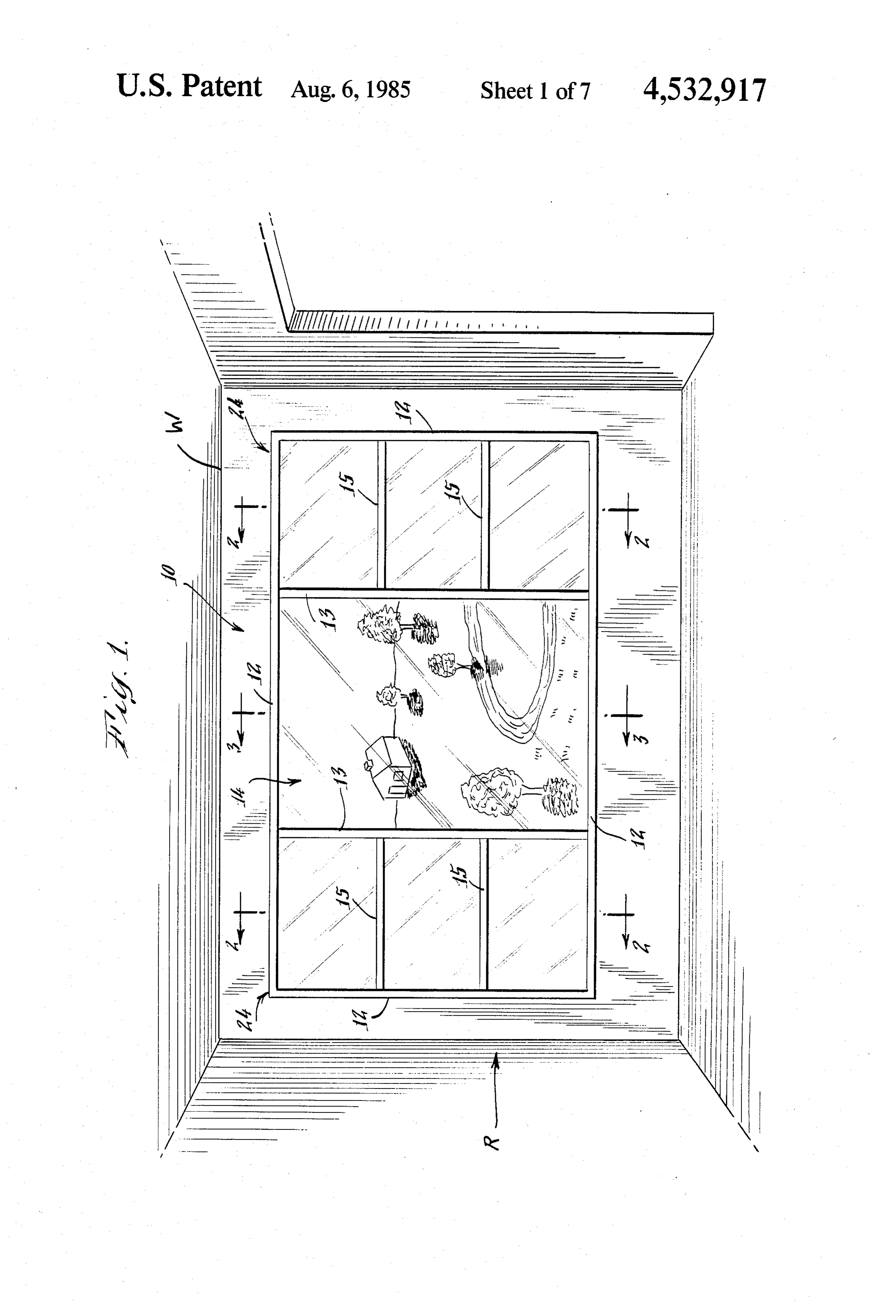
have such a material that has a very small coefficient of 50 FIG. 1 is a perspective view of a wall with a modular thermal expansion. An acceptable material must be a solar panel constructed according to the invention phase change material that has a relatively high storage placed therein;
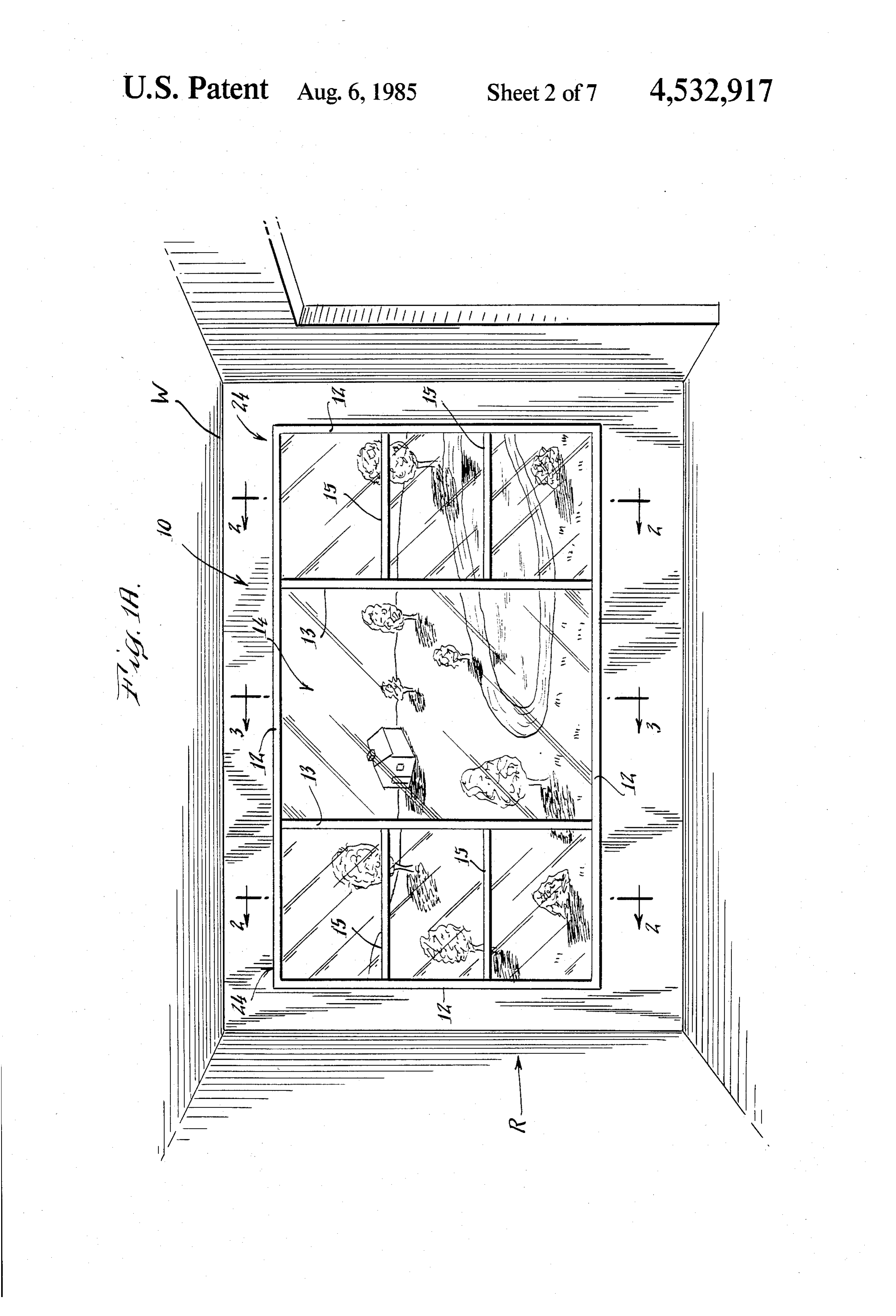
of thermal energy per unit of volume during its phase FIG. 1A is a similar view after the solar energy heat change. ing units have become clearly optically transparent as a 55 result of phase change due to storage of solar energy;
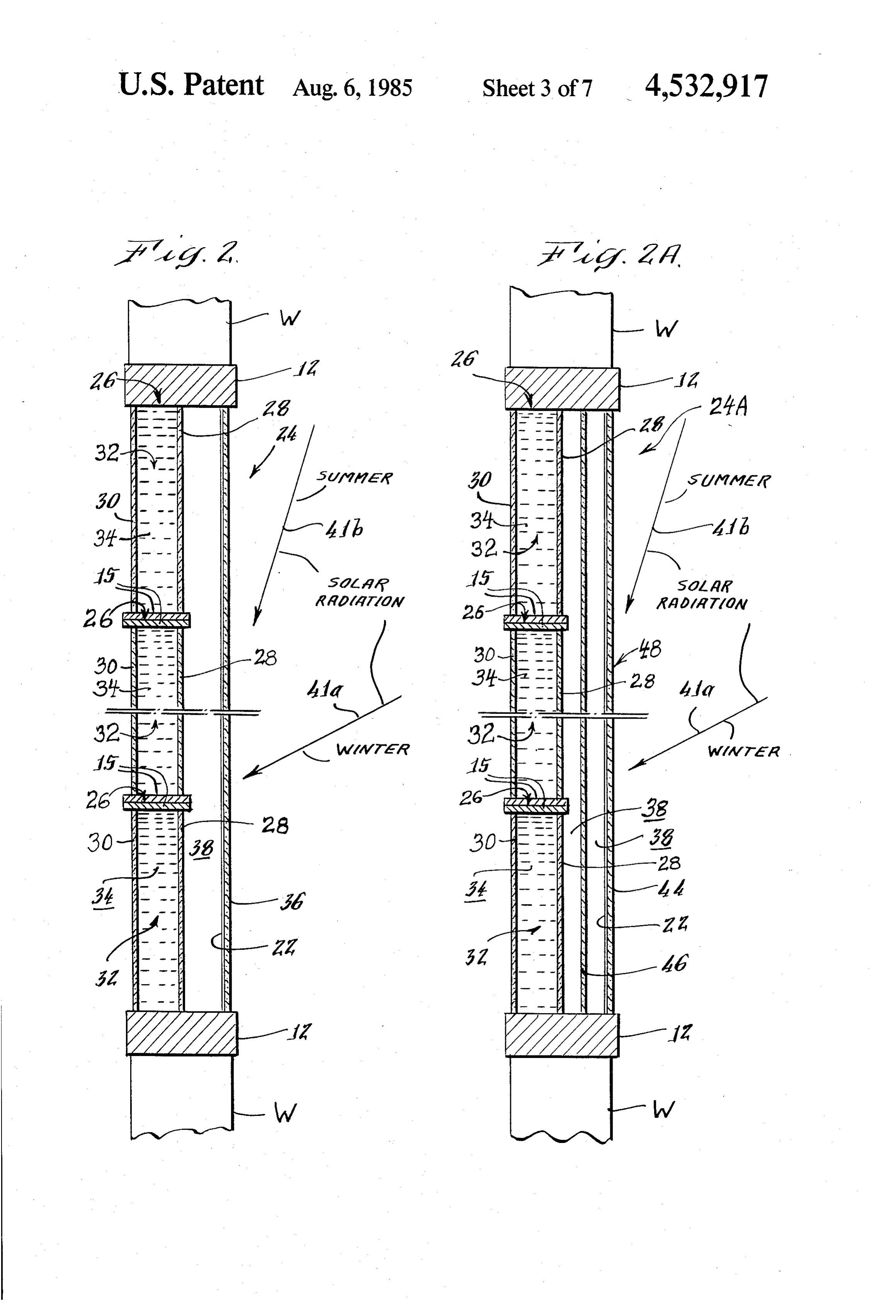
SUMMARY OF THE INVENTION FIG. 2 is a vertical cross-sectional view taken along According to the present invention, it has been dis the line 2-2 of FIG. 1;
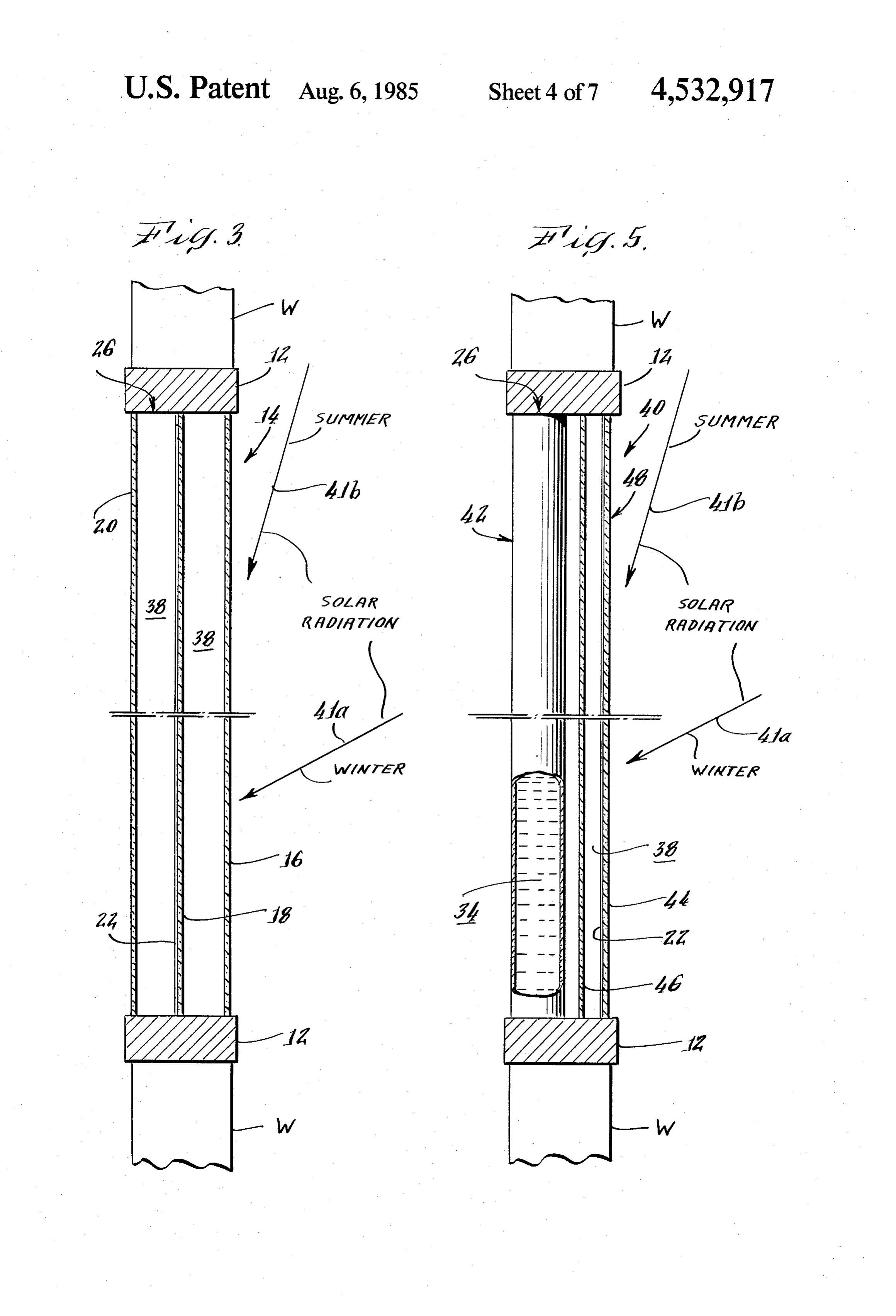
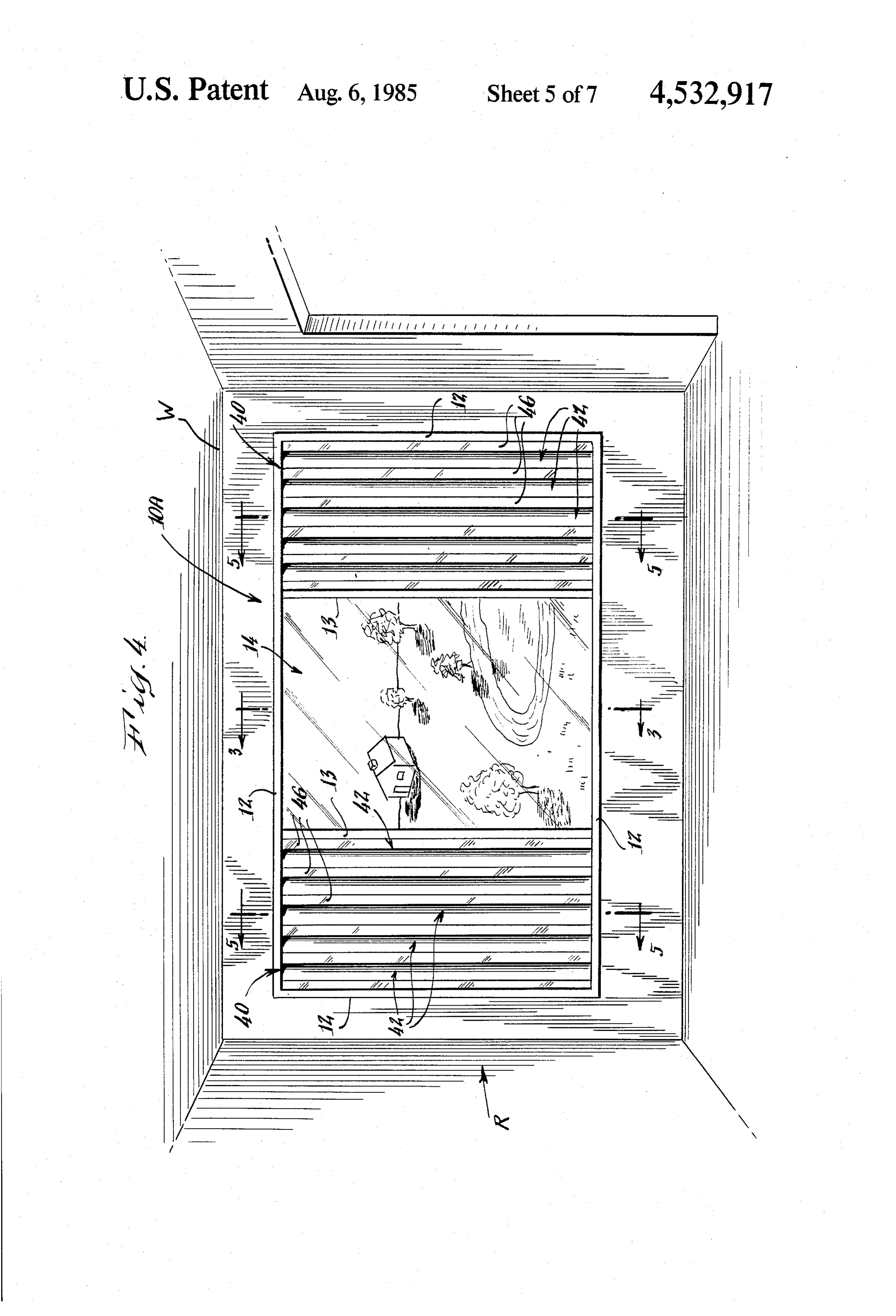
covered that a highly effective and desirable modular FIG. 2A is a vertical cross-sectional view of a struc passive solar energy heating-illuminating-and-viewing ture which is thermally similar to FIG. 2; unit for an enclosed space (living space or working 60 FIG. 3 is a vertical cross-sectional view taken along space) can be obtained when polyethylene glycol char the line 3-3 of FIGS. 1 and 4;
acterized by a heat of fusion of about 33 to 37 cal/gm. FIG. 4 is a perspective view of a wall with another (4,170 to 4,670 Btu's per cubic ft.), a melting point of embodiment of a modular solar panel constructed ac about 13 to 25 C. (55 to 77 F.) and a specific gravity cording to the invention placed therein; of about 1.125 at 20° C. (68°F), plus isotropic freezing 65 FIG. 5 is a vertical cross-sectional view taken along and melting characteristics, with only a very modest the line 5-5 of FIG. 4;
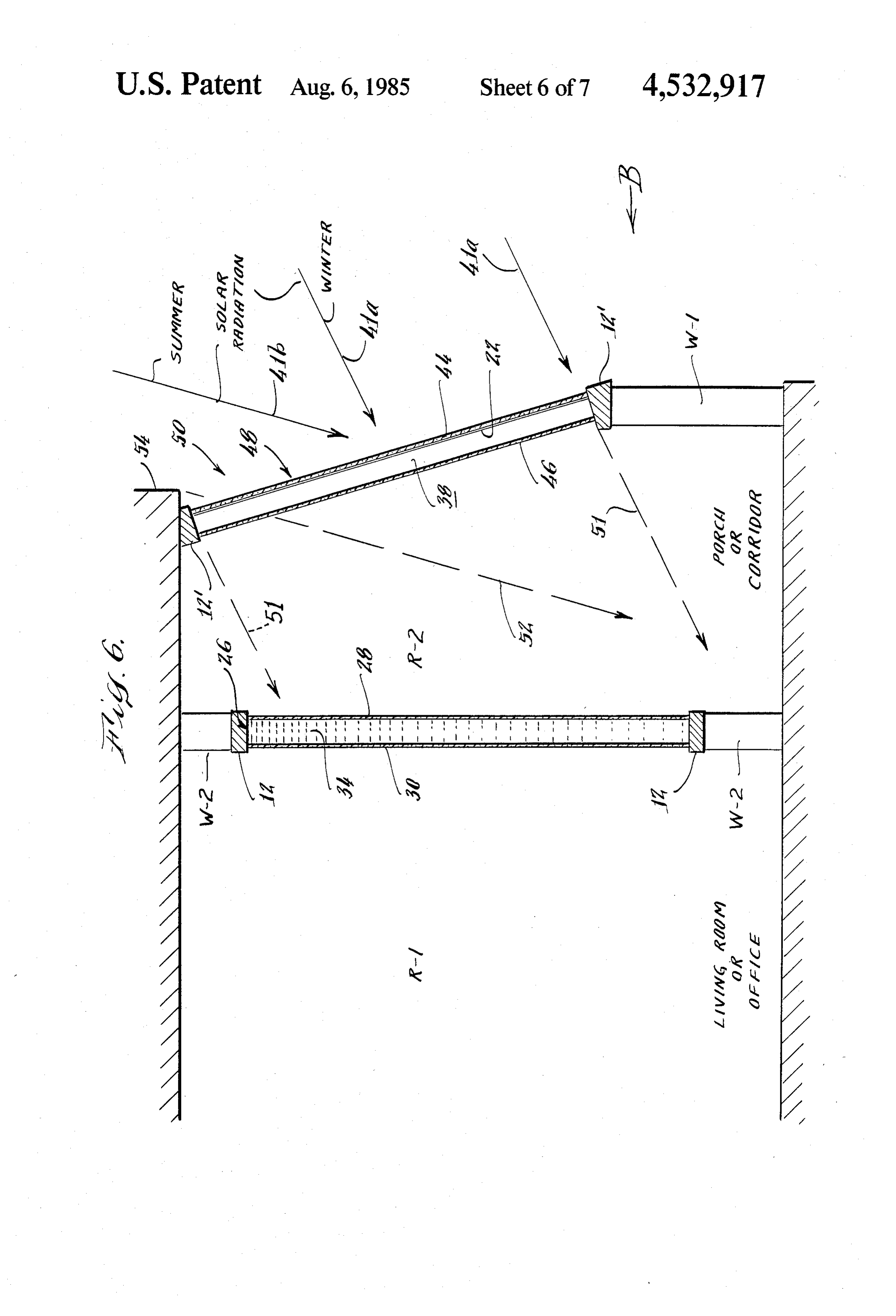
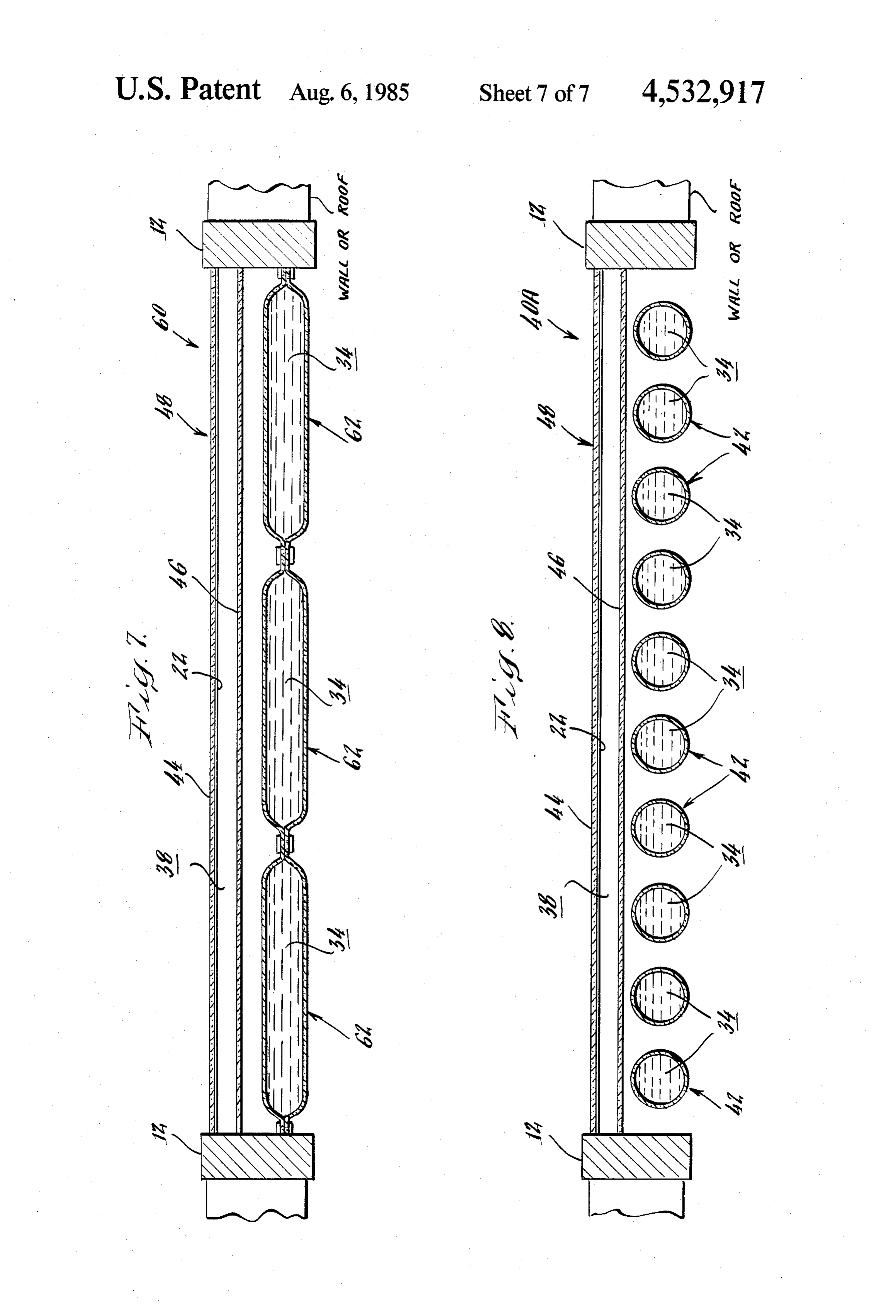
change in volume of less than 2% during phase change FIG. 6 is a vertical cross-sectional view showing is employed in a container in the units, said container details of another embodiment of a modular solar heat 11 ing unit of this invention in two nearby walls of an polyethylene glycol is in its clear, transparent high enclosed space to be heated; and stored-energy liquid state. The container can be formed FIGS. 7 and 8 are sectional views of two other em in any desired shape, such as a tube, a vacuum formed bodiments of a modular solar heating units of this inven panel, a framed window or wall structure or the like. tion. Any transparent material which permits the solar rays DETAILED DESCRIPTION OF THE to pass therethrough is suitable for forming the fluid INVENTION tight container for holding the polyethylene glycol. As examples of suitable materials, there are many to be
The phase change material employed as the heat mentioned, for example, transparent glass, polyvinyl storage medium in the solar heating units of this inven O chloride, polyvinyl butyrate, polycarbonate, acrylics, tion is polyethylene glycol characterized by heat of polyacrylates, polyesters, and the like. fusion of about 33 to 37 calories per gram (4,170 to 4,670 Likewise, the clearly optically transparent glazing Btu's per cubic ft.), a melting point of about 13° C. to material in sheet form employed in the solar units of this 25 C. (55°F. to 77 F.), a specific gravity of about 1.125 invention can also be formed of any transparent mate at 20° C., and isotropic freezing and melting characteris 15 rial which permits solar rays to pass therethrough such tics with only a very modest increase in volume or less as the material referred to hereinbefore as suitable for than 2% during phase change from solid to liquid. Poly forming the fluid-tight container. However, the prefera ethylene glycol of the described characteristics is par ble transparent glazing material in glass. ticularly advantageous for use in the solar heating units Transparent insulation material suitable for placing of this invention because this phase change material on the rear (inner) surface of the transparent glazing can changes from a solid to liquid in a very narrow tempera be any suitable transparent insulation material which ture range closely corresponding to the desired temper transmits short wavelength solar rays while preventing ature of a room or enclosed space (living or working longer wavelength heat rays from radiating through the space) to be heated. Thus, there is a close coupling glazing. As an example of such a suitable transparent between the desired air temperature in the room or 25 insulation material, there may be mentioned for example enclosed space to be heated and this phase change mate the product Heat Mirror transparent insulation sold by rial for stabilizing and closely regulating the living or the Southwall Corporation, of Palo Alto, Calif. The working space temperature of such space to be heated. Heat Mirror product transmits solar radiation but Furthermore, the polyethylene glycol does not exhibit blocks heat radiation by reflecting the heat rays. Other corrosive effects, nor stratification, nor segregation, nor 30 examples of transparent insulation glazing material are: precipitation, such effects as occur with conventional “SUNGATE' Glass from PPG Corporation of Pitts water soluble salts that have been proposed by others burgh, Pa.; or glass for minimizing longer wavelength for thermal storage. In addition, the polyethylene gly heat loss made by Pilkington Glass Works and commer col is characterized by a highly desirable low level (2% cially available in England.
or less) of volumetric expansion/contraction over the 35 In operation, the modular solar energy heating unit of liquid-solid transition range (phase change range). Fur this invention operates as follows. During the day, sun thermore, the polyethylene glycol is advantageously light in the form of solar radiation passes through the transparent when liquid and translucent when solid. transparent glazing sheet or sheets and the transparent Especially preferred for use as the phase-change ma insulation on the rear surface thereof and impinges on terial for use in this invention is the polyethylene glycol 40 the front transparent surface area of the fluid-tight con known as polyethylene glycol 600 having a heat of tainer holding the polyethylene glycol phase change fusion of approximately 35 cal/gm. (63 Btu's/lb.) dur material. As the solar rays pass through the transparent ing change of state from solid to liquid within a temper surface area of the container and otherwise strike the ature range of about 13 to 25 C. (55° to 77 F.). Most container walls, the translucent, milky-white solid poly especially preferred would be a polyethylene glycol 45 ethylene glycol in the container melts and stores energy having a heat of fusion of approximately 35 cal/gm. as latent heat of fusion without appreciable rise in tem and having a melting temperature of from about 20 to perature of the phase change material. During the eve 22° C. (68° to 70 F). The polyethylene glycol em ning and night when the sunlight is no longer present, ployed in this invention exhibits only a small change in the phase change material gives off its heat to the sur volume during its change in state, so that only a rela 50 roundings as the melted material freezes releasing the tively small amount of trapped air in each fluid-tight stored energy. The transparent insulation on the trans container of the modular solar energy heating unit pro parent glazing sheet prevents undue loss of thermal vides resilience to accommodate expansion/contraction energy by preventing heat radiation from radiating of the polyethylene glycol for preventing rupture of the through the glazing.
fluid-tight container in which this polyethylene glycol 55 The modular solar energy heating units of this inven is held. A suitable polyethylene glycol for use in this tion can be employed in a multitude of environments to invention is, for example, polyethylene glycol 600 sold heat an enclosed space for living or working. For exam by the Union Carbide Corporation, of New York, N.Y. ple, a heating unit of this invention may be placed in a under the trademark CARBOWAX. transparent wall, a transparent roof or window, or may The fluid-tight container in which the polyethylene 60 be removably or interchangeably mounted on tracks, glycol is contained can be any suitable fluid-tight con racks or clips in a sunlight impingement area of a room tainer having at least one surface area (the front surface or other enclosed space to be heated. By the term "an area) transparent to sunlight. In a preferred embodiment enclosed space to be heated' is meant any substantially of this invention the fluid-tight container will be clearly enclosed area where regulation of the temperature is optically transparent on both front and rear surfaces for 65 desired for human comfort, such as for example, a allowing illumination to ente the enclosed living or room, a hallway, or corridor, or other living space, a working space and for enabling a viewer in the enclosed warehouse, factory, office or other work area. The units space to see clearly through this container when the are capable of assembly in a multitude of building types, 12 building locations and a variety of applications where sheets of glazing 28 and 30 are separated by a region 32 absorption of solar energy for subsequent release of filled with polyethylene glycol phase change material thermal energy is desired. Those skilled in the art will 34. On the outer side of the container 26 and in spaced, readily appreciate the various applications for such a parallel, planar relationship thereto is another clearly solar heating unit. For example, a unit of this invention 5 optically transparent glazing sheet 36 (FIG. 2) having can be assembled as part of a transparent/translucent on its inner surface and facing toward container 26 a office wall or partition. layer of transparent insulation 22. The space 38 between In association with a corridor or porch along the the insulation layer .22 and the containers 26 is filled south side of a building, a heating unit of this invention with air or any other suitable gas insert to the insulation is superior to glazing alone protected by reflective 10 layer 22.
binds or by solar control film (e.g. "Scotchtint solar In operation as shown in FIG. 2 during daylight control film from 3M Corporation, of Minneapolis, hours when solar radiation 41a and 41b is available, this Minn.) in that in employing the present invention the solar radiation passes through the transparent glazing solar energy is stored and subsequently is advanta 36, insulation layer 22, space 38 and the transparent geously utilized for heating, rather than throwing it 15 1 sheet 28, whereby it melts the polyethylene glycol 34 in away into the exterior ambient as occurs to considerable container 26, thereby storing latent heat of fusion in the extent with reflective blinds or solar control film. liquid phase change material. The solar heating units of this invention are highly Advantageously, when the early morning sunlight effective solar energy heating units due to the design illuminates the storage units 24, the polyethylene glycol thereof, and the particular materials of construction. phase change material 34 is solid, thus being translucent, Furthermore, such solar heating units are lightweight milky white. Consequently, the units 24 thus provide a and space saving and are low cost per Btu stored. Addi diffuse, tionally, such units are easily produced, inexpensive and FIG. 1, pleasant illumination into the room R as seen in capable of mass production by known techniques; ex viewing area 14. Asviewer while the can see through the central cept that sealant, if any, in contact with the phase 25 sorbs the solar energy,this phase change material 34 ab it changes into a clearly transpar change storage material must be unaffected thereby. ent liquid. Consequently, the units 24 on either side of Exemplary embodiments of the solar heating units of the central viewing area attractively the present invention are set forth in the drawings. Re clearly transparent, thereby expandingbegin to become ferring to FIGS. 1-3, a modular solar energy heating parent viewing area to include portions of thesetrans the clearly two unit of this invention is shown as a component part of a units 24. At last, when all of the phase change material window unit of a building or room. A window indicated 34 has become liquid from absorbing solar energy, the generally by the numeral 10 is disposed in the south facing wall W of an enclosed space or room, indicated. clearly transparent viewing area of the window 10 will generally by R, of a building. In this exemplary form, have attractively expanded and spread out to the full the window unit 10 comprises a peripheral frame 12 35 size defined with in the frame 2, as shown in FIG. A. including a pair of mullions 13 having disposed therein When the solar radiation is interrupted, such as at a central, triple-glazed (FIG. 3), transparent viewing night, the liquid phase change material 34 begins to region or window area 14, preferably of glass, including solidify, thereby releasing its latent heat of fusion as an outer sheet 16, an intermediate sheet 18, and an inner thermal energy which is conducted through transparent sheet 20, each of transparent glazing material. sheets 28 and 30 and is radiated as relatively long wave As shown in FIG. 3, the transparent viewing surface length thermal radiation from these sheets 28 and 30. 14 has a layer of transparent insulation 22 disposed on Radiation of thermal energy to the outside of the en the inner face of the intermediate sheet 18. It will be closed space is prevented or substantially reduced by appreciated, however, that said transparent insulation the insulation layer 22. However, thermal energy radi material 22 can be place on the inner side of the outer 45 ated from the sheet 30 into the space or room R is desir sheet 16 or the inner side of the inner sheet 20, wherein ably available for heating this enclosed space or room. the term "inner side' refers to the side facing the en In FIG. 2A is shown a modified solar heating unit closed space R. It will be appreciated that although it is 24A in which the single clearly optically transparent possible to place the transparent insulation layer 22 on glazing sheet 36 in the unit 24 of FIG. 2 is replaced by the inner side of the sheet 20, this is not as desirable as 50 two clearly optically transparent glazing sheets 44 and being on the inner side of the sheet 18 or 16, because the 46 with the space 38 between them being filled with air transparent insulation layer is then exposed to damage or other suitable gas which is inert with respect to the by contact with persons or objects or possibly by dam insulation layer 22. The other parallel space 38 between age from exposure to the atmosphere. The preferred the inner glazing 46 and the outer sheet 28 of the units location in the case of a triple-glazed window 14, as 55 26 is filled with air or other suitable inert gas. shown, is to place the insulation layer 22 on the inner In FIG. 2A when the insulation layer 22 is present, as side of the intermediate sheet 18, as shown. shown, the thermal performance of the thermal storage In planar neighboring relationship to said central heating unit 24A is superior to the unit 24 of FIG. 2. window area 14 and on opposite vertical sides of the When the insulation layer 22 is omitted from the mullions 13 are a pair of identical modular solar energy 60 inside surface of the outer glazing sheet 44, then the heating units 24. The modular solar heating units 24 double-glazed unit 24A, including two trapped air (or each comprises three vertically extending, rectangular gas) spaces, is thermally approximately equivalent to fluid-tight containers 26 (FIG. 2 or FIG. 2A) mounted the single-glazed unit 24 (FIG. 2) including one trapped one above another. Each of the solar heating units 24 is air (or gas) space 38 plus the insulation layer 22. formed by two spaced, parallel, clearly optically trans 65 In FIG. 3, it is to be understood that the spaces 38 parent sheets of glazing 28 and 30 and bounded on its between the respective glazing sheets 16, 18 and 20 are perimeter by portions of the frame 12 and by one of the filled with air or any other suitable gas inert to the mullions 13, and by a horizontal rail 15 or rails 15. The insulation layer 22.
Page 13scan →
A further embodiment is disclosed in FIGS. 3, 4 and upon them due to the hydrostatic pressure of the liquid 5 wherein a modified form of modular solar energy phase change material 34 between them. heating units 40 are shown as component parts of a Alternatively, instead of using such stiffening braces, window unit of a building or room. A window unit, the large container in the wall or partition W-2 (FIG. 6) indicated generally by the numeral 10A, is disposed in may comprise a plurality of smaller containers 26, for the south-facing wall W of an enclosed space or room R example each one being only 2 feet tall, arranged one of a building. The window unit 10A comprises a periph above another, with horizontal rails 15 between them, eral frame 12 including a pair of mullions 13 having as shown in FIGS. 2 and 2A. It is to be understood that disposed therein a central triple glazed viewing region in FIGS. 2 and 2A each of the container units 26 is or window area 14 (FIG. 3) preferably of glass, having 10 individually fluid tight and self-contained. Thus, for an outer 16, intermediate 18 and inner 20 sheet of example if each of the containers 26 is two feet tall, a clearly optically transparent glazing material. As shown thermal storage unit 24 or 24A (FIG. 2 or 2A) which is in FIG. 3, the transparent viewing region 14 has a layer approximately six feet tall is assembled by stacking up of transparent insulation 22 disposed on the inner face of 15 three of the containers 26 vertically aligned one above the intermediate sheet 18. another. The horizontal rails 15 at the top and bottom of In planar neighboring relationship to the central the respective container units 26 are appropriately se viewing area 4 and on opposite vertical sides of the cured together, for example by bolts, clamps or ma mullions 13 are a pair of identical modular solar energy chine screws (not shown) to complete the assembly. heating units 40. The modular solar units comprise a 20 In FIG. 6 the container 26 (or containers 26) in the plurality of parallel planar arranged, spaced-apart, wall or partition W-2 provide desirable translucent fluid-tight clearly optically transparent tubular contain illumination into the enclosed living or work space R-1 ers 42 filled with the polyethylene glycol phase change when the phase change material 34 is solid and enables material 34 (FIG. 5). On the outer side of the containers occupants storage of the space R-1 to look through the thermal container(s) 26 into the enclosed space R-2 and 42 between them and the direction of solar radiation 25 and in spaced, parallel, planar relationship thereto are also to look out through the window 48, when the mate two spaced apart, vertical, parallel transparent glazing rialThe 34 is in its high-stored-energy liquid state. solar thermal energy heating unit 50 includes the sheets 44 and 46 which may be the panes of a conven fluid-tight container(s) 26 together with the double tional double glazed window 48. On the inner face of glazed window the outer sheet 44 there is shown disposed in co-exten 30 48 in FIG. 5 and48inwhich may be similar to the window FIG. 2A. As shown in FIG. 6, the sive overlapping relationship thereto a layer of the window 48 is mounted in a frame 12" and is inclined at transparent thermal insulation 22. The space 38 between an angle to the vertical in the range from 15 to 40 in layer 22 and sheet 44 is filled with air or other suitable order to place the panes 44 and 46 approximately per gas inert to layer 22. This window 48 is mounted in the pendicular to the low angle mid-winter solar radiation same frame 12 with the tubular containers 42.
Another embodiment of a modular solar energy heat 41a for achieving maximum transmission of the solar energy onto the outer transparent surface area 28 of the ing unit 50 of this invention and its use is shown in FIG. container 26. In this example the window 48 is inclined 6 where the heating units serves to simultaneously heat 17 from the vertical, and substantially the entire area of the enclosed spaces R-1 and R-2 on both the inner and the outer sheet 28 of the container 26 is bathed in solar outer side of the fluid-tight container portion 26 of the radiation 41a transmitted by the inclined window 48 unit 50. In a building, generally indicated by B, there is an outer south-facing wall W-1 and a spaced apart inner during arrows the mid-winter months, as shown by the dashed 51. However, as shown by the dashed arrow 52, wall W-2 separated by an enclosed space, for example the portion 54 of the building B prevents the summer such as a porch, corridor or the like. In the exterior wall solar radiation 41b from reaching the container 6, W-1, there is placed in a position situated so as to re 45 thereby avoiding over-heating of the enclosed space ceive solar radiation a double-glazed transparent aper R-1. It is to be understood that the window 48 in FIG. ture or window 48 having an outer pane 44 and an inner 6 may be vertical, if desired.
pane 46, each of clearly optically transparent glazing In operation, the solar energy unit 50 (FIG. 6) is material. On the inner face of pane 44, there may be identical to the units 24, 24A and 40 as described in that disposed in a co-extensive overlaying relationship 50 solar radiation enters the building through the south thereto a layer 22 of the transparent thermal insulation facing window 48 and strikes the transparent surface 28 described above. The space 38 between layer 22 and of the container 26 melting the polyethylene glycol 34 pane 46 is filled with air or other suitable gas inert to the therein and storing latent heat of fusion in the process. insulation layer 22. Upon interruption of the solar radiation, the liquid poly In the internal wall or partition W-2, there is placed a 55 ethylene glycol begins to freeze, releasing its latent heat fluid-tight, rectangular, transparent container 26 filled of fusion as thermal energy conducted through the with polyethylene glycol phase change material 34. In transparent surfaces 28 and 30 and being radiated there the embodiment shown in FIG. 6, the container 26 is from. Thermal energy radiates from both sheets 28 and formed by a pair of strong, vertical, parallel, spaced 30 of container(s) 26 for warming both the porch or apart clearly optically transparent sheets 28 and 34 60 corridor R-2 and the living room or office R-1 on oppo mounted in a frame 12 in the wall 12. This container 26 site sides of the container. Thermal insulation layer 22 is similar to the container 26 shown in FIGS. 2 and 2A. prevents or inhibits to a substantial extent any loss of If it is desired that the fluid-tight container 26 be thermal energy through window 48 by blocking or sufficiently large to comprise the major area of the reflecting thermal radiation from containers 26 back internal wall or partition W-2, then the container sheets 65 into the enclosed space R-2.
28 and 30 are externally braced with vertical and/or Another embodiment of a modular solar energy heat horizontal stiffening members (not shown) for support ing unit of this invention is disclosed in FIG. 7. The ing these sheets against the outward spreading forces heating unit is designated generally by the numeral 60, 14 and comprises a peripheral frame 12 which supports a ylene glycol 34, the frame of the unit includes one or plurality of suspended, vacuum-formed, fluid-tight, more horizontal frame members 15 which separate the clearly optically transparent containers 62. Each of the unit into separate fluid-tight compartments 32 arranged containers 62 includes a pair of vacuum-formed, tray one above another. For example, in the case of a win like panels of clearly optically transparent material, dow four feet high the retrofit heater unit includes two each panel having a peripheral rim displaced out of the separate fluid-tight compartments 32 one above the plane of the main body of the panel. The pair of panels other in vertical planar relationship and each being have their rims secured together to form the container approximately two feet high and each being essentially 52. Two parallel, spaced apart, transparent glazing filled with the phase change material 34. Similarly, in sheets 44 and 46 are positioned in frame 12 in spaced 10 the case of a window six feet high, the retrofit heater overlaying relationship to the containers 62. The two unit includes three of such separate fluid-tight compart parallel glazing sheets comprise an inner sheet 46 closest ments 32 arranged one above another in vertical planar to containers 62 and an outer sheet 44. On the inner face relationship. For the majority of retrofit solar heater of sheet 44 facing toward the sheet 46 there may be a units, it is preferred that the compartment region 32 layer 22 of transparent thermal insulation as described 5 between the respective outer and inner planar transpar above. The unit 60 shown in FIG. 7 is suitable for plac ent glazing sheets 28 and 30 not exceed a height of 2.5 ing in a wall, partition, roof or like structure, of an feet in order to keep the hydrostatic pressure moderate. enclosed space in a manner such that the outer transpar However, in the case of tall narrow retrofit solar heater ent sheet 44 faces the incoming solar radiation. units the vertical frame members serve to support and The double-glazed window 48 in FIG. 7 may be stiffen the glazing sheets 28 and 30, in which case the similar to the windows 48 in FIGS. 2A, 5 and 6. The fluid-tight compartment region 32 may be taller than containers 62 are manufactured from any vacuum-form the preferred height of 2.5 feet.
able, clearly optically transparent plastic sheet material Although an advantageous solar heating benefit is which will permit the solar radiation to pass there obtained when retrofit solar heater units 26 are fitted through. 25 into the interior of windows having only a single glaz A further embodiment of a modular solar energy ing sheet 36 (FIG. 2), the preferred installation is to fit heating unit 40A embodying this invention is shown in such solar heater units into the interior of double-glazed FIG. 8. The unit 40A is similar to one of the units 40 in windows (FIG. 2A). Placement of such solar heater FIGS. 4 and 5 and is suitable for placing in a wall, units into a double-glazed window is preferred, because partition, roof, or like structure, of an enclosed living or the overall economic return to the user in saving heat work space in a location for incoming solar radiation to ing fuel costs is considerably greater. pass through the outer clearly optically transparent Advantageously, a dye soluble in the polyethylene double-glazed window 48 into the fluid-tight tubular glycol phase change material 34 may be included in the containers 42 of the phase change material 34. The foregoing embodiments of this invention. This dye in double-glazed window 48 in FIG. 8 may be similar to 35 creases the ability of the translucent material 34 to ab the double-glazed window 48 in FIGS. 2A, 5, 6 and 7. sorb energy from incident solar radiation when the It is to be understood that the air or inert gas in the material is in its translucent state. Thus, its milky while spaces 38, as shown in the various FIGURES, is dry so translucent appearance is changed to a particular tint or that moisture condensation cannot occur. As used in the lighter or darker color as may be desired by the archi claims herein, the term "gas' is intended to be suffi 40 tect or owner for aesthetic effect. The concentration ciently broadly interpreted to include a mixture of and color of the respective dye to be added may be gases, for example such as air, which is a mixture pri specified for achieving a particular color coordinated marily of nitrogen and oxygen. appearance for the various window heating units in the Turning attention back to FIGS. 2 and 2A, it will be building.
appreciated that the planar fluid-tight containers 26 can 45 The phase change material 34 when in its milky matte be supplied as modular units for use in retrofitting into white translucent state has an absorptivity of about 40% existing windows for converting the window from a for incident solar radiation. Adding a dye as described conventional window into a passive solar energy increases this absorptivity. An increase in absorbtivity is heater. The modular retrofit passive solar energy heat important on non-opportune or non-ideal days, in other ing unit 26 includes spaced parallel outer and inner 50 words, on cloudy or overcast days. clearly optically transparent planar glazing sheets form Another advantage of adding a soluble dye is to mod ing surface areas 28 and 30, respectively, with a border erate the ambient glare of the window heating unit on ing frame 13 and 15 encircling these two surface areas bright sunny days when the phase change material 34 for holding them in spaced parallel relationship and for has become transparent. The pleasant tint or color shad sealing the unit to render it fluid-tight. The region be 55 ing remains in the transparent container. The resultant tween these two transparent surface areas 28 and 30 is tint or color shading of the dyed phase change material essentially filled with polyethylene glycol phase change reduces the penetration of sunlight directly into the storage material 34 having the advantageous character heated space, thereby minimizing any overheating. istics as described above. In a preferred embodiment of Thus, light and heat control advantages, plus aesthetic the retrofit unit this phase change material 34 is approxi 60 enhancement are provided by adding such a dye. mately one centimeter thick (approximately 0.4 of an Further, the glass glazing forming the container for inch thick). the dyed phase change material 34 can be clear, rather The bordering frame of the retrofit solar heater 26 is than being tinted glass. Clear glass is less expensive, for shaped to fit snuggly into the interior margin of the example, than bronze colored glass. Moreover, bronze existing window frame 12. In the case of tall retrofit 65 glass tends towards thermal cracking when hotter than heater units 26 in order to minimize the hydrostatic its surroundings. In certain buildings for aesthetic rea pressure occurring between the transparent surface sons and/or interior light intensity control purposes and areas 28 and 30 due to gravitation acting on the polyeth for increasing the absorbing of solar energy, it may be 15 desirable that the inner transparent surface area 30, preted sufficiently broadly in context with the present which faces the enclosed space to be heated R or R-1 specification to include them when they are colorless and which is adjacent to the phase change material 34, and to include them when they are tinted. may be tinted glass glazing, for example, tinted grey, The same respective reference numerals are used to bronze or green, and such tinted glass glazing 30 may be indicate corresponding elements, i.e. elements perform used regardless of whether or not the phase change ing the same or similar functions, throughout the vari material 34 contains any dye. OuS FIGURES.
In addition, there is the tint and color customizing From the foregoing, it will be appreciated that the advantage for aesthetic effect at a particular building embodiments and description provided are merely ex site. It is not practical to customize the color or tinting O emplary and that various embodiments and modifica of window glass, except in the case of very large build tions thereof will be apparent to those skilled in the art ing installations where the added increment of cost for and are within the contemplation of the invention. specialized glass manufacture can be spread over a large We claim:
economic entity. In contrast to specialized color glass 1. A modular passive solar energy heating and out production, all of the containers for the phase change 15 doors viewing unit adapted to absorb and store solar material 34 are made of standard clear glass. Then, the energy and subsequently release said solar energy as tint and color customizing is economically achieved by thermal energy in an enclosed space comprising: using a stable soluble dye. There are a myriad of stable a fluid-tight rigid container member having two op dyes available which are soluble in this phase change posite surface areas clearly optically transparent material 34. 20 and adapted to receive solar energy, EXAMPLES OF SUITABLE DAYS solar energy heat storage phase change material dis posed in said container, said phase change material
Brown-Color Index Solvent Brown No. 12 Common being polyethylene glycol characterized by a heat Name-Bismarck Brown, available from Ciba Geigy, of fusion of about 33 to 37 ca/gm (4,170 to 4,670 S.A., of Basle, Switzerland 25 Btu's per cubic ft.), a melting point of from about Grey-Color Index Solvent Black No. 1 A monazo dye 13 to 25° C. (55° to 77 F.) and a specific gravity of not having any common name, available from Ciba approximately 1.125 at 20 C., Geigy, S.A. of Basle, Switzerland said phase change material in said fluid-tight con Blue-Color Index Solvent Blue No. 19 An Anthraqui tainer member being translucent milky white when none dye. Common Name-Oraset Blue B, available 30 in its low-stored-energy solid state and being from Ciba Geigy, S.A., of Basle, Switzerland. clearly optically transparent to visible light when Green-Color Index Solvent Green No. 3 An Anthra in its high-stored-energy liquid state for enabling a quinone dye Common Name-Sudan Green 4B, viewer to look through said container member, available from GAF Corporation, New York City, clearly optically transparent glazing in sheet form N.Y. 35 having an inner and an outer side, said transparent The above dyes are described in the Third Edition of glazing being separated from said fluid-tight con the Color Index, published by the Society of Dyers and tainer member, and being positioned so as to permit Colorists. solar radiation to pass through the glazing to a In the event the construction of the containers 26 or transparent surface area of the fluid-tight container 62 or the construction of the compartment regions 34 member, the outer side of said glazing being dis requires use of a sealant in contact with the phase posed to face incoming solar radiation, said inner change storage material 34 such sealant must be unaf side of said glazing facing toward said transparent fected thereby. For example, silicon sealant is suitably surface area of the fluid-tight container member, unaffected thereby. said inner side of the glazing being separated from The term "south-facing' as used herein is intended to 45 said transparent surface area of the fluid-tight con be broadly interpreted to include any area oriented tainer member by a gas space, generally facing southerly; that is, within the 90' com said glazing transmitting short wavelength solar and pass range from South East to South West (true direc visible light rays while preventing longer wave tions, not magnetic directions). It is out preference for length heat rays from radiating through the glaz superior results that the south-facing area be oriented 50 ing, within the 45 compass range from South South East to said glazing being positioned on the opposite side of South South West. said fluid-tight container member from said en As used herein, the term "heat rays' or "longer closed space, wavelength heat rays' is intended to mean the rela whereby when said phase change material is in its tively long wavelength (as compared to the wavelength 55 low-stored-energy solid state said fluid-tight con of visible light) electromagnetic radiation which radi tainer member presents a back-illuminated milky ates from objects at comfortable room temperature and white appearance to a viewer in said enclosed from human beings. space, and
As used herein, the phases "optically clear", "clearly whereby when said phase change material is in its optically transparent", "optically transparent', and 60 high-stored-energy liquid state a viewer can see "transparent', as applied to "glass', 'glazing', 'glazing through said fluid-tight container and through said surface', 'glazing sheets', 'glazing material', "surface glazing.
area', 'surface areas', "insulation layer' and "mate 2. A modular passive solar energy heating unit as rial' are intended to mean such glass, glazing, glazing claimed in claim 1, in which:
surfaces, glazing sheets, glazing materials, surface areas, 65 said glazing prevents longer wavelength heat rays insulation layers, and material as allow a viewer to look from radiating through itself by having a reflective through them and see objects outside of a building insulation layer which reflects the longer wave clearly during daytime and are intended to be inter length heat rays, 16 said reflective insulation layer being clearly optically being polyethylene:glycol characterized by a heat transparent. of fusion of about 33 to 37 ca/gm (4,170 to 4,670 3. A modular passive solar energy heating and out Btu's per cubic ft.), a melting point of from about doors viewing unit as claimed in claim 1, in which: 13 to 25°C. (55 to 77°F) and aspecific gravity of the inner surface area of said container facing toward approximately 1.125 to 20 C, said enclosed space is tinted. said phase change material in said fluid-tight con 4. A window unit for a wall or roof of an enclosed tainer being translucent milky white when in its space wherein: low-stored-energy solid state and being clearly said window unit comprises within a window views optically transparent to visible light when in its ing framing structure a central, multiple glazed, O high-stored-energy liquid state for enabling a transparent viewing surface, and in planar relation viewer to look through said fluid-tight container ship thereto and on at least one side of said central when said phase change material is liquid, viewing surface, a modular passive solar energy at least one clearly optically transparent glazing in heating unit of claim 1. flat sheet form mounted in said frame, said trans 5. The window unit of claim 4, wherein: 5 parent glazing being spaced from the outer surface said central, multiple glazed, viewing surface come area of said fluid-tight container and being ar prises an inner glazing surface adapted to face an ranged in said frame on the opposite side of said enclosed area to be heated, an outer glazing surface fluid-tight container from said enclosed space adapted to face incoming solar radiation and an when said frame is so mounted in such position for intermediate glazing surface between said inner 20 permitting solar radiation to pass through said glaz and outer glazing surfaces, said intermediate glaz ing sheet and to impinge upon said outer transpar ing surface having disposed thereon in a manner ent surface area of said fluid-tight container when coextensive therewith a transparent insulation said frame is so mounted in such position, means which transmits short wavelength solar rays the outer side of said glazing sheet being disposed to while reflecting longer wavelength heat rays for 25 face the incoming solar radiation, said inner side of preventing them from radiating through said inter said glazing sheet facing toward said outer trans mediate glazing surface. parent surface area of the fluid-tight container, 6. The modular passive solar energy heating unit of gas being included between said inner side of the claim 1, wherein: glazing sheet and said outer surface area of the there area plurality of fluid-tight container members 30 container, placed and adapted to absorb solar energy passing said glazing sheet transmitting short wavelength solar through the transparent glazing in sheet form. and visible light rays while preventing longer 7. The modular passive solar energy heating unit of wavelength heat rays from radiating through the clain 6, wherein: glazing sheet, the plurality of fluid-tight container members are 35 whereby when said phase change material is in its mounted in an exterior wall of an enclosed space to low-stored-energy solid state said fluid-tight con be heated and said transparent glazing in sheet tainer member presents a back-illuminated milky form is mounted in an exterior wall of said enclosed white appearance to a viewer in said enclosed space to be heated. space, 8. A modular passive solar energy heating unit of 40 whereby when said phase change material is in its claim 6, wherein: high-stored-energy liquid state a viewer in said said each of said fluid-tight container members is a enclosed space can see through said fluid-tight vacuum formed panel of clearly optically transpar container and through said glazing, and ent material. whereby said phase change material releases its heat 9. The modular passive solar energy heating unit of 45 of fusion as it changes back into a solid state for claim 1, wherein: maintaining the enclosed space at a comfortable said fluid-tight container member is mounted in an temperature.
interior wall of an enclosed space to be heated, and 11. For mounting in a wall or roof of a building in a said transparent glazing in sheet form is mounted in solar-radiation-receiving position, a passive solar en an exterior wall of an enclosed space to be heated. 50 ergy heating window unit, as claimed in claim 10, in 10. For mounting in a wall or roof of a building con which:
taining an enclosed space for living or working within said two spaced parallel planar glazing sheets of said the building near such wall or roof and for being in a fluid-tight containing are spaced approximately Solar-radiation-receiving position, a passive solar en one centimeter apart from each other, and ergy heating window unit, comprising: 55 said polyethylene glycol is in a planar layer approxi a frame adapted to be mounted in such a wall or roof mately one centimeter thick. in such a position, 12. For mounting in a wall or roof of a building in a at least one flat fluid-tight container mounted within solar-radiation-receiving position, a passive solar en said frame and having opposite parallel, flat, rigid, ergy heating window unit, as claimed in claim 10, in surface areas of clearly optically transparent mate 60 which:
rial, the inner of said surface areas facing inwardly said inner and outer surface areas of said fluid-tight toward such an enclosed space when said frame is container are a pair of spaced parallel planar glaz mounted in such wall or roof in such position, and ing sheet with said phase change material substan the outer of said surface areas facing outwardly tially filling the region between said pair of planar toward the exterior of the building when said frame 65 glazing sheets.
is so mounted in such position, 13. A passive solar energy heating window unit as Solar energy heat storage phase change material dis claimed in claim 10, in which: a dye soluble in said posed in said container, said phase change material phase change material is added to said material in said 17 container for aesthetic effect, for increasing absorbtivity parent glazing being spaced from and parallel to when said material is in its low-stored-energy translu the outer flat surface area of said fluid-tight con cent state and for decreasing penetration of sunlight tainer and being arranged in said frame on the directly into said enclosed state when said material is in opposite side of said fluid-tight container from said its optically transparent high-stored-energy liquid state. 5 enclosed space when said frame is mounted in such 14. For mounting in a wall or roof of a building in a position for permitting solar radiation to pass Solar-radiation-receiving position, a passive solar en through said glazing sheet and to impinge upon ergy heating window unit, as claimed in claim 10, in said outer transparent surface area of said fluid which tight container when said frame is mounted in such said glazing sheet has a reflective insulation layer 10 position, covering it, said reflective layer being clearly opti the outer side of said glazing sheet facing the incom cally transparent for visible light rays and being ing Solar radiation, the inner side of said glazing reflective of longer wavelength heat rays. sheet facing toward said outer flat transparent sur 15. For mounting in a wall or roof of a building in a face area of the fluid-tight container, Solar-radiation-receiving position, a passive solar en 15 Said glazing sheet being transparent with respect to ergy heating window unit, as claimed in claim 10, in visible light rays while being opaque with respect which:
at least one of said fluid-tight containers is mounted in to longer wavelength heat rays for transmitting said frame in one end of the frame and at least one visible light rays while preventing longer wave of said fluid-tight containers is mounted in said 20 length heat rays from radiating through the glazing frame in the other end of the frame and a window sheet, is mounted in said frame between said containers, Said phase change material in its low-stored-energy said window having at least double glazing, and Solid stage in said fluid-tight container member at least one clearly optically transparent glazing sheet presenting a back-illuminted milky white appear mounted in said frame outside of each of said fluid 25 ance to a viewer in said enclosed space and thereby tight containers and being spaced from the outside provides a diffuse pleasant daylight illumination in surface area of the container. said enclosed space, 16. For mounting in a wall or roof of a building in a Said phase change material in its high-stored-energy solar-radiation-receiving position, a passive solar en liquid State being clearly transparent for enabling a ergy heating window unit, as claimed in claim 15, in 30 viewer in said enclosed space to see through said which: fluid-tight container and through said glazing a double-glazed window is mounted in said frame sheet, and outside of each of said fluid-tight containers and said phase change materal releasing its heat of fusion being spaced from the outside surface area of the as it changes back into a solid state in said tempera container. 35 ture range of 13° C. to 25° C. (55°F. to 77°F) for 17. A passive solar energy window heating unit for maintaining the enclosed space at a comfortable installation in a wall or roof of an enclosed space com temperature in said range. prising: 18. A passive solar energy window heating unit as a peripheral frame adapted to be mounted in the wall claimed in claim 17, in which:
or roof in a position for receiving solar radiation, two clearly optically transparent planar glazing at least one flat rigid fluid-tight container mounted sheets of glass are mounted in said frame in spaced within said frame and having two opposite parallel parallel relationship forming a double-glazed win flat surface areas of clearly optically transparent dow, said double-glazed window being spaced rigid glazing material, the inner of said flat surface from and parallel to the outer glass surface area of areas facing inwardly toward such an enclosed 45 said flat fluid-tight container, and space when said frame is mounted in the wall or said double-glazed glass window transmits visible roof in such position, and the outer of said flat light rays while preventing longer wavelength heat surface areas facing outwardly toward the exterior rays from radiating through them. of the building when said frame is mounted in such 19. A passive solar energy window heating unit as position, 50 claimed in claim 18, in which:
solar energy heat storage phase change material fill the inner surface of the outer glass glazing sheet of ing container, said phase change material being said double-glazed window is covered by a reflec polyethylene glycol characterized by a heat of tive insulation layer, said reflective layer being fusion of about 33 to 37 ca./gm. (4,170 to 4,670 clearly optically transparent for visible light rays Btu's per cubic ft.), a melting point of from about 55 and being reflective of longer wavelength heat 13° C. to 25° C. (55° F. to 77° F) and a specific rays, and gravity of approximately 1.125 at 20° C., dry gas between said two glazing sheets inert to said said phase change material in said fluid-tight con reflective insulation layer. tainer being translucent milky white when in its 20. A passive solar energy window heating unit as low-stored-energy solid state and being clearly 60 claimed in claim 17, in which:
optically transparent to visible light when in its said two opposite parallel flat surface areas of said flat high-stored-energy liquid state for enabling a fluid-tight container of clearly optically transpar viewer in the enclosed space to look outdoors ent glazing material are glass, and through said fluid-tight container and through said said clearly optically transparent glazing in flat sheet two parallel flat transparent glazing surface areas 65 form mounted in said frame parallel to said flat when said phase change material is liquid, container is also glass.
at least one clearly optically transparent glazing in 21. A passive solar energy window heating unit as flat sheet form mounted in said frame, said trans claimed in claim 20, in which:
Page 18scan →
the inner of said flat glass surface areas facing in through said retrofit unit and out through the win wardly toward the enclosed space is tinted. dow, and 22. A passive solar energy window heating unit as said phase change material during phase change ex claimed in claim 20, in which: hibits a change in volume of less than two percent said glass sheet mounted parallel to said flat container 5 during phase change for enabling the glass glazing is coated with a reflective insulation layer which is sheets to accommodate such modest change in clearly optically transparent for visible light rays volume.
but is reflective of longer wavelength heat rays. 24. A modular passive solar energy window heating 23. A modular passive solar energy window heating 1O unit as claimed in claim 23, in which: unit adapted to absorb and store solar energy and subse a plurality of said glass-glazed fluid-tight containers quently to release the stored energy as thermal energy are positioned one above another adjacent one to in an enclosed space such as living space or office space, another in aligned vertical orientation for provid said unit being adapted to be installed into existing win ing a relatively tall window unit, and dow openings on a retrofit basis comprising: each of said containers has a vertical height not ex outer and inner clearly optically transparent flat glass 15 ceeding 2.5 feet for keeping the hydrostatic pres glazing sheets, sure moderate in the phase change material con a frame encircling said two glass glazing sheets hold tained between the outer and inner glass glazing sheets of each container.
ing them in spaced parallel relationship and sealing the region between said two glazing sheets for 20 unit asAclaimed 25. modular passive solar energy window heating in claim 23, in which:
forming a fluid-tight container of generally overall said glass glazing sheets are spaced apart approxi planar configuration, mately one centimeter (approximately 0.4 of an solar energy heat storage phase change material es inch), and sentially filling said planar container, said phase said polyethylene glycol is in a planar layer approxi change material being polyethylene glycol charac 25 mately one centimeter thick between said sheets. terized by a heat of fusion of about 33 to 37 ca./gm. 26. A modular passive solar energy heating unit as (4,170 to 4,670 Btu's per cubic ft.), a melting point claimed in claim 23, in which: a dye soluble in said of from about 13° C. to 25°C. (55°F. to 77°F) and phase change material in said container is added to said a specific gravity of approximately 1.125 at 20 C., material for aesthetic effect, for increasing absorbtivity said phase change material in said planar fluid-tight 30 when said material is in its low-stored-energy translu container being translucent milky white when in its cent state and for decreasing penetration of sunlight low-stored-energy solid state for providing attrac directly into said enclosed state when said material is in tive illumination into the enclosed space from the its optically transparent high-stored-energy liquid state. window in which said retrofit unit is installed, and 27. A modular passive solar energy window heating being clearly optically transparent to visible light 35 unit as claimed in claim 26, in which: when in its high-stored-energy liquid state for en the inner planar glasss glazing sheet is tinted. abling a viewer in the enclosed space to look c s
Provenance
- Collection
- Patents citing this work
- Pages
- 18
- Method
- pdftotext (the PDF's own text layer) + pdftoppm 300dpi page scans
- Patent office record
- patents.google.com →
- Source
- Google Patents citing-documents table
- Assignee
- Taff Douglas C
- Published
- 1985-08-06
- Transcribed from
- patentimages.storage.googleapis.com →