

patent · US4695472A
Methods and apparatus for extending the shelf life of fluid food products
22 September 1987
Text
Page 1bibliographic recordscan →
United States Patent (19)
Dunn et al.
54 METHODS AND APPARATUS FOR
EXTENDING THE SHELF LIFE OF FLUED
FOOD PRODUCTS
75 Inventors: Joseph E. Dunn, Rancho LaCosta; Jay S. Pearlman, San Diego, both of
Calif.
Assignee: Maxwell Laboratories, Inc., San Diego, Calif.
Int. Cl. ................................................ A23L 3/32 52 U.S. Cl. .................................... 426/237; 426/238;
1,934,703 11/1933 Golden .................................. 99/451
2,637,408 5/1953 Yadoff...... ... 422/22 4,457,221 7/1984 Geren .................................. 426/238
OTHER PUBLICATIONS
Potel et al, "Electric Field Effects on Bacteria and Yeast Cells", Radiat. Environ. Biophys; 22, pp. 149-162
Primary Examiner-Robert Yoncoskie
Attorney, Agent, or Firm-Fitch, Even, Tabin & Flannery
Methods and apparatus for preserving fluid food prod ucts by subjecting the fluid foodstuffs such as dairy products, fruit juices and fluid egg products to con trolled, pulsed, high voltage electric field treatment. The methods and apparatus further contemplate the utilization of treatment for storage temperature control in the preservation of perishable fluid foodstuffs. 25 Claims, 17 Drawing Figures
Drawings
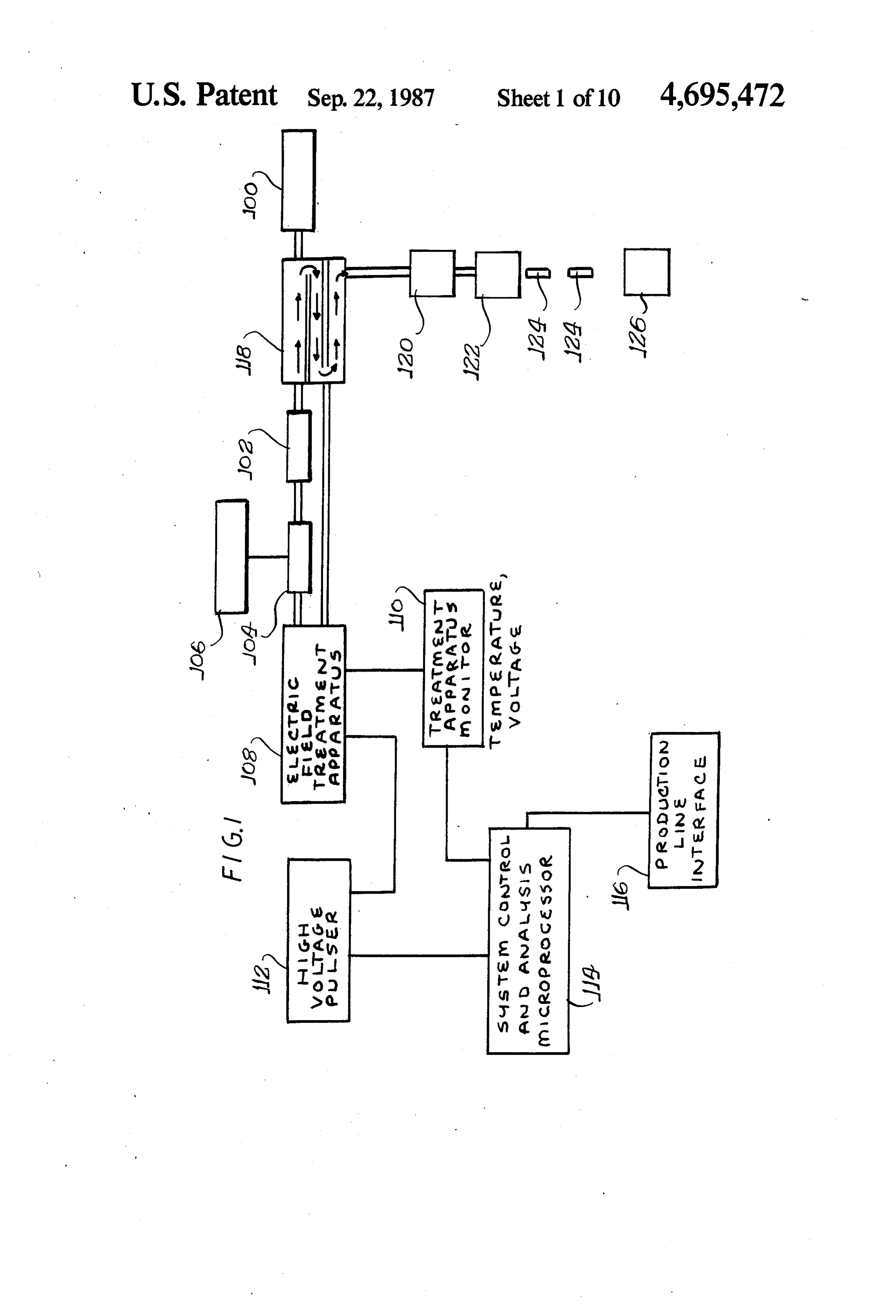
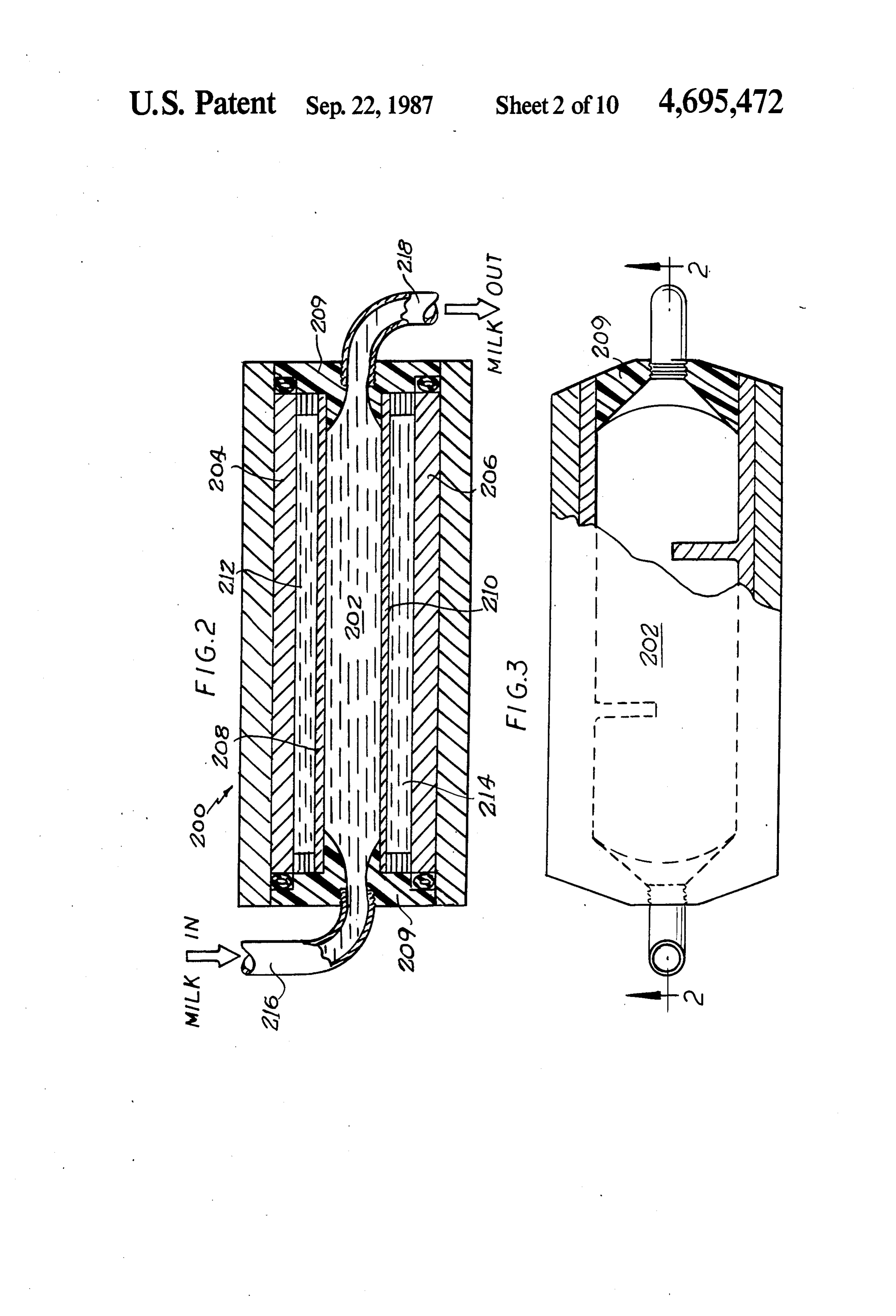
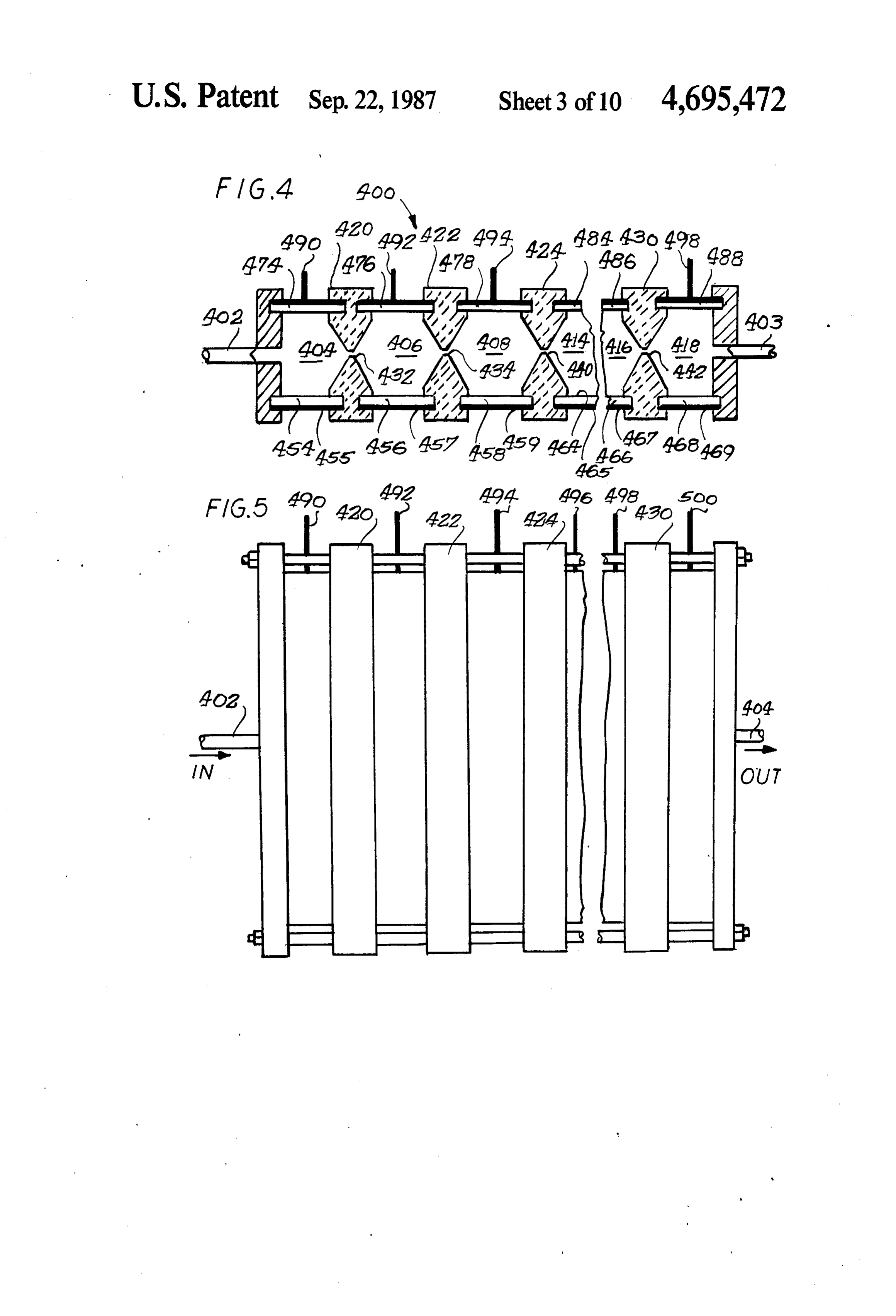
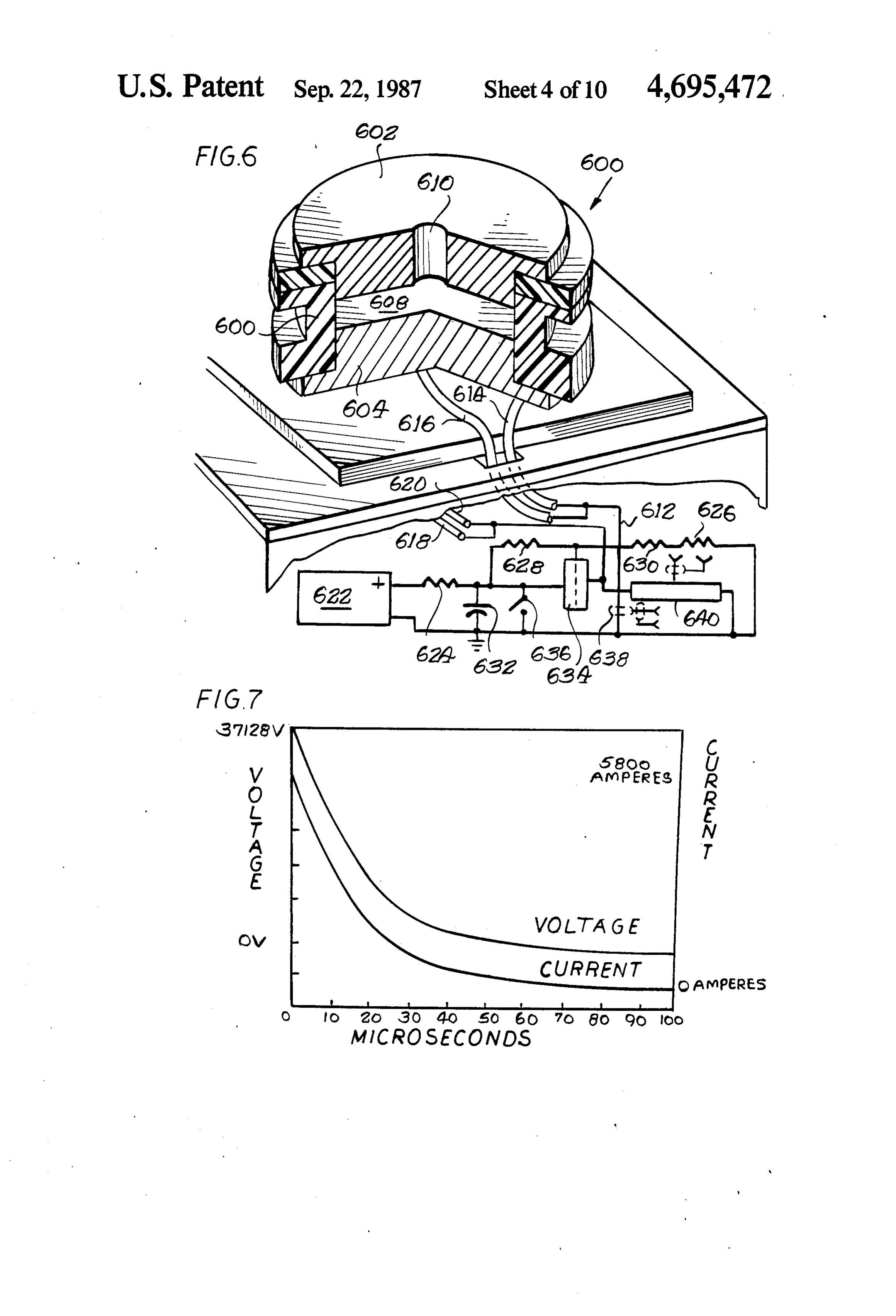
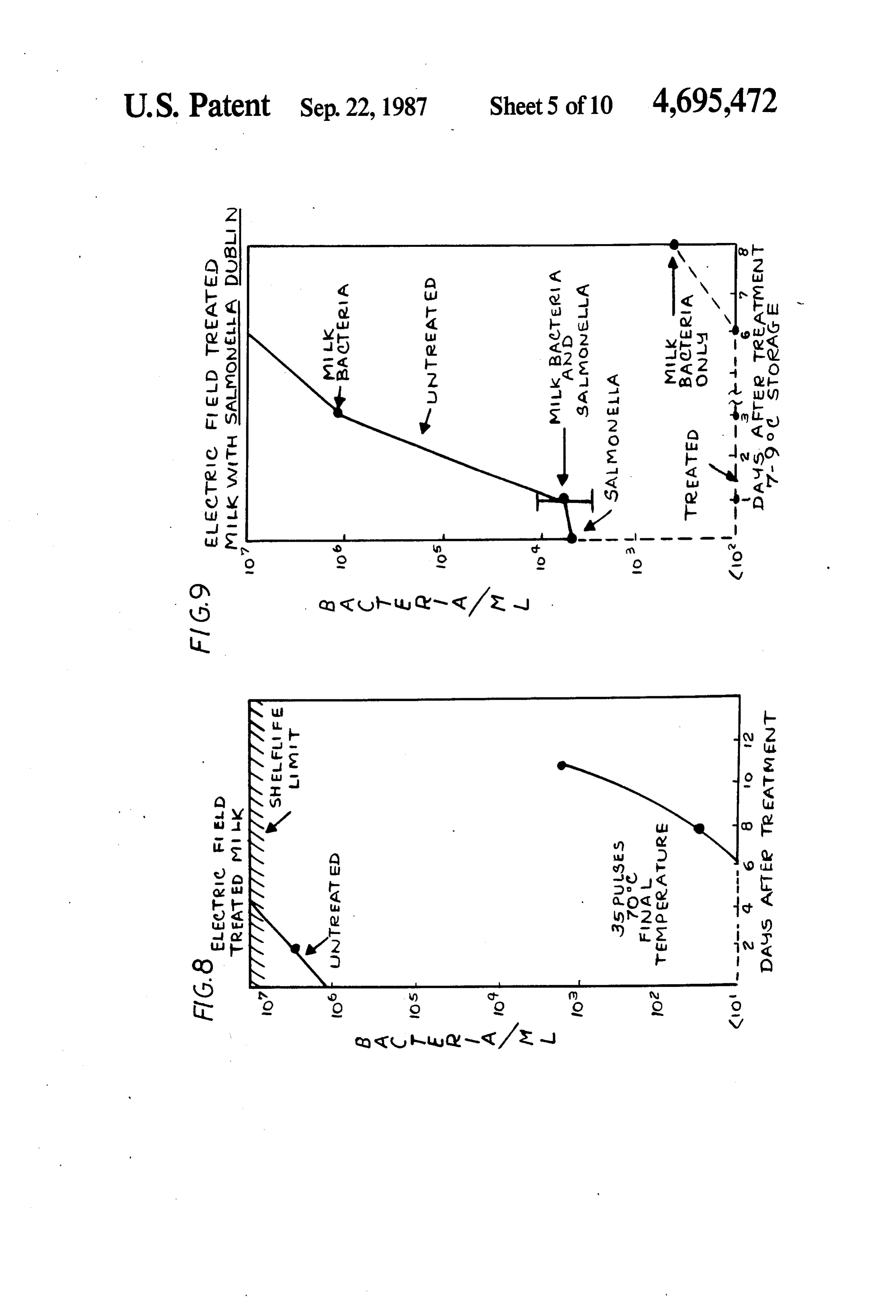
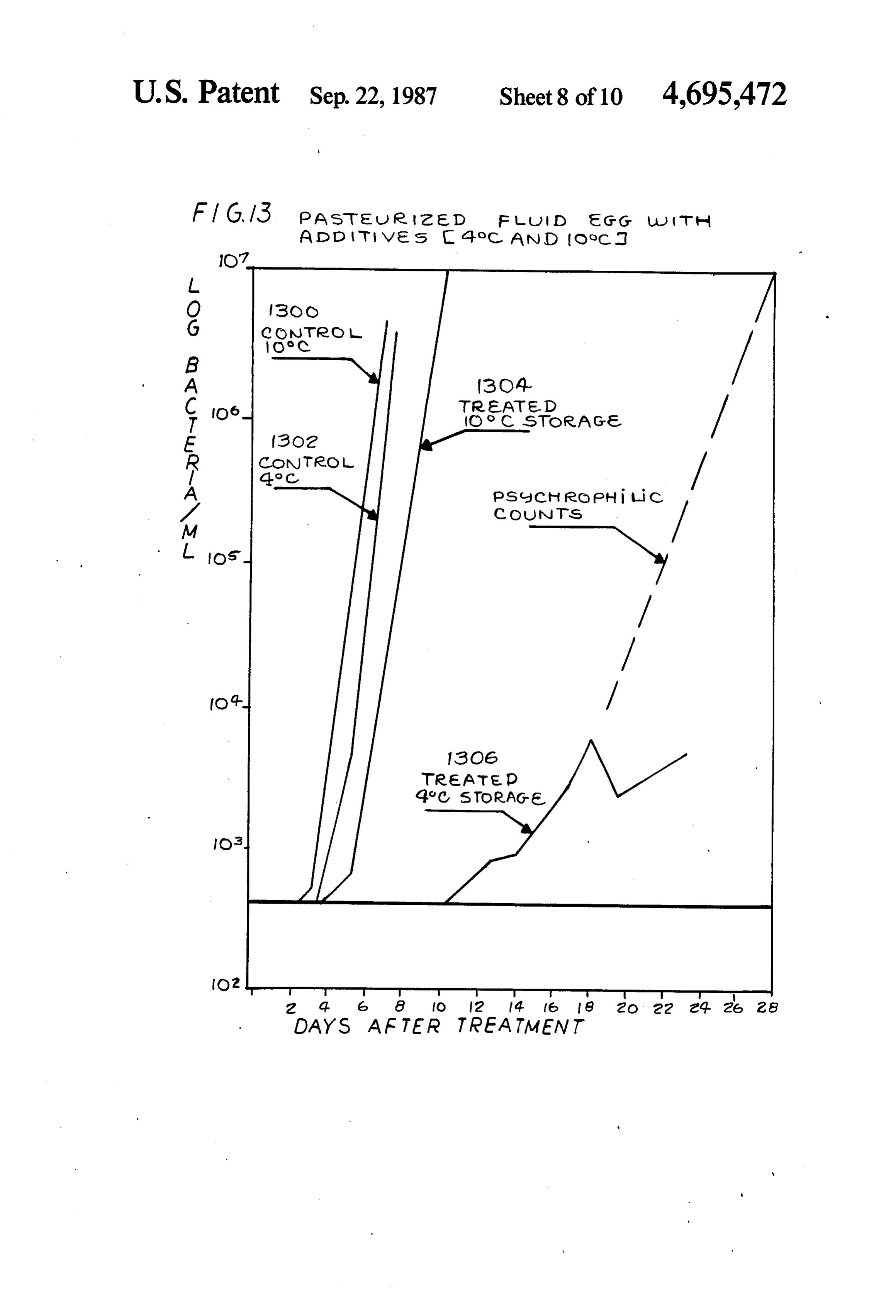
FIG. 1 is a schematic illustration of an embodiment of taining chemical preservatives as a function of time a processing system for extending the shelf life of per after pulsed electric field treatment at a temperature ishable liquid foodstuffs in accordance with the present elevated to approximately 60' C. in comparison with invention; control samples.
FIG. 2 is a cross sectional side view of an embodi
FIG. 13 is a graphic representation of the microbio logical population of pasteurized fluid egg product con FLUID FOODSTUFFS taining chemical preservatives as a function of time 50 Fluid Fat Carbo after pulsed electric field treatment, in comparison with Food
FIG. 15 is a graphic representation of the microbio GrapeJuice
Page 2drawing sheetscan →
Page 3drawing sheetscan →
Page 4drawing sheetscan →
Page 5drawing sheetscan →
Page 6drawing sheetscan →
Page 7scan →
FIG. IO toe Gruyr -8. CRC F eld TRSAT
T WITH Seas ASD
Y foS
1 2 3 4 5 e 7 p. 9 to II 2 la 14 is ?ee 17 1819)) 28 3o 32 34. DAL is 7-9 oc
F/ G s // a lectre C F ELD TR8ATe ut T- Lou CoNC
D toGueT
Nu TRA. ON Of f S AST si Joy
Page 8scan →
Le CTTim
Ric P8Field Treats D to Guet RATURE Const Roll
FIG.16 UNPAs tauRazs D And Past surzs D uu T - A D OT Ves (OOc
Page 9drawing sheetscan →
Page 10scan →
F/G,W 14 un PAst surzso And PAs Tsurized Fluid s G-G- with ADDIt Vas C40 C)
D As AFT e R TR cAm NT unpasteurizeged PA steur 28 D Fluid SG-G
O 2 3 4 5 6, 7 a 9 to it 2 3 4 DA - 5 AFTe R TREATns NT
Page 11scan →
A DDT VEs AT S la Vate D T R SATnn NT fo7 Ten PERATUR.
TR8AT8D 49 C storeAG 8 S Peae AD PA 8
COUNTs
Days after treatment
Page 12scan →
More recently, separately from the art of food preser
METHODS AND APPARATUS FOR EXTENDING vation, the effect of strong electric fields on microor THE SHELF LIFE OF FLUID FOOD PRODUCTS ganisms in nonnutrient media has been studied as a mechanism for reversibly or irreversibly increasing the
The present invention is directed to methods and 5 permeability of the cell membrane of microorganisms apparatus for preserving fluid liquid foodstuffs, and and individual cells Sale, et al., “Effects of High Elec more particularly is directed to such methods and appa tric Fields on Microorganisms III. Lysis of Erythro ratus for extending the shelf-life of perishable fluid cytes and Protoplasts', Biochmica et Biophysica Acta, foodstuffs such as dairy products, fruit juices and liquid 163, pp. 37-43 (1968); Hulsheger, et al., "Killing of egg products, which are growth media for microorgan 10 Bacteria with Electric Pulses of High Field Strength", isms. The present invention is also directed to preserved Radiat. Environ Biophys, 20, pp. 53-65 (1981); Hulshe liquid foodstuffs which have extended shelf-life. ger, et al., "Lethal Effects of High-Voltage Pulses on E. coli K12', Radiat. Environ. Biophys. 18, pp. 281-288
BACKGROUND OF THE INVENTION (1980); Zimmermann, et al., "Effects of External Elec Substantial technical effort has been directed to the S trical Fields on Cell Membranes', Bioelectrochemistry preservation of perishable fluid food products such as al.,and Bioenergetics, 3, pp. 8-63 (1976); Zimmermann, et milk products, natural fruit juices and liquid egg prod Membrane"Electric Field-Induced Cell-to-Cell Fusion', J. ucts which may normally contain a wide variety of al;, Biol., 67, pp. 165-182 (1982); Hulsheger, et microorganisms, and which are excellent culture media 20 Cells", Radiat. Field
"Electric Effects on Bacteria and Yeast for microorganisms.
Practical preservation methods which have found (1983);Carrier U. Zimmermann, et al., "The Development of significant commercial application predominantly uti inDrug Systems: Electrical Field Induced Effects lize heat treatment such as pasteurization to inactivate 7, pp. 553-574 (1980);Biochemistry Cell Membranes',
Jacob, et and Bioenergetics, or reduce the microorganism population. For example, 25 Implications of Electric Field Effects II. Inactivation of milk products are conventionally pasteurized at a mini Yeast Cells and Repair of Their Cell Envelope', Zeits mum temperature of at least about 72° C. for 15 seconds chrift fur Allgemeine Mikrobiologic, 21, 3, pp. 225-233 (or equivalent time/temperature relationship) to de (1981); Kinositas, Jr., "Formation and Resealing of stroy pathogenic bacteria and most of the nonpatho Pores of Controlled Sizes in Human Erythrocyte Mem genic organisms, with degradative enzyme systems also 30 brane', being partial or totally inactivated. However, products Neamann,Nature, 268, 4, pp. 438-440 (August, 1977); et al., "Gene Transfer into Mouse Lym processed in this manner are still generally nonsterile phoma Cells by Electroporation in High Electric and have limited shelf-life, even at refrigeration temper Fields', IRI Press Limited, Oxford, England, pp. ature. The shelf-life of liquid foodstuffs may be substan 841-845). The application of high electric fields to re tially extended by higher heat treatment processes such 35 versibly increase the permeability of cells has been used as "ultra high pasteurization', or "ultra heat treatment to carry out cell fusion of living cells and to introduce (“UHT”) such as treatment of from about 94° C. for 3 normally excluded components into living cells. Elec seconds to about 150 C. for one second in conjunction tric fields in nonnutrient media have a direct lethal with aseptic packaging to achieve complete destruction effect upon microorganisms with the rate of kill depen of all bacteria and spores. However, such heat treat 40 dent upon the field strength above a critical field level ment typically adversely affects the flavor of the food and the duration of the applied high voltage pulse or product, at least partially denatures its protein content pulses.
or otherwise adversely affects desired properties of the These studies postulate the cell membrane as the site fluid food product. Other approaches to liquid food of a critical effect, of reversible or irreversible loss of preservation, which also have certain disadvantages, 45 membrane function as the semipermeable barrier be include the use of chemical additives or ionizing radia tween the cell and its environment. An external field of tion. short duration is assumed to induce an imposed trans The bactericidal effects of electric currents have also membrane potential, which may produce a dramatic been investigated since the end of the 19th century, with increase of membrane permeability above a critical various efforts having been made to utilize electrical 50 electric field value. Because an increase in cell permea currents for treating food products, such as described in bility prevents the counteracting of differences in os U.S. Pat. Nos. 1,900,509, 2,428,328, 2,428,329 and mality of the cell content and surrounding media, ex 4,457,221 and German Patent Nos. 1,946,267 and change or loss of cell contents, cell lysis and irreversible 2,907,887. The lethal effects of low-frequency alternat destruction may occur as secondary mechanisms in ing current with low electric field strength have been 55 nonnutrient media which limit the ability of cells to largely attributed to the formation of electrolytic chem repair themselves, and which adversely affect permea ical products from the application of current through ble cells through osmotic pressure differences between direct contact electrodes, as well as ohmic heating pro the medium and the interior of the cell. duced by current flow through an electrically resistive However, such research has not found practical ap medium. As described in U.S. Pat. No. 3,594,115, lethal 60 plication in respect to methods for providing fluid food effects of high voltage arc discharges have also been products having extended shelf life. Accordingly, it is attributed to electrohydraulic shock waves. However, an object of the present invention to provide methods such electrolytic chemical products may be undesirable and apparatus for extending the shelf life of perishable in fluid foodstuffs, and the utilization of explosive arc food products such as dairy products, natural fruit discharges to produce microbiologically lethal shock 65 juices and fluid egg products. These and other objects waves has not found widespread application in the pro of the present invention will become apparent from the vision of edible liquid foodstuffs having extended shelf following detailed description and the accompanying life. drawings of which:
Page 13scan →
FIG. 1 is a schematic illustration of an embodiment of taining chemical preservatives as a function of time a processing system for extending the shelf life of per after pulsed electric field treatment at a temperature ishable liquid foodstuffs in accordance with the present elevated to approximately 60' C. in comparison with invention; control samples.
FIG. 2 is a cross sectional side view of an embodi
Description of the invention
ment of a pulsed electric field treatment processing cell unit which may be utilized in the system of FIG. 1; Generally in accordance with the present invention, FIG. 3 is a top view, partially broken away, of the methods and apparatus are provided for preserving pulsed electric field treatment processing cell unit of fluid foodstuffs which are normally excellent bacterio FIG. 2; 10 logical growth media. By "fluid foodstuff' is meant an FIG. 4 is a cross sectional side view of an embodi edible pumpable food product having a viscosity of less ment of a continuous current, high clectric field treat thai about 1000 centipoise, and preferably less than ment cell assembly which may be utilized in the pro about 150 centipose, at a temperature above 0° C., com cessing system of FIG. 1; prising in the range of from about 50 to about 95 percent FIG. 5 is a top view, partially broken away, of a 15 by weight water, and from about 4 to about 50 percent portion of the electric treatment cell assembly of FIG. by weight of solids selected from the group consisting 4; of proteins, carbohydrates and fats, and mixtures FIG. 6 is a perspective view, partially broken away, thereof, based on the total weight of the fluid foodstuff. of an embodiment of a static pulsed electric field treat The viscosity of the foodstuff may generally best be ment cell for testing the effect of pulsed electric field 20 determined at ambient temperature (e.g., about 23 C.) treatment on perishable liquid food products, together or an elevated processing temperature (e.g., 65 C.). By with an electrical schematic diagram of the high voltage "bacteriological growth medium' is meant that upon pulse generation circuitry for the test apparatus; storage at a temperature in the range of 10 C. to about FIG. 7 is a graphic representation of an oscilloscope 30°C., the fluid foodstuff, with its indigenous microbio trace of voltage and current response through a liquid 25 logical population or when seeded with test organisms, food product upon pulsed discharge of the apparatus of will demonstrate an increase in biological content or FIG. 6; activity as a function of time as detectable by direct FIG. 8 is a graphic representation of the shelflife microscopic counts, colony forming units on appropri extension provided by pulsed electric field treatment of ate secondary media, metabolic end product analyses, natural, high pulp orange juice; 30 biological dry or wet weight or other qualitative or FIG. 9 is a graphic representation of the effect of other quantitative analytical methodology for monitor pulsed electric field treatment on the microbiological ing increase in biological activity or content. For exam content, over time, of fluid milk seeded with Salmonella ple, under such conditions the microbiological popula dublin as compared to an untreated control sample; tion of a liquid foodstuff which is a bacteriological FIG. 10 is a graphic representation of the shelf-life 35 growth medium may at least double over a time period extension provided to yogurt seeded with a low level of of two days. The fluid foodstuffs will have an electrical yeast, by pulsed electric field treatment utilizing the conductivity of at least about 0.001 mhos cm, al apparatus of FIG. 6, which has been reseeded with though deionized food products may also be treated yeast after a specified time period; which have lower conductivities, and a combined so FIG. 11 is a graphic representation of the shelf-life 40 dium and potassium content of at least about 0.10 extension provided to yogurt seeded with a low level of weight percent, based on the total weight of the fluid yeast, by pulsed electric field treatment utilizing the foodstuff. The compositions of typical fluid food prod apparatus of FIG. 6; ucts which are biological growth media, derived from FIG. 12 is a graphic representation of the increase in "Nutritive Value of American Foods in Common shelf-life extension of yogurt which is provided by con 45 Units', Agriculture Handbook No. 456 of the U.S. De trol of temperature parameters by pulsed electric field partment of Agriculture (1975), are as follows: treatment utilizing the apparatus of FIG. 6;
FIG. 13 is a graphic representation of the microbio logical population of pasteurized fluid egg product con FLUID FOODSTUFFS taining chemical preservatives as a function of time 50 Fluid Fat Carbo after pulsed electric field treatment, in comparison with Food
Product
Water Protein Wt hydrate control samples; Whole Milk 87.4 3.48 3.48 4.91 05 .144 FIG. 14 is a graphic representation of the microbio (3.5% fat) logical population of unpasteurized and pasteurized Yogurt** 89.0 3.40 1.68 5.22 .050 .142 fluid egg product with chemical preservatives as a func 55 Raw Orange 88.3 .685 .20 10.0 0008 .2 tion of time after pulsed electric field treatment; Juice
FIG. 15 is a graphic representation of the microbio GrapeJuice
Raw Lemon
.001 trace logical population of pasteurized and unpasteurized Juice fluid egg product without chemical preservatives at a Raw Grape- 90.0 .48 08 9.18 0008 .16 storage temperature of 4 C. as a function of time after 60 fruit Juice pulsed electric field treatment; Apple Juice 87.8 .08 trace 11.9 0008 10 FIG. 16 is a graphic representation of the microbio Raw Whole 73.7 12.88 11.50 90 .12 .13 logical population of unpasteurized and pasteurized Eggs Fresh Egg 87.6 10.88 .02 .79 15 .14 fluid egg product with chemical preservatives at a stor Whites
Split Pea 70.7 6.99 2.60 16.99 77 .22 age temperature of 10° C. as a function of time after 65 Soup" pulsed electric field treatment; and Tomato 81.0 .60 2.10 12.69 79 187 FIG. 17 is a graphic representation of the microbio Soup" logical population of pasteurized fluid egg product con Tomato 68.6 2.0 588 25.4 1.04 .362
Page 14scan →
-continued minutes of the electric field treatment. The high voltage
Fluid foodstuffs
electrically field treated fluid foodstuff may be rapidly cooled by means of continuous flow heat exchange
Food Water Protein Wt hydrate Na K units prior to packaging or bulk storage. In this manner, Product Wt 7% Wt 9% 9, Wt 7, Wt 92 Wt 9% 5 it is believed that electrically treated organisms having Catsup cell wall damage may be cooled to an inactive meta "condensed - commercial bolic condition before cell wall repair may be accom **from partially skimmed milk plished, thereby enhancing the product shelf-life. This synergistic relationship between electric field
In accordance with the present methods, all of the 10 treatment and temperature during and after treatment fluid foodstuff is subjected to a sequential plurality of such that the use of heating and/or cooling and electric high electric field pulses, each having a minimum fieid field in a carefully controlled manner greatly enhances strength of at least about 5,000 volts per centimeter, and the effect of the process over that achieved using elec preferably at least about 12,000 volts per centimeter, tric field or heating or cooling alone. The temperature and each having a duration of at least about 1 microsec 15 control is carried out so that the processed liquid food ond and preferably a duration in the range of from stuff is respectively above or below the optimal temper about 5 to about 100 microseconds, to provide an elec ature range for biological activity. During the electric trically field stressed fluid foodstuff. All of the fluid field treatment phase, the high voltage electric pulse foodstuff should be subjected sequentially to at least 2 treatment process may be either discontinuous, with high electric field pulses, and more preferably at least 20 about 5 pulses. The treatment interval between pulses discrete portions of fluid foodstuff being treated as a unit by subjecting all of the liquid foodstuff to a se should desirably be less than about one minute, and quence of pulsed electric fields which are each of sub preferably less than about one second. By the "dura stantially uniform field strength throughout all of the tion' of an electric field pulse is meant the length of liquid food product to be treated. The processing may time the electric field exceeds the minimum field 25 strength. As indicated, all of the electrically stressed also be continuous, with the treated foodstuff flowing fluid foodstuff should be subjected to the multiple pulse steadyandstream.
into being emitted by the treatment system in a
Heating of the liquid foodstuff for tem treatment.
It is also desirable that the fluid foodstuff be subjected perature control during processing may be carried out concomitantly with the high voltage electric field ing) through electric field energy deposition (resistive heat pulses, to pulses of high electrical current density ited to, or through other means, for example, but not lim through all of the fluid foodstuff, of at least about 1 heatingthermal through heat exchange, steam injection, resistive a resistive source secondary to the microsecond, and preferably in the range of from about primary electric field driver, or microwave heating. 5 microseconds to about 100 microseconds. Typically, for fluid food products having an electrical resistivity in 35 theTypical operating conditions for the system include provision of electric pulses having electric field the range of from about 1 to about 1000 ohm-centime ters, the current density of the current pulses should be strengths about 25 of from about 5 kilovolts per centimeter to kilovolts per centimeter with flat-topped or at least about 5amperes per square centimeter, and most exponentially decaying pulse shapes of typical duration preferably at least about 12 amperes per square centime between 1 and 100 microseconds and repetition rates ter. 40
The electrically stressed fluid foodstuff should be between 0.1 and 100 hertz. Higher electric field maintained under substantially sterile conditions, and strengths may be provided, such as up to about 30 may be packaged to provide a packaged food product kV/cm particularly for very short duration pulses and having extended shelf-life. Desirably, the electrically depending on the properties of the fluid foodstuff being stressed fluid foodstuff may be maintained and pack 45 processed.
mity of the
However, at high field strengths, the unifor electric field and current density through aged under aseptic conditions after being subjected to the pulsed electric field treatment. the fluid foodstuff degrades as a function of time, with a tendency to produce arcs or current filaments. Ac
In accordance with various preferred aspects of the cordingly, present invention, the temperature at which the fluid precision higher strength field pulses may require high foodstuff is treated may be controlled to substantially 50 control of field uniformity and pulse length to increase the shelf-life of the treated product. In this prevent the development such filaments or arcs. Where regard, all of the food product may be subjected to at heating by electric field is beneficial, exponentially de least one such electric field pulse at a temperature of at caying pulse shapes are employed; where the heating by least about 45 C. and more preferably, at least about electric field treatment is to be kept to a minimum, 55 C. By subjecting the fluid food product to pulsed 55 relatively flat-topped electric field pulses are used. electric field treatment at pasteurization temperatures, Electric field treatment should best be carried out such as in the range of from about 63 to about 75 C., with pulses having an electric field strength in the range substantially improved shelf-life extensions may be of from about 12 kilovolts per centimeter to about 25 achieved over those obtained by pasteurization alone, kilovolts per centimeter. Depending upon the applica without the adverse effects on the fluid food product 60 tion, i.e., the selective killing of a particular organism which result from UHT treatment at high temperature. versus the broad spectrum killing of mixed bacterial In addition, by promptly cooling the electric field populations, pulse duration should be in the range of treated liquid foodstuff to a refrigeration temperature of from about 1 to 100 microseconds with preferred values less than about 10 C., and preferably in the range of between 10 and 40 microseconds. The variation of pulse from about 0° C. to about 9 C., further substantial 65 duration may be used to control heating within the improvement in shelf-life may be obtained. Desirably, liquid food product being treated. For example, long the food product should be cooled to refrigeration tem pulse lengths can be used to raise the temperature of the perature within 30 minutes, and preferably within 3 sample to temperatures synergistic with the electrical 15 effect; multiple, short square wave pulses can then be kill level; in a manner similar to cooling, the heat affects rapidly delivered to complete the treatment. cellular metabolism at temperatures greater than the Sequential electric field (and concomitant electric growing temperature of the bacteria, even though the current) pulses may be of the same polarity, or may be elevated temperature may be less than that which kills of sequentially alternating polarity. It is also noted that through immediate exposure.
the electric field pulsed may preferably be established Even though the treatment temperature is not high between electrodes having respective positive and neg enough to produce significant shelf life extension by ative polarity with respect to a ground potential, or itself, elevated temperatures which stress the treated between electrodes, one of which is maintained gener bacteria can greatly enhance the kill and shelf life exten ally at ground potential and the other of which is pulsed 10 sion provided by the treatment. Moreover, posttreat at either positive or negative potential with respect to ment incubation conditions further significantly affect ground potential. High voltage electric pulses inay also the shelf life extension. Electrically treated liquid food be provided, however, between electrodes, both of products incubated at room temperature after treatment which are at either positive or negative potential with may begin to regenerate immediately, whereas samples respect to ground potential. 15 incubated at refrigeration temperatures (4-9 C.) typi As indicated, various preferred aspects of the present cally do not begin to increase in numbers until several invention concern synergistic utilization of the effects days after treatment. These observations are believed to of electric field treatment at elevated, controlled tem relate to the degree of repair occurring during and after peratures together with control of post-treatment incu sample treatment.
bation or storage temperature. Such thermally con 20 As indicated, in accordance with the present inven trolled processing has been found to not only affect the tion, the fluid foodstuff is subjected to a plurality of degree of microbiological kill seen immediately after high voltage electric pulses. The fluid food product treatment but also the long term microbiological viabil may be subjected to such a plurality of pulses by a vari ity, i.e., shelf life. ety of processing techniques. In one such processing Heat applied before or during electric field treatment 25 method, the liquid foodstuff is introduced into a treat may be used to produce microbiological kill rates in the ment zone between two electrodes which have a con fluid foodstuff greater than those obtainable by electric figuration adapted to produce a substantially uniform field or heat treatment alone. The elevation of heat electric field therebetween. High voltage electric pulses during treatment to a temperature stressful to but not may be applied to the electrodes to subject the liquid necessarily lethal to microorganisms for the time em 30 foodstuff to the multiple pulse treatment by pulsed field ployed, is believed to exaggerate the membrane damage apparatus such as lumped transmission line circuits, sustained during treatment. This may occur through an Blumlein transmission circuits and/or capacitive dis increase in membrane fluidity or porosity, producing charge circuits. If the liquid foodstuff is continuously greater damage per treatment dosage, a decrease in the introduced into the treatment zone to which high volt capability of the damaged microorganism to effect re 35 age pulses are periodically applied, and fluid foodstuff is pair during and after treatment due to the disruptive concomitantly withdrawn from the treatment zone, the - effects of such stressful temperature elevation upon rate of passage of the liquid foodstuff through the treat cellular metabolism, and/or an increase in any osmotic ment zone should best be coordinated with the pulse effects secondary to the electric field membrane dam treatment rate so that the liquid foodstuff is subjected to age. By rapidly cooling the electrically treated fluid 40 at least two pulses within the treatment zone. The liquid foodstuff to a refrigeration temperature, it is believed foodstuff may be subjected to treatment in a sequential that the normal cellular mechanisms for repair or de plurality of such treatment zones, as will be described in crease of the electric field-induced cell membrane per more detail hereinafter.
meability are retarded, thereby increasing cell vulnera Also in accordance with various other aspects of the bility and decreasing the reproductive capacity of re 45 present invention, methods for effectively subjecting all maining bacteria or spores which survive the electric of the liquid food product to a sequential series of high field treatment. electric field and current pulses may also be carried out When microorganisms are subjected to high electric by continuously forcing the fluid foodstuff through an fields for sufficiently long periods of time, cell permea orifice zone of restricted length and cross sectional area bility is established and transcellular ion and osmotic 50 from a first electrode zone and to a second electrode flow may occur. This flow may be interrupted because zone, continuously conducting an electrical current biological membranes are exceptionally resilient and the between the first electrode zone and the second elec induced transmembrane pores resealed in time for the trode zone through the liquid food product such that an cell to survive. A permeable cell which is not destroyed electrical field of at least about 5000 volts per centime by the electric field treatment must reseal its membrane, 55 ter is maintained in the restricted orifice zone. The rate reestablish active transport and readjust its internal of passage of the liquid food product through the high ionic and fluid content if it is to survive. field restrictive orifice zone should result in an effective In nutritive media such as milk, natural fruit juices pulsed treatorifice ment time of at least about 1 micro and natural liquid egg products, cells that are actively second for the foodstuff as it is forced through the zone. growing at the time of treatment may recover under 60 In accordance with apparatus aspects of the present appropriate conditions. However, in accordance with invention, pulsed field treatment apparatus for preserva the present invention, effective processing may be car tion of liquid foodstuffs is provided comprising an elec ried out in nutritive media by temperature control. In tric field treatment chamber comprising a first electrode cubation at refrigeration temperatures after treatment means for making electrical contact with liquid food can reduce the metabolic level of electrically treated 65 stuff disposed adjacent said first electrode means in said microorganisms and hence tend to diminish recovery chamber, a second electrode means spaced apart from and repair. Similarly, elevation of the temperature of said first electrode means for making electrical contact the sample during treatment may be used to increase the with liquid foodstuff disposed in said chamber between 16 said first electrode means and said second electrode and an electric field treatment cell 108 in which the means, an inlet conduit means for introducing a fluid electric field treatment of the liquid foodstuff is carried foodstuff to be treated into said electric field treatment out. The treatment cell has associated therewith a cell chamber, an outlet conduit means for discharging fluid monitor 110 having appropriate sensor instrumentation food product which has passed through said treatment 5 to monitor the temperature and voltage conditions chamber, means for applying high voltage electrical within the cell. The high voltage pulses to the cell are pulses to said first and second electrode means at a rate provided by high voltage pulser 112, which may be a of at least about 0.01 pulse per second and preferably at high voltage lumped transmission line circuit, properly least about one pulse per second to provide an electric impedance matched to the treatment cell, a Blumlein field between said electrodes through a fluid foodstuff 10 transmission line circuit properly impedance matched located therebetween of at least about 5000 volts per to the treatment cell 108, or a capacitive discharge cir centimeter, and means for pumping a fluid foodstuff cuit. The temperature and voltage information from the through said inlet conduit means at a rate such that all of cell monitor 110 is provided as a data input stream to the said fluid foodstuff is subjected to at least two pulses in system control and analysis microprocessor 114, which transit through said high voltage treatment zone before 15 controls the operation of the high voltage pulser 112. it is conducted from the chamber through said outlet The system control and analysis microprocessor 114 is conduit means. Such apparatus may further include provided with a production line interface 116 which is means for heating the fluid foodstuff to a predetermined adapted to interface with automated production line temperature of at least about 45' C., and more prefera apparatus having computer control systems. The illus bly at least about 55' C. before introduction to the treat 20 trated electric field processing system further comprises ment chamber, and may further include means for cool refrigeration apparatus 120 for cooling the treated pro ing the fluid foodstuff which has passed through said cess stream from the heat exchanger 118 to provide a one or more treatment zones to a refrigeration tempera refrigerated, electrical field treated foodstuff stream for ture in the range of from about 0 to about 10 C. aseptic packaging apparatus 122. The packaging appa Desirably, the first and second electrode means may 25 ratus 122 packages the treated process stream into either be adapted to prevent direct electrolysis of the fluid individual sterilized consumer packages 124 or steril foodstuff upon application of a pulsed electric field ized bulk transport containers which are stored in re thereto. In this regard, such electrodes may comprise an frigerated storage apparatus 126 until delivery to the electrically conductive electrolysis electrode, an ion consumer. In operation, the liquid food product to be permeable membrane and an intermediate electrolyte, 30 treated, which in the illustrated embodiment may be such that ionic electrical connection is made with the fluid milk, a natural fruit juice such as orange juice, or fluid foodstuff through the ion permeable membrane a liquid natural egg product, is pumped from the storage rather than by direct contact with the electronically reservoir 100 to the heat exchange unit 118 so that the conductive electrode. heat energy is conserved within the treatment system. Also contemplated by the present invention, is elec 35 In this regard, the treated liquid food product which has tric field treatment apparatus comprising means defin passed through the cell 108 is conducted into heat ex ing a first electrode reservoir zone, means defining a change relationship with the liquid food product which second electrode reservoir zone, means defining a re is to be introduced into the treatment cell 108 by means strictive orifice between said first reservoir zone and of heat exchanger 118. After exiting the heat exchange said second reservoir zone, means for continuously 40 unit 118, the fluid food product to be treated may be conducting an electric current in fluid foodstuff be heated to a predetermined temperature by heating unit tween said first reservoir zone and said second reservoir 102. The extent of such heating, if any, is determined by zone and through said at least one said restrictive orifice the desired processing temperature within the electric to provide an electric field gradient in said restrictive pulse processing cell 108. Because the electric cell treat orifice of at least about 5000 volts per centimeter, and 45 ment may also raise the temperature of the liquid food means for forcing fluid foodstuff from said first elec product, the degree of heating provided by the heating trode reservoir zone through said restrictive orifice into unit 102 may depend in some measure upon the effi said second reservoir zone at a rate which provides an ciency of the heat exchange unit 118. Typically, the effective pulsed field treatment time in said restrictive temperature of the fluid product emerging from the orifice of at least about 1 microsecond, and preferably in 50 heating unit 102 may be at least about 40 C., and in the range of from about 5 to about 50 microseconds. By some cases may be at least about 50 C. or more. providing restrictive orifices of relatively short channel The heated liquid food product stream from the heat length, such as less than about 0.1 centimeters, prefera ing unit 102 is conducted to the deaeration unit 104. In bly in the range of from about 0.05 to about 0.005 centi the unit 104, the liquid may be subjected to vacuum meters, and by forcing the fluid food product through 55 conditions of at least about 20 inches of mercury in the orifice at high differential pressure of at least about order to remove dissolved gases and/or product bub 50 psi across the orifice, short treatment times and high bles which might adversely affect the development of a field current gradients may be provided on a continuous substantially uniform electric field in the treatment cell processing basis. 108.
Having generally described various aspects of the 60 The deaerated liquid food product is continuously present invention, electric field treatment of fluid food passed through the electric pulse treatment cell 108, in products will be more particularly described with re which it is subjected to, in the illustrated embodiment, a spect to the processing system which is schematically plurality of high voltage electric pulses at a field illustrated in FIG.1. As shown in FIG. 1, the electric strength of at least about 12,000 volts per centimeter field food processing system comprises a storage reser 65 and a duration in the range of from about 5 to about 50 voir 100 for the liquid food product to be treated, an microseconds. At least one of the pulses is carried out at inline heating unit 102, a deaeration apparatus 104 hav a temperature in the range of from about 50° C. to about ing a suitable vacuum system 106 associated therewith, 70° C. The treated liquid food product is conducted 17 back to the heat exchange unit 118 where it is cooled by tially affecting the uniformity of electric field develop the incoming liquid food product, and is subsequently ment through the food product to be treated. conducted to refrigeration unit 120 where it is cooled to In order to provide electrical conduction between the a temperature of less than about 10' C., and preferably metallic electrodes 204, 206, and the ionic membranes less than about 5 C. within about one minute of its 208, 210, electrolyte zones 212, 214 are provided be pulsed electric field treatment. While in the illustrated tween the respective electrodes 204, 206 and the ion embodiment, the refrigeration unit is used to substan transport membranes 208, 210. The electrolyte pro tially immediately cool the product in an energy effi vided in the ion conductivity zones 212, 214 should have a relatively high conductivity in respect to the cient manner, it is noted that the product may also be O conductivity cooled after it is packaged. The cooled, electrically of the liquid food product to be treated in the zone 202. Moreover, the electrolyte should best be treated liquid food product stream is subsequently intro substaitially duced as an input stream to aseptic packaging apparatus which may produce free of components such as chloride ions, 122 which packages the product in sterilized containers undesirable electrolysis products, it 124 under sterile conditions. The packaged product 15 being recognized in any event that such products are containers 124 are maintained under refrigeration con isolated from the food product being treated by the ditions by appropriate refrigeration storage apparatus ionically selective membranes 208, 210. Suitable elec 126 until distribution to the consumer. Such storage trolyte solutions include sodium carbonate, sodium hydroxide, potassium carbonate and potassium hydrox apparatus may include refrigeration storage units at the ide solutions, and mixtures thereof. The cation content packaging plant, refrigeration transport units in the 20 of the electrolytes may be adjusted so that there is no distribution system, and refrigeration storage units at net change the distribution warehouse, grocery store or other con treated. Theinelectrolyte cation content of the food product being may be circulated continuously sumer distribution center. Because of the extended through the zones 212, 214 in order to remove electrol shelf-life properties provided by the electric pulse treat ysis products and/or to maintain temperature equilib ment, such refrigerated storage may be carried out over 25 rium within the treatment cell, taking appropriate care an extended period of time while maintaining the fresh to electrically isolate the respective electrolyte circula ness and keeping qualities of the processed food prod tion systems.
uCt. In order to prevent an undesired degree of concentra Illustrated in FIGS. 2 and 3 is an embodiment 200 of tion or depletion of ionic components as a result of ionic a continuous flow electric pulse treatment cell unit 30 transport to or from the electrolyte zones 212, 214 which may be utilized in the apparatus of FIG. 1. The across the respective membranes, the circulating elec illustrated cell unit 200 comprises an electric field treat trolyte of each respective zone may be replaced from ment zone 202 defined between plane metallic conduc time to time with fresh electrolyte solution having the tive plates 204, 206 which are maintained in parallel desired composition. The electrolyte solution from one relationship by dielectric spacing element 209 which 35 electrolyte zone may also be exchanged periodically extends continuously about the periphery of the cell with the electrolyte solution from the other zone. In unit 200. The plane metallic plates may form electrodes addition, the relative polarity of the electric pulses ap in direct contact with the fluid food product to be plied to the respective electrolyte zones 212, 214 may be treated. However, in the illustrated cell unit 200, the alternated after each pulse, or after a predetermined metallic electrodes 204, 206 do not directly contact the 40 number of pulses, so that the net transport of ionic com liquid food product being subjected to electric field ponents to and from the respective zones, averaged treatment in order to isolate electrolysis products from over time, is minimized or eliminated. the fluid food product. In this regard, the internal elec The thickness of the cell treatment zone 202 along the tric field treatment zone 202 is further defined by ionic direction of the electric field may desirably be at least conductive membranes 208, 210 which, together with 45 about 0.25 centimeters and will preferably be in the the dielectric spacing insulator 209 form an enclosed range of from about 0.5 centimeter to about 3 centime zone 202 which is physically isolated from the elec ters. The treatment unit 200 is rectangular in shape, and trodes 204, 206. The membranes 208,210 may be of any is adapted to be "stacked' in an array of a plurality of suitable ion permeable material which is desirably sub such cells to form the treatment apparatus 108. It may stantially inert to the passage of ionic electric current 50 be desirable to degas the liquid food product issuing therethrough. The ion membrane material should best from a cell unit prior to introduction into a subsequent have a specific conductance which is at least equal to cell unit in the treatment apparatus. Accordingly, for the specific conductance of the liquid food product example, a vacuum degassing apparatus may be pro being treated within the treatment zone 202. Suitable vided at outlet conduit 218 for degassing of the output food grade ion permeable membrane materials include 55 stream to produce a degassed, treated stream for intro cation permeable membrane materials such as sulfo duction into the subsequent cell. Treatment cell units nated polystyrene, acrylic acid copolymers, and fluori formed between concentric electrodes may also be uti nated hydrocarbon polymers having pendant ionic lized.
groups, such as Nafion polyfluoroethylene polymers In operation, the fluid food product to be treated, having pendant sulfonic acid groups. Such polymers are 60 such as liquid milk or natural liquid fruit juice, is intro adapted to permit cationic transport through the mem duced through input conduit 216 while high voltage brane upon application of an electric potential across electric pulses are repetitively applied to the metallic the membrane, but tend to exclude anionic transport electrodes 204, 206 at a rate coordinated with the rate of across the membrane. Other ion conductive mem flow of the food product through the zone 202, such branes, such as commercially available high conductiv 65 that a plurality of at least two pulses is applied during ity food grade anionic and cation electrophoresis mem the transit time of the most rapidly traveling component branes may also be utilized. The membranes may be of the food product introduced through the zone 202. supported in an appropriate manner without substan The polarity of the electric pulses may be reversed upon 18 alternate pulses, or at other intervals, so that the ionic 440, 442 between the electrode reservoir zones. Each of components do not become depleted or concentrated in the reservoir zones may also be in respective electrical the respective zones 212, 214. Moreover, as shown in contact with an ion permeable membrane 454, 456, 458, FIG. 3, the treatment zone may be provided with baf 464, 466, 468, such as a food grade cation permeable fles to provide a tortuous path therein in order to in 5 membrane, and associated metallic electrode 455, 457, crease the minimum residence time of the fluid foodstuff459, 465, 467, 469. A suitable conductive aqueous elec in the zone. trolyte 474, 476, 478, 484, 486, 488, such as a sodium or Upon exiting the treatment zone 202, the treated potassium hydroxide, phosphate or carbonate solution liquid is conducted from the zone by conduit 218, which provides ionic conduction between the respective ion may form the input conduit to another treatment unit O permeable membrane and metal electrode of each of the 200. The length of the liquid in the treatment conduit electrode reservoirs. Other appropriate types of elec 218 may be relatively long in comparison with the trodes or means for making electrical cuntact with the thickness of the treatment cell, in order to limit the liquid food product in the respective reservoir zones electrical conductance between the cells. may also be used.
It will be appreciated that, in the absence of cooling 5 In operation, a continuous potential is applied to each between cells 200, subsequent cells may operate at a of the electrodes from a suitable power supply (not higher temperature in view of the ohmic heating of the shown) by means of cables 490, 492, 494, 496, 498, 500 liquid food product being treated. Because the conduc so that an electric field of at least about 5000 volts per tivity of the food product tends to increase with increas centimeter is established through the slot-like openings ing temperature, higher currents may be provided in 20 432, 434, 440, 442 between the respective electrode subsequent cells for a given pulse potential, which may reservoir zones 404, 406, 408, 414, 416, 418. The length beneficially enhance the shelf life of the treated prod of the openings 432, 434, 440, 442 in the direction of uct. A plurality of at least two treatment cell units 200 fluid travel between the electrode reservoir zones is and preferably from about 3 to about 10 such units may relatively small, thereby producing a relatively high be utilized to form an electric pulse treatment unit such 25 field gradient within the orifice. as the treatment unit 108 of FIG. 1. By introducing the liquid food product to be treated As indicated, it is important that a substantially uni under high pressure by means of inlet conduit 402, the form electric field be provided throughout the liquid liquid food product may be forced at high velocity foodstuff treatment zone. If a uniform field is not through the respective openings 432, 434, 440, 442. larly at higher field gradient levels, or under condi 30 Because all of the liquid food product which exits from tions of impedance mismatch between the high voltage the discharge conduit 403 has passed through each of source (e.g., a Blumlein source) and the treatment the orifices 432, 434, 440, 442, it will be appreciated that chamber, current filaments or the formation of all of the fluid food product is effectively subjected to a "streamer' arcs may develop within the treatment zone. plurality of high electric field pulsed treatments upon its When electric fields exceed an upper threshold value, 35 passage through the device 400. e.g., about 25 kilovolts per centimeter for milk, the The average residence time of the liquid food product distribution of field within the chamber rapidly changes in each of the reservoirs 404, 406, 408, 414, 416, 418 upon firing to yield 'streamer arcs'. These result in should be less than about 1 minute, and will preferably very little kill because of their small path area through be less than about 5 seconds. The velocity of the food the sample. Exceeding a threshold voltage value may 40 product through the orifices may be adjusted to provide produce not only large arcs through the fluid food the desired treatment time within a high voltage gradi product between the discharge electrodes, which may ent electric field.
fracture the treatment chamber and leave pits upon the For example, the fluid food product may be forced electrodes, but also may produce multiple, small under pressure at a velocity of about 100 meters per streamer arcs which generate no visible chamber dam 45 second through the slot-like orifices having a length in age but which do not produce proper treatment of the the direction of fluid travel of about 0.1 cm. to provide fluid food products. a treatment time of about 10 microseconds. The applied As previously indicated, the pulsed electric field voltage between respective electrode reservoir zones treatment may be provided by applying a pulsed elec may be in the range of from about 1000 to about 2000 tric field to a treatment Zone between two electrodes volts.
which provide a substantially uniform field between the Having generally described the methods, apparatus electrodes. The liquid food product to be treated may and processing systems of FIGS. 1-5, various aspects of also be subjected to pulsed electric field treatment by high voltage pulsed electric field treatment of specific establishing a continuous, high gradient electric field in liquid food products utilizing the laboratory scale a relatively small treatment Zone, and continuously and 55 pulsed electric field treatment apparatus of FIG. 6 will rapidly passing the liquid food product to be treated now be described. Illustrated in FIG. 6 is a pulsed elec through the continuous, high gradient electric field tric field treatment static test apparatus 600 having two ZOe, substantially parallel stainless steel electrodes 602, 604 Pulsed electric field treatment apparatus 400 which which form a test chamber 608 with a cylindrical nylon continuously passes the liquid food product through an 60 spacer 606. The chamber 608 has a height of 2 cm. and established, high gradient electric field treatment zone an inner diameter of 10 cm. when capped on either end is shown in FIG. 4. The apparatus 400 comprises a by the electrodes.
plurality of electrode reservoir zones 404, 406, 408, 414, A liquid foodstuff to be treated may be inserted 416, 418 which are electrically isolated from each other through a small hole 610 in one of the electrodes 602, by intervening dielectric separating elements 420, 422, 65 604 to completely fill the chamber 610. The illustrated 424, 430 so that the only means for passage of electrical electric pulser 612 comprises a high voltage power current, and the fluid food product itself, between the supply 622, two 400 kilohm resistors 624, 626, two 50 reservoir zones is one or more small passages 432, 434, megohm resistors 628, 630, a bank 632 of six parallel 19 connected 0.4 microfarad capacitors, a spark gap switch The impact of the treatment was very pronounced, 634 and a dump relay 636, A current monitor 638 and a with over 5 logs (base 10) of inactivation observed on voltage probe 640 are also provided for monitoring the the first day after treatment. As can be seen from FIG. performance of the system. The electrical pulser 612 is 8, over a week of shelf-life extension was observed attached to one electrode of the processing chamber 5 beyond the normal three day shelf-life. The orange juice with flexible cables 614, 616, and to the other electrode was sampled after ten days and was found to be accept by means of cables 618, 620. able in terms of taste and odor. The untreated sample In operation, the filling aperture 610 of the chamber was found unacceptable after four days.
608 is used for making temperature measurements. In TABLE 1.
this regard, approximately every five pulses, a ther O High Pulp Orange Juice mometer is inserted into the chamber, the temperature Electrical Treatment Given is read, and then the chamber is topped off with sterile Peak Resist- Resist solution to compensate for the liquid removed by the Peak Current aCe ivity Temp. insertion of the thermometer. Typically, the replace 15 Pulse if Voltage (Amperes) (Ohms) (Ohm-cm) (C.) ment liquid represents less than 1% of the total volume 1 33600 being treated. 6 33600 5600 6.07 234
Upon discharge of the pulser 612, the chamber volt 11 34000 6400 5.31 207 age waveform has a decaying exponential form with a 18 35700 8000 4.46 76 waveform time constant given by the product of the 19 49 processing chamber resistance and the power supply 22 capacitance. Typical voltage and current waveforms 30 35700 9000 3.97 57 65 for treatment of fluid milk are shown in FIG. 7, for a characteristic exponential decay time of about 20 micro seconds. The corresponding "treatment time' is related 25 For a given pulse, the peak electric field (in units of to energy delivery time, and is therefore half of the RC kV/cm) is determined by taking the peak voltage delay. The treatment time defined in this manner is shown above and dividing by 2 cm. The area of the approximately 10 microseconds for the Example of treatment chamber is 78 cm2. The pulse duration ("RC FIG. 7. time') is given by the product of the capacitance (2.4 The t-reatment time provided to a liquid food prod 30 microfarads) and the resistance.
uct by the apparatus 600 of FIG. 6, for a particular The microbiological results obtained using treated capacitance and initial voltage is a function of the resis and untreated (control) samples incubated at 9 C. (H2 tance of the liquid food product being processed. The C.) after treatment are given in Table 2. Colony counts resistivity of food products can vary widely (e.g., from were performed on samples serially diluted in sterile approximately 50 ohm-cm to several hundred ohm-cm). 35 by saline and plated on standard plate count agar medium Moreover, the resistivity of a liquid food product will serial (1/10) dilutions performed with sterile saline typically decrease with increased temperature, so that solution (0.87 weight percent NaCl) as the diluent. Five over a course of treatment during which the tempera one-half 25 microliter droplets of each dilution were placed on ture of the liquid food product increases due to ohmic (two dilutions of a divided standard plate count agar plate heating, the peak current will also increase and the 40 inverting the per plate) and air dried at 36° C. prior to plate for incubation. Droplet colony treatment time will decrease. The increased current also can enhance deactivation. counts were performed at 24-48 hours after plating. The present invention has particular utility in respect The counts for each of the 5 drops were averaged. The to the preservation, decontamination or shelf-life exten average obtained was multiplied by 40 times the dilu sion of juices, juice concentrates or other fruit products 45 tion factor to obtain the original count/ml. Using this which might contain contaminating microorganisms technique, the minimum detectable count is about originating from or during the processing of the source 400/ml. Because of this sensitivity limit, occasional spread plates were prepared by plating 1 ml of undi fruit.
In this regard, a study of the effects of high voltage luted sample and 0.5 ml of sample diluted 1/10 in order to observe residual organism numbers and initiation or pulsed electric field treatment on a freshly produced, 50 regrowth.
high pulp natural orange juice having a short shelf-life is carried out using the apparatus 600 of FIG. 6, which has TABLE 2 an electrode area of 78 square centimeters and a height High Pulp Orange Juice Colony of 2 centimeters. A capacitance of 2.4 microfarads was Counts After Electrical Treatment utilized in the pulser 612. 55 Time After Untreated Treated A total of 35 high voltage pulses was applied to a 156 Treatment (Hrs) (CFU/ml) (CFU/ml) ml sample of orange juice purchased directly from a 0 1.3 x 10⁶ 5 grocery store, having a naturally occurring mixture of 42.5 107 5 microbiological contaminants. The microbiological 199 population of the orange juice as purchased was a mix 60 ture of yeasts, molds and bacteria with many small slow growing colonies observed in platings. The treatment The present invention also has particular utility in the course is shown in Table 1. The voltage ranged from preservation, decontamination or shelf-life extension of 33.6 kV to 35.7 kV over the course of 35 pulses, and the milk, milk products and fluid foodstuffs derived from current increased from 5600 Amperes on the fifth pulse 65 milk or milk products which might contain microbio to 9000 Amperes on the thirty-second pulse. Thus, the logical contaminants due to a milk background. impedance range for the processing chamber with the To determine the effect of pulsed electric field treat orange juice was 4 ohms to 6 ohms. ment on milk having a known quantity of specific mi 20 croorganisms, a homogenized and pasteurized milk was TABLE 5 purchased from a commercial source, and laboratory Treatment of Milk Inoculated grown Escherishia coli ATCC strain 10536 was added With Sainonella dubin prior to electrical discharge treatment at a cell concen Den tration of 8.1 x 10⁶ E. coli per ml. This sample was 5 Peak Peak sity Resist- Resist treated in the 156 ml. volume cylindrical treatment Pulse Voltage Current (A/ ance tivity Temp.
chamber of the apparatus 600 of FIG. 6, using six 0.4 uF 36. 6.2 79 5.9 230 o capacitors connected in parallel, which were charged 5 36.7 7.0 90 5.3 2O7 and then connected through the milk sample to ground 10 O more via a spark gap switch. A sufficiently slow treatment 30 36.7 10.0 28 3.7 144 -- rate as used to allow for sample cooling between 40 36.7 11.0 . 4 3.3 129 63 discharges. The temperature of the spiked milk sample at the start of treatment was 13 C. The treatment his tory is given in Table 3. The treated product is rapidly chilled to 7-9 C. 15 after treatment and stored at this temperature. It is peri
TABLE 3 odically tested for microbiological content, as previ
Treatment Course for Milk Seeded with E. Coli ously described. The treatment results are set forth Peak graphically in FIG. 9, and in Table 6.
Temp. Peak Current 20 Immediately after treatment, the control count was
Pulse it (°C) Voltage (Amperes) 3,800 S. dubin, whereas the treated sample showed no 1: 7 285.60 3700 S. dublin and less than 20 milk bacteria. In the shelf-life 2. 21 3728 4900 test, the samples were followed for a period of eight 3. 23 39984 5600 days. After one day, the control showed a mixture of 4 25 42840 6000 milk bacteria and S. dublin with a total count of 4,600 per ml, while no S. dublin was seen in the treated sam 10 32 42840 7000 ple. After 192 hours (8 days), the control sample 12 36 42840 7200 showed substantial bacteria growth with a count 18 39 42840 greater than 107 counts/ml. The treated sample, on the 19 42840 8000 3O other hand, after eight days only had a bacteria count of approximately 400/ml and no S. dublin were observed during the entire period of the test. These results may *These pulses used to test cell prior to 20 full voltage pulses suggest that the deactivation from the pulsed electric field treatment process is selective and the S. dublin are
The resistance in ohms, at peak voltage and peak cur- 35 preferentially deactivated over the milk bacteria. rent conditions may be calculated for each pulse by In the case of the control (untreated sample), the milk dividing the voltage volue by the current value. The bacteria outgrew the S. dublin so rapidly that the exis corresponding resistivity value in ohm-cm may be cal tence of S. dublin in the control was not observable after culated by multiplying this respective resistance value a three day period.
by a factor of 39 for the apparatus of FIG. 6. TABLE 6 The microbiological results obtained using treated Time After Untreated Treated and untreated (control) samples are presented in Table Treatment (Hrs.) (counts/ml) (counts/ml) 4. Colony counts were performed on samples serially O 3,800 S" 2OB: diluted in sterile saline and plated on Standard Plate 45 OS
Count Agar Medium (Difco), as previously described. 72 1.2 x 10° S + B 10OB The percentage kill immediately after treatment was 144 2.7 x 10⁷ B 100B 99.91%. 192 107 B 400B *S = Salmonella dubin
Time After Untreated Treated 50 S+ B = Mixed Population of Salmonella dublin and Milk bacteria Treatment (Hrs.) (counts/ml) (counts/ml)
O 8.1 x 10⁶ 7.4 x 10³ Processing methods in accordance with the present 9. 7.6 x 10⁶ 5.8 x 10³ invention are particularly effective in increasing the 45 9.1 x 10⁶ 3.6 x 10 shelf-life of yogurt, which is a fermented dairy product 95 (4 days) 4.7 x 10⁷ 3.1 x 10³ 55 typically fermented by a mixed lactic acid bacteria cul 140 (5.8 days) 6.2 x 10⁶ 1.4 x 10⁵ ture such as a mixture of S. thermophilus and L. bulgari *This count represents a mixed population of E. Coli and milk bacteria and is cus. In this regard, a test run was carried out using a therefore not directly comparable to the preceding numbers. It does, however, yogurt which was seeded with Saccharomyces cerevisiae, represent an upper limit.
This test run indicated the possibility of using electric
A similar test run is carried out using milk seeded 60 reductions field processing to obtain semi-selective kill. Multi-log in viability can be obtained for relatively prior to treatment with a Salmonella dublin strain ob large oval shaped yeast in yogurt, while cotreated lacto tained through the California State Health Laboratory. bacilli (relatively small and cylindrically shaped) ex In this run, a homogenized and pasteurized milk press significantly reduced losses in viability (metabolic seeded with 3800 S. dublin per milliliter is subjected to 65 factors may also play a role in this differential kill). 40 high voltage discharges over a 25 minute time per Table 7 presents the treatment course to which the iod, utilizing the test apparatus of FIG. 6, with the yeast seeded yogurt sample was processed in the electri treatment parameters set forth in Table 5. cal discharge device 600 of FIG. 6.
Page 21scan →
TABLE 7 TABLE 10-continued
Peak Peak Peak Peak Resist- Resist
Temp. Voltage Current Voltage Current aCe ivity Temp. Pulse if (C.) (Volts) (Amperes) Pulse if (Volts) (Amperes) (Ohms) (Ohm-cm) (C.)
5 35 31416 The results of the shelf-life study of the product treated
3644 11,800 in accordance with Table 10 are graphically illustrated
As previously indicated, control of processing tem
The resistance in ohms, at peak voltage and peak cur- 15 perature in conjunction with electric field processing rent conditions may be calculated for each pulse by parameters may provide substantial shelf-life extension dividing the voltage value by the current value. The in accordance with the present invention.
corresponding resistivity value in ohm-cm may be cal This synergistic effect was demonstrated during elec culated by multiplying this respective resistance value 20 tric field processing experiments employing low repeti by a factor of 39 for the apparatus of FIG. 6. tion rates. For example, milk seeded with S. dublin and The treated product is rapidly cooled and stored at a treated under similar conditions of electric field at repe temperature of 7-9 C. The resultant treatment upon tition rates of one discharge per minute were carried out yeast and lactobacilli counts for treated samples are at different processing temperatures. Samples which compared to untreated sample results in Table 8. 25 were maintained during treatment at less than 40 C.
TABLE 8 show variable low levels of kill (10% survival) immedi
Effect of Electric Field on Yeast in Yogurt ately after treatment, whereas samples maintained at 50'
Time After Stor, Yeast Lactobacillus C. during treatment show several orders of magnitude Treatment Temp. (count X 10/mi) (Count X 10°/ml) greater kill (0.01% survival). Untreated, control sam (Hrs) ("C.) Untreat Treated Untreat Treated 30 ples held at 50° C. for the time employed during pulsed O 4. 47 <0.1 650 23 electric field testing show substantially no loss of micro bial viability. Thus, a synergism is shown which ele 143 (6 day) 4 82 <0.1 - - vates the kill obtained during combined heat and elec 191 (8 day) 20% 39,000 40* -- -- tric field processing which exceeds that shown using "Room temperature storage after six days indicates that surviving yeast were 35 either treatment alone.
present Similarly, the temperature of incubation after treat ment has an effect upon the long term response of mi
As indicated by Table 8, dramatic reduction in yeast croorganisms. For example, milk containing Salmonella viability was achieved, whereas, lactobacilli within the dublin, treated under conditions of electric field produc treated sample were affected to a lesser degree. Incuba- 40 ing moderate kills immediately after treatment, re tion at room temperature was begun after 6 days to sponded differently depending upon the incubation increase the yeast growth rate to verify the existence of temperature after treatment as set forth in Table 11.
surviving yeast in the treated sample. Milk containing Salmonella dublin was treated with
Shelf-life extension experiments for yogurt samples moderate levels of electric field at a peak temperature of seeded with moderate levels of yeast are also performed 45 about 40° C. Identical portions of the treated milk were using the test apparatus 600 of FIG. 6, following the then incubated at room temperatures (19-22 C.) or course of treatment as set forth in Tables 9 and 10. refrigerator temperatures (4° C) as were portions of the TABLE 9 same milk not treated with electric field. Colony form
Course of Treatment for 50 ing ability on standard plate count agar at several times
Yogurt + Low Level of Yeast after treatment is given in Table 11.
Peak Peak Resist- Resist TABLE 11 Voltage Current ance ivity Temp.
Pulse it (Volts) (Amperes) (Ohms) (Ohm-cm) (°C) Effect of Temperature After Electric Field Treatment 35260 8,600 4.1 160 Time After Counts (X 10)/ml 2 37100 10,000 3.71 145 55 Treatment Storage at 4 C. Storage at 19-22 C. 4. 33558 9,200 3.65 142 (Hours) Untreated Treated Untreated Treated
46 260 0.96 tntc+ tntc
The results of the shelf-life study of the product treated 60 * = Too numerous to count in accordance with Table 9 are graphically illustrated in
FIG. 10. The effect of control of processing temperature is TABLE 10 also dramatic for yogurt which has been seeded with
Peak Peak Resist- Resist- 65 yeast. The results of peak temperatures of 45° C. and 55°
Voltage Current aCe ivity Temp. C. versus shelf-life are shown in FIG. 12. The shelf-life Pulse # (Volts) (Amperes) (Ohms) (Ohm-cm) ("C.) extension was ten days for a 45° C. peak and greater 1 31416 7,800 4.03 157 -- than one month for 55 C.
Page 22scan →
The above measurements show the efficacy of the TABLE 14 synergism of heat and electric field on the reduction, Unpasteurized Fluid Egg Containing Additives both short term and long term of microbiological viabil Peak Peak Resist- Resist ity ("shelf-life'). In particular, the data demonstrates Voltage Current ace ivity Temp. that the combined effect is substantially greater than the 5 Pulse if (Volts) (Amperes) (Ohms) (Ohm-cm) (°C) effect of heat or electric field alone. 35600 8400 4.24 165 24 The methods of the present invention also find partic 5 35600 10000 3.56 39 ular utility in the preservation of fluid egg products 10 35600 1200 3.18 24 which in untreated form have particularly limited shelf 20 35600 12000 2.97 116 life and may naturally be subject to Salmonella dublin 10 25 35600 12400 2.87 112 50 contamination. A series of food preservation tests using high voltage pulsed electric field treatment are carried out on fluid egg samples using the test apparatus 600 of After 15 pulses and after 20 pulses, a 5 minute test per FIG. 6. The tests are carried out on a fluid whole egg 15 iodAwas initiated to maintain temperature control. pasteurized liquid egg product sample containing product from which a portion of the yolk is removed, to determine the relative preservation effect of pasteuriza potassium sorbate and citric acid ("additives') is also tion, addition of chemical preservatives, or "additives' subjected to pulsed electric field heat treatment. The (potassium sorbate and citric acid), and electric field treatment parameters are set forth in Table 15. treatment of unpasteurized liquid egg product, pasteur TABLE 15 ized liquid egg product, and pasteurized egg product 20 Pasteurized Fluid Egg Product Containing. Additives containing chemical preservatives. The electric field Peak Peak Resist- Resist treatment temperature is also examined. Voltage Current aCe ivity Temp. A first test is carried out in which the fluid egg sam Pulse it (Volts) (Amperes) (Ohms) (Ohm-cm) (C.) ple temperature during pulsed electrical treatment is l kept less than 50 C. The fluid egg sample is unpasteur 10 35600 04.00 3.42 133 ized and does not contain chemical preservatives. The 15 35600 1600 3.07 120 47 treatment parameters including peak voltage and pead 20 34.888 1200 2.9 113 current values are set forth in the following Table 12. 25 o 47
Unpasteurized Fluid Egg Product After 15 and 20 pulses, a five minute rest period was Peak Peak Resist- Resist initiated to maintain temperature control. Voltage Current ace ivity Temp. A pasteurized fluid egg sample containing additives is Puise # (Volts) (Amperes) (Ohms) (Ohm-cm) (°C) also subjected to pulsed electric field treatment, while 3 36312 9000 4. 156 26 35 permitting the temperature to rise to approximately 60 13 3416 0800 3.16 23 C. The test parameters are set forth in Table 16.
Table 16
23 34888 10400 3.35 3. Pasteurized Fluid Egg Product Containing 25 46 Additives at Elevated Treatment Temperature
Voltage Current ance ivity Temp.
In this test run, in order to maintain temperature con Pulse if (Volts) (Amperes) (Ohms) (Ohm-cm) (°C) trol, a five minute waiting period occurred after the 1 38448 9600 4.01 156 twentieth pulse. 5 37736 10400 3.63 142 A liquid egg product sample which has previously 4s 10 been subjected to pasteurization heat treatment condi 20 37024 4200 2.61 102 tions is also subjected to pulsed electric field treatment. 2. 37024 3000 2.85 111 The treatment parameters are set forth in the following 25 37024 3800 2.68 105 Table 13. 30 3632 4000 2.60 101 58
Pasteurized Fluid Egg Product Portions of the electrically treated samples are subse Peak Peak Resist- Resist quently immediately stored at about 4' C. and about 10 Voltage Current ace ivity Temp. C., respectively, and are periodically tested for microbi Pulse if (Volts) (Amperes) (Ohms) (Ohm-cm) (C.) ological count as previously discussed to examine the 1 36312 1200 5 95 18 55 shelf-life of the product. The results of the shelflife tests 6 36312 92.00 3.95 54 are graphically illustrated in FIGS. 13-17.
The first six graphs (FIG.S. 13-16) show the log counts (base 10) of the bacterial population for pasteur ized and unpasteurized samples of the fluid egg product, 60 with and without chemical additives. Data are pres
A five minute rest period was similarly initiated after ented for storage at both 4° C. and 10° C. the twentieth pulse in the treatment described in Table In FIG. 13, line 1300 represents the log bacteria count 3. data for the pasteurized control product stored at 10° C. An unpasteurized liquid egg product which contains while line 1302 represents the data for the pasteurized preservative amounts of potassium sorbate and citric 65 control product stored at 4 C. Line 1304 represents the acid ("additives") is also subjected to pulsed electric data for the electric field treated pasteurized fluid egg field treatment. The treatment parameters are set forth product with chemical additives, which was stored at in Table 14. a about 10° C. following pulsed electric field treatment.
Page 23scan →
Line 1306 similarly represents the data for the electric lieved to be of the order of or less than mesophile count, field treated pasteurized fluid egg product with chemi at less than 400/cm3 at day 28. The sample is split on cal additives, which was stored at about 4 C. following day 25 into two parts and the storage temperature of pulsed electric field treatment. one part was increased to 12 C., the count went from FIG. 14 presents the shelf-life test data for unpasteur 200 to 105 counts in three days (day 28), demonstrating ized and pasteurized fluid egg product with additives at that the media is a viable nutrient for the remaining few 4 C. Line 1400 presents the storage data for the unpas mesophiles. These results are similar to the long shelf teurized control sample with additives, but without life extension previously described with respect to pulsed electric field treatment, while line 1402 similarly pulsed electric field current treatment of yogurt. No presents the storage data for the pasteurized control 10 Salmonella dublin were observed in any pulsed electric sample with additives which was not subjected to field treated samples of the fluid egg product, but were pulsed electric field treatment. Line 1404 presents the observed in unpasteurized samples (with and without data for the unpasteurized additive containing product chemical additives). These results are consistent with which was subjected to pulsed electric field treatment pulsed electric field treatment of raw milk seeded with while line 1406 presents the storage data for the pasteur 15 Salmonella dublin as previously described. ized additive containing product which was subjected Accordingly, it will be appreciated that improved to pulsed electric field treatment. The data similarly methods and apparatus for the preservation of fluid demonstrates the substantial increase in shelf-life pro foodstuffs such as dairy products, fruit juices and liquid vided by the pulsed electric field treatment. egg products have been provided in accordance with Similarly, FIG. 15 presents the data comparing the 20 the present disclosure.
unpasteurized and pasteurized fluid egg product at the While the present invention has been particularly 4° C. storage temperature. Lines 1500 and 1502, respec described with reference to specific embodiments, it tively, present the storage data for the unpasteurized will be appreciated that various modifications and adap and pasteurized control samples. Lines 1504 and 1506, tations will be apparent from the present disclosure respectively, show the microbiological shelf-life exten 25 which are intended to be included within the scope of sion provided to the unpasteurized egg product and the the accompanying claims.
pasteurized egg product which were subjected to What is claimed is:
pulsed electric field treatment. 1. A method for preserving a fluid foodstuff which is FIG. 16 similarly presents microbiological storage a microbiological nutrient medium comprising the steps data for unpasteurized and pasteurized fluid egg prod 30 of uct with additives at a storage temperature of about 10' . providing an edible, pumpable fluid foodstuff which C. Lines 1600 and 1602, respectively, present the data is a microbiological nutrient medium having an for the unpasteurized and pasteurized control samples indigenous microbiological population, said fluid with additives. Lines 1604 and 1606, respectively, pres foodstuff having a viscosity of less than about 1000 ent the corresponding data for the unpasteurized egg 35 centipoise at a temperature about 0° C. and com product containing additives and the pasteurized egg prising from about 50 to about 95 percent by product containing additives which were subjected to weight water, and from about 4 to about 50 percent pulsed electric field treatment. by weight of solids selected from the group consist FIG. 17 shows the counts over a 28 day period with ing of proteins, carbohydrates, fats and mixtures the temperature of the sample during treatment ele 40 thereof, based on the total weight of the fluid food vated to approximately 60° C. (Table 16). Lines 1700 stuff, ... and 1702, respectively, present the data for the pasteur subjecting the fluid foodstuff to a plurality of substan ized fluid egg product control sample containing addi tially uniform high electric field and current pulses tives at respective storage temperatures of 10 C. and 4 through all of the fluid foodstuff, each of said plu C. Line 1704 presents the improvement provided to the 45 rality of pulses having a minimum field strength of pasteurized fluid egg product with additives by pulsed at least about 5,000 volts per centimeter and a cur electric field treatment at an elevated treatment temper rent density of at least about 12 amperes per square ature, while line 1706 presents the data for the pasteur centimeter, and each of said plurality of pulses ized fluid egg product with additives subjected to having a duration in the range of rom about 1 to pulsed electric field treatment at the elevated treatment 50 about 100 microseconds and heating said edible temperature and subsequently stored at a temperature pumpable fluid foodstuff to a treatment tempera of about 4 C. The shelf-life extension demonstrated in ture of at least 45 C. such that all of said fluid line 1706 represents a remarkable shelf-life extension. In foodstuff is subjected to at least one of said high fact, no counts were observed at all by the standard electric field pulses at said treatment temperature plate-count method, indicating less than 400/cm3. 55 of at least about 45 C. to provide a pulsed high Counts eventually were detected with the more sensi electrical field treated fluid foodstuff, tive spread plate measurement. maintaining the pulsed high electric field treated fluid These results demonstrate significant shelf-life exten foodstuff under substantially sterile conditions con sion provided by pulsed electric field treatment. The ditions and packaging the pulsed high electric field test data of the sample of Table 16 further demonstrate 60 treated fluid foodstuff to provide a packaged food significant extension of shelf-life by providing elevated product having extended shelf-life. temperature pulsed electric field treatment. The treat 2. A method in accordance with claim 1 wherein said ment provides an increase in shelf-life to over 28 days at pulsed high electric field treated fluid foodstuff is 4' C. storage. The psychrophile and mesophile counts promptly cooled to a refrigeration temperature of less were below the plate count detection threshold of about 65 than about 10° C. within 30 minutes of said high electric 400/cm3 for over 28 days. Using a spread plate, field pulse treatment.
100/cm3 mesophile count was detected at day 18, reach 3. A method in accordance with claim 1 wherein said ing 200/cm3 at day 28. The psychrophile count is be fluid foodstuff is sequentially introduced into a plurality 24 of high electric field treatment zones, and wherein said tivity in the range of from about 1 to about 1,000 fluid foodstuff is degassed by subjecting said fluid food ohm-centimeters, stuff to vacuum conditions in at least one degassing subjecting all of the fluid foodstuff to a sequential zone following passage through at least one of said plurlaity of at least 5 high electric field pulses treatment ZOnes, through all of the fluid foodstuff, each of said plu 4. A method in accordance with claim 1 wherein said rality of at least 5 pulses having a minimum field edible, pumpable fluid foodstuff is introduced into at strength of at least about 12,000 volts per centime least one treatment zone between two electrodes which ter and a current density of at least about 12 am produce a substantially uniform electric field therebe peres per square centimeter, and each of said plu tween, and wherein a plurality of high voltage electric 10 rality of pulses having an effective duration of at pulses are applied to said electrodes to subject said fluid least about 1 microsecond and heating said edible foodstuff to multiple pulse treatment withi, each of said pumpable fluid foodstuff to a treatment tempera at least one treatment zones. ture of at least 55 C, such that all of said food 5. A method in accordance with claim 3 wherein said product is subjected to at least one of said high fluid foodstuff is continuously transported through at 15 electric field pulses at said treatment temperature least one of said treatment zones at a rate such that said of at least about 55 C. to provide a uniformly fluid foodstuff is subjected to at least two of said high pulsed high electrical field treated fluid foodstuff, electric field pulses within said at least one treatment cooling said uniformly pulsed high electric field
6. A method in accordance with claim 4 wherein said 20 treated foodstuff to a refrigeration temperatue of electrodes are conductive ionic membrane electrodes. less than about 10° C. within 30 minutes of subject 7. A method in accordance with claim 1 wherein a ing said fluid foodstuff to said sequential plurality sequential plurality of said pulses have the same electric of high electrid field pulses, and maintaining and field polarity. packaging said uniformly pulsed high electric field 8. A method in accordance with claim 1 wherein a 25 treated fluid foodstuff under substantially sterile sequential plurality of said pulses have alternating elec conditions to provide a packaged food product tric field polarity. having substantially extended shelf-life over that of 9. A method in accordance with claim 1 wherein a said fluid foodstuff prior to said high electric field plurality of said high electric field pulses are provided pulse treatment.
16. A method for preserving a fluid foodstuff which is through said edible, pumpable fluid foodstuff by contin 30 a microbiological uously forcing said fluid foodstuff through an orifice of nutrient medium comprising the steps zone of restricted length and cross sectional area from a providing an edible, pumpable fluid foodstuff which first electrode zone to a second electrode Zone, and wherein an electrical current is continuously conducted is a microbiological nutrient medium having an between the first electrode zone and the second elec 35 indigenous microbiological population, having a trode zone through the fluid foodstuff such that an viscosity of less than about 1000 centipoise at a electrical field of at least about 5,000 volts per centime temperature above 0° C. and comprising from ter is maintained in said restricted orifice zone. about 50 to about 95 percent by weight water, and 10. A method in accordance with claim 9 whrein the from about 4 to about 50 percent by weight of rate of passage of said food product through the high 40 solids selected from the group consisting of prote field restrictive orifice zone provides an effective pulsed ins, carbohydrates, fats and mixtures thereof, based high electric field treatment time of at least about 1 on the total weight of the fluid foodstuff, microsecond for the foodstuff as it is forced through the heating said edible pumpable fluid foodstuff to a treat restricted zone. ment temperature of at least 45 C., 11. A method in accordance with claim 1 wherein 45 continuously conducting all of said heated fluid food said fluid foodstuff is deaerated prior to said high elec stuff through at least one pulsed electric field treat tric field pulse treatment. ment zone between and in contract with two sub 12. A method in accordance with claim 1 wherein stantially inert electrodes, applying at least two said fluid foodstuff is a natural fruit juice. sequential electric pulses each of at least 1 micro 13. A method in accordance with claim 1 wherein 50 second duration and of substantially uniform elec said fluid foodstuff is a liquid egg product. tric field strength of at least about 12,000 volts per 14. A method in accordance with claim 1 wherein centimeter and of current density of at least 12 said fluid foodstuff is a liquid dairy product. amperes per square centimeter through all of said 15. A method for preserving a fluid foodstuff which is heated fluid foodstuff as it passes between said a microbiological nutrient medium comprising the steps 55 electrodes through said at least one treatment Zone of such that all of said heated fluid foodstuff is sub providing an edible, pumpable fluid foodstuff which jected to at least one of said high electric field is a microbiological nutrient medium having an pulses at said treatment temperature of at least indigenous microbiological population, having a about 45° C. to provide a pulsed high electrical viscosity of less than about 1000 centipoise at a 60 field treated fluid foodstuff, temperature above 0 C, and comprising from cooling said pulsed high electric field treated fluid about 50 to about 95 percent by weight water, and foodstuff to a refrigeration temperature of less than from about 4 to about 50 percent by weight of about 10° C. within 30 minutes of the high electirc solids selected from the group consisting of prote field pulse treatment and packaging said pulsed ins, carbohydrates, fats and mixtures thereof, and 65 high electric field treated fluid foodstuff. haing a conbined sodium and potassium content of 17. A method for preserving a fluid food product at least about 0.1 percent, based on the total weight which is a microbiological nutrient medium comprisin of the fluid foodstuff, and having an electrical resis the steps of 25 providing an edible, pumpable fluid foodstuff which foodstuff in said second electrode zone without direct is a microbiological nutrient medium having an electrolytic electrode contact with the fluid foodstuff. indigenous microbiological population, having a 21. A method for preserving a fluid foodstuff which is viscosity of less than about 1000 centipoise at a a microbiological nutrient medium comprising the steps temperature above 0 C. and comprising from 5 of about 50 to about 95 percent by weight water, and providing an edible, pumpable fluid foodstuff which from about 4 to about 50 percent by weight of is a microbiological nutrient medium having an solids selected from the group consisting of prote indigenous microbiological population, having a ins, carbohydrates, fats and mixtures thereof, based viscosity of less than about 1000 centipoise at a on the total weight of the fluid foodstuff, 10 temperature above 0° C. and comprising from continuously forcing said fluid foodstuff at a treat about 50 to about 95 percent by weight water, and ment temperature of at least about 45 C. from a from about 4 to about 50 percent by weight of first electrode zone to a continuous current treat solids selected from the group consisting of prote ment zone through a first restricted orifice zone of ins, carbohydrates, fats and mixtures thereof, based restricted length and cross-sectional area into a 15 on the total weight of the fluid foodstuff, second electrode zone of said first continuous cur placing said foodstuff in an electric field treatment rent treatment zone while continuously conducting zone between ion permeable electrode membranes an electric current between said first electrode in contract with said fluid foodstuff, zone and said second electrode zone through the applying a sequential plurality of high electric field fluid foodstuff to maintain an electrical treatment 20 pulses through the ion permeable electrode mem field having a field strength of at least about 5,000 branes to the fluid foodstuff between the ion per volts per centimeter and an electrical current den meable electrode membranes at a treatment tem sity of at least about 5 amperes per square centime perature of at least about 45 C., each of said pulses ter through the fluid foodstuff in the restricted having a duration in the range of from about 1 to orifice zone and wherein the rate of passage of the 25 about 100 microseconds and each of said pulses fluid foodstuff through said restricted orifice zone having a minimum field strength of at least about provides a pulsed electric field treatment duration 5,000 volts per centimeter and a current density of to said fluid foodstuff as it passes through said at least bout 12 amperes per square centimeter restricted orifice zone of at least about 1 microsec ond in said treatment field, 30 without direct electrolytic contact with said food sequentially forcing said fluid foodstuff which has stuff, passed through said first restricted orifice zone packaging the pulsed electric field treated fluid food through at least one additional restricted orifice stuff under substantially sterile conditions to pro zone and subjecting said fluid foodstuff to an elec vide a packaged food product having extended tric treatment field of at least 5,000 volts per centi 35 shelf life.
meter and an electrical current density of at least 22. A method in accordance with claim 21 wherein at about 5 amperes per square centimeter for a dura least one of said ion permeable electrode membranes is tion of at least 1 microsecond in said electric treat an organopolymeric membrane whih permits cationic ment field of at least 5000 volts percentimeter upon transport upon through the organopolymeric membrane application of an electric potential across the or passage through said at least one additional re 40 stricted orifice zone to provide a high voltage ganopolymeric membrane.
23. A method in accordance with claim 21 wherein at pulsed fluid foodstuff, and packaging said high voltage pulsed fluid foodstuff to least one of said ion permeable electrode membranes in provide a packaged food product having an ex an organopolymeric membrane which permits anionic tended shelf-life. 45 transport through the organopolymeric membrane 18. A method in accordance with claim 17 wherein upon application of an electric potential across the or said electrical field strength through said fluid foodstuff ganopolymeric membrane.
24. A method in accordance with claim 21 wherein in the restricted orifice zone and the at least one addi said electric field pulses are applied by providing an tional restricted orifice zone is at least 12,000 volts per aqueous centimeter. 50 electrolyte adjacent each of the ion permeable 19. A method in accordance with claim 17 wherein electrode membranes opposite the fluid foodstuff, pro the fluid foodstuff is forced through said restricted ori viding electrically conductive electrodes in contact fice zone at a pressure of at least about 50 psi and with the respective electrolytes, and applying high volt wherein the restricted orifice has a channel length of age electric field pulses to the electrically conductive less than about 0.1 centimeter in the direction of fluid 55 electrodes.
foodstuff flow. 25. A method in accordance with claim 24 wherein 20. A method in accordance with claim 17 wherein said electrolyte comprises an edible sodium or potas said electrical current is provided between a first ion sium compound and wherein the ion permeable elec permeable polymer membrane in contact with the fluid trode membranes each have a specific conductivity of at foodstuff in said first electrode zone and a second ion 60 least that of the fluid foodstuff.
permeable polymer membrane in contact with the fluid
Page 26scan →
United states patent and trademark office
Certificate of correction
DATED September 22, l987 PAGE l of 3 NVENTOR(S) : Joseph E. Dunn; Jay S. Pearlman It is certified that error appears in the above-identified patent and that said Letters Patent is hereby corrected as shown below:
Column l, Line 36, after "treatment" insert --"--. Column 3, Line 28, change "shelflife" to -shelf-life--. Column 4, Line l3, change "centipose" to --centipoise--. Column 6, Line 5l, after "development" insert --of--. Column 8, Lines l0-ll, change "posttreatment" to
Line 58, change "treatorifice ment time" to
Column l3, Line 29, after "not" insert --maintained, --. Line 30, change "larly" to --particularly--.
Column l5, Line 2, change the comma after "636" to a period. Line 29, change "t-reatment" to --treatment--.
Page 27scan →
United states patent and trademark office
Certificate of correction
DATED ; September 22, l987 PAGE 2 of 3 INVENTOR (S) : Joseph E. Dunn; Jay S. Pearlman it is certified that error appears in the above-identified patent and that said Letters Patent is hereby corrected as shown below:
Column 18, Line 7, change " (ohm-cm2)" to -- (ohm-cm)--.
Column 2l, Line 27, change "pead" to - peak . Column 24, Line 29, change "comprising" to
Column 24, Line 35 change "about" to -- above.--
Column 24, Line 49, change "rom" to --from--.
Column 24, Line 58, delete "conditions".
Claim l5, Column 25, Line 66, change "conbined" to claim l6, Column 26, Line 47, change "contract" to --contact 15, Column 25, line 66, change "haing" to -having claim le, Column 26, Line 63, change "electire" to --electric--. -
Claim 17, Column 26, Line 67, change "comprisin"
claim 2l, Column 28, Line l8, change "contract"
Page 28scan →
United states patent and trademark office
Certificate of correction
DATED September 22, l987 PAGE 3 of 3 NVENTOR(S) : Joseph E. Dunn; Jay S. Pearlman
It is certified that error appears in the above-identified patent and that said Letters Patent is hereby Corrected as shown below:
Claim 2l, Column 28 Line 28, change "bout" to
Claim 22, Column 28, Line 38, change
Claim l0, Column 25, Line 39, change "whirein" to
Claim l8, Column 27, Line 48, delete "the" (second Occurrence).
Claim l5, Column 26, Line 23, change "electrid"
Signed and Sealed this
Fourteenth Day of November, 1989
Attest:
Jeffrey m. samuels
Attesting Officer Acting Commissioner of Patents and Trademarks
Provenance
- Collection
- Patents citing this work
- Pages
- 28
- Method
- pdftotext (the PDF's own text layer) + pdftoppm 300dpi page scans
- Patent office record
- patents.google.com →
- Source
- Google Patents citing-documents table
- Assignee
- Maxwell Laboratories, Inc.
- Published
- 1987-09-22
- Transcribed from
- patentimages.storage.googleapis.com →