

patent · US4707229A
Method for evolution of oxygen with ternary electrocatalysts containing valve metals
17 November 1987
Text
Page 1bibliographic recordscan →
United States Patent (19)
Dempsey et al.
54 METHOD FOR EVOLUTION OF OXYGEN
WITH TERNARY ELECTROCATALYSTS
CONTAINING WALVE METALS
75 Russell M. Dempsey, Hamilton;
Inventors:
Anthony R. Fragala, North Andover;
Anthony B. LaConti, Lynnfield; John
F. Enos, Peabody, all of Mass.
73 Assignee: United Technologies Corporation,
Hartford, Conn.
Related U.S. Application Data 60 Division of Ser. No. 368,254, Jun. 28, 1982, Pat. No. 4,457,824, which is a continuation-in-part of Ser. No. 307,456, Oct. 1, 1981, abandoned, which is a division of
(51) Int. Cl'................................................ C25B 1/02 (52. U.S. C. .... ... 204/129; 204/290 F;
Field of Search ..................... 204/129, 290 F, 283
3,632,498 1/1972 Beer ................................. 204/290 F
3,980,053 9/1976 Horvath ....... A. ... 204/129
4,191,618 3/1980 Comer et al. ....................... 204/128 4,326,943 4/1982 Bänziger et al. ... 204/290 F 4,348,268 9/1982 Miller ............................. 204/290 F Primary Examiner-R. L. Andrews
Attorney, Agent, or Firm-I. David Blumenfeld; Alan C. Cohen
A gas generating apparatus and method is described which utilizes a novel catalytic oxygen evolving elec trode for such electrochemical systems as electrolysis cells and oxygen concentration cells. The electrochemi cal cells include a catalytic cathode and an improved catalytic anode positioned on opposite sides of, and in electrical contact with, a cation exchange membrane. A source of direct current potential between the cathode and the anode and means for removing gas from at least one of the electrodes are provided. The improved cata lytic anode is a ternary platinum group reduced metal oxide alone or in combination with platinum group metals and/or platinum group metal oxides or mixtures of the foregoing having at least one valve metal compo nent such as titanium, hafnium, zirconium, niobium, tantalum and tungsten.
5 Claims, 3 Drawing Figures
Drawings
Page 2drawing sheetscan →
Page 3drawing sheetscan →
Page 4scan →
desirable to improve the efficiency of the devices and
METHOD FOR EVOLUTION OF OXYGEN WITH processes and at the same time reduce the cost of the TERNARY ELECTROCATALYSTS CONTAINING devices and processes. Furthermore, it is always desir VALVE METALS able to improve the resistance of the materials used in 5 the electrochemical cells to the corrosion effects of
This application is a divisional of our application Ser. chemicals. Since these electrochemical gas generating No. 368,254 filed 6/28/82, now U.S. Pat. No. 4,457,824, and gas concentrating devices utilize and/or generate which is a continuation-in-part of Ser. No. 307,456 filed acid media, there is a tendency of these acids (hydrogen 10/1/81, now abandoned, which in turn is a divisional ions or protons and other acid media) to corrode the of Ser. No. 142,589 filed 4/21/80 and now U.S. Pat. No. 10 catalysts, especially the catalysts used at the anode and 4,311,569 issued 1/15/82. thereby reduce the life of the device. This invention relates to apparatus and methods for Stabilized electrocatalysts have been used as elec the generation and concentration of gases, and more trodes in processes and devices for the generation of particularly, it relates to an apparatus and process for chlorine by electrolysis of an aqueous alkali metal hal the generation and concentration of oxygen by electrol 15 ide at the anode of an electrolysis cell which includes a ysis using catalytic cathodes and improved catalytic solid polymer electrolyte in the form of a cation ex anodes. change membrane to separate the cell into catholyte Electrochemical cells of the type utilizing an ion and anolyte chambers. The catalytic electrodes at exchange membrane, otherwise known as and desig which the chlorine and caustic are produced are thin, nated herein as a solid polymer electrolyte membrane 20 porous, gas permeable catalytic electrodes which are associated with a pair of catalytic electrodes have been bonded to and embedded in opposite surfaces of the described in the prior art in various forms and applica membrane so that the chlorine is generated at the elec tions. In one form, such electrochemical cells may be trode membrane interface. This results in electrodes utilized to generate electrical energy and are commonly which have very low overvoltages for chlorine dis known as fuel cells. In another form, such electrochemi 25 charge and the production of caustic. The catalytic cal cells have been used in gas sensing and dosimeter electrodes recommended for this electrolysis cell for devices and processes. In still other forms, such electro the production of chlorine include a catalytic material chemical cells have been utilized for gas generation comprising at least one reduced platinum group metal utilizing special electrocatalysts. oxide which is thermally stabilized by heating reduced Various metals and alloys are utilized as the catalytic 30 oxides in the presence of oxygen, and in a preferred electrodes for such fuel cells, for gas sensing and dosim embodiment, the electrodes are fluorocarbon bonded eter cells and other cells such as those used for gas with thermally stabilized reduced oxides of a platinum generation and gas concentrating. The performance of group metal such as platinum, palladium, iridium, rho the catalyst at the gas evolving electrode (anode) or at dium, ruthenium, and osmium. In the electrolysis cell the gas concentrating electrode (anode) is crucial in the 35 for the production of chlorine, it was also discovered effectiveness and efficiency of the cell and conse that one or more reduced oxides of a valve metal such quently, it is crucial in the economics of the process. as titanium, tantalum, niobium, zirconium, hafnium, Such catalysts as platinum, platinum black and plati vanadium, or tungsten could be added to stabilize the num-iridium alloys and mixtures therof have been used electrode against oxygen, chlorine and the generally in the past as catalysts for these cells. harsh electrolysis conditions. The foregoing disclosure Electrochemical cells and methods for gas generation relates only to an electrochemical cell for the produc utilizing specific catalysts and electrodes are well tion of chlorine from a medium such as aqueous sodium known in the prior art. In U.S. Pat. No. 3,992,271, an chloride.
electrolysis and oxygen concentrating cell utilizing an The choice of catalyst in an electrochemical cell and oxygen evolving catalytic anode is described. The oxy 45 its effectiveness in a given cell, depends upon a complex gen evolving catalystic anode utilizes a reduced plati set of variables such as the surfce area of a catalyst, num-iridium oxide alloy and provides improved perfor availability of oxides of its species on the catalyst sur mance and efficiency even though the use of such re face, contaminants in the reactant, and the nature of the duced platinum-iridium oxide alloys as oxygen elec conversion taking place in the cell. Consequently, it is trodes in fuel cells had always resulted in poorer perfor 50 and always has been difficult to predict the applicability mance of the cell. However, the iridium, as well as the of a catalyst useful in one electrochemical cell system to platinum, utilized as the alloying metals in the catalyst a different system. Even though one type of catalyst of U.S. Pat. No. 3,992,271 is quite expensive, and it was may produce advantageous results in one type of elec discovered in U.S. Pat. No. 4,039,409 that a reduced trochemical cell system, it does not always follow that alloy oxide of platinum and ruthenium containing about 55 such an improvement will be realized when the same 5 to 60% ruthenium, had better performance than the catalyst is utilized in a different electrochemical cell reduced platinum-iridium oxide alloy catalyst, and it system. As explained above, it is always desirable not was much less expensive to produce since the cost of only to improve the stability of the catalysts and other ruthenium salts utilized to fabricate the platinum elements of the electrochemical cells, it is always desir ruthenium alloy was approximately half the cost of the 60 able to improve the efficiencies of the electrochemical iridium salts. Thus, in U.S. Pat. No. 4,039,409, there was cells and the processes carried out therein. provided a catalytic cathode and a gas evolving cata It is, therefore, the primary object of the present. lytic anode containing a reduced platinum-ruthenium invention to provide an improved method and appara alloy oxide containing 5 to 60% by weight of ruthenium tus for gas generation utilizing an improved electrocata positioned on opposite faces of a cation exchange men 65 lyst at the gas evolving electrode. brane. It is a further object of the present invention to pro Although the prior art gas generating and concentrat vide an improved gas generation apparatus and process ing devices and processes work efficiently, it is always with which to concentrate gases or produce gases by 5 electrolysis which utilizes a catalyst which provides (a) providing a catalytic cathode; improved performance, improved stability and reduced (b) providing a catalytic anode; COSt. (c) positioning an ion exchange membrane between, Another object of this invention is to provide a and in electrical contact with, the cathode and the method and apparatus for producing oxygen by the 5 anode;
electrolysis of media which evolve oxygen and protons (d) providing a direct current potential between the by electrolysis, with substantially lower and improved cathode and the anode; cell voltages. (e) providing a gaseous stream including oxygen at Still another object of the present invention is to the cathode; and, provide an improved gas generation apparatus and a O (f) supplying water to one of the electrodes to be process for concentrating oxygen or producing oxygen acted on electrochemically; by electrolysis utilizing an improved, stable catalyst at the improvement comprising providing a catalyst at the the oxygen evolving anode. oxygen concentrating anode consisting of at least two Other objects and advantages of the invention will platinum group metal-containing compounds and at become apparent from the following discription. 5 least one valve metal-containing compound. In accordance with the invention, oxygen is electro Still another aspect of the invention is the use of a lytically generated by the steps comprising, providing a ternary oxygen-evolving catalyst not only in direct catalytic cathode; providing a catalytic oxygen evolv contact with an acidic perfluorocarbon membrane but ing anode; positioning a cation exchange membrane as part of a freestanding electrode in an acidic anolyte. between, and in electrical contact with, the cathode and 20 When incorporated in a freestanding electrode the ter the anode; providing a direct potential between the nary oxygen-evolving catalyst is deposited on a conduc cathode and the anode and supplying water to one of tive substrate which may itself be a valve metal or other the electrodes to be acted on electrochemically to substrate.
evolve oxygen at the anode, wherein the improvement Critical in the process and apparatus of the present comprises the step of providing a catalyst at the oxygen 25 invention is the use of a catalyst at the catalytic anode evolving anode consisting of at least two platinum wherein the catalyst consists of at least two platinum group metal-containing compounds and at least one group metal-containing compounds and at least one valve metal-containing compound. In another aspect of valve metal containing compound. As used herein, the the invention, there is provided an apparatus for the valve metals are titanium, tantalum, niobium, zirco production of oxygen by the electrolysis of a medium 30 nium, hafnium, vanadium and tungsten. The platinum which evolves oxgyen and protons by electrolysis, group metals are platinum, palladium, rhodium, ruthe comprising, a catalytic cathode; a catalytic oxygen nium, osmium, and iridium. In this invention, "metal evolving anode comprising a catalyst consisting of at containing compounds' is defined as the metal oxides, least two platinum group metal-containing compounds the reduced metal oxides, the metals and mixtures and and at least one valve metal-containing compound; an 35 /or alloys thereof.
ion exchange membrane (solid polymer electrolyte These and various other objects, features and advan membrane) disposed between and in electrical contact tages of the invention can be best understood from the with, the cathode and the anode; means for providing a following description taken in connection with the ac direct potential between the cathode and the anode; and companying drawings in which:
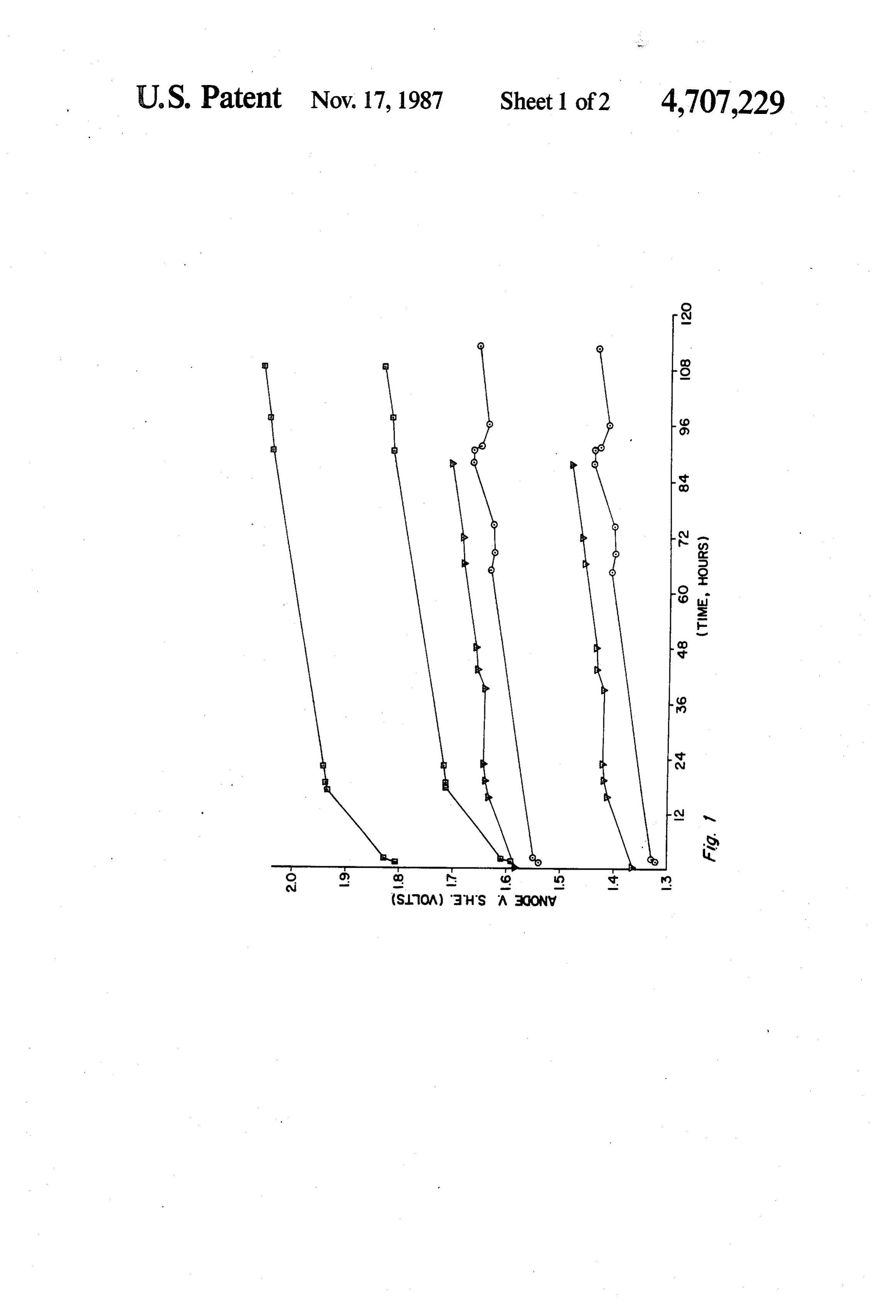
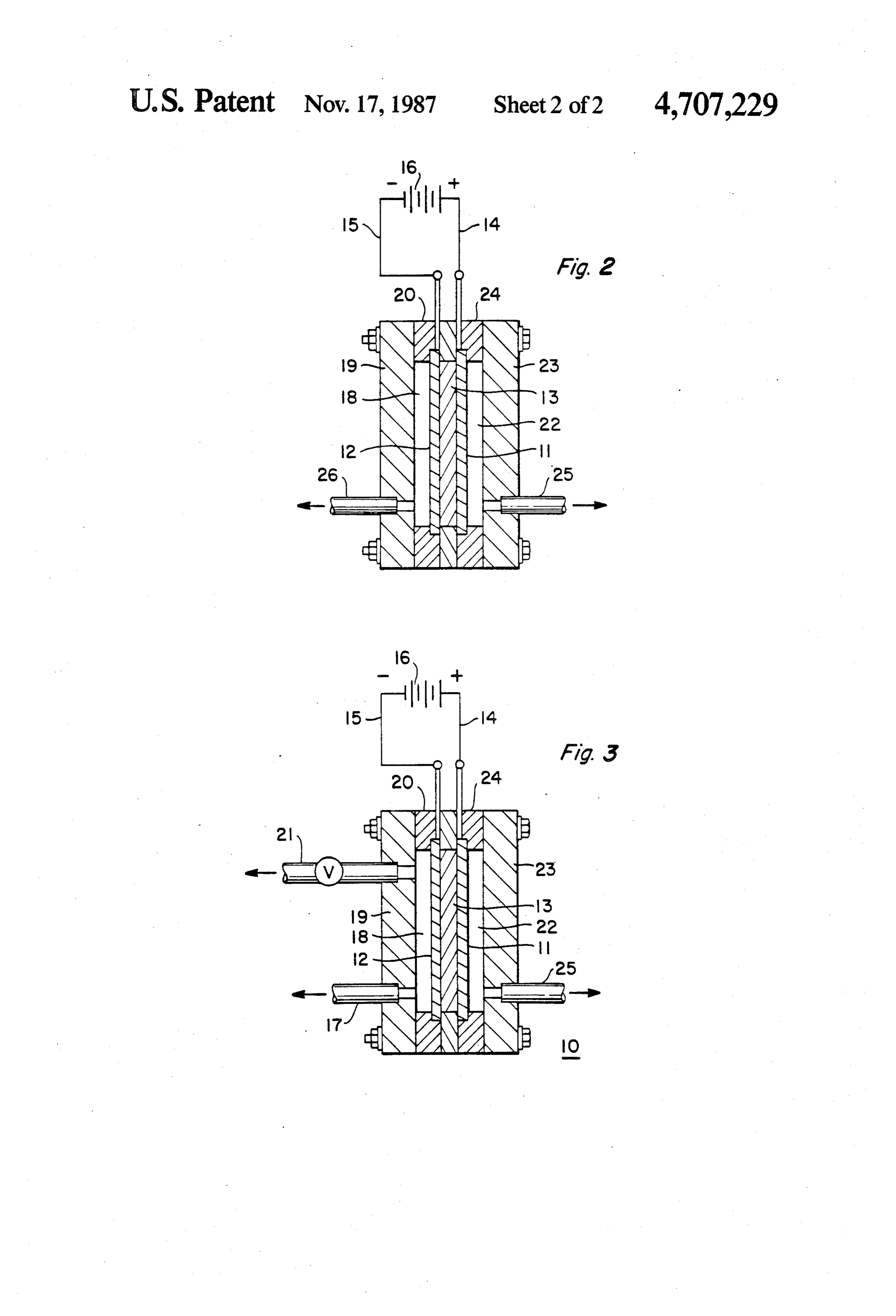
means for supplying a medium which evolves oxygen FIG. 1 is a sectional view of a gas generation appartus and protons by electrolysis. for the production of gases, such as oxygen and hydro In another aspect of the invention, there is provided a gen, by electrolysis which is capable of carrying out the process for the production of oxygen by the electrolysis process of the invention and which is constructed with of media which evolve oxygen and protons by electrol the catalytic anode of the present invention; ysis, compising: 45 FIG. 2 is a sectional view of a gas generating appara (a) continuously supplying the medium which tus of the gas concentrator type or air depolarizer elec evolves oxygen and protons, to a catalytic oxygen trolyzer having a catalytic anode made in accordance evolving anode in an electrolytic cell wherein the with the invention and capable of carrying out the pro catalytic oxygen evolving anode is separated from cess of the invention; and, a catalytic cathode by a cation exchange mem SO FIG. 3 is a graph comparing performance of the brane, and the catalytic oxygen evolving anode and ternary oxygen-evolving catalyst in a highly acidic the catalytic cathode are in electrical contact with medium as a function of time with the performance of the cation exchange membrane, the catalytic oxy two-constituent and single constituent platinum group gen evolving anode comprising a catalyst consist metal catalysts.
ing of at least two platinum group metal-containing 55 The devices illustrated in FIGS. 1 and 2 are used to compounds and at least one valve metal-containing illustrate the catalytic anodes of the present invention compound; and are clearly described in U.S. Pat. No. 4,039,409. (b) continuously providing an aqueous medium to the In FIG. 1 of the drawings, there is shown a gas gener catalytic cathode; ation apparatus in the form of an electrolysis cell. In this (c) supplying current to the anode and the cathode to 60 cell, oxygen anode chamber 22 (anolyte chamber) com electrolyze the medium which evolves oxygen and municates with oxygen outlet 25 while hydrogen cath protons at the anode; and, ode chamber 18 (catholyte chamber) communicates (d) removing oxygen from the anode and gas formed with hydrogen outlet 26. In the operation of the elec from the protons from the cathode. trolysis cell of FIG. 1, a direct current potential is ap In another aspect of the invention, there is provided a 65 plied across catalytic anode 11 and catalytic cathode 12 method for electrolytically generating oxygen from from batteries 16 while a hydrogen-containing com oxygen contained in a gaseous stream by concentrating pound or a medium which evolves oxygen and protons, the oxygen at the anode, comprising the steps of: such as water, aqueous sulfuric acid, aqueous sodium 6 sulfate, and the like, is supplied at the catalytic anode. are free of carbon monoxide or carbon fuel contami The direct current applied across catalytic anode 11 and nants) through inlet 17 and cathode chamnber 18 to catalytic cathode 12 dissociates the medium at the catalytic cathode 12. A direct current potential is ap anode to produce oxygen and protons (hydrogen ions). plied across catalytic cathode 12 and catalytic anode 11 The hydrogen accumulates in catholyte chamber 18 and from battery 16 to concentrate the gas (oxygen) which is removed through outlet 26 while oxygen accumulates collects in anode chamber 22 and is removed through in anolyte chamber 22 and is removed through outlet outlet 25. When the gas (air or impure oxygen) is fur 25. nished through the cathode, water either from a wick In the electrolysis cell of FIG. 1, no gases are sup ing device, from steam, or from some other source of plied to the apparatus but a direct current potential is 10 humidification, or through back diffusion through the applied across the improved catalytic anode of the pres ion exchange membrane is furnished to the cathode. ent invention to the catalytic cathode from the battery, With a cation exhange membrane employed between and a hydrogen-containing or proton-containing com the anode and the cathode, hydrogen ions are con pound such as water, for example, is supplied at the ducted through the membrane from the oxygen output improved catalytic anode. The catalytic anode is a cata 15 side to the oxygen inputside. Water, which is formed at lyst consisting of at least two platinum group metal-con the oxygen input side, migrates through the electrolyte taining compounds and at least one valve metal-contain from the oxygen output side to the oxygen input side ing compound. Dissociation of the hydrogen-contain with the hydrogen ion. Since water does not back dif ing or proton-containing compound at the catalytic fuse rapidly enough from the oxygen input side to the anode results in molecular hydrogen gas (H2) being produced at the catalytic cathode while oxygen gas is oxygen output side to replenish water at the catalytic produced at the improved catalytic anode. With a cat either dissociated orwater anode, additional is required because water is ion exchange membrane, the reactions at the electrodes is most easily accomplished bywith migrates hydrogen ions. This supplying water to the are as follows: gas (oxygen) outputside by flooding the anode chamber At the improved catalytic anode: 25 or through use of wicking means. The reactions for the H2O-O2+2H +2e. gas (oxygen) concentration at the various electrodes are as follows:
At the catalytic cathode: at the cathode;
In the electrolysis cell described above, the medium at the anode:
which evolves oxygen and protons, that is the hydro H2O-O2-2Hi +2e.
gen-containing or proton-containing compounds which 35 also contain oxygen, for example, water, required to produce hydrogen ions (protons) and oxygen, for exam Although an anion exchange membrane may be uti ple, by dissociation at the improved catalytic anode, is lized as the solid polymer electrolyte for oxygen con supplied through the catalytic anode by flooding the centration, there is an advantage in utilizing a cation anode chamber (anolyte chamber) or through the use of 40 exchange membrane for the solid polymer electrolyte in wicking. This mode of supply of water or other media that carbon dioxide pick-up from the air is minimized. which evolve oxygen and protons, or oxygen and hy It has been found that an improved gas generation drogen ions, is preferable to a cathode water feed. apparatus and an improved process for generating gas Briefly, in FIG. 2, there is shown generally at 10 a gas from a medium which evolves oxygen and protons by generation apparatus in the form of an oxygen concen electrolysis, for example, from water, is possible by trator embodying the invention and capable of carrying 45 utilizing an improved catalytic anode which provides out the process of the invention. The same numbers superior performance and superior stability in oxygen have been used to show similar parts in FIGS. 1 and 2. concentration and in the generation of oxygen and hy Apparatus 10 is shown with a catalytic anode 11 which drogen by electrolysis. It has been found that catalysts consists of at least two platinum group metal-containing consisting of at least two platinum group metal-contain compounds and at least one valve metal-containing 50 ing compounds at least one valve metal-containing compoound, a catalytic cathode 12 and an ion exchange compound result in improved performance in that the membrane or solid polymer electrolyte membrane 13 voltage required in the operation of the electrolysis cell positioned or interposed between, and in electrical may be less thereby reducing power consumption dur contact with anode 11 and cathode 12. Electrical leads ing usage, and in improved stability in that the catalytic 14 and 15 are connected to electrodes 11 and 12 and to 55 anode made in accordance with the present invention an external power source 16 shown in the form of a increases the life of the electrolysis cell also thereby battery connected across the electrodes. resulting in increased economy. Furthermore, the use of An oxidant, such as air or impure oxygen, is supplied less-costly platinum group metal-containing compounds to cathode 12 through an inlet conduit 17 and chamber in conjunction with a less-costly valve metal containing 18 (the catholyte chamber) formed by endplate 19, gas 60 compound results in a lowerintial cost for the electroly ket 20 and cathode 12. A valved outlet 21 is provided sis cell.
for exhaust impurities from cathode chamber 18. An As explained above, it has been discovered that the output gas chamber 22 (anode chamber) is formed by improved catalytic anode having a catalyst consisting of anode 11, endplate 23 and gasket 24. The concentrated at least two platinum group metal-containing com oxygen provided to anode-chamnber 22 is supplied to a 65 pounds and at least one valve metal-containing com suitable outlet conduit 25 for consumption or storage. pound may be used in electrolysis cells for the concen The gas concentrator shown in FIG. 2 operates by tration of oxygen from air or certain other oxygen-con supplying the gas (air or impure oxygen, both of which taining gases or for the preparation of oxygen by the 7 electrolysis of a medium which evolves oxygen and containing platinum group metals. Examples of useful protons (hydrogen). Thus, oxygen and hydrogen can be platinum group metals are platinum, palladium, rho obtained from water, aqueous sulfuric acid, aqueous dium, ruthenium, osmium and iridium. Although the sodium sulfate and the like. The medium which evolves catalytic anodes of the present invention generally em oxygen and protons also includes deuterium oxide and brace the platinum group metals and metal oxides, the tritium oxide. For example, if water is supplied to one or preferred catalytic anodes are made from the reduced both of the electrodes of the electrolysis cell, dissocia metal oxides, such as reduced ruthenium oxide, reduced tion, that is, electrolysis of the water, can take place, iridium oxide, reduced platinum oxide, reduced palla and oxygen and hydrogen are produced at the two dium oxide, reduced rhodium oxide and reduced os electrodes. Hydrogen ion is selectively transported 10 mium oxide.
across the ion exchange membrane. When the apparatus In accordance with the present invention, it has been operates in the gas concentration mode, such as the found that at least two platinum group metal-containing concentration of oxygen, for example, the driving force compounds must be present in the improved catalytic of the applied potential as well as the permselective anode. Mixtures or alloys of the platinum group metal nature of the ion exchange membrane (solid polymer 15 containing compounds have been found to be more electrolyte) permits an oxidant such as air or impure stable, and any combination of the platinum group met oxygen to be fed to the cathode of the apparatus. Hy al-containing compounds may be used in mixtures or drogen ion is formed at one of the catalytic electrodes alloys which make up the composition of the catalytic (the anode) and passes through the solid polymer elec anode. For example, the catalytic anode may comprise trolyte membrane to the opposite electrode (the cath 20 a reduced platinum group metal oxide and a platinum ode) where water is formed. metal; it may comprise a platinum group metal oxide A variety of ion exchange membranes may be used in and a reduced platinum group metal oxide; it may com the cell. One which functions very adequately is a per prise a platinum group metal, a platinum group metal fluorocarbon sulfonic acid solid polymer electrolyte oxide and a reduced platinum group metal oxide; it may sold by E. I. Dupont de Nemours & Co. under its trade 25 comprise two or more reduced platinum group metal designation "NAFION". Various catalytic materials oxides with two or more platinum group metal oxides such as platinum black, for example, may be utilized for and the like.
the catalytic cathode. The catalytic electrodes, both The improved catalytic anode must also comprise at cathode and anode, are customarily pressed into, en least one valve metal-containing compund. As used bedded upon or mounted directly upon the surface of 30 herein, valve metal-containing compound is defined as a the ion exchange membrane otherwise designated in the valve metal oxide, a reduced valve metal oxide, valve prior art as the solid polymer electrolyte. The catalytic metal and mixtures thereof. The term also embraces cathode and the solid polymer electrolyte membrane alloys of the foregoing valve metals and alloys contain can be chosen by one skilled in the art and are not critis ing valve metals. The valve metals include titanium, cal in the practice of the present invention. Various 35 tantalum, niobium, zirconium, hafnium, vanadium, and catalytic cathode materials, alternative ion exchange tungsten. In the preferred embodiments of the present membrane materials, their properties and mode of prep invention one or more reduced oxides of the valve met aration and the like, are described in the prior art in als such as the reduced oxide of titanium, the reduced cluding U.S. Pat. No. 3,297,484. The catalytic elec oxide of tantalum, the reduced oxide of niobium, the trodes are generally of the thin, porous, gas permeable reduced oxide of zirconium, the reduced oxide of half type which are bonded to and embedded in opposite nium, the reduced oxide of vanadium, and the reduced surfaces of the membrane so that the gases are gener oxide of tungsten, may be used to stabilize the catalytic ated right at the electrode-membrane interface. anode against attack by acid, i.e., when protons are Alternatively, the catalytic electrode, and particu present in the medium being electrolyzed, the medium larly the anode electrode, may be freestanding with the 45 is acidic and generally such acidic media attack the ternary catalyst deposited on a conductive support. electrode and reduce the life of the electrode or when Such an electrode may be positioned in intimate contact the membrane itself is in an acidic form. It has been with the membrane or it may be spaced from the mem found that the electrodes made in accordance with the brane facing the anode chamber. present invention and containing at least one valve In its broadest aspect, the improvement of the present 50 metal containing compound and at least two platinum invention is directed to the catalytic anode or catalytic group-metal containing compounds substantially extend oxygen-evolving anode or catalytic oxygen concentrat the life of the catalytic anode. The improved catalytic ing anode wherein the improvement comprises a cata anodes of the invention may also contain various mix lyst consisting of at least two platinum group metal-con tures and alloys of the valve metal-containing com taining compounds and at least one valve metal-contain 55 pounds. For example, the improved catalytic anodes ing compound. In the most preferred embodiment, the may comprise one or more reduced oxides of a valve improved anode comprises a ternary ctalyst consisting metal, one or more oxides of a valve metal or one or of two platinum group metal-containing compounds more valve metals or any mixture of the foregoing. For and a valve metal-containing compound. By use of the example, the improved catalytic anode may comprise phrase "platinum group metal-containing compound' 60 (along with at least two platinum group metal-contain as used herein, is meant a reduced platinum group metal ing compounds as described above) a reduced oxide of oxide, a reduced platinum group metal oxide in combi titanium and tantalum metal, or an oxide of hafnium and nation with a platinum group metal, a reduced platinum a reduced oxide of niobium or titanium metal and tanta group metal oxide in combination with a platinum lum metal or any combination in the form of mixtures group metal oxide, or a reduced platinum group metal 65 and/or alloys of the valve metal-containing compounds oxide in combination with platinum group metals and as defined above.
platinum group metal oxides, and mixtures thereof. The Examples of preferred improved catalytic anodes of phrase also embraces alloys of the foregoing and alloys the invention are ternary alloys of 50% platinum-25% 8 ruthenium-25% titanium, 50% platinum-25% rutheni nique is used for mounting the electrode to the solid um-25% hafnium, 50% ruthenium-25% iridium-25% polymer electrolyte membrane. titanium, 50% ruthenium-25% iridium-25% hafnium, Alternatively, a fluorocarbon polymeric binder such 50% ruthenium-25% iridium-25% niobium, 50% ru as polyviniledene fluoride, (PVF), of the type sold by thenium-25% iridium-25% tungsten, 50% ruthenium the Pennwalt Corporation under its trade designation 25% iridium-25% tanatalum. and 50% ruthenium-25% Kynar, may be utilized. PVF is a thermoplastic, low iridium-25% zirconium. The foregoing preferred ter cost material, which has a low melting temperature and nary alloys are the reduced metal oxides. is useful as a binder to form a liquid and gas pervious The amount or concentration of each of the platinum electrode aggregate incorporating the ternary catalyst group metal-containing compounds and the valve met O of the instant invention.
al-containing compounds in the mixture or alloy com As a freestanding electrode the molded aggregate of position of the catalytic anode is not critical as long as the catalytic and polymeric binder particles is deposited the alloy contains at least two platinum group metal on a conductive substrate rather than fixing or attaching containing compounds and at least one valve metal-con the aggregate to the ion transporting membrane which taining compound. Generally, the at least two platinum 15 separates the cell into anode and cathode chambers. group metal-containing compounds comprise at least The substrate may be a valve metal such as titanium, 50% by weight of the alloy or mixtures of the metal tantalum, niobium, zirconium, hafnium, valadium and containing compounds. Up to 50% by weight of the tungsten. In a preferred embodiment the ternary oxy valve metal-containing compound is useful with the gen-evolving catalyst is deposited on a platinized 5/0 preferred amounts of valve metal-containing compound mesh niobium screen which, if desired, can be sup being about 0.5%-50%, and the most preferred amount ported on a sturdier conductive support such as a coarse of the valve metal-containing material being about expanded metal titanium screen or, for that matter, on a 25-50% by weight. Thus, when the concentration of non-conductive support. The ternary catalyst may be the valve metal-containing compound is 0.5% by deposited on the conductive substrate, in a variety of weight, the composition of platinum group metal-con 25 ways. It may be deposited by painting a liquid solution taining compounds comprises 99.5% of at least two of the catalyst on the screen; evaporating the solvent platinum group metal containing compounds. and drying. Alternatively, a molded aggregate of ter The platinum group metal-containing compounds of nary catalytic and polymeric binder particles is depos the catalyst composition for the catalytic anode may be ited on the surface by means of pressure and heat with present in equal amounts or may be present in any suit 30 the pressure ranging from 400-1000 psi and the temper able combination. For example, about 99.5% of the ature from 200-450 F.; the latter being the melting platinum group metal-containing compounds may be a point of the polymeric binder.
first platinum group metal-containing compound, and The mixtures and alloys of the present invention may the second platinum group metal-containing compound, be made in any manner well-known as the Adam's may be 0.5% by weight. In preferred embodiments, the 35 method, the catalytic alloy can be prepared by ther second platinum group metal-containing compouond of mally decomposing the mixed metal salts of the com the composition is about one-half the amount of the first pounds used in the alloy in the presence of a strong platinum group metal-containing compound in the com oxidant such as sodium nitrate (NaNO3), followed by position. Of the entire composition including the plati subsequent electrochemical reduction. For example, by num group metal-containing compounds and the valve the Adam's method as described in U.S. Pat. No. metal-containing compounds, the second platinum 4,039,409, the chloride salts of ruthenium, iridium and group metal-containing compound generally contains tantalum are mixed with an excess sodium nitrate. Ru up to about 25% by weight of the composition and thenium chloride, iridium chloride and tantalum chlo preferably from about 5 to about 25% by weight of the ride infinely-divided form are mixed in the same weight composion. Unless otherwise indiciated, all percent 45 ratio as desired in the final alloy with the excess sodium ages are weight percent. nitrate, and the mixture is fused in a silica dish at about Other materials may also be included in the catalyst 500 C. for 3 hours. The residue is then washed thor composition of the improved catalytic anode as long as oughly to remove any water-soluble salts such as solu the materials do not affect the performance or the stabil ble nitrates and chlorides leaving a residue of the ruthe ity of the electrode in the processes and apparatus of the 50 nium oxide-iridium oxide, tantalum oxide. The resulting invention. For example, various binders and extenders suspension of mixed oxides is reduced by an electro which are well-known in the art may be used in the chemical reduction technique, and the product is a re catalytic anode. Extenders are generally materials hav duced ruthenium-iridium-tantalum alloy. The alloy may ing good conductivity and may contribute to the stabil be dried thoroughly, comminuted and then graded as ity, life, porosity, conductivity and the like of the cata 55 desired, for example, by use of sieves such as a 400 mesh lyst material. One such conductive extender has been nylon screen. Stabilization is then affected by tempera found to be graphite and may be used in an amount up ture (thermal) stabilization, i.e., by heating the platinum to 30% by weight of the composition. In other cases, it group metal-containing compound at a temperature has been found advantageous to use a binder to bond the below that at which it begins to decompose, and prefer catalyst materials, this is the alloys or mixtures, such as 60 ably, by heating the reduced oxides of the platinum the ternary alloy, to the solid polymer electrolyte mem group metal at a temperature at which the reduced brane. Binders are well-known in the art and include oxides begin to decompose. Thus, the reduced oxides of polytetrafluoroethylene particles which may be mixed the platinum group metals may be heated at about with a mixture or alloy of the at least two platinum 350-370° C. from 30 minutes to 6 hours. The preferred group metal-containing compounds and the at least one 65 thermal stabilization procedure is accomplished by valve metal-containing compound prior to fixing the heating the reduced oxides for 1 hour attemperatures in material to the solid polymer electrolyte membrane or the range of 550 to 600 C. The materials are further prior to casting the catalytic electrode, whichever tech stabilized by mixing them with other reduced oxides of 9 other platinum group metals and also with the reduced sive ternary catalyst of the present invention is better oxides of the valve metals. In one mode of the present than the voltage in those cells using the prior art binary invention, it has been found that the ternary alloys of (two metal-containing) catalysts. For example, the im reduced oxides of the platinum group metals are very proved anode catalyst of the invention made from the effective in producing stable, long-lived anodes in the 5 reduced oxides of 50% platinum/25% ruthenium/25% oxygen gas generation processes and apparatus of the hafnium show improved performance (less cell voltage present invention. In the case of the ternary alloy, the or reduced cell voltage) at a current density of 100 composition is preferably 5% to about 25% by weight amps/ft2 and 300 amp/ft2.
of reduced oxides of one platinum group metal-contain ing compound, approximately 50% by weight of an 10 EXAMPLE 2 other reduced oxide of a platinum group metal-contain- Several reduced metal oxides containing ruthenium ing compound and the remainder a valve metal-contain- and iridium platinum group metals were formed into ing compound. The catalyst compositions made in ac- alloys and/or mixtures with the valve metals. The mod cordance with the present invention for use in the oxy- ified Adams method discussed above was used to pre gen generating or concentration apparatus may be 15 pare the ternary alloys and/or mixtures from the mixed sieved through the appropriate size mesh screen where halides or nitrate salts of the various metals fused with desired. sodium nitrate to form the oxides. These oxides were Anode and cathode current collectors well-known in then electrochemically reduced, and the resulting mate the art may also be used to engage the catalytic anode rials (alloys and/or mixtures) were formed into elec and the catalytic cathode respectively to make electri- 20 trodes and placed upon the surface of a solid polymer cal contact therewith. electrolyte membrane identified as NAFION and dis closed in detail above. A reduced platinum black cata
EXAMPLE 1 lyst was used as the cathode material. The hydrated
To illustrate the operational characteristics of an membrane having the defined catalytic anode and cath electrolysis cell utilizing the improved catalytic anodes 25 ode was placed in an electrolysis cell similar to that of the invention and to show the superior performance shown in FIG. 1 and described in the specification. The of the oxygen generating processes and apparatus of the performance of the cell at about 82° C. (180 F) is present invention, electrolysis cells similar to those in shown in Table 2 below where several ternary catalyst FIG. 1 were constructed and various oxygen evolving anodes of the present invention containing the platinum anodes were used therein. The catalyst cathode of each 30 group metals, ruthenium and iridium, and various valve of the electrolysis cells contained a platinum catalyst, metals, are compared with a prior art platinum/iridium such as platinum black. The solid polymer electrolyte catalyst anode.
membrane was a cation exchange membrane having TABLE 2 electrodes with active areas of approximately 1/20 ft2 operating in a flooded anode mode. The cells were 35 PENSE SRMESSEESTRESS operated at 150 F. The performance of several of the CATALYSTANODES electrolysis cells were compared when the improved CELL POTENTIAL (VOLTS) catalytic anodes having at least two platinum group Current *Ru(50)/Ir(25)/ "Ru(50)/Ir(25)/ metal-containing compounds and at least one valve Density, *Pt(50)/Ir(50) Ta(25) Zr(25) metal-containing compound, and more specifically con- 40 (amps/f). Anode Catalyst Anode Catalyst Anode Catalyst taining a ternary alloy, were compared with prior art 100 1475 1.438 1.447 catalytic anodes having reduced platinum group metal 8 E. s: s: oxides. In one case a 50% platinum-50% iridium (re- 1500 i541 i914 1906 duced metal oxide) was used as the anode catalyst, and *Designates percentage of reduced metal oxide alloy in anode catalyst. in another case the prior art reduced oxide of 80% 45 platinum-20% ruthenium was used as the anode catalyst material. The performance designated as cell potential EXAMPLE 3 in volts for various current densities in amperesper Valve metal-containing ruthenium/iridium catalysts square foot are set forth in Table 1 for the various alloys were made in accordance with the procedure set forth and mixtures shown in the table. 0 in Example 2, and solid polymer electrolyte membranes
Table 1
Performance comparison of electrolysis cells using binary
And ternary alloy catalystanodes
Cell potential (volts)
Current
Density *Pt(50)/Ir(50) *Pt(80)/Ru(20) *Pt(50)/Ru(25)/Hf(25) Pt(50)/Ru(25)/Ta(25) (amps/ft) Anode Catalyst Anode Catalyst Anode Catalyst Anode Catalyst
"Designates percentage of reduced metal oxide alloy in anode catalyst
The cell was operated at about 66 C. It can be seen from the data in Table 1 that the results achieved with the electrolysis cell containing a 50% platinum/25% using the described ternary catalysts as anodes and 'ruthenium/25% hafnium ternary catalyst anode demon- 65 platinum black as cathodes were used in electrolysis strates the feasibility of lower cost, high performance cells identical to those described in Example 2. The test catalysts of the present invention for electrolysis. In cells were run at about 82" C. (180°F). Electrolysis cell certain instances, the cell voltage using the less expen- voltage at various current densities for these electrolysis 10 cells using the improved electrode (anodes) of the in- powder mixture placed on a titanium foil. A platinized vention are shown in Table 3 below. The cell voltages 5/0 mesh niobium screen was placed over the pow may be compared with the prior art 50% platinum/.50% dered mixture and bonded to the screen by heat and iridium reduced oxide anode catalyst shown in Table 2. pressure; 400 psi at 80 C. for four (4) minutes. The 5 screen was then placed over one side of the cation mem
Table 3
Cell potentialsat warious current densites of electrolysis cells using
Ternary alloy catalyst anodes
CELL POTENTIAL (d.c. VOLTS)
Current
Density *Ru(50)/Ir(25)/Ti(25) *Ru(50)/Ir(25)/Hf(25) "Ru(50)/Ir(25)/Nb(25) "Ru(50)/Ir(25)/W(25) (amps/ft) Anode Catalyst Anode Catalyst Anode Catalyst Anode Catalyst
"Designates percentage of reduced metal oxide alloy in anode catalyst.
The foregoing data demonstrates that less expensive oxygen generating anodes can be prepared and oper- brane and the screen supported bonded aggregate at ated in electrolysis cells as efficiently and in many cases 20 tached thereto by the application of heat and pressure more efficiently than the prior art catalytic oxygen (600 psi at 80% for five(5) minutes). Electrical contact evolving anodes. Power reduction, that is, reduced cell to the screen current collector was through tantalum Voltages, is significant, and if the reduction in cell po- contact wires tack-welded to the collector screen. The tential is even as little as 50 millivolts, substantial sav- membrane was placed in the cell housing to separate the ings in power consumption can be realized. The forego- 25 housing into anode and cathode chambers.
ing data demonstrates efficient oxygen evolution with A freestanding anode electrode was prepared and the improved ternary catalyst anode of the invention. comprised a bonded aggregate of the ternary catalyst EXAMPLE 4 and a polymeric Teflon binder deposited on a conduc 0 tive substrate in the form of a platinized 5/O mesh nio
To determine the inherent stability of the oxygen 30 bium screen. The catalyst was a ternary Ru(50)/Ir(25)- evolving alloy, a cell utilizing a 10 mil DuPont Nafion /Ta(25) alloy; i.e., a catalyst comprising 50 and 25 120, 1200 equivalent weight membrane was prepared weight percent of two platinum group metals, ruthe with 46.6 cm anode and cathode electrodes bonded to metal, opposite sides of the membrane. The cathode electrode nium and irridium, and 25 weight percent of a valve tantalum. The relative proportions of the polyvi was a bonded aggregate of platinum black at a loading 35 miledene fluoride binder and the catalyst was 20 of 4 mg/cm and polytetrafluoroethylene (PTFE). The mgs/cm2 of the catalyst and twelve (12) weight percent anode was a bonded aggregate of the ternary catalyst of of the binder. Electrical contact to the platinized nio the invention (at a loading of 4 mg/cm) and polytetra- bium substrate was made through tanatalum contact fluoroethylene. The current collectors were platinized wires tack-welded to the screen. The freestanding niobium screens. Deionized water was supplied to the 40 anode electrode was mounted 0.36 centimeters from the anode chamber and the cell operated at 82 C. at a Nafion membrane. The anode and cathode compart current density of 1072 ma/cm (~1009.5 ASF). After ments were filled with aqueous solutions of six normal 3000 hours of operation the cell voltage was 1.76 volts (6N) H2SO4 to provide a conductive anolyte between and iR free potential 1.58 volts. After 6700 hours of the freestanding electrode and the membrane and also operation the cell voltage was 1.81 volts and the iR free 45 to provide an accelerated test for determining the resis potential 1.63 volts. The extremely small voltage in tance of the ternary catalyst on a conductive substrate crease over this 3700 hour additional period (~0.014 in a very highly acidic medium, i.e., 6 normal sulfuric mV per hour) shows that the ternary catalyst of the acid. A saturated calonel electrode was used as a refer invention, consisting of at least two (2) platinum group ence electrode and a Luggins capillary located between and one valve group metals, oxides or alloys is ex- 50 the anode and the membrane was utilized to make elec tremely stable and represents a substantial advance. trolytic contact to the saturated calomel electrode. A valve group metals, oxides or alloys is extremely stable dynamic hydrogen electrode was also utilized in order and represents a substantial advance. to obtain anode voltage data for oxygen evolution in an XAMPLE 5 acidic medium versus a standard hydrogen electode.
E 55 The cell was operated at room temperature, 21 C. The To illustrate the effectiveness of an oxygen-evolving cell was run for a period of approximately 108 hours electrode utilizing a valve metal containing ternary catalyst as a freestanding electrode in an acidic medium, and data taken at various times to determine the anode potential for oxygen evolution versus a standard hydro the following tests were carried out: gen electrode. The performance is shown in Table 4 A membrane cell was prepared using a 10 mil Nafion 60 below:
120, 1200 equivalent weight cationic membrane. The cathode and anode electrodes for cell were prepared as TABLE 4 follows: Time Voltage v. SCE Voltage vs. SHE A cathode comprising a molded agrregate of plati- 12 H. -- 1.324 -- 1.544 num black and polyviniledene fluoride binder particles 65 2 -- 1.329 -- 1.549 was prepared in the following manner: 15 weight per- 6: IE I cent of KYNART-7 polyviniledene fluoride particles 74 +1404 4.1624 was mixed with 12 mg/cm2 of platinum black and the 90 -- 1.443 - 1663
Page 11scan →
TABLE 4-continued environment is exceptionally good in that the cell volt Time Voltage v. SCE Voltage vs. SHE age slope is fairly low. It can be readily predicted from this data that the performance of an electrode contain ing such a ternary catalyst in a less harsh acidic environ 96 -- 1.416 -- 1.636 ment, such as 1-2 normal, would be even better so that 112 -- 1.437 - 1.657 the catalyst not only performs well but has extremely good long-life potential. This is also obviously evident from its performance over 6700 hours in electrolysis of
EXAMPLE 6 water when bonded to an acidic membrane.
A second freestanding electrode was then prepared catalyst As shown in Curve 3, an electrode using the ternary which consisted of a prior art catalytic anode electrode volts better when compared to the voltage is almost 0.4 comprising an aggregate of 50% ruthenium and 50% group metal than an electrode using single platinum irridium catalytic particles bonded to polyviniledene after about 12-15 hours,The catalyst.
slope of the voltage curve, less than that of an electrode fluoride particles in the same relative proportions as in 5 utilizing but a single platinum group metal. It is appar Example 4. The electrode was supported on a 5/0 mesh ent, therefore, that the oxygen-evolving catalyst of the platinized niobium screen and the cell operated under instant invention and electrodes utilizing this identical conditions for a period of 106 hours to deter the surface of conductive substrates perform catalyst exception mine the oxygen evolving potential of the Rulr cata lytic electrode versus a standard hydrogen electrode. 20 ally well as an oxygen-evolving catalyst in any environ ment and extraordinarily well in acidic environments.
TABLE 5 The foregoing data demonstrates that less expensive Time Voltage v. SCE Voltage vs. SHE oxygen generating anodes can be prepared and oper 0.1 Hr - 1.374 - 1.594 ated in electrolysis cells as efficiently and in many cases 16.1 -- 1.415 --.635 more efficiently than the prior art catalytic oxygen 19.6 -- 1.420 -- 1.640 25 evolving anodes. Power reduction, that is, reduced cell 23.6 -- 1.423 -- .643 voltages, is significant, and if the reduction in cell po
44.5 -- 1.439 - 1.659 tential is even as little as 50 millivolts, substantial sav 47.3 -- 1.439 --.659 ings in power consumption an be realized. The forego 65 -- 1.460 + 1680 ing data demonstrates efficient oxygen evolution with 7.5 -- .467 - 1.687 30 the improved ternary catalyst anode of the invention.
While other modifications of the invention and varia tions thereof which may be employed within the scope
EXAMPLE 7 of the invention have not been described, the invention is intended to include such modifications as may be
A third freestanding anode electrode was prepared 35 embraced within the following claims. comprising a bonded aggregate of platinum and polyvi What is claimed is:
niledene fluoride particles mounted on a 5/0 mesh plati 1. In a process for generating oxygen by electrolyzing nized niobium substrate which was again positioned 0.6 a medium including an oxygen containing compound in cms from the membrane and the cell run with an aque a cell having a separator capable of ion transport and ous solution of 6NH2SO4 for a period of 100 hours. The 40 having oppositely charged electroconductive anode performance is shown in Table 6 below: and cathode electrodes, the oxygen-evolving anode TABLE 6 electrode having a catalytic element comprising a ter
Time Voltage v. SCE Voltage vs. SHE nary catalyst of a first platinum group metal compound, a second platinum group metal compound and a valve 1.5 -- 1.610 -- 1.830 metal containing compound wherein said valve metal 17.5 -1.715 --1935 containing compound comprises about to about 50 percent by weight, the first platinum group metal com 25.5 -- 1.736 --1.956 pound comprises about 5 percent to about 25 percent by weight and the second platinum group metal compound 97.5 -- 1.89 --2.039 comprises the remainder of said ternary catalyst 113.8 -- 1.834 --2.054 wherein the electrolysis at the anode electrode for the evolutions of oxygen is carried out in an acidic medium.
The anode voltage data versus the saturated calomel 2. The process according to claim 1 wherein the electrode was normalized versus a standard hydrogen 55 anode is positioned in the medium and spaced from said electrode and the anode voltage for the three electrodes separator.
as a function of time as shown in Tables 4-6 is plotted as 3. The process according to claim 1 wherein the Curves 1-3 of FIG. 1. Curve 1 represents the anode catalytic layer is superimposed over a passivatable sub voltage versus the standard hydrogen electrode for an Strate.
oxygen-evolving catalyst utilizing a ternary catalyst of 60 4. The process according to claim 1 wherein the the invention. Curve 2 is the binary ruthenium irridium anode electrode maintained in the acidic solution during catalyst and Curve 3 the platinum catalyst. The perfor electrolysis comprises a porous layer of catalytic parti mance of a ternary catalyst on a conductive substrate cles in contact with the membrane. over a period of 100 hours is at least 50 mvs better than 5. The process according to claim 1 wherein the the performance of an electrode containing a catalyst 65 anode electrode at which oxygen is evolved by electrol which is a mixture or alloy of two platinum group met ysis in an acidic medium is bonded to one side of the als. It should also be noted that performance of the membrane.
ternary catalyst in the extremely harsh 6N sulfuric acid ak sk k k
Provenance
- Collection
- Patents citing this work
- Pages
- 11
- Method
- pdftotext (the PDF's own text layer) + pdftoppm 300dpi page scans
- Patent office record
- patents.google.com →
- Source
- Google Patents citing-documents table
- Assignee
- United Technologies Corporation
- Published
- 1987-11-17
- Transcribed from
- patentimages.storage.googleapis.com →