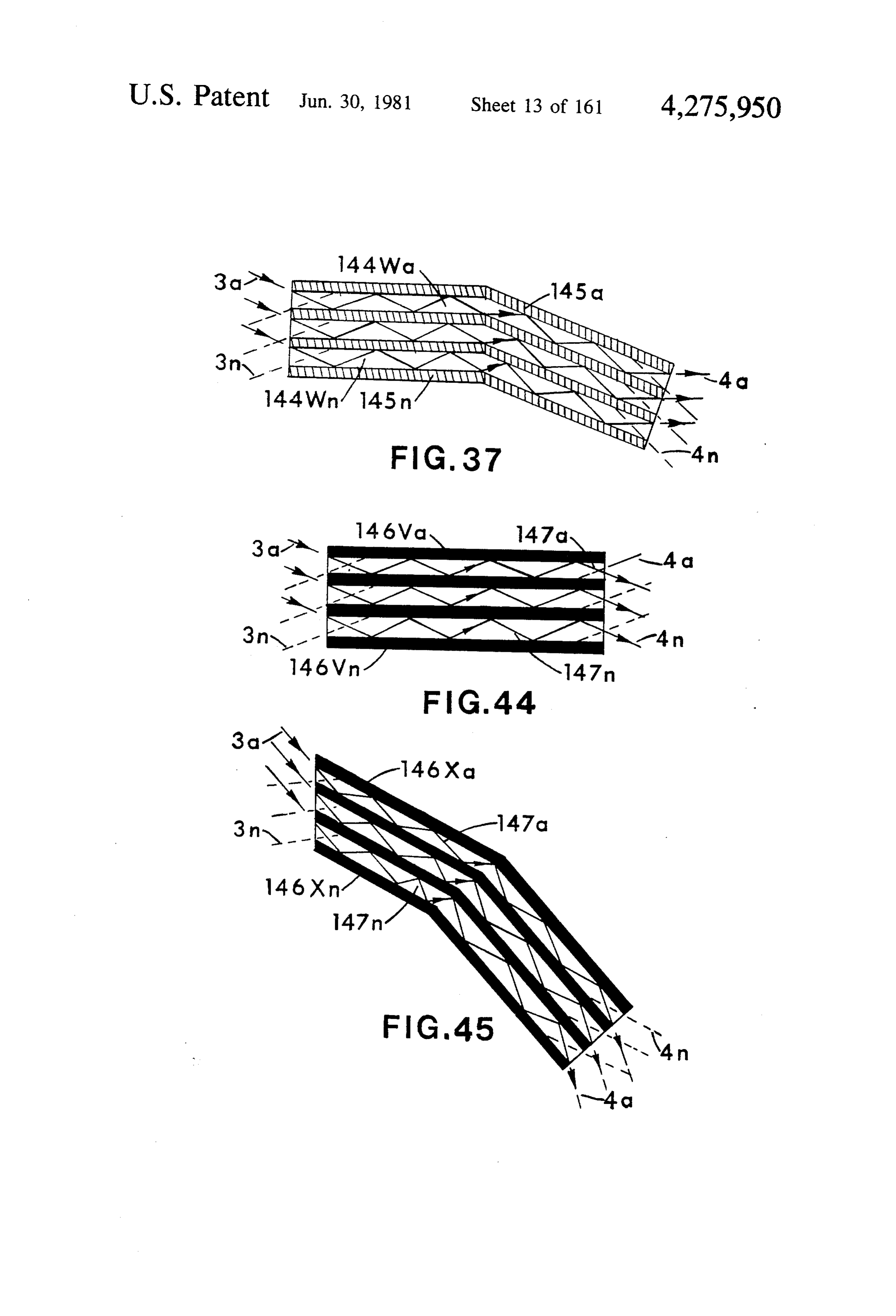
(145)
Low Refractive Material
Also written transparent refractive material · material · low refractive area · area · solid · TRY
Where it is first named
ie rR EY ide hae ad 3am SOS TRY 145
How it is written
- (low refractive area 145) 2×
- (low refractive material 145) 2×
- (solid 145) 1×
- (transparent refractive material 145) 1×
- (TRY 145) 1×
- (material 145) 1×
- (area 145) 1×
Drawings 26
-
FIG.40 oan · Light Guide Lens #4,275,950 - Illustrations
-
Page 147 · Light Guide Lens #4,275,950 - Illustrations
-
FIG. 163 Tilustrates schematically a side view crosssection of a filter coated flat-surface transparent thin- · Light Guide Lens #4,275,950 - Illustrations
-
Page 172 · Light Guide Lens #4,275,950 - Illustrations
-
Page 173 · Light Guide Lens #4,275,950 - Illustrations
Where it is named · 9
Light Guide Lens #4,275,950 - Illustrations 9×
-
material (material 145)
… 5 comprises of a light refractive (transparent) material lenscore 144 with a low refractive outer surface coating material 145. …
-
low refractive material (low refractive material 145)
… The zone between the high refractive material 144 and the low refractive material 145 produces a reflective surface to incident light rays. …
-
low refractive area (low refractive area 145)
For purposes of illustration the low refractive area 145 is highly exaggerated in demension. …
-
area (area 145)
For purposes of illustration the low refractive area 145 is highly exaggerated in demension. In actuality, area 145 is a very thin coating of highly polished material to prevent any light blockage. …
-
low refractive area (low refractive area 145)
… The high refractive area 144 is transparent and passes the maximum amount of light whereas the low refractive area 145 is reflective and passes no light energy. Together, the transparent lens-core 144 and the very highly reflective surface make up the light-guide stem.
-
solid (solid 145)
… 4, solid 144 to solid 145 of FIG. §, air 147 to solid
-
low refractive material (low refractive material 145)
than air) of FIG. 8, and solid 146 to liquid 150 of FIG. 9) the light-guide principle can be used. Since the wallzone between the high refractive material 144 and the low refractive material 145 provides a reflective surface to incident light rays, a critical angle of reflection 152 (typically 21°) is formed within the lens-core 144. …
-
transparent refractive material (transparent refractive material 145)
… 17) would cause light rays 3a xxx n to pass through the transparent refractive material 145 and be lost for further light transmission. …