(43)
Resonant Charging Choke
Also written Charging Choke
Where it is first named
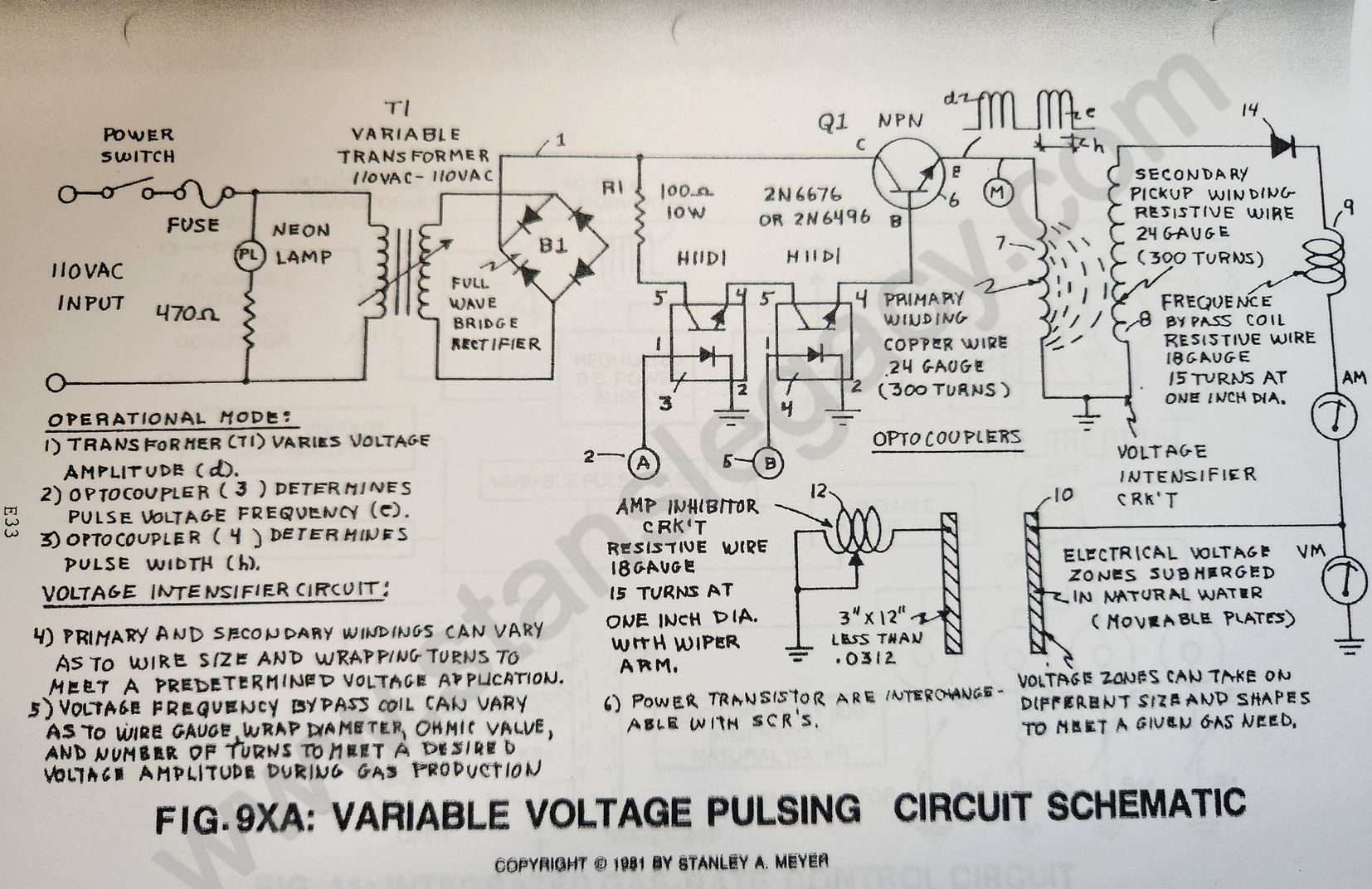
Secondary Pickup Winding (resistive wire coil) (42), Blocking Diode (14), Resonant Charging Choke (resistive wire coil) (43), Resonant Cavity Inner Surface (45) (forming a Positive Electrical Voltage Zone), Resonant Cavity Outer Surface (44) (forming a Negative Voltage Zone).
How it is written
- (43) 6×
Drawings 1
-
The resistive value of said wire-coil (47) acts as a resistor while performing in like manner as a Resonant Charging Choke (43). · SINGLE VOLTAGE RESONANT "Q"
Where it is named · 6
SINGLE VOLTAGE RESONANT "Q" 6×
-
Resonant Charging Choke (43)
Resonant Charging Choke (43): Said Resonant Charging Choke (43) is a Modulator Inductor which sets up an oscillation of a given charging frequency (voltage pulsing rate) with the effective capacitance of a pulse-forming network in order to charge a line to a high voltage. …
-
Resonant Charging Choke (43)
Resonant Charging Choke (43): Said Resonant Charging Choke (43) is a Modulator Inductor which sets up an oscillation of a given charging frequency (voltage pulsing rate) with the effective capacitance of a pulse-forming network in order to charge a line to a high voltage. …
-
Charging Choke (43)
… The resistive value of said Charging Choke (43) acts as a resistor... preventing amp flow still further.
-
Resonant Charging Choke (43)
Electrical Voltage Zones (44/45): Said High Voltage Output from said Resonant Charging Choke (43) forms a Positive Electrical Voltage Pulse Potential (voltage zone) across said voltage surface area (45) immersed in natural water, see step-charging graph 16A as to 20YA Section AA again.
-
Resonant Charging Choke (43)
The resistive value of said wire-coil (47) acts as a resistor while performing in like manner as a Resonant Charging Choke (43).