
Water Fuel Injection System
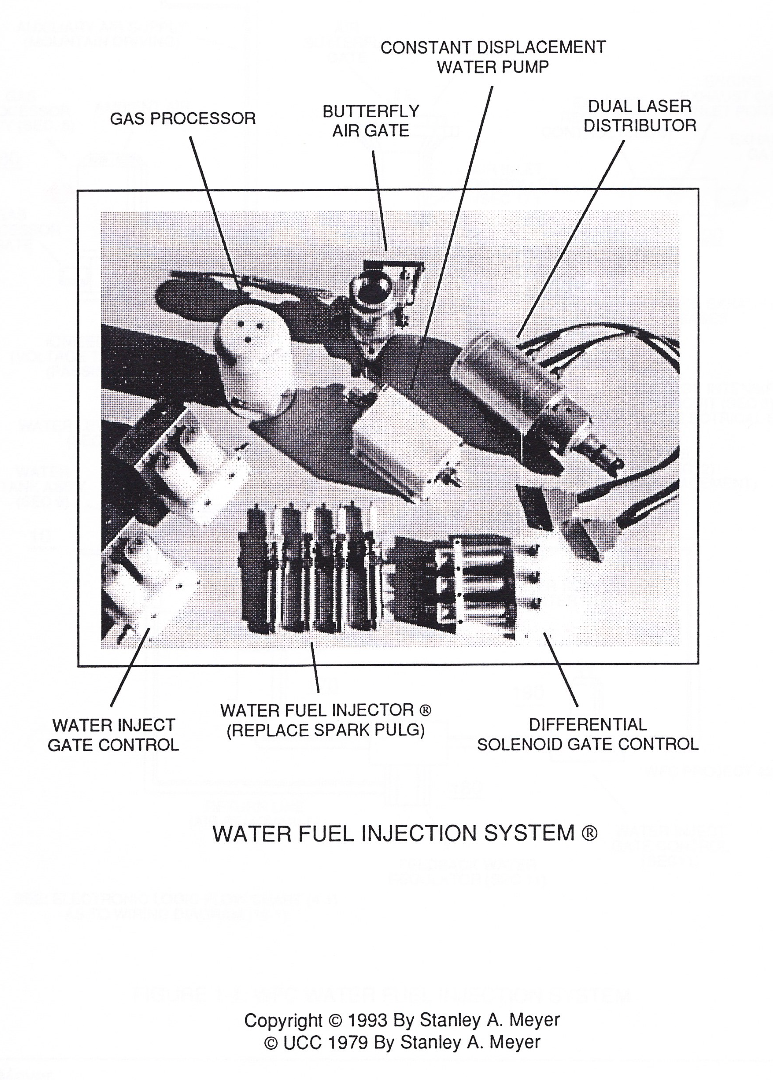
Water Fuel Injection System
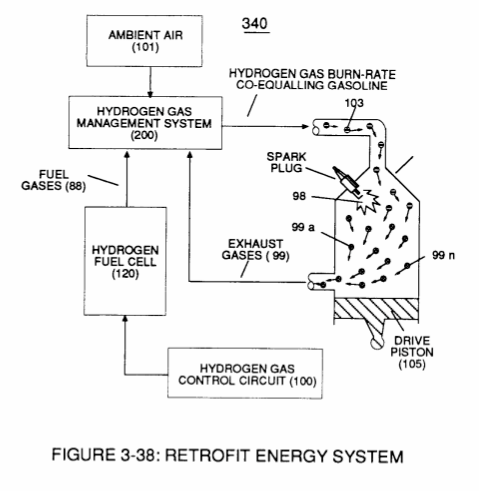
WFC Hydrogen Gas Management System is ideally suited as a retrofit energy system to both reciprocating (rotary piston engine) and turbine jet engines associated with the aviation industry...but in different ways: Reciprocating WFC fuel-kits can be similar to car design (340) of Figure (37) of WFC (422 DA);
Whereas, Water Fuel Injector Kit (10) of Figure (1) can alternately be used as a self-contained Fuel-unit having no pressurized vessel which converts water directly into thermal explosive energy (gtnt) on demand, as illustrated (10) of Figure (1) as to Figure (40) of Figure (2B).
Operationally, Water Fuel injector assembly (10) of Figure (1) as to (40) of Figure (2B) performs several functions simultaneously to produce thermal explosive energy-yield (gtnt) (16) on demand:
First water mist (47) of Figure (3A) is injected into fuel-mixing chamber (35) of Figure (3B) by way of water spray ports (41a xxx 41n) of Figure (3A);
Secondly, ionized air gases (46a xxx 46n) of Figure (3A) (laser primed ambient air gases having missing electrons) produced by Ambient Air Ionizer (80) of Figure (4) as to Figure (1) and non-combustible gases (45) of Figure (3A) are intermixed with expelling water mist (47a xxx 47n) to form Water-fuel mixture (48) by way of gas mixing disc (34) of Figure (3B) as to (30) of Figure (2A);
thirdly, the resultant moving Water-Fuel mixture (48) of Figure (3B) enters into Voltage Igniter Stage (180) of Figure (3B) and exposed to high intensity voltage fields (33 / 36) (typically 2,000 volts or above @ 10 Khz or above) opposite electrical polarity (E7 / E8)
...which, in turn, not only performs electrical polarization process (160) of Figure (25) undergoing Dielectric Resonant (240) of Figure (30); but, also sets up and triggers Hydrogen Fracturing Process (390) of Figure (41) as to Figure (6) under control state (on demand) via electrical-static spark ignition (49 / 51) of Figure (3B)....releasing thermal explosive energy (gtnt) (16) passing beyond gas exit port (32) of Figure (3B), as further illustrated in Figure (2) as to Figure (1).
To ensure proper energy-flame projection and subsequent energy-flame stability, constant placement water pump (170) causes and allows ionized ambient air gases (46), non-combustible gases (45), and water (47) to be displaced under static pressure up to and beyond 125 psi respectively.
Energy-Flame density is enhanced and sustained by causing ionized gases (46a xxx 46n) of pray port (42) to be deflected into liquid spray path (41), together water mist (47) and ionized air (46) are,now, directed toward and deflected through non-combustible gas spray path
producing uniformed water-fuel mixture (48), as illustrated in Figure (3B).
Energy-Flame temperature is regulated by controlling the volume flow-rate of each fluid- ediums (47 / 45/ 46) in direct relationship to applied voltage intensity (33 /36), as further strated ni Figure (2B) as to Figure (3B). To elevate Energy-flame-temperature still further,
ylp increase fluid-displacement (46/47) while maintaining or reducing the volume flow rate of n-combustible gases (45) during an increase of applied voltage amplitude (VO x Vn) of Figure
)32 saot Voltage Intensifier Circuit (110) of Figure (7) and Electron Extraction Circuit (120) of Figure (8). To lower Energy-flame temperature simply increase the amount of non-combustible
geas (45a xxx) or reduced the fluid flow rate (45 / 46/ 47)) uniformly while lowering pulse
gaetol amplitude (xxx VO). To establish a predetermined or given Energy-flame temperature
adjust fluid-medium (45 / 46 / 47)) and applied voltage amplitude (VO xxx) independent of each acher ot obtain the desired results.
The resultant energy-flame pattern is further maintained by allowing the ignited,compressed, and moving gases (29) of Figure (3B) to be projected to, pass through and
beyond nozzle-port (32) under pressure due ot gas expansion caused by thermal gas ignition.
Voltage Igniter Stage (180) of Figure (3B) as to Voltage Intensifier Circuit (110) Figure (7) ast o Extraction Circuit (120) of Figure (8) performs several functions simultaneously to initiate
nda trigger thermal explosive energy-yield (gnt) (16) beyond normal gas burning levels:
Water droplets (28a xxx 28n) escaping from spray-mist (47) and exposed ot high intensity
voltage fields of opposite polarity 33/ 36) are stimulated ot undergo Electrical Polarization Process (160) of Figure (25)...which not only separates and splits the unlike atoms of the water molecule
but also causes the unlike atoms (hydrogen atoms 77a / 77b and oxygen atom 76) to experience electron ejection (230) of Figure (29) as to (71) of Figure (8) since voltage intensifier circuit (110) of Figure (7) inhibits and prevents electron flow to enter into gas ignition process (180), as further
ilustrated in Figure (6).
The newly liberated water molecule atoms (oxygen 76 and hydrogen atoms 77a / 77b
mmediately interact with laser primed ionized ambient air gases (7a xxx In of Figure 1-8) (see
#FC memo 420) to cause the resultant highly energized and mass destabilized combustible gas
aotms (93a xxx 93n) of Figure (8) to perform Hydrogen Fracturing Process (80) of Figure (7)
when electrostatic force (14/16) thermally ignites (kinetic agitation) destabilized water-fuel mixture
93a xxx 93n) under gas compression... preventing the formation of the water molecule during
hermal gas ignition....satisfying Energy Gas Detonation Equation.
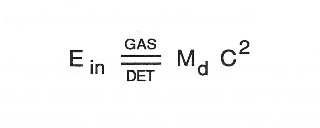
which states
That, whenever the mass-size of a combustible gas atom is decreased (Md), thermal
explosive energy-yield (gtnt) is increased (Ein) during thermal gas combustion (Gas //
Detonation.), as so illustrated in (100) Figure (6) as to (90) of Figure (5).
Incoming ambient air gases (5a xxx 5n) become laser primed and ionized when passing
hguorh Ambient Air Ionizer (Gas Processor) (80) of Figure (4) as to (10) of Figure (1) since
cectron extraction circuit (120) of Figure (8) not only captures and consumes ejected electrons (7a
cx 7n) of Figure (6); but, also prevents electron flow into destabilizing gas process (180), as so
Musrtaetd in Figure (3B).
In terms of performance reliability and safety, ionized air gases (46a xxx 46n) and liquid
water (47a xxx 47n) do not become energy activated (volatile) until water-fuel mixture (48) reaches
cirage Igniter Stage (180). Injected non-combustible gases (45a xxx 45) retards and controls the
bustion rate of the Hydrogen Fracturing Process (100) of Figure (6) during gas-ignition.
In other or alternate applications, laser primed ionized liquid oxygen (68) of Figure (1-10)
CF* memo 420) and laser primed liquid hydrogen (69) of Figure (1-10) stored in separate
skni can be used in place of fuel-mixture (48); or, liquefied ambient air gases (6) alone with
source (8) can, also, be substituted as a fuel-source (48) to trigger Hydrogen Fracturing
10). Additional WFC Injector Assemblies (20) of Figure (2) are arranged in cluster
array (20a xxx 20n) to increase energy-yield output (16a xxx 16n) of Figure (10 / 1 / 12).
WFC injector assembly (10) of Figure (1) as to (30) of Figure (2A) is design variable to be
retrofitable by replacing fossil-fuel injector ports affixed to jet engines (see Figure 11), heating
systems (Figure 10), rockets engines (Figure 12), or even car spark plugs (130) of Figure (9)
which simply uses Water Fuel management (WFMS) system fluid- metering system (40) to control
sag ignition (16), as illustrated in (40) of Figure (2B). Sequential pulsing of Water Fuel Injector
20/30) of Figure (1) as to (40) of Figure (2B) is system activated by Pulse Gate Valve (190) of
Figure (1) to further control a predetermined energy-flame (16).
In essence, then, the Water Fuel Injector system (40) simply processes and converts water
into a useful hydrogen fuel on demand at the point of gas ignition...thereby, co-equally or
superseding fossil-fuel safety standards...especially when ionized ambient air gases (46a xxx 46n)
and non-combustible gases (45a xxx 45n) are intermixed with water supply (47) prior to entering.
Water Fuel Injector Plug (20 / 30), as illustrated ni (40) of Figure (2B) as to (10) of Figure (1).
Design Application:
Water Fuel Injector
(Taper Resonant Cavity Chamber)
To set up, trigger, and perform Hydrogen Fracturing Process (390) of Figure (41) (see
WFC Memo 422 DA) gas ignition stage (100) of Figure (6) ... releasing thermal explosive energy
gtnt) via flame projection (16) of Figure (3B) as to Figure (14), Water Fuel Injection System (10)
of Figure (1) as to (170) of Figure (13) incorporates and uses Taper Resonant Cavity Chamber
(180) of Figure (14) to enhance operational parameters of Hydrogen Fracturing Process (100) of
Figure (6) being stimulated to activation by opposite electrical voltage fields (49/51) of Figure (3B)
as to (180) of Figure (14).
In like manner, water supply (10) of Figure (170), non-combustible gases (45) (Engine
Exhaust gases), and ambient air ionized gases (46) (air gases having missing electrons) are
uniformly intermixed when moving into, passing through and beyond fluid mixing chamber (250)
of Figure (13) by way of venturi tube-cavity (51)... allowing water fuel mixture (47/45/46) (48) to
be particle aligned by opposite electrostatically charged atoms ...positive charged gas particles (81a
xxx 81n) being directed to and attached to negative charged oxygen atom (76) of water molecule
(47); while, during the same interim period of time, negative charged gas particles (82a xxx 82n)
being directed onward ot and affix themselves ot positive charged hydrogen atoms (77a / 77b), as
illustrated in (200) of Figure (16). The resultant water fuel-mixture (48) is, now, pressurized up to
and beyond 125 lbs of fluid-pressure by Fluid Displacement Pump (170) of Figure (13), as before,
ot cause and form water fuel-droplets (48a xxx 48n) when water fuel (48) enters into, passes
through and beyond spray ports (41a xxx 41n) forming Quenching Disc Structure (190) of Figure
(15). The injected water fuel-droplets (48a xxx 48n), now, surrounds outer surface area of
exposed positive probe (33) while entering into Taper Resonant Cavity (180), as illustrated in (70)
of Figure ( B ) as to Figure (14).
Once water fuel-droplets ( xxx 48n) fully occupies open space cavity (Resonant Cavity
Zone) (35) and then exposed to applied pulsating opposite electrical voltage fields (49/51) of
voltage wave form (210) of Figure (17), the electrically stimulated water fuel droplets (48a xxx
48n) are subjected to release thermal explosive energy (gtnt) (16) undergoing Electrical-Resonant
ni a sequential manner: By first, separating water molecule (47) into its component gases (oxygen
76 / hydrogen 77a - 77b) by way of the Electrical Polarization Process (160) of Figure (25) (WFC
Memo 422 DA); secondly, by electrically attenuating the electrical-forces of the newly formed and
liberated combustible gases (76, 77a - 77b) via Energy-Priming Process (520) (see WFC Memo
424 titled "Atomic Energy Balance of Water); thirdly, by ionizing the released combustible gases by
way of Electron Ejection Process (230) of Figure (29) (WFC Memo 422 DA), as further illustrated
ni (80) of Figure (4); and finally, spark-ignite the highly destabilized combustible gases (laser
primed combustible gases having missing electrons) by electrostatic discharge (kinetic energy
agitation), as further exemplified in (280) of Figure (17); all sequential gas priming functions
occurring progressively in an instant of time.
Subsequent and repetitive formation of applied gated electrical voltage pulse-train (210a
x 210n) of Figure (17) to continued in-flow of water fuel droplets (48a xxx 48n) not only sustains and maintains Hydrogen Fracturing Process (100) of Figure (6) but, also, regulates
Thermal Explosive Energy release (16a x 16n) of Figure (14) by attenuating applied voltage
amplitude (xxx VL xxx), as graphically shown ni Figure (20F) (WFC Memo 420). This further increase in voltage amplitude xxxx VL) simply exerts a greater magnitude of opposite Electrical-
Stress (SS' - RR') of Figure (25) (TT' - UU') of Figure (29) (WFC Memo 422 DA) across
combustible gas atoms (76, 77a - 77b) which, in turns, ejects a greater number of electrons while preventing the formation of the water molecule (390) of Figure (41) (WFC Memo 422 DA) during
thermal gas-ignition (180) of Figure (17). Voltage Intensifier Circuit (220) of Figure (18) allows
Electrical-Stress variation (SS' = RR' / TT' = UU') since voltage Intensifier Circuit (220) inhibits
electron - flow (amp restriction) into voltage triggering process (210) of Figure (17) as to (100) of
Figure (6).
Electron restriction while varying voltage intensity (Va = Vn) is accomplished by
performing several functions simultaneously: Incoming pulse-train (210a xxx 210n) is adjusted ot
"tune-in" to the Dielectric Properties of Water (47) which allows Resonant Action (see WFC Memo
424, once again) to occur since the Dielectric property of water (78.54 valve) becomes a integral
part of Electronic Circuit (110) of Figure (7) as to (220) of Figure (18) ... forming a capacitor (E7 /
E8) in series with Resonant Charging Chokes (56/57) placed on opposite sides of Resonant Cavity
Zone (35) as to Figure (7) and (8) . . . forming a Resonant Pulsing Circuit (110) of Figure (7) with
setp up Pulsing Transformer (33/36), as shown in (220) of Figure (18).
Adjusting Pulse-train (210a xxx 210n) in such a way as to allow pulse off-time (T2) to be
synchronized with collapsing and re-formation of electromagnetic field coupling across pulsing
transformer (52/53) ot produce unipolar pulse frequency (Tla xxx Tin), as illustrated in (220) of
Figure (18) as to Figure (17). Pulse on-time (T1) having a predetermined constant voltage level
( xxx VL xxx) is adjusted to maximize transference of electromagnetic energy to Secondary Coil
53) during pulsing operations. The resultant and newly formed gated Resonant Pulse-train ( T1 +
2 a xxx T1 +T2n) (58) voltage amplitude (Vo xxx Vn) is, now, attenuated by Sequential Voltage
Amplitude Control Circuit (59) once step up Secondary Coil (53) produces a higher voltage level
xxxVI) above incoming pulse-train (210) since Secondary Coil (53) has a greater number of turns
of wire. Sequential Switch Circuit (59) simply switches in and out Booster Pickup Coils (61a x
61n) in series electrical hookup with Secondary Coil (53) output to elevate voltage intensity across
Resonant Charging Chokes (56/57).
Forming Resonant Charging Chokes (56/57) by using Stainless Steel Electro-Inductance
wire-material (430F / T304 or equivalent) which, when electrically pulsed transmits voltage
intensity while restricting amp flow during Resonant Pulsing operations. Together, the resistive
valve of Stainless Steel wire-coil (56/57) and its inductance generated electromagnetic field (62) of
Figure (19) opposes the movement of electrons since the dielectric valve of wire-coils (56/57)
inhibits electron exchange while the generated inductance field (62) locks onto the electromagnetic
field of the electrons ...generated coil inductance field (62) being greater in electromagnetic... [ends abruptly...]
The Following Page 1-7 is/was not available :(
The "Plus Factor" is that induce external electromagnetic field (63/64) across Resonant coil-
-Tap (67) increases voltage intensity (voltage potential) still further rather than diminishes peak
voltage potential due to resistive valve of the stainless steel wire. In other words, the inductance
and capacitance valves of stainless steel induction coil (56/57) bypasses voltage drop across its
resistive load (ohmic valve of wire). This induced voltage phenomenon encourages and therefore
prevents resonant pulse frequency (58) from being impaired or altered while being electrically
transmited to Resonant Cavity (180) of Figure (14) via electrical tabs (71) and (72) of Figure (14).
Funneling Effect
Enhancement of the operational parameters of Hydrogen Fracturing Process (100) of
Figure (6) is further exemplified when incoming Resonant voltage-wave (58) of Figure (18)
electrically transmitted across Resonant Cavity Zone (35) during water injection cycle... causing
Resonant Cavity Zone (35) to function and perform as a voltage wave-guide (86) of Figure (14)
since the gradual decrease in cross-sectional circumference area (85) of Figure (14) is in linear
progression ... reducing both voltage surfaces areas (83/84) in parallel space relationship from
algrer segmental area (85a) ot smaller segmental area (85n). This resultant " Funneling Effect"
260) , now, allows voltage amplitude (Vn) wave-form (58) to travel the length of Resonant Cavity
Zone (35) from Start-Point (85a) to End-Point (85n) . increasing voltage intensity (xxx VL = Vn)
sa parallel voltage surfaces (83/84) diminishes ni size relationship (85a = 85n), as illustrated in
210) of Figure (17).
This "progressive" increase ni voltage intensity (V_= Vn) due to the "Funneling Effect",
now, allows several gas processing functions to occur in a instant of time: Voltage amplitude level LV of Pulse- wave (58) si predetermined (20,000 V.D.C. typically)ot start and cause Electrical
Polarization Process (160) at a relative rapid rate of gas production at segmental point (85a) when Itage point (V[xx Va) si reached. As voltage intensity increases (VL x Va x Vb) onward
ward segmental point (85b), Energy Pumping Action (520) of Figure (4-3) (WFC Memo 424) as
o (280) of Figure (34) (WFC Memo 422 DA) is activated to peak performance levels. At
segmental point (85c) voltage intensity (VL x Va x Vb x Vc) si increased sufficiently enough ot
propagate Gas Ionization Process (230) of Figure (29) (WFC Memo 422 DA). At termination point
85), voltage intensity (VL x Va x Vb x Vc x Vn) is, now, increased ot the point ot cause
Gas Ignition as Combustible Gas Atoms (76, 77a - 77b) which are, then, expelled from Gas
Noezl Port (87) of Figure (14) under dynamic pressure to allow thermal gas expansion (16) ...releasing thermal explosive energy (gnt) beyond and away from Resonant Cavity Chamber
(180), as illustrated in Figure (14).
To prevent preignition of gases traveling toward Exit-Port (87), Resonant Cavity (35) open
space (open resonant cavity) parallel dimension between positive voltage surface (82) and negative
voltage surface (83) is small enough (typically .010 or so) to function as a Quenching Circuit, as
illustrated in Figure (24SD) (WFC Memo 420).
o increase energy levels (16a xxx 16L = 16n) of Hydrogen Fracturing Process (100) as to
390), even further, simply switch-on additional Booster Coils (61a x 61L - 61n) ni sequential
order ot increase voltage intensity (VL =Vn =Vm)ot higher magnitude of "Electrical Force" (Vma
x Vmn) which is due to the inductance/capacitance values of each succeeding coil-structure (61a
x 61n) forming Booster coil-Assembly (250), as illustrated in (240) of Figure (20). To return or
olwer Voltage Intensity (xxx Vmn) to Secondary Voltage Level (71), once again, inductance core-
ugls (73) (magnetic core material) advances (via solenoid Control 74) toward, passes through
inside coil-wrap (250) in linear manner to "Switch-Off each adjacent coil-stage (61a xxx 61n) by
"Shunting" or "Redirecting" induced voltage intensity (Vmn xxx Vma) to its respective electrical
out-put leads ( 72n - 72c - 72b - 72a), as shown in Figure (20).
This "Shunting Effect" occurs when the magnetic field strength of each individual coil-
structure (61) (being electrically energized) induces and forms magnetic core-field (75) which
opposes and stops current flow within the exposed coil-stage (61a -61b -61c - 61n). This resultant
"Shunting Effect", now, allows voltage intensity (Vma = Vmn) to be placed across Resonant
Cavyti Zone (35) to not only compensate for water impurity that might alter the operational
parameters of Hydrogen Fracturing Process (100) as to (390) but, also, provide "Instant" "Power-
Boost" when needed. The established "Power Boost" energy level (16a xxx 16n) is changeable,
however, by, simply, electrically moving or displacing (back and forth movement) Core-Slug (73)
to another stop-location (72)...adjusting energy-level (16a xxx) on demand.
to another stop-location (72)...adjusting energy-level (16a xxx) on demand.
In alternate form, Core-Slug (73) is replaced by a series of Choke Coils (77a xxx 77n)
arranged ni such a way as ot increase voltage Intensity (Voltage Pulse Amplitude) (VL~ Vn xxx)
digitally by sequentially switching-on / switching -off Choke Coils (77a xxx 77n) to allow applied
Voltage Intensity (VL~ Vn x) ot be placed across Voltage Expander Coils (78a xxx 78n) ni direct
relationship to electrically energized shunt-coil (76). For example, as adjacent Shunt - Coil (76b) is
switch-on while, simultaneously, Choke Coil (76a) is switch-off by Electronic Switch Circuit (79), Voltage Intensity (VL~ Vn xxx) is increased due ot inductance / capacitance of Voltage Expander
Coil (78a) which is,now, added to Electrical Circuit (250) by electrical pathway (82a) since
electromagnetic coupling field (76b) prevents electron flow to cause open circuit (82b)... thereby
establishing Voltage Level Logic Function (260) which is electronically transferable in sequential
order (260a xxx 260n) by Laser Acceleration Control Circuit (4-4) of (220) of Figure
(18). thereby, attenuating voltage amplitude (voltage intensity) beyond Secondary Coil (53)
voltage levels (71), as illustrated ni (220) of Figure (18).
Attenuating variable voltage amplitude (72a xxx 72n) in conjunction with incoming gated
pulse-train (210a xxx 210n), now, expands gated pulse width (76a x 76n) as voltage amplitudes
V(o xxx Vn) increases, forming step up voltage wave Form (77) of Figure (17). This newly
formed synchronized and repetitive dual expanding voltage wave form ( 77a xxx 77n) is further
enhanced by "Funneling Effect" (260)... maximizing voltage dynamic across Resonant Cavity (35)
.always subjecting and exerting increase "Electrical-Stress " (SS'-RR' / TT' - UU') of opposite
polarity across Hydrogen Fracturing Process (100 /390) to the point of gas ignition.
Amp Inhibiting Circuit Vs Voltage Enhancement
Beyond amp restricting characteristic of said Amp Inhibiting Circuit of Figure (1-18) as to
VCI Dual Single-coil Assembly (Figure 1-19A) and VIC Bifilar-Wrap Coil Assembly (Figure -1
19B), the spiral-wrapped coils being paired together, also, causes voltage level enhancement
beyond applied voltage input since the "Distributed Capacitance" (Cl xxx Cln =C2a xxx C2n) /
"Distributed Inductance" (FLa xxx FLn =FL2a xxx FL2n) of said "Bifilar" wrapped coils
encourages the compounding effect (increasing magnetic field-strength during each pulsing cycle)
of electromagnetic field-strength (Rpla xxx Rpin = Rp2a xxx Rp2n) (mutual induction) when
applied Pulse-Voltage Frequency (49a xxx 49n) passes through the positive energized Resonant
Charging Choke (56). Furthermore, the paired coils-wires opposite voltage potential [positive
electrical attraction force (B+) equaling negative electrical force (B-)] [herein called "Electrical
Stress" (SS' = RR") as to (160) of Figure (3-26)] are always equal in electrical magnitude/electrical
intensity since the wire-length of each coil are the same. Pulse-Voltage repetition rate sets up the
step-up electrical charging effect (Figure 1-3) since the "Resonant Cavity" functions as a Capacitor
ER) due to the dielectric value (Resistance to amp flow) of water which becomes an integral part
fothe VIC Circuit, as so illustrated in (650) of Figure (7-4). The resultant voltage enhancement
(Voltage Amplitude) can exceed 40 kilovolts to instantly convert water (droplets) into thermal
explosive energy (gtnt), as so illustrated in voltage Intensifier Circuit Diagram (Figure 1-18). Both
VIC Dual Single-Coil (Figure 1-19A) and VIC Bifilar-Wrap Coil (Figure 1-19B) function similarly
without incurring amp influxing. (See WFC U.S. Patent Validation Report titled "Natural Water
Hydrogen Generation System filed September 16,1981)