
Atomic Interaction to Voltage Stimulation
Atomic structure of an atom exhibits two types of electrical charged mass-entities.
Orbital electrons
having negative electrical charges (-) and a nucleus composed of protons having positive electrical
charges (+).
In stable electrical state,state, the number of negative electrically charged electrons equals the
same number of positive electrically charged protons ... forming an atom having "no" net electrical charge.charge.
Whenever one or more electrons are "dislodged"dislodged" from the atom, the atom takes on a net positive
electrical charge and is called a positive ion.ion.
If an electron combines with a stable or normal atom, the
atom has a net negative charge and is called a negative ion.
ion.
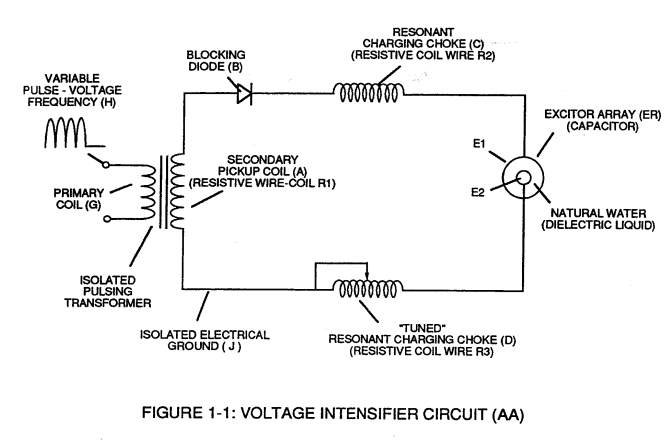
Voltage potential within an electrical circuit (see Voltage Intensifier Circuit as to Figure 1-1) can
cause one or more electrons to be dislodged from the atom due to opposite polarity attraction between
unlike charged entities, as shown in Figure (1-8).
|
Voltage Intensifier Circuit as to Figure 1-1
|
Figure (1-8)
|
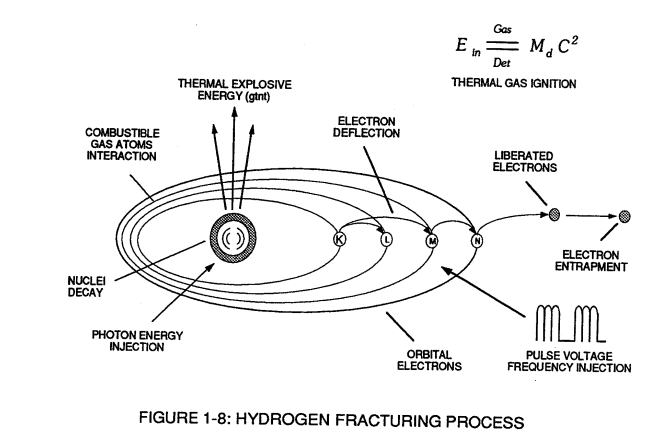
(see Figure
_1-_61-6 again as to Figure 1-9) as toNewtons'Newton's
and Coulomb's Laws of electrical force (RR)._____________________________________________________________________________StanleyA.
Hydrogen

The resultant electrical attraction force (qq') combines or joins unlike atoms together by way of
covalent bonding to form molecules of gases, solids, or liquids.
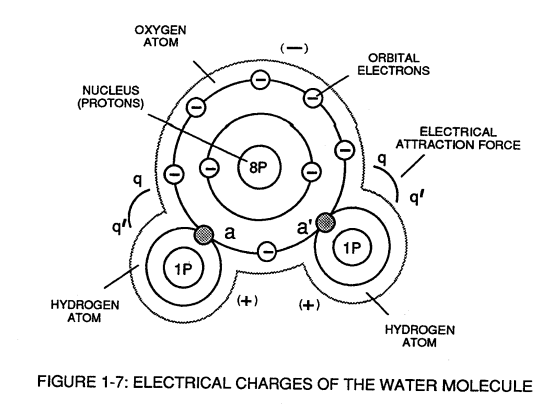 When the unlike oxygen atom combines with two hydrogen atoms to from the water molecule by
accepting the hydrogen electrons (aa' of Figure 1-7), the oxygen atoms become "net" negative
electrically charged (-) since the restructured oxygen atom now occupies 10 negative electrically
charged electrons as to only 8 positive electrically charged protons.protons.
The hydrogen atom with only itS
its positive charged proton remaining and unused,unused, now, takes on a "net" positive electrical charge equal to
the electrical intensity of the negative charges of the two electrons (aa') being shared by the oxygenatom atom.
... satisfying the law of physics that for every action there is an equal and opposite reaction.reaction.
The
sum total of the two positive charged hydrogen atoms (++) equaling the negative charged oxygen atom
(--) forms a "no" net electrical charged molecule of water.
Only the unlike atoms of the water molecule
exhibits opposite electrical charges.