
Capacitance Reactance
Capacitance Reactance is determined by the insulation resistance (Rs+ Re) and Inductance
(LIIL2) interacting together during D.C. Pulsing.
Dielectric property of water opposes amp leakage (Re) while another property of water takes-on
an "Electrical Charge". Water temperature (Rt) (cool-to-the-touch) keeps (Re) constant since amp flow
remains minimal. Plate Inductance (Lc) is Inductance Reactance of Inductor (L1 )
RE: VIC Matrix Circuit Memo WFC 426
Stanley A. Meyer 7- 10
and Inductance Reactance of lnductor (L2) in series with Resonant Capacitor (140 -170) of Figure (7-6)
as to (690) of Figure (7-8).
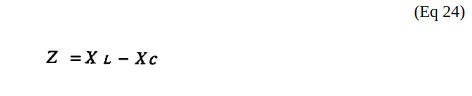
In terms of Component Reactance, Inductors (LIIL2) should always be larger than Capacitor
(ER) of Figure (7-2) in order to maximize amp restriction to enhance "Voltage Deflection" (SS' - 617a
xxx 617n - RR') of Figure (7-4) and, is expressed by :
(Eq 24)
Whereas,
Capacitor (ER) should remain relatively small due to the dielectric value of water to obtain
maximum Thermal Explosive Energy-Yield (16a xxx 16n) of Figure (4-5) and subsequently establishing
Quenching Circuit (370) of Figure (3-40) to prevent gas ignition inside traveling voltage wave-guide
(590) of Figure (6-2) as to (730) of Figure (7-12) ... to bring-on and trigger Hydrogen Fracturing Process
(390) of Figure (3-42) once liberated and expanding water gases (100) of Figure (4-8) passes beyond
exit port (E9d) ... activating Voltage Ignition Process (90) of Figure (5-5) ... utilizing Dynamic Voltage
Potential (600) of Figure (6-3) of opposite electrical stress (SS' - 617 - RR') to cause thermal atomic
agitation (90) of Figure (4-7) (kinetic heat by atomic motion) which, when occurring at gas exit port (32)
of Figure (4-5), spark-ignites expanding water gas-fuel (45/46/47) of Figure (4-5) during water inject
cycle (70) of Figure (4-5) ... releasing thermal explosive energy (gtnt) (16) under control state.