Electrically Charged Water Molecule
Atomic structure of an atom (76) and (77) of Figure (3-27) exhibits two types of electrical
charged mass entities, orbital electrons (79) having negative electrical charges ( - ) and a nucleus (84)
(at least one proton) having a positive electrical chargedcharge ( + ).
The positive electrical charge of the
nucleus equals the sum total of all negative electrical charged electrons when the atom is in "stable-
state."
In stable state or normal-state, the number of electrons equals the number of protons to give the
atom "no" net electrical charge.
Whenever one or more electrons are "dislodged" from the atom, the atom takes-on a net
positive electrical charge and is called a positive ion. If a electron combines with a stable or normal
atom, the atom has a net negative charge and is called a negative ion.
ion "voltage potential (65) within electrical circuit (60) can cause one or more electrons (79) to be
dislodged from the water molecule atom (85) of Figure (3-26) due to opposite electrical polarity
attraction (qq') of Figure (3-29) between unlike charged entities, as shown in (160) of Figure (326) as
to Newton's and Coulomb's laws of electrical-force.
These same laws of electrical-force (qq') is used to
combine or join atoms together by way of covalent bonding (opposite electrical forces) to form a
molecule of water (85), as illustrated in (210) of Figure (3-27).
The liquid molecule of water (210) of Figure (3-27) is formed when the two hydrogen atoms
(77a1b) takes-on a net "positive electrical charge" (78), which is, equal to the net "negative electrical
charge" (81) of the oxygen atom (76). The resultant electrical force (qq') between the opposite
electrical charged hydrogen (77) and oxygen (76) atoms keeps water molecule (210) intactStanley A Meyer3-13RE: WFC Hydrogen Gas Management SystemMemo WFC 422 DA
when the hydrogen atom (77) shares its electron (84) with oxygen atom (76).
The electrical strength
of attraction force (qq') between the water molecule atoms is determined by the electrical size of the
hydrogen atoms and the displacement of its negative charged electrons (84) during covalent sharing.
Oxygen atom becomes negative electrical charged (81) since oxygen atom (76), now, has a total of
ten negative charged electrons (79a xxx 79n) in its "K" plus "L" orbits while maintaining it's original
eight positive charged protons which makes up oxygen nucleus (83). Since the hydrogen proton (84)
(hydrogen nucleus) remain (after covalent link up), then the hydrogen atom takes-on a positive
charged (78) co-equalling the positive charge of the hydrogen nucleus proton (84).
Together, the
total net charge of water molecule (85) is zero despite the fact that each water molecule atom retains
its electrical charge.
In other words, water molecule (85) is a electrically bipolar molecule having a
stable configuration of charged atoms bound together by electrostatic force (qq').
Electromagnetic
bonding forces between unlike atoms (76n7) are negligible or non-existence, since oxygen atom
(76) electrons are paired together, while rotating in opposite direction which, in turn, causes oxygen
atom (76) to be electromagnetically neutral to hydrogen atom (77).
Electron theory of magnetism
requires orbital electrons to spin in the same direction before an atom can exhibit a electromagnetic
field.
Furthermore, external electrical force (66/67) can alter the electromagnetic properties of a
atom since electromagnetic force is dependent on the movement of charged particles in a
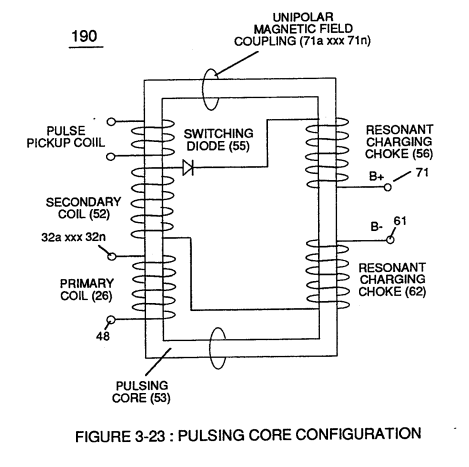
electrostatic field.field voltage Intensifier circuit (190) of figure (3-23), now, allows voltage to
dissociates water molecule (85) by overcoming electrostatic bonding force (qq') between unlike
atoms (76n7) while restricting amp flow, as illustrated in (160) of Figure (3-26).
|
Figure (3-23)
|
Figure (3-26)
|