
Gas Processor
To obtain higher energy-yields beyond the normal gas combustion process,process, ionized ambient air
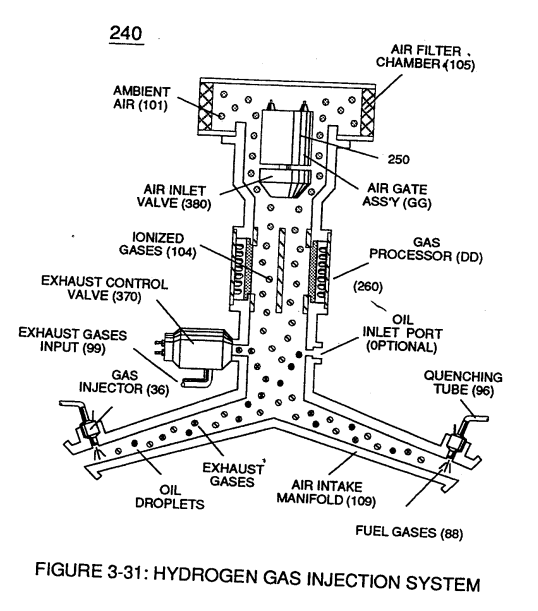
gases (104) of Figure (3-31) is, now, exposed to and intermixed with Fuel-Gases (88) prior to
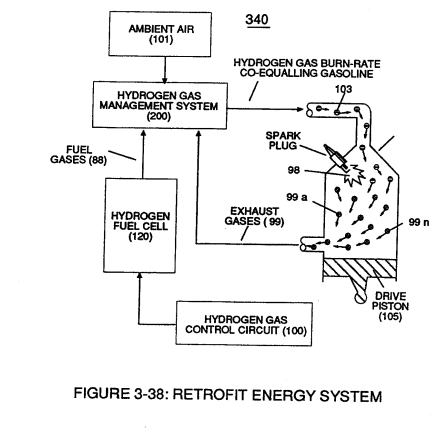
thermal gas ignition (98) of Figure (3-38), as illustrated in (240) of Figure (3-31).
Figure (3-31)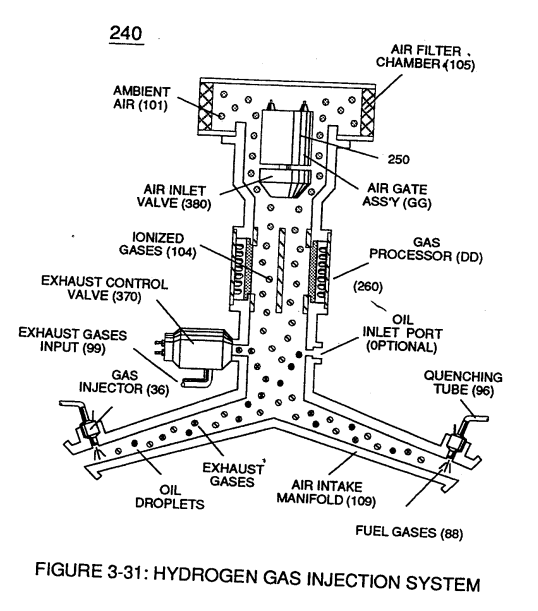 |
Figure (3-38)
|
 As ambient air
gases (l01)101) enters into and passes through air f1lterfilter chamber (105) toward and beyond air gate
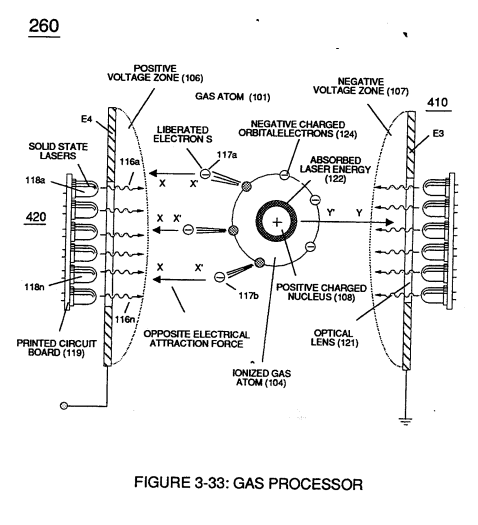
assembly (GG), the moving air gases (101) are exposed to a high energy voltage fields (up to and
beyond 2,000 volts)volts) (106/107) of opposite electrical polarity which causes ambient air gases to
become ionized gases (104), as illustrated in (260) of Figure (3-33).
Positive electrical voltage field
(106) causes negative charged orbital electrons (l24a124a xxx) to be ejected from gas atom (101) due to
opposite electrical attraction force (xx'); while, at the same time, negative electrical voltage field
(107) exerts a second electrical attraction force (yy') on gas atom positive charged nucleus (108)
...
opposite electrical attraction forces (xx') and (yy') being of equal intensity,intensity, as further illustrated in
(260) of Figure (3-33).
Once electron ejection occurs, the liberated and free floating electrons (117a xxx 117n)
continues to migrate toward positive voltage zone (106); whereas, the newly formed ionized gas
atom (having missing electrons) (104) continues to move onward and through air intake manifold
(109) of Figure (3-31) to engine cylinder (102) of Figure (3-38).
The resultant ionized gas process (260) of Figure (3-33) is performed by Electron
Extraction Circuit (270) of Figure (3-34) which function in like manner to Voltage Intensifier
Circuit (60) ofFi~ (3-22) except amp consuming device (390) (such as a light bulb _11_2 placed
between Resonant Charging Choke (56) and Gas Resonant Cavity (410) of Figure (3-34) is added to
pulsing circuit (60) to cause and convert liberated electrons (117a xxx 117n) into radiant heat -
energy (Kinetic energy) (113) in the form of light energy (l14) ... thereby preventing electrons (117a
xxx 117n) from re-entering ionized gas process (260) ... destabilizing gas atom (101).
Repetitive formation of electrical voltage force or voltage intensity (65a xxx 65n) of Figure
(3-21) attracts and causes liberated electrons (117a,xxx 117n) to move electrically away from gas
resonant cavity (410) and physically interact with light bulb filament (115) to initiate and performStanley A Meyer3-20RE: WFC Hydrogen Gas Management SystemMemo WFC 422 DA
kinetic conversion process (390), as further illustrated in (270) of Figure (3-34).
The newly established
and on-going electron conversion process (390) continues to aid ionized gas process (260) as other gas
atoms (101a xxx l0In) are destabilized into ionized gas vapor (104a xxx 104n).
The electron
conversion process (390) is, of course, terminated when applied pulse voltage potential (65) is switched
off. Pulsating voltage potential or voltage intensity (65a xx 65n) is adjusted, also, to "tune-in" to the
resonant properties of ambient air gases (101) since ambient air gases (101) exhibits a dielectric value
(air-gap of one inch resisting electron arc-over of up to 17,000 volts applied) between voltage plates
(E3) and (E4), forming capacitor (410) of Figure (334).
Voltage fields (106/107) are physically configured (skin effect) by T304 stainless steel material
to form voltage plates (E3!E4) of Figure (3-33) which are not only chemically inert to gas ionization
process (260) but, also, forms tubular Gas Resonant Cavity (410) of Figure (3-34) having
approximately the same size and shape of liquid resonant cavity (170) of Figure (3-25), as illustrated in
(270) of Figure (3-34).
To further destabilize gas atom (104), emitted laser energy (electromagnetic energy having zero
mass) (116) is, now, injected into Gas Resonant Cavity (410) via optical lens (121) and superimposed
onto gas ionized process (260) and subsequently absorbed by gas atom nucleus (108), as illustrated in
(260) of Figure (3-33) as to (270) of Figure (3-34). The absorbed laser energy (122) of Figure (3-35) not
only causes ionized gas atom orbitals electrons (124) to be deflected away from gas atom nucleus (108)
but, also, weakens electrostatic force (AA') between gas atom nucleus (108) and deflecting electrons
(123a xxx) ... allowing even a greater number of electrons (117a xxx) to be ejected from ionized gas
atom (104) being simultaneously subjected to Electron Extraction Process (260), as illustrated in (280)
of Figure (3-35).
In essence, then, laser interaction (280) along with applied voltage process (260) causes gas
atom (101) to go into sub-critical state (destabilizing the mass entity of a gas atom) since absorbed
laser energy (122) prevents electrons re-capture (atoms accepting electrons) while interfacing circuit
(270) dislodges, captures, and immediately consumes ejected electrons (117a xxx) In other words,
ambient air gases (101) has, now, become a electromagnetically primedStanley A Meyer3-21RE: WFC Hydrogen Gas Management SystemMemo WFC 422 DA
destabilized gas atoms (l04a xxx 100n) having missing electrons.
Solid state light-emitting diode (118) of Figure (3-33) arranged in a cluster-array (118a xxx 118n)
mounted on printed circuit board (119) emits a discrete wave-length of light energy (electromagnetic
energy) when light circuit assembly (420) of Figure (3-43) is electrically pulsed (126a xxx 126n) via
variable pulsing circuit (125) in such a way as to vary light intensity (116) to match the light absorption
rate of ionized gas (104), and, is determined with respect to the forward current through Led's (118) by
(Eq 15)
Where
I led, is the specified forward current (typically 20ma per diode); V led is the led voltage drop
(typically 1.7 volts for red emitter's).
Ohm's law for led circuit in parallel array,array, and, is given by
(Eq 16)
Where
It is the forward current through led cluster-array; Vcc is volts applied (typically 5 volts)
Whereby
Laser or light intensity is variable as to duty cycle on/off pulse frequency from 1hz up to and
beyond 10khz, and is given by
(Eq 17)
Le is light intensity in watts; Tl is current on-time; 1'2 is current off-time; and (ION) = RMS value of
load current during on-period.StanleyA
In terms of assembly, gas resonant cavity (410), electron extraction circuit (270), optical
lens (121) forms gas processor (260) of Figure (3-31).
In retrospect to operational parameters, led's
(118) light spectrum (extending from the visible into the Ultraviolet light region)region) can be selected
for a given or predetermined electromagnetically gas priming application (280) since gas nucleus
(108) is more responsive to coherent rather than diffused light source.source.
Applied voltage amplitude
(Va xxx Vn), applied voltage pulse frequency (65a xxx 65n), and applied current pulse train (126a
xxx 126n) are design variable to "tune-in" to the resonant properties of gas atom (101) while
stimulating and performing gas process (260) which attenuates electrical force (AA') of Figure (3-
35) to disrupt the mass equilibrium of gas atom (104).
The resultant and newly formed sub-critical gas atoms (104a xxx l04n) are directed onward
through air intake manifold (109) of Figure (3-31) to and beyond both exhaust gas metering port
(370) and injector port (36) where metered fuel-gas (88), metered exhaust gases (99), and metered
sub-critical gas atoms (l04a104a xxx l04n)104n) forms gas-mixture (103) entering engine cylinder (102), as
illustrated in (240) of Figure (3-31) as to (340) of Figure (3-38).