
Hydrogen Fracturing Process
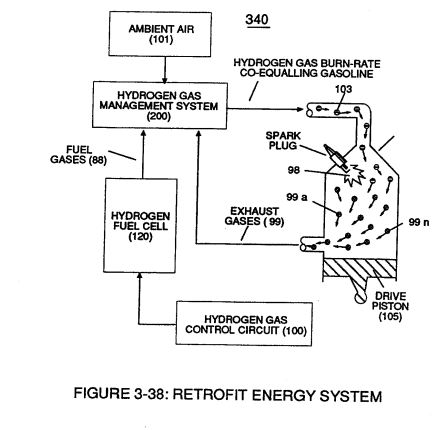 Incoming processed hydrogen fuel gas (103) is, now, exposed to thermal spark ignition
process (98) which triggers thermal explosive energy-yield (gtnt) (127) that causes piston-action
(105) of Figure (3-38) to exceed normal gas combustion process associated with hydrogen to air
mixture of gases in stable state.
Thermal atomic interaction (127) is caused when sub-critical gas
ions (104a xxx 104n) (derived from both water bath ~ and ambient air gases 1Qlgases) fails to unite with
or covalently link up or covalent bond with highly energized (laser primed)primed) hydrogen atom
(128).
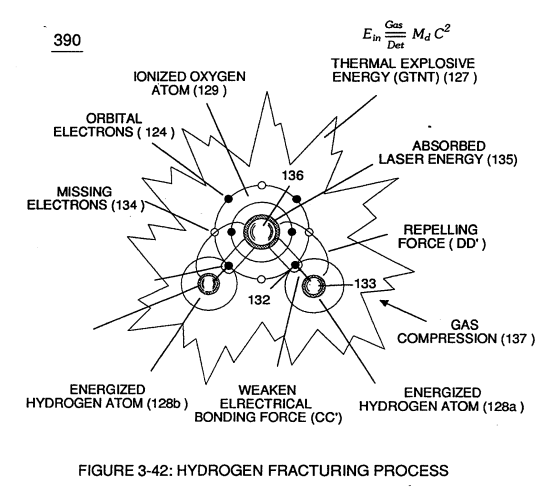
Sub-critical Oxygen atom (129) having less than the normal amount of covalent electrons
(orbital electrons) is unable to reach "stable-state"state" (six to eight covalent electrons required)required) when
the two hydrogen atoms (128 a/b) seek to form the water molecule during thermal gas ignition.
Absorbed laser energy (131) of hydrogen gas atom nucleus (133) weakens "electrical
bonding" force (CC') between hydrogen atom electron (132) and hydrogen atom nucleus (133);
while, at the same time, absorbed laser energy (135) prevents oxygen atom (129) from reaching
"stable state"state" when electrical attraction force (BB') (opposite electrical attraction force being
equivalent to the number of missing electrons)electrons) locks onto and pulls away hydrogen atom electron
(132) while repelling force (DD') keeps the two positive charged nucleusesnucleus's (133/136) apart.
 These
These
"'abnormal"abnormal" and "unstable"unstable" conditions coupled with thermal interaction (gas ignition) under gas
compression (137) of Figure (3-42) as to Figure (3-38) (fuel-gas 88 being compressed via piston-Stanley A Meyer3-23RE: WFC Hydrogen Gas Management SystemMemo WFC 422 DA
action 105)105) causes combustible gas atoms (129 and 128a/b) to decay ... releasing thermal explosive
energy (gtnt) (127) under control means.
This atomic thermal-interaction between sub-critical
combustible gas atoms (127 and 128a/b) is, now, herein after called "The Hydrogen fracturingProcess. Process. "