
Taper Resonant Capacitor (ERt)
Capacitor (ER) is automatically formed when dielectric liquid of water (Re) is placed between
Electrical Conducting Plates (EIIE2) of Figure (1-1) page (1-13) (Memo WFC 420).
Stainless steel T304 material is used to form Electrical Voltage-Plates (EIIE2) which do "not"
chemically interacts (chemically inert) (Lab tested less than .0001/year decomposition rate) with
liberated water gases (hydrogen _86, oxygen _87, and non-combustible gases W being exposed to an
high intensity voltage pulse-field (64a xxx 64n) with negligible amp flow. Electrical Plates herein called
"Excitor" Plates or Voltage Zones (E1/E2) can take-on different configuration of shapes to maximize
Dynamic Voltage Potential (600) of Figure (6-3) for different application of usage: (35a) Traveling
Constant Electrical Voltage Wave by way of linear cylindrical resonant cavity (Tubular Cavity 730A),
(35b) Traveling Compressional (concentrating electrical intensity) Electrical Voltage Wave by way of
taper cylindrical resonant cavity (730B), (35c) Traveling Expanding Electrical Voltage wave by way of
non-linear cylindrical resonant cavity (730C) ... or any voltage surface combination thereof ... each
resonant cavity design acting and functioning as a Voltage Wave-guide (570) and gap-size (35)
sufficient enough to allow the "Quenching Effect" to take place, as illustrated in (730) of Figure (7-12)
as to (370) of Figure (3-40).
The dielectric property of water (being 78.54 ohms @ 25° C) permits the storage of '"Electrical
Charge" when a potential voltage difference exists between Electrical Voltage-Plates (EIIE2) as to
(E9IEI0).
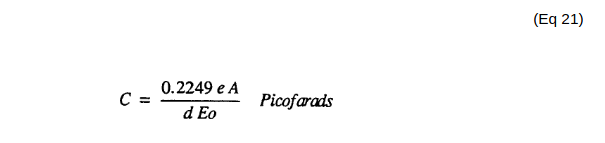
Capacitance (Cp) of Figure (7-6) as to (690) of Figure (7-8) is detennined by the surface area
(A) of Electrical Voltage-Plates (E1/E2 - E9/E10), the distance (d) between the Electrical Plates (in
inches), and the pennittivity (Eo) of the dielectric property of water (85) and, is expressed in the
following equation:
(Eq 21)
RE: VIC Matrix Circuit Memo WFC 426
Stanley A. Meyer 7- 9
Where,
(Eo) is Free-Space Permittivity of Water established by VIC Circuit (690) of Figure (7-8)
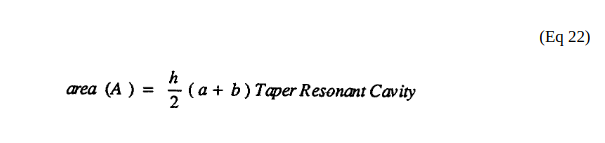
ability to restrict amp flow, (e/Eo) Ratio is the Dielectric Constant of Water, (A) is the surface Area of
Resonant Cavity and, is expressed in the below equation:
(Eq 22)
Where,
(h) is longitudinal length of tapered resonant cavity, (a) being exit pan circumference surface
point (E9d) of Figure (6-2), (b) being cylindrical circumference surface point (E9a) of Figure (6-2)
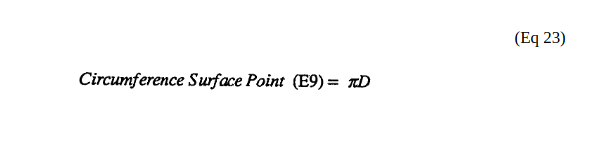
where tapered surface statts, (a) (b) circumference surface points (E9a)(E9d) respectively detennined by
below expressed equation: (see diagram 720 of Figure 7-11)
(Eq 23)
Where,
(D) is diameter cross section of cylindrical surface at designated point (E9a - E9n), (x) being
mathematical constant 3.1416.