
Transformer Action
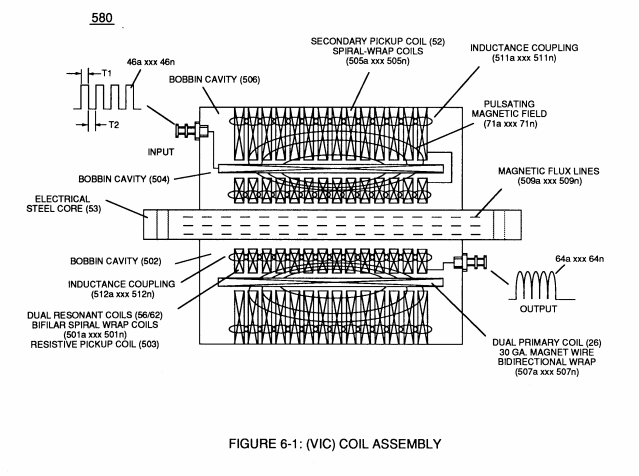
Inductance Core (53) of Figure (6-1) composed of "Grain Oriented"Oriented" Electrical Steel
laminations step up applied Voltage (49) when Magnetic Field Coupling (71) of Figure (7-8) cross
over to Secondary Pickup Coil-Coil-winding (52) which has more turns of wire than Primary Coil-
winding (26) by way of "Eddy"Eddy" currents that inducesinduce magnetic flux lines of forces (71a xxx 71n)
emanating away from magnetic core material (53) and caused by Primary Coil (26) being
electrically energized during pulsing operations (T1a xx T1n), as illustrated in (690) of Figure
(7-8).
Magnetic Induction (71a - 71n) is determined by Inductance Permeability (μL) of core
material (53) along with VIC circuit geometry ability to step up Voltage Potential (Vo - Vn) by way
of "Transformer Action"Action", and is expressed in the following equations: (Eq 25)
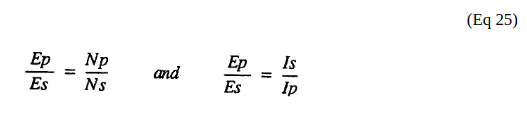
Where,Where,
(Ep) is voltage induced in Primary Coil (26),
(Es) is Voltage induced in Secondary Coil
(52),
(Np) is the number of turns of wire that make up Primary Coil-Wrap (504) of Figure (6-1),
(Ns) is the number of turns of wire that make up Secondary Coil-Wrap (505) of Figure (6-1),
(Is) is
the established current flow (under load)load) in Secondary Coil-Winding (52) ,
(Ip) is the amount of
current flow in the Primary Coil-Winding (26) when electrically "energized" during pulsing
operations (49a xxx 49n - T3 - 49a xxx 49a).RE:
The turns ratio of the VIC TransfonnerTransformer (26/52) is detennineddetermined by the following equation: (Eq 26)
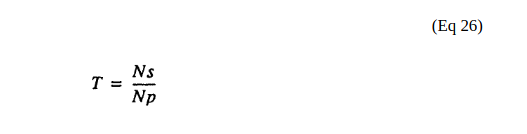
Where,Where,
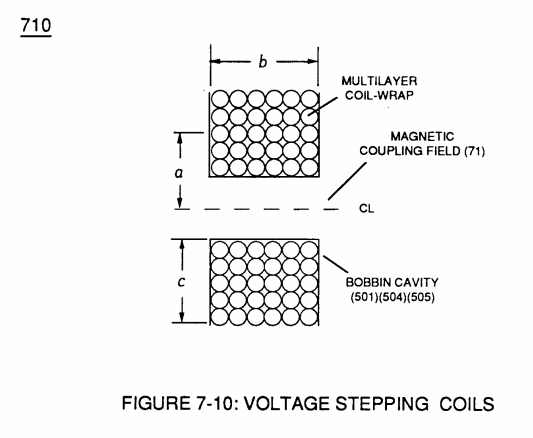
(Ns) is the number of turns of wire for each bobbin cavity (505) of Figure (6-1) as to (710) of
Figure (7-10) that are electrically connected in series arrangement (505a xxx 505n) to fonnform Secondary
Coil-Wrap (52),
(Np) is the number of turns of the primaryPrimary Coil (26) wire-wrapped about spool cavity
(504)
... each bobbin cavity adhering to equation (Eq 20), as illustrated in (710) of Figure (7-10).
|
(505) of Figure (6-1) |
(710) of Figure (7-10)
|
The impedance ratio of VIC transformer is determined by:(Eq 27)

Where,
Where,
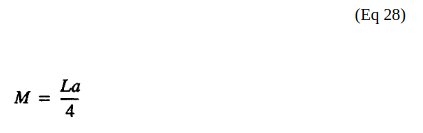
(1'2) is the sum of the magnetic field strength (FL4) of the primary coil (26) and the induced
magnetic field (FL3) of the Secondary Pickup Coil (52) during each pulse cycle (TI)T1) in direct
relationship to repetitive pulse cycling (T1a xxx T1n) and both magnetic fields (FL31FL4)FL3/FL4) interacting,
and is expressed in the following equation:(Eq 28)
Where,Where,
(M) is the mutual inductance expressed in the same units .as (La),
(La) is the total inductance of
Primary coil (26) and Secondary coil (52) with fields aiding.RE:aiding VIC Matrix Circuit Memo WFC 426Stanley A. Meyer 7- 13
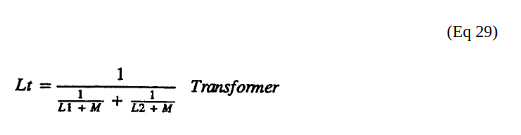
Coupling Inductance (Rp) between the Primary coil (26) and Secondary Coil (52) is
further extrapolated in the following equation:(Eq 29)
Where,
Where,
(Lt) is the total inductance,
(L1) and L2) are the inductanceinductances of each individual transformer
coils (26)(52),
(M) is the mutual inductance of each transformer coil (26/52) being in parallel
relationship with fields aiding.
aiding Coupling Inductance (Rp1) and (Rp2) in (690) of Figure (7-8) is further expressed in the
following equation:(Eq 30)

Where,Where,
(Lt cc) is the total inductance of Choke Coils (FL1 - FL2),
(L1) and (L2) are the inductance
inductances of each individual choke coil (56)(62) in series with Secondary Coil (52) Electrical Voltage
Potential (700) of Figure (7-9) and being exposed to the same Voltage Transformer (26 - 53 - 52)
magnetic field (Rp) with aiding fields,
(M) is the mutual inductance of choke coils (L1/L2) since
Transformer Magnetic Field (Rp) is the excitation External Magnetic Field (Rp1/Rp2) by way of
Unipolar Pulsing Core (53).
VIC Coil Assembly (580) of Figure (6-1) as to (690) of Figure (7-8) in reference to
Schematic Circuit (620) of Figure (7-1) is constructed in such a way as to rotate and position
Inductor Coils (26 - 52 - 56 - 62) to be of the same electromagnetic polarity orientation,orientation, indicator
mark (e)
... thus, allowing Inductance Fields (FL1 - FL2 - FL3 - FL4) to be aiding one another
during the same sequence of pulse-time (T1) ... thereby, allowing Inductance Charging Effect (660)
of Figure (7-5) and Resonant Voltage Effect (670) of Figure (7-6) to interact with the dielectric
properties of water (Re) to cause and inhibit electron flow (IF) since "electrons" magneticRE: VIC Matrix Circuit Memo WFC 426Stanley A. Meyer 7- 14
field (547) of Figure (5-9) locks onto the electromagnetic fields of each energized choke coils
(FL1/FL2) during Voltage Excitation (Vo -Vn) which, now, brings on and allows "Electron
Bounce Phenomenon"Phenomenon" (700) of Figure (7-9) to take place.
(See Appendix B Note 1)
Note 1) The Electron Inhibiting Effect (631) of Figure (7-6) to cause "Electron Clustering" (Grouping/collecting negative charged particles at a given point) (700) of Figure (7-9) to produce ''Negative Voltage Potential" ( B- ) at one side of Water Gap (Cp) of Figure (7-8) is accomplished by low electrical power input (Tab 38) when Choke-Coil (62) of Figure (7-1) magnetic field (FL2) (690) of Figure (7-8) during pulse on-time (49) impede "Electron-Flow" since electron mass is composed of electromagnetic matter which interacts with magnetic field strength (FL2).
Capacitance Charging Effect (628) prevents amp influxing away from Water Gap (Cp) in a similar manner
... producing "Electrical Stress" (SS' - RR') (B+/B-) across Water Gap (Cp) since both Choke-Coils (56/62) conduct voltage potential (Negative or Positive) during pulsing operations.