
Dynamic Ways To Produce Electricity
WATER, THE SOURCE FOR ELECTRICITY:
The previous sections have outlined how hydrogen may be safely, easily and economically extracted from natural water. Not only that, the previous pages have shown how hydrogen may be harnessed for use as a free and abundant fuel source. Also, it has been shown how the hydrogen may support a flame in excess of 2,500 degrees Fahrenheit to supply thermal energy. But, in practical terms, how can this hydrogen energy from natural water be used to create electricity for use in factories, homes and businesses? This may be done in several ways.
LIMITS PLACED ON CONVENTIONAL POWER SYSTEMS:
Currently, there are several ways to use high temperature flames to produce electrical energy. First, high temperatures may be used to power gas-actuated electrical generators. The high flame heats the gas, which becomes the driving force to power the generator, which in turn creates the electricity for use. Similarly, heat may be used to create steam to drive generators for electrical production. Or, the hydrogen burn rate may be adjusted to co-equal the burn rate of fossil fuels (as previously described) to operate a gas-driven (internal combustion engine) electrical generator. The gas-driven engine not only provides mechanical to turn the electrical generator, but also manufactures the exhaust gases needed to process the hydrogen gas on demand. This feedback technique is extremely good since the gas engine requires no special cooling apparatus nor the use of special high temperature alloys or materials for construction.
What does this mean for the consumer? Remembering that hydrogen by atomic weight is more than two and a half times more powerful than gasoline (NASA test data), and that 2/3rds of a water molecule contains hydrogen, not more than six gallons of water is needed to heat or cool an average 2,000 square foot home (rated at 135,000 per degree day) in a 24-hour period. Several additional gallons of water are all that is needed to provide home electricity during the same time period. Also, a few gallons of water is all that is needed to run a typical passenger car in excess of 55 miles per hour.
All the systems may utilize the hydrogen by adjusting the burn-rate downward without sacrificing power yield. All systems have the capability to recycle hydrogen back into the form of water for energy reuse. See Figure A.
FIGURE A:
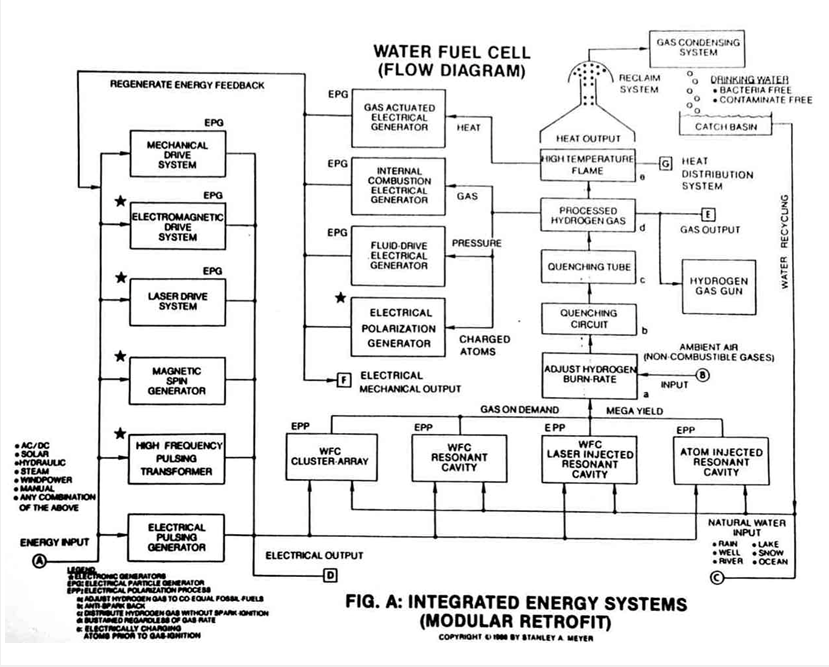
All of the above gas-driven systems are efficient and adequate, and all have common characteristics. They all have mechanical displacement parts that result in component wear during application. This may lead to higher operating costs because the lifespan of some mechanical parts may be limited. In order to provide an even more efficient and reliable energy system that complies with the laws of economics (the person with the least expensive way will be successful). Meyer has discovered how to create electrical energy without the need for moving mechanical parts.
THE BIRTH OF NEW TECHNOLOGY: THE EPG SYSTEMS:
Meyer has done this by developing the "Electrical Particle Generator” (EPG system). He contemplated the idea of how to create a device with no mechanical moving parts that could produce electrical energy in all applications.
In order to do this, he knew he had to solve a multiplicity of problems. He needed to develop a system that conformed to his development specifications for the Fuel Cell. These specifications would allow the device to be constructed easily and economically, without the aid of hi-tech manufacturing techniques. He also knew he must make the system reliable, durable and efficient. He knew he also had to overcome the opposing magnetic field problem that requires high torque (rotational force) power input to operate conventional rotary electrical generators.
EPG: PRINCIPLES OF OPERABILITY:
He accomplished the task with the Electrical Particle Generator by moving permanently magnetized gas through a non-magnetic, closed looped, tabular system; see Figure 26. As it moves, this magnetically charged gas traverses a pickup coil, which generates electrical energy. This process satisfies the law of physics that states that a magnetic field must pass through a coil of wire for the production of electricity.
FIGURE 26:
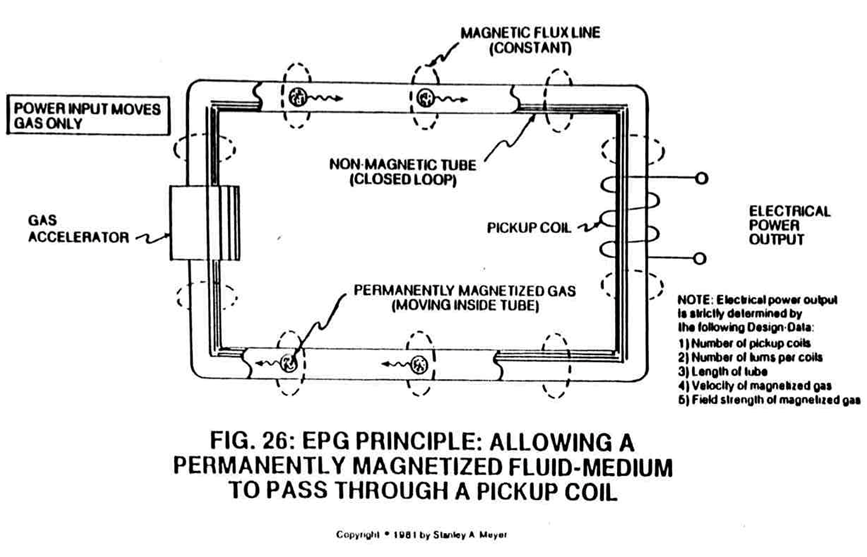
Now, the permanently magnetized gas (which actually may be a fluid medium or semi-solid slurry) passes through the closed looped system without interruption. The energy input into the electrical particle generator is to move the gas, not to create the magnetic field of the gas. Since the moving gas field is attenuated to minimize the opposing EMF fields of the pickup coils, very little input energy is required to move the magnetized gas. Power output from the electrical particle generator is simply determined by the coil-wrap of the tube through a given number of coils.
EPG: MECHANICAL DRIVE SYSTEM:
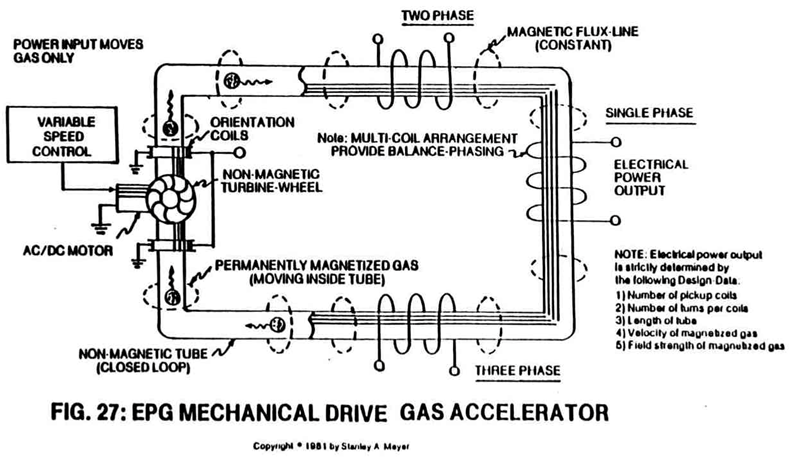
Only a few pounds of pressure s needed to drive the magnetically charged gas through the system. This may be done mechanically by a small, non-magnetic turbine wheel powered by a small AC or DC electric motor; see Figure 27; or powered by hydraulics, steam, wind power, or even manpower. But again, moving parts wear out, so this is the least desirable method of moving the gas through the system, despite the fact input to output efficiency of the electrical particle generators exceeds the performance "specs" of typical rotary electrical generators.
FIGURE 27:
EPG: ELECTROMAGNETIC DRIVE SYSTEM:
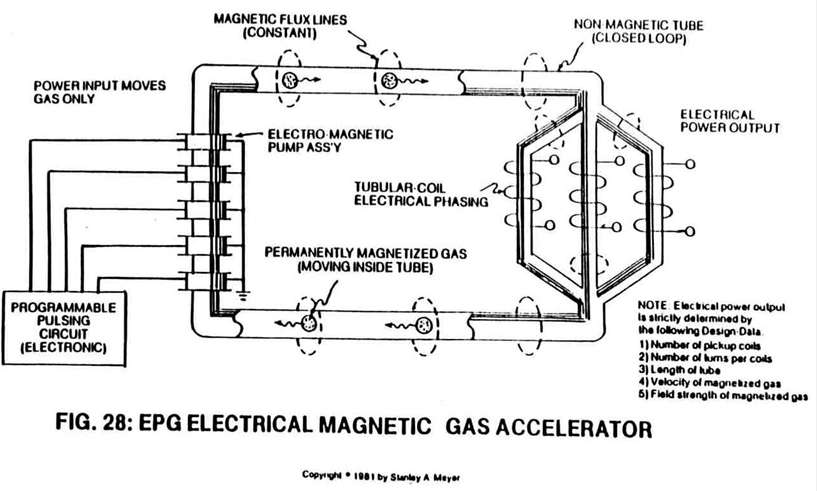
Another way to move the magnetically charged gas through the closed looped system is the use of an Electromagnetic Pump Assembly, as shown in Figure 26C and 28. The multi-coil arrangement is pulsed in a way as to allow the electromagnetic field to "walk" in a linear motion. Since the walking fields lock onto the gas, the gas moves onward to and through the pickup coils and is recycled again for continuous power generation. Increasing pulsing rate increases gas velocity which, in turn, increases power output without system change.
FIGURE 26C:
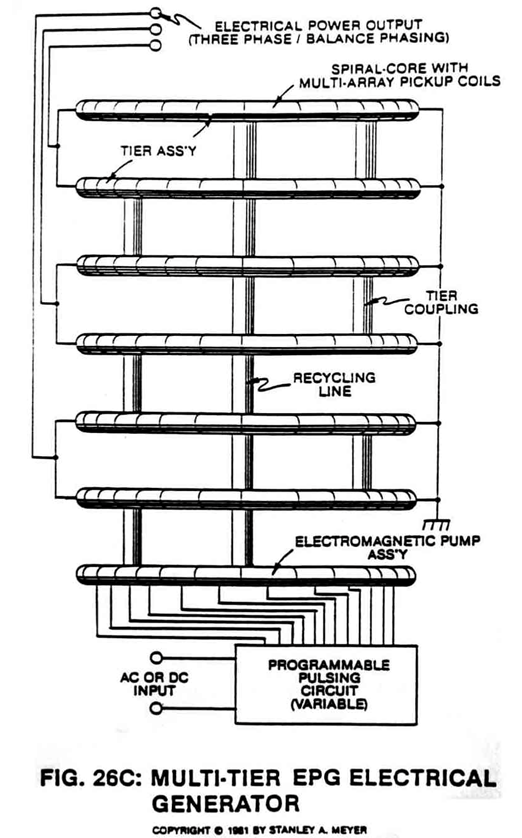
FIGURE 28:
EPG: PARTICLE BEAM ACCELERATORS:
Finally, and most dynamic, is the use of a laser team driven EPG system; see Figure 29. In this system, the permanently charged particles of gas are driven close to the speed of light through the closed looped system by the physical motion of the low power laser beam. In this application, the non-magnetic tube is used as a typical light-guide (reflective surface inside a hollow tube). In other applications, particle beam accelerators beyond the laser can be used for gas displacement...moving the gas-field for electrical power generation.
FIGURE 29:
EPG: ATTENUATING GAS—FIELD:
In each progression of the above cases, there is an increase in power output because the movement of the gas through the system is greater. In each case, low energy is required to move the gas through the tubular system. Because of the flexibility of the system design, it is the geometrical configuration of the system that determines power output. In all cases, power input deals with moving the gas...not creating an electromagnetic field for the gas. In all cases, the field of the gas can be attenuated in ways to overcome EMF opposition: horizontal to vertical deflection, rotational, compressional wave, and/or field balancing between different magnetic fields, as shown in Figure 26A. Any combination of these attenuated fields can be used simultaneously while moving the magnetized gas. To spin the moving gas along the longitudinal axis of the tube without mechanical