
The Principles of Discovery
In order to conform with the development criteria, it is clear that hydrogen gas must be produced economically—without the use of exotic materials or complicated processes. The question loomed before Stan Meyer of how to easily separate the hydrogen from the oxygen in the water molecule. If the atoms of the water molecule could easily be disassociated, hydrogen would be a cheap and abundant fuel source.
THE PURSUIT OF KNOWLEDGE:
Meyer dealt with the prospect of how to capitalize upon the natural potential held by the hydrogen and oxygen atoms which keep the water molecule bound together. He discovered the simple yet profound principle, ELECTRICAL POLARIZATION OF THE WATER MOLECULE.
ELECTRICALLY CHARGING THE WATER MOLECULE:
It is already known that the hydrogen and oxygen atoms by themselves may take on electrical charges. But until now, no one discovered that by simultaneously exposing the water molecule to one positively charged and one negatively charged electrical voltage zone, the unlike hydrogen and oxygen atoms assume opposing electrical characteristics, equal in magnitude and potential, thereby stabilizing the electrical polarity of the water molecule into existence. In the water molecule, the two hydrogen atoms take on a positive (+) electrical care and the one oxygen atom takes on a negative (-) electrical charge, thereby satisfying the two basic laws of physics...for every action there is an equal and opposite reaction, and that all things must reach a stable state, as so illustrated in Figure 2.
FIGURE 2:
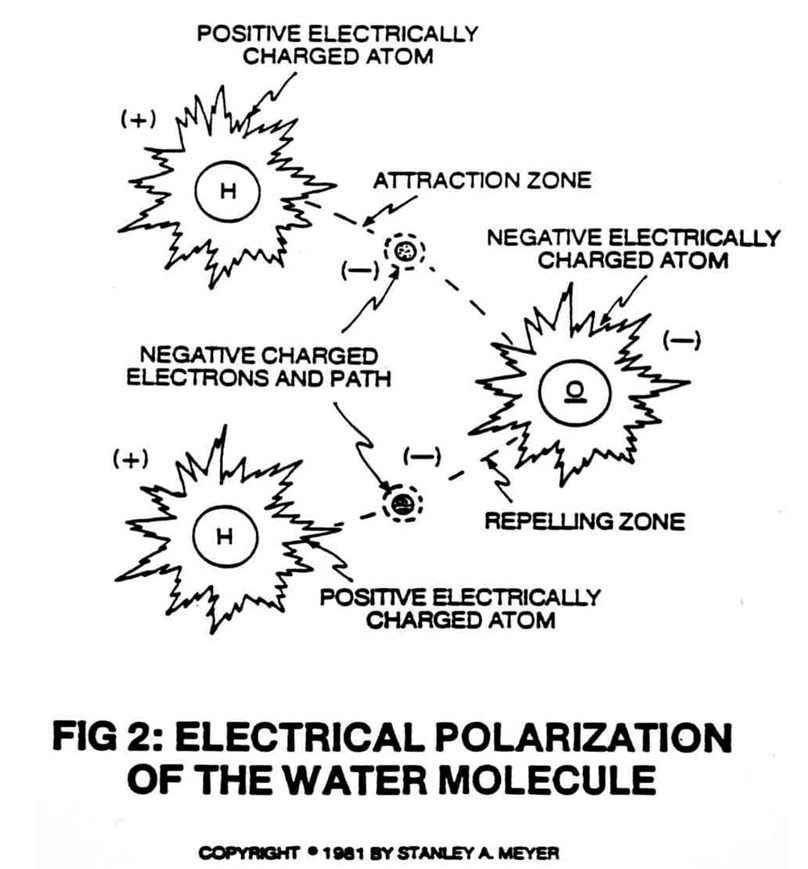
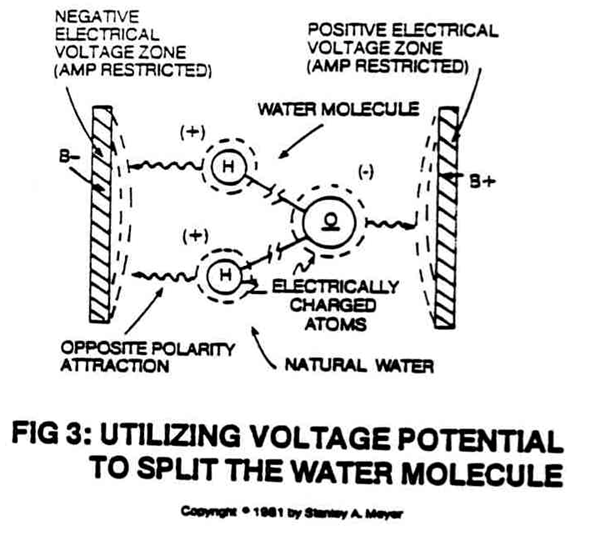
Although the molecule, is stabilized, in electrical polarity by the simultaneous application of the two oppositely charged voltage zones, the bond between its atoms is greatly weakened in this process. The positively charged hydrogen atoms are attracted to the negatively charged voltage zone, and the negatively charged oxygen atoms are attracted to the positively charged voltage zone...satisfying the opposite polarity attraction law of physics as shown in Figure 3.
FIGURE 3:
ELECTRICAL POLARIZATION PROCESS:
Simply, the electrical polarization of the water molecule is basically a four-step process. First, oppositely charged electrical voltage zones are simultaneously introduced to either side of the water molecule. Secondly, the water molecule becomes electrically polarized (electrically charged). Thirdly, this electrical polarization of the hydrogen and oxygen atoms greatly weakens the stability of the water molecule. And, finally, because the-voltage zones are still present with their opposite electrical attractions, the water molecule is split into it component parts. The hydrogen and oxygen atoms separate, with the hydrogen being attracted to the negative electrical voltage zone,