

article
Engineers Still Seek Water Fuel Cell Secret
Ben Phlegar, AP Automotive Writer · 16 November 1961
Engineers Still Seek Water Fuel Cell Secret
By Ben Phlegar, AP Automotive Writer
DETROIT (AP) — Even before gasoline engines became standard power plants for automobiles, scientists were dreaming of using water for fuel.
The steamers tried and failed, although a small cult still talks of their revival. Charlatans got rich quick on magic pills which supposedly turned tap water into gasoline.
But behind it all has been a solid basis of scientific fact—the fuel cell. This is usually defined as an electrochemical device in which the chemical energy of conventional fuel is converted directly into low voltage electrical energy.
Science has known the fuel cell principle since the early 1800s. Over and over it has been proved sound. But as yet it has not been proved practical, especially for automobiles.
In a paper presented to the American Petroleum Institute’s Division of Refining last spring, W. J. Sweeney and C. E. Heath of the Esso Research and Engineering Co. of Linden, N.J., noted that 100 research laboritories the world over are studying fuel cells.
“The hope is that some day a practical fuel cell will be developed which will have twice the efficiency of the best present day thermal power plant—say 80 per cent,” the report said. “The surest thing about the fuel cell is that the theoretical concept is sound! This fact has tickled the imagination of everyone from laboratory boy to banker. They seem to say, ‘You scientists tell us it is possible, why don’t you go and make one,’ or ‘Someone is going to do it, why not us:’ ”
The dream car would be powered by electricity. Now it would have to use storage batteries. But unlike conventional batteries, which deliver only the electricity previously stored, a fuel cell generates current as long as fuel is provided.
Ideally, this electricity would come from fuels costing next to nothing.
Before you decide to wait for such a car, consider the opinion of Manuel Shaw, head of electrochemical research, including fuel cells, at the Autolite Co. in Toledo.
Dr. Shaw says, “If you are counting on a fuel cell to take dollars out of you car expense and add only pennies to your water bill—don’t.”
He says the major problem is cost.
Sweeney and Heath elaborated on this point: “From the standpoint of simplicity, pure hydrogen and pure oxygen are a relatively easy fuel and oxidizer combination around which to develop a fuel cell.
“However, hydrogen is several times as expensive as natural gas, oil or coal. And since one needs eight pounds of pure oxygen for every pound of hydrogen, the oxygen in turn could cost as much as or more than the hydrogen. In the case of natural gas, petroleum or coal, the oxygen required could cost several times more than the fuel.”
The Esso scientists say the economics of the fuel cell will depend on how important fuel costs are. In Cases where efficiency is the prime aim, the fuel cell may become the answer.
But they point out the first cost of a complete fuel cell system for an automobile, including controls and motors “is likely to be considerably higher than the first cost of a gasoline engine giving the same top performance.”
Since this top performance, meaning maximum horsepower, is almost never used “it is difficult to justify the higher fuel cost of the fuel cell system by the greater fuel economy.”
Sweeney and Heath foresee the possible application of the fuel cell to buses, trucks and ships, and to large stationary power plants.
They are confident that because so many are interested in fuel cells and the concept is both attractive and scientifically sound, eventual success is assured.
Just when this will come no one seems willing to predict.
For those car owners who can’t wait and who are determined to run their car on water Dr. Shaw has a suggestion — the Stanley Steamer.
About this piece
Meyer is not in it; he was twenty-one. The archive holds it because the words "water fuel cell" were in American headlines two decades before he used them for his own device, and because it records what the phrase meant in 1961: a hydrogen–oxygen fuel cell, the hydrogen having to come from somewhere. The article's own complaint — that hydrogen costs more than the fuels it would replace — is the problem Meyer's cell set out to answer, by making the hydrogen from water on board. The spelling "laboritories" and the slip "you car expense" are the paper's.
The original
Provenance
- Shelf
- Press coverage
- Page
- 29
- Byline
- Ben Phlegar, AP Automotive Writer
- Rights
- The newspaper page is copyright its publisher and is reproduced here as a record of what was printed at the time; the archive claims nothing in it. The watermark marks the archive’s copy, not its ownership. The citation is what a reader needs to find the original.
- Caption
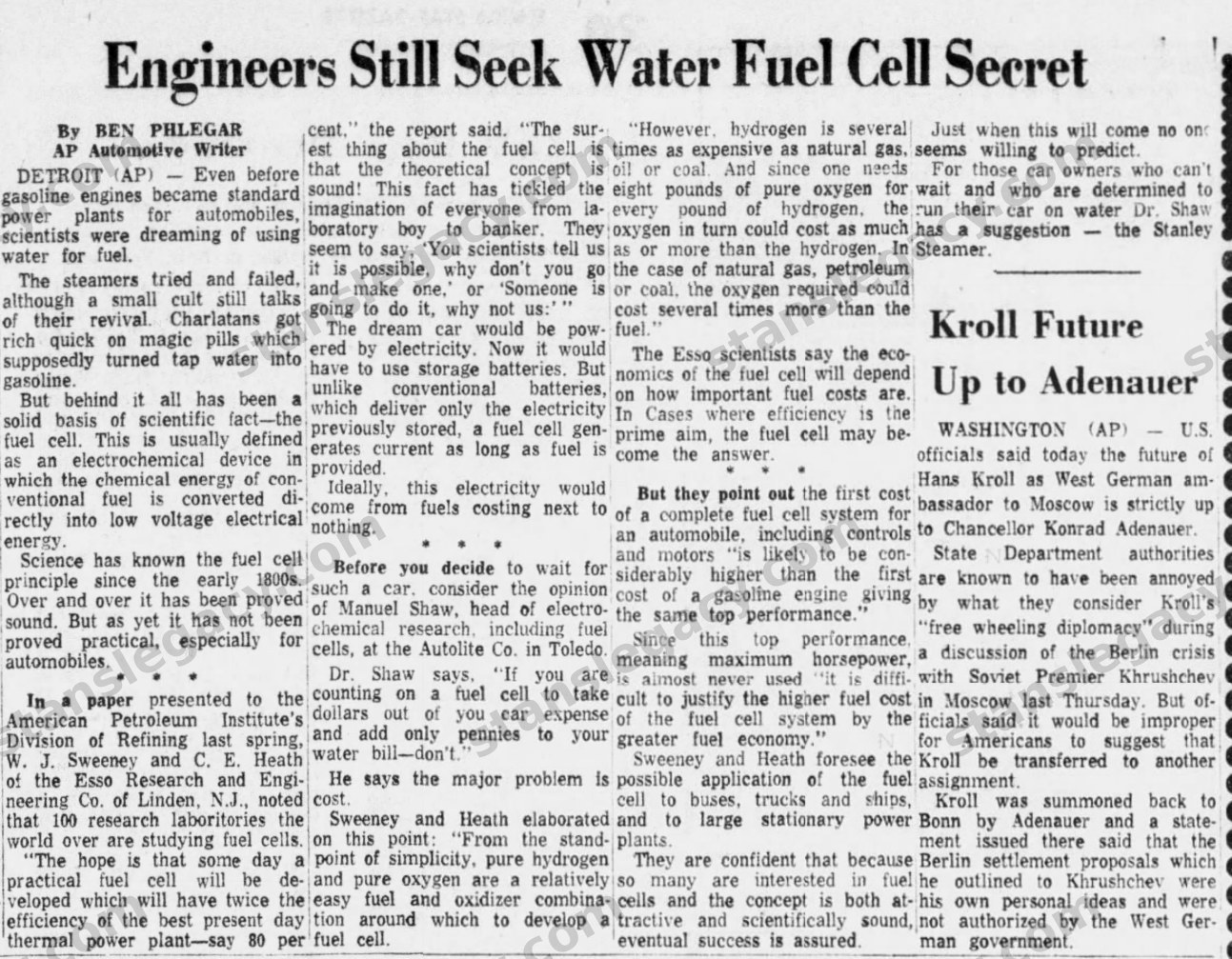
- Star-Gazette, Elmira, New York, Thursday 16 November 1961, page 29. The column on the right belongs to another story.
- Citation
- Star-Gazette, Elmira, New York (Associated Press), November 1961, pp. 29, by Ben Phlegar, AP Automotive Writer
- Publication
- Star-Gazette, Elmira, New York (Associated Press)
- Transcription
- A clipping from the printed page, supplied by the archive’s editor.