

article
Electricity and Water to Run Our Autos
Unsigned · 1 June 1917
Electricity and Water to Run Our Autos
A stub: the first page is photographed below; page 145, where it continues, is not in the photograph.
What the page says
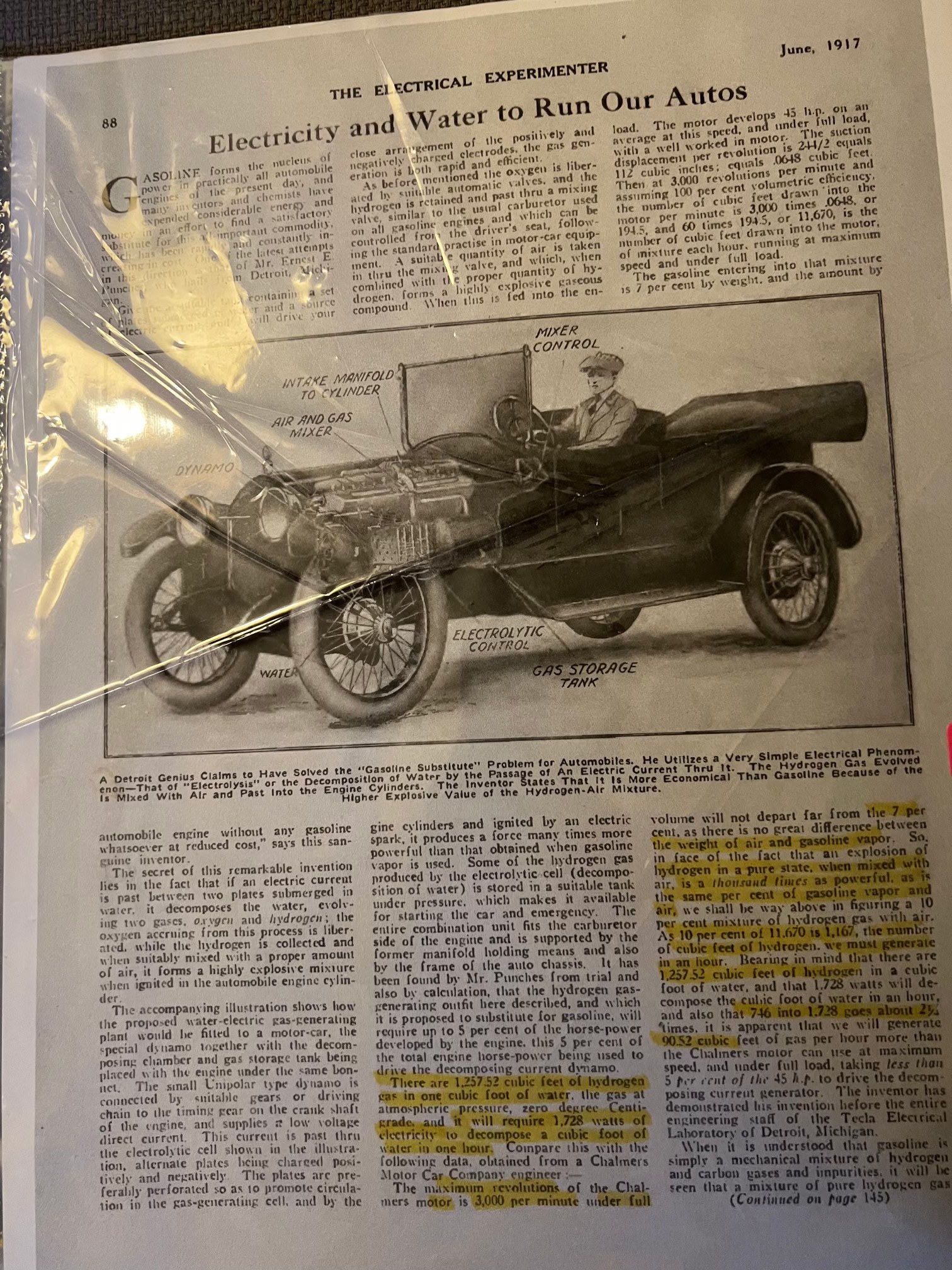
The article credits Ernest E. Punches of Detroit with a way to run a car on water and electricity. Its drawing shows a touring car fitted with a water tank, an electrolytic cell, a gas storage tank, a mixer and controls at the driver's seat, and a dynamo. The text explains the scheme: a small low-voltage dynamo driven from the engine's timing gear passes current through a cell of alternately charged, perforated plates; the hydrogen is collected and stored under pressure, mixed with air in a carburettor-like valve, and fed to the cylinders, with the oxygen let off. It works through the arithmetic against a 45-horsepower Chalmers engine and names the Tecla Electrical Laboratory of Detroit as having seen the invention demonstrated.
The archive's note on the numbers
The highlighted figures are the article's own: about 1,257 cubic feet of hydrogen from a cubic foot of water, and 1,728 watts to decompose that cubic foot in an hour. The first is right: a cubic foot of water is about 1,570 moles, which is about 1,240 cubic feet of hydrogen at freezing point. The second is not. Splitting that much water takes about 450 megajoules, some 125 kilowatt-hours even at perfect efficiency, so 1,728 watt-hours is short by a factor of about seventy. The same gap between what a cell costs to run and what its gas returns is the one every later water-car claim, Meyer's included, has had to answer.
The copy was kept in a binder labelled "Magazine articles, Stanley Meyer" in James Wight's papers.
The original
Provenance
- Shelf
- Press coverage
- Page
- 88, continued on 145
- Byline
- Unsigned
- Rights
- Published in 1917 and in the public domain in the United States.
- Caption
- The Electrical Experimenter, June 1917, page 88.
- Citation
- The Electrical Experimenter, New York, June 1917, pp. 88, continued on 145, by Unsigned
- Publication
- The Electrical Experimenter, New York
- Transcription
- From the James Paul Wight / Good News Productions papers, photographed for the archive in September 2026. A photograph of the printed page through a plastic sleeve; not yet transcribed.