

article
Did Stanley Meyer die because he knew how to turn water into fuel?
Jane Warren · 28 July 1998
Did Stanley Meyer die because he knew how to turn water into fuel?
Theories abound over the death of a ‘genius’ whose invention could have wiped out the oil industry
By JANE WARREN
IT IS the stuff of science fiction. An eccentric inventor claims he has discovered a technology that will change the world. But hours after receiving a multi-million dollar grant to develop his invention, he collapses, screaming: “I’ve been poisoned” before he dies.
Stanley Meyer, a silver-haired engineer turned private inventor, first set out in the Seventies to single-handedly solve America’s energy crisis. For years he toiled obsessively in his Ohio lab before emerging to cry “Eureka”. He had found the answer — and it came out of the tap.
Meyer said he could make fuel from water. He claimed that he had developed an electrical technique for “splitting water” that could cheaply remove hydrogen from ordinary tap water, creating energy for everything from car engines to power plants. Meyer, 57, even claimed to have been working secretly with NASA in a rocket fuel application.
Although scientifically his process appears nonsensical, he nevertheless gathered a worldwide following of adherents along with investors in activities at his firm Water Fuel Cell, based at his computerised workshop in his garage. Here, beneath his modest home in Grove City, Meyer and a dozen researchers continued [to] refine his technology until [Marc]h 21 this year, when he sudden-
[The story continues in the columns along the foot of the spread, which are folded out of the photograph. Their first lines, left to right:]
- “…the plate glass window and scream-”
- “…home and around the land where his” — the next line appears to begin “proposed 56-acre research centre”, but is not safely legible
- “…Andrew Riley, killed in America by an” — the next line begins “explosion while researching”
- “…been threatened many times.” His” — the next line appears to name a friend of ten years, not safely legible
- “…of Lords, but in 1996 Sir Anthony” — the next line appears to read “died before that took place”
[The right-hand column picks up mid-quotation. Whose words these are is on the part of the page the photograph does not show.]
…bumped off? Bull***t. He was paranoid city, his own worst enemy. He was a crazy inventor not an important scientist.”
Mallove, who was technical advisor to the 1997 techno-thriller about cold fusion, The Saint, visited Meyer on a number of occasions. “He kept claiming he’d been offered millions to suppress his technology. Of course, he was always going to be a big hero by introducing his process to the world. But he never did.”
Lawrence Simanowitz, a British freelance director who filmed Meyer over several days for the Equinox documentary, says: “Yes, he was slightly off the rails. But scientific geniuses are often mad. It doesn’t mean he hadn’t found something. We certainly spoke to serious scientists convinced by him. He talked many times about big funding deals, but none of them had ever come off.”
OFF CAMERA, Meyer, a devout Christian, told Simanowitz he wanted to earn $9 million from his work: enough to print and distribute one Bible for every person in the world. Says another friend: “Meyer intended to become the next Bill Gates, but he wanted to use his multi-billion fortune for the good of the world.”
“Certainly he did himself no favours,” says Dr Eugene Mallove. “He got investment money but never […]
On the page around it
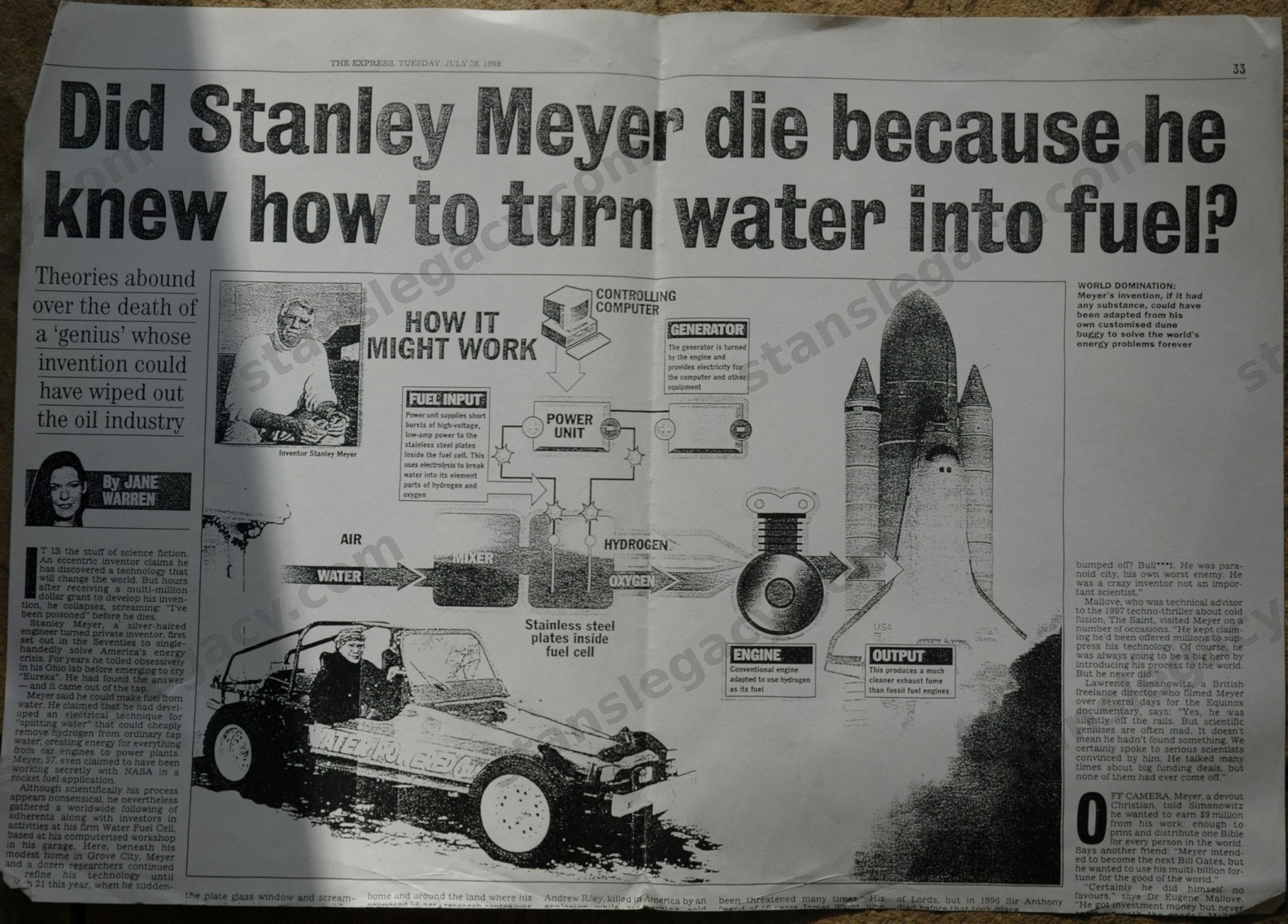
A photograph of Meyer at the bench, captioned “Inventor Stanley Meyer”. The dune buggy, with WATER POWERED on its side. And across the middle of the spread a diagram headed HOW IT MIGHT WORK, running from AIR and WATER through a MIXER to “stainless steel plates inside fuel cell”, out as HYDROGEN and OXYGEN to an ENGINE, and on — for no reason the diagram gives — to a space shuttle at lift-off. Its boxes read:
- Fuel input. “Power unit supplies short bursts of high-voltage, low-amp power to the stainless steel plates inside the fuel cell. This uses electrolysis to break water into its element parts of hydrogen and oxygen.”
- Controlling computer, above the power unit.
- Generator. “The generator is turned by the engine and provides electricity for the computer and other equipment.”
- Engine. “Conventional engine adapted to use hydrogen as its fuel.”
- Output. “This produces a much cleaner exhaust fume than fossil fuel engines.”
Beside the shuttle: WORLD DOMINATION: “Meyer’s invention, if it had any substance, could have been adapted from his own customised dune buggy to solve the world’s energy problems forever.”
Where this spread is wrong
This is the earliest national printing of the poisoning story the archive holds, and most of what is now repeated about Meyer’s death is already in its first paragraph. Set against the record:
- “Hours after receiving a multi-million dollar grant.” The archive has no record of any grant. What it has is a dinner meeting with two Belgian investors at a restaurant in Grove City.
- “Screaming: ‘I’ve been poisoned.’” The words come from his brother Stephen, who was there, and in his telling they are “They poisoned me”. The Franklin County coroner found a ruptured cerebral artery aneurysm. See The day Stan died.
- “Until [Marc]h 21 this year, when he suddenly…” He collapsed on the evening of Friday 20 March 1998 and died in hospital the next day, the 21st. The spread puts the collapse on the day of the death.
- “This uses electrolysis.” The diagram is the paper’s, and it describes the one thing Meyer always said his cell was not. His whole claim, right or wrong, was that voltage separated the water by polarity rather than by conventional electrolysis — which is what the Ohio court’s expert witnesses said it actually was.
What it adds
Lawrence Simanowitz. The director of the Equinox film It Runs on Water, on the record about the man he filmed for several days: “slightly off the rails”, but “we certainly spoke to serious scientists convinced by him”, and the funding deals “none of them had ever come off”. The archive holds the film and not, until now, a word from the man who made it.
The Bible. Off camera, Meyer told Simanowitz he wanted $9 million from the work — enough to print one Bible for every person in the world. It sits beside the book he was writing in 1987, “With the Lord, There Is Purpose”, as the second piece of evidence of what he meant the money to be for.
Mallove, sceptical. Eugene Mallove is usually cited as a friend to Meyer’s cause. Here, four months after the death, he is harder than that: Meyer “kept claiming he’d been offered millions to suppress his technology”, “was always going to be a big hero… but he never did”, and “certainly he did himself no favours”. Mallove himself was killed in 2004, and his words here are now quoted less often than the headline above them.
Wanted: the rest of the page
Five columns of continuation are folded out of this photograph, and they hold the collapse itself, the land for a research centre, a list of other inventors who died, a threat, and something about the House of Lords and Sir Anthony Griffin. If you have this issue, a flat photograph of the bottom third of pages 32 and 33 would complete it.
The original
Provenance
- Shelf
- Press coverage
- Page
- 32–33, a double-page spread
- Byline
- Jane Warren
- Rights
- The newspaper page is copyright its publisher and is reproduced here as a record of what was printed at the time; the archive claims nothing in it. The watermark marks the archive’s copy, not its ownership. The citation is what a reader needs to find the original.
- Caption
- The Express, Tuesday 28 July 1998, pages 32–33; the folio 33 is at the top right. The spread is photographed flat; the five columns of continuation along the bottom run off the fold after their first line.
- Citation
- The Express, London, July 1998, pp. 32–33, a double-page spread, by Jane Warren
- Publication
- The Express, London
- Transcription
- A photograph of the printed spread, supplied by the archive’s editor. The upper part of the page is transcribed in full. The continuation along the foot of the spread is folded out of the photograph after its first line, and those lines are given as fragments. No copy of the article could be found online.